Determine the necessary mass, volume, or concentration for preparing a solution.
Taxonomy Tree
| Kingdom | Organic compounds |
|---|---|
| Superclass | Organic acids and derivatives |
| Classe | Carboxylic acids and derivatives |
| Subclass | Carboxylic acid derivatives |
| Intermediate Tree Nodes | Not available |
| Direct Parent | Carboxylic acid hydrazides |
| Alternative Parents | Organonitrogen compounds Organic oxides Hydrocarbon derivatives Carbonyl compounds |
| Molecular Framework | Aliphatic homomonocyclic compounds |
| Substituents | Carboxylic acid hydrazide - Organic nitrogen compound - Organic oxygen compound - Organic oxide - Hydrocarbon derivative - Organooxygen compound - Organonitrogen compound - Carbonyl group - Aliphatic homomonocyclic compound |
| Descrição | This compound belongs to the class of organic compounds known as carboxylic acid hydrazides. These are carboxylic acid derivatives containing a carbonyl group in which the carbon is directly linked to a hydrazide group (N-N). |
| External Descriptors | Not available |
| Sensibilidade | Light and air sensitive |
|---|---|
| Peso molecular | 156.23 |
| XLogP3 | 1.500 |
| Hydrogen Bond Donor Count | 2 |
| Hydrogen Bond Acceptor Count | 2 |
| Rotatable Bond Count | 2 |
| Exact Mass | 156.126 Da |
| Monoisotopic Mass | 156.126 Da |
| Topological Polar Surface Area | 55.100 Ų |
| Heavy Atom Count | 11 |
| Formal Charge | 0 |
| Complexity | 130.000 |
| Isotope Atom Count | 0 |
| Defined Atom Stereocenter Count | 0 |
| Undefined Atom Stereocenter Count | 0 |
| Defined Bond Stereocenter Count | 0 |
| Undefined Bond Stereocenter Count | 0 |
| The total count of all stereochemical bonds | 0 |
| Covalently-Bonded Unit Count | 1 |
H302:Harmful if swallowed
H315:Causes skin irritation
H319:Causes serious eye irritation
H335:May cause respiratory irritation
P261:Avoid breathing dust/fume/gas/mist/vapors/spray.
P264:Wash hands [and …] thoroughly after handling.
P270:Do not eat, drink or smoke when using this product.
P271:Use only outdoors or in a well-ventilated area.
P280:Wear protective gloves/protective clothing/eye protection/face protection.
P321:Specific treatment (see ... on this label).
P330:Rinse mouth.
P302+P352:IF ON SKIN: wash with plenty of water.
P304+P340:IF INHALED: Remove person to fresh air and keep comfortable for breathing.
P305+P351+P338:IF IN EYES: Rinse cautiously with water for several minutes. Remove contact lenses if present and easy to do - continue rinsing.
P362+P364:Take off contaminated clothing and wash it before reuse.
P405:Store locked up.
P403+P233:Store in a well-ventilated place. Keep container tightly closed.
P501:Dispose of contents/container to an approved waste disposal plant.
P264+P265:Wash hands [and …] thoroughly after handling. Do not touch eyes.
P301+P317:IF SWALLOWED: Get medical help.
P337+P317:If eye irritation persists: Get medical help.
P332+P317:If skin irritation occurs: Get medical help.
P319:Get medical help if you feel unwell.
No item-specific tested application protocols are provided. The following general workflow illustrates hydrazone bioconjugation to aldehyde-bearing biomolecules (literature guidance):
Hydrazone ligation to oxidized glycoproteins:
Notes:
These are general suggestions; optimize for your specific system.
This compound is a synthetic acyl hydrazide intended for laboratory research. It is not a natural metabolite and has no assigned physiological role.
General biochemical relevance of hydrazides (literature context):
Caveats and best practices:
No medical, diagnostic, or therapeutic use is intended or implied; for research use only.
As a small organic hydrazide, this compound is not itself a buffering agent and is not used to control pH.
Practical notes where buffers are relevant (literature/general):
If your goal is pH control or electrophoresis, select established buffers (PBS, Tris, HEPES, acetate) instead; this product serves as a reactive ligand rather than a buffering component.
Greener choices center on solvent selection and safer activation strategies rather than changing the reagent itself.
Greener solvent options (literature guidance):
Comparison (general):
Process-intensification and safety:
Trade-offs:
No pharmacopeial monograph or excipient status is provided for this item. It is offered strictly for research and laboratory use.
General formulation context (literature/general):
What is specific to this item:
Regulatory note: This product is not intended as an API, excipient, or for diagnostic use. Do not use in humans or animals.
Item-specific specifications (this lot):
Literature/computed reference data (non-binding, for context):
General handling implications of properties:
Always consult the item-specific CoA/SDS for definitive physical specifications.
Item-specific grade/purity: Not specified for this item; refer to CoA/Spec Sheet.
Interpretation and context for common grades (general guidance):
Stabilizers/antioxidants:
Analytical verification (typical, not item-specific claims):
What is specific to this listing:
2-Cyclohexylacetohydrazide is a versatile nucleophilic acyl hydrazide used as both a coupling partner and a protected acyl unit in synthesis.
Key application families (literature/general):
Practical tips:
General conditions (literature guidance; adjust to your system):
Hydrazone formation with aldehydes/ketones:
Acyl azide generation and Curtius rearrangement:
Acyl activation/coupling:
Workup/purification:
Yields: Highly substrate- and condition-dependent; consult primary literature for closely related substrates.
Item-specific hazard information:
General safety guidance for acyl hydrazides (literature-based; not a substitute for the SDS):
Always defer to the product SDS and institutional EHS policies for authoritative guidance.
Solvent choice for 2-cyclohexylacetohydrazide should balance its polar hydrazide functionality with the hydrophobic cyclohexyl group.
General miscibility and polarity (literature-based):
Selection scenarios:
Small comparison (guidance):
Always verify solvent compatibility with other reagents and the intended reaction conditions.
Item-specific storage (from Product Data):
General handling and reconstitution guidance:
Stability notes:
For definitive instructions, consult the lot-specific CoA and SDS.
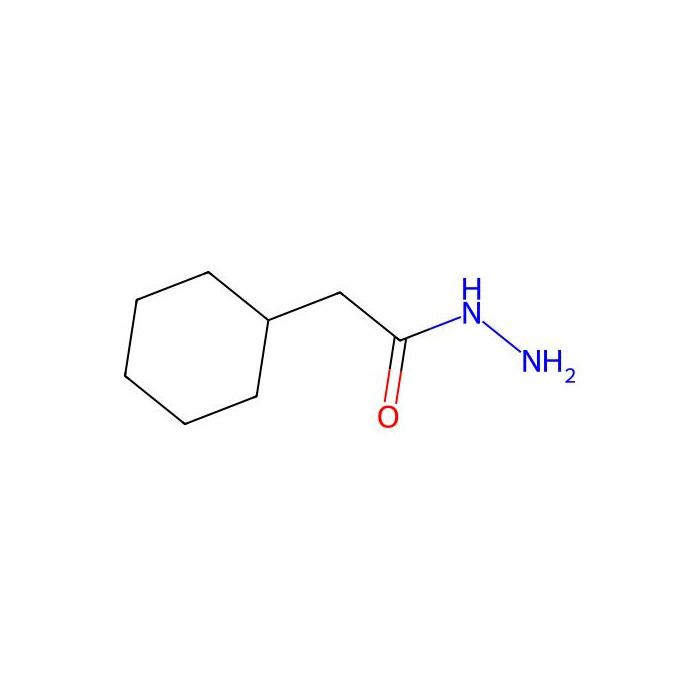
2-Cyclohexylacetohydrazide is the hydrazide derivative of cyclohexylacetic acid, featuring an aliphatic cyclohexyl group tethered via a methylene to an acyl hydrazide (–CONH–NH2).
Item-specific identifiers (from Product Data):
Computed/literature structural details (for reference; not item specifications):
Notes:
Functional handles and reactivity:
Retrosynthetic/forward strategies (literature/general):
Practical considerations:
Not applicable. This product is a small-molecule hydrazide reagent and is not an antibody, enzyme, or affinity probe with defined biological target specificity.
For conjugation uses, specificity arises from chemoselectivity toward carbonyl groups (aldehydes/ketones) rather than a biological epitope.