This compound belongs to the class of organic compounds known as alkyl-phenylketones. These are aromatic compounds containing a ketone substituted by one alkyl group, and a phenyl group.
External Descriptors
Not available
1. Djoumbou Feunang Y, Eisner R, Knox C, Chepelev L, Hastings J, Owen G, Fahy E, Steinbeck C, Subramanian S, Bolton E, Greiner R, and Wishart DS. ClassyFire: Automated Chemical Classification With A Comprehensive, Computable Taxonomy. Journal of Cheminformatics, 2016, 8:61.
Determine the necessary mass, volume, or concentration for preparing a solution.
Dilution Calculator
Determine the dilution needed to prepare a stock solution.
Reconstitution Calculator
Revisões
Avaliações dos Clientes
Application Protocols
Not applicable. No immunoassay or bioanalytical application validations (e.g., WB, IHC, IF, FC) are associated with this small-molecule reagent. For synthetic uses, refer to the Reaction Conditions and Synthetic Utility sections for general procedural guidance.
Biological Roles
This compound is an aryl–alkyl ketone intended for synthetic and materials research. It does not have established endogenous biological roles.
General information (literature-based, not item-specific):
Physicochemical profile (hydrophobic, aryl ketone) suggests passive membrane affinity; however, no validated biochemical pathway participation is reported.
Photochemistry: Aromatic ketones can act as triplet sensitizers under UV irradiation; ortho-alkyl substitution modulates intersystem crossing and triplet energy. Such properties are occasionally leveraged in polymer/photoresist research, not as biological functions.
Metabolic considerations: In xenobiotic metabolism studies, aryl–alkyl ketones typically undergo Phase I reductions (to secondary alcohols), oxidations (to benzylic acids), or conjugations (glucuronidation/sulfation) after carbonyl reduction. These are general observations, not specific usage claims.
For research use only; no medical, diagnostic, or therapeutic use is intended or implied.
Buffer Applications
Not typically applicable. 2′-Methylpropiophenone is a hydrophobic organic reagent and is not used to formulate aqueous buffer systems or pH standards.
Practical note: When conducting aqueous workups or biphasic oxidations/reductions involving this ketone, select buffer systems (e.g., NaHCO3, phosphate) based on the reaction needs, but the compound itself is not a buffering agent.
Green Alternatives
While 2′-methylpropiophenone itself is a target/intermediate rather than a solvent, greener choices can be made for its synthesis and subsequent transformations.
Greener solvent options (for common steps):
Enolate reactions: Replace DCM/DMF with 2-MeTHF or CPME; both enable low-temperature enolate chemistry with improved safety and renewability (2-MeTHF from hemicellulose).
Oxidations: Use aqueous H2O2 with acid catalysts (e.g., formic acid) instead of m-CPBA for Baeyer–Villiger, reducing chlorinated waste.
Reductions: Perform NaBH4 reductions in EtOH or 2-propanol instead of MeOH/DCM mixtures to lower toxicity.
Tradeoffs (literature-based):
2-MeTHF vs THF: 2-MeTHF offers higher boiling point and partial water immiscibility aiding workup, but can give different enolate selectivity and may contain peroxides; ensure proper testing.
CPME vs Et2O: CPME is less volatile and forms fewer peroxides, but may slow reactions relying on high ether polarity.
H2O2 oxidations: Cleaner waste streams but may require catalysts and careful temperature control to avoid over-oxidation.
Small comparison (general):
THF: fossil-derived, high performance; forms peroxides; fully miscible with water (workup considerations).
DCM: excellent for peracid oxidations; chlorinated solvent with disposal concerns—prefer AcOEt/MeCN when feasible.
Implement solvent selection and reagent choices aligned with PMI/E-factor goals without compromising chemoselectivity.
Pharmaceutical Uses
No pharmacopeial/excipient role is specified for this item; refer to CoA/Spec Sheet for any regulatory notes.
General, non-clinical context (literature):
Aryl–alkyl ketones like 2′-methylpropiophenone are used as synthetic intermediates in fine chemical and discovery workflows. They may serve as precursors to aryl alcohols, esters (via Baeyer–Villiger), or reduced hydrocarbons, which can be evaluated as building blocks in medicinal chemistry libraries.
In process development, such ketones can act as model substrates for benchmarking enolate alkylations, oxidations, and hydrogenations, aiding method transfer to API intermediate stages. No therapeutic claims are made.
This product is supplied strictly for research and laboratory use only.
Physical Properties
Item-specific specifications (exact numerical specs for this catalog item): Not specified for this item; refer to CoA/Spec Sheet.
Literature/computed data for the compound (reference values, not item specifications):
Physical state: colorless to pale yellow liquid (literature for aryl–alkyl ketones of this class)
Boiling point: typically ~238–242 °C at 1 atm (literature, varies with data source)
Melting point: expected below 0 °C (literature; liquid at room temperature)
Density: approximately ~0.99–1.03 g/mL at 20–25 °C (literature range for o-alkylated propiophenones)
Refractive index (nD20): commonly around 1.52–1.54 (literature, indicative for conjugated aryl ketones)
Vapor pressure: low at ambient temperature (inferred from high boiling point; literature)
Solubility: low in water; miscible with common organic solvents (EtOH, MeOH, DCM, THF, Et2O, hexanes) (literature)
LogP: expected in the 2.0–3.0 range (literature estimates for aryl–alkyl ketones; hydrophobic)
UV–Vis: π→π* band in near-UV (ca. 245–280 nm), n→π* weaker at longer wavelength (literature for aryl ketones)
Notes:
Values above are typical literature ranges for 2′-methylpropiophenone or closely related isomers and are provided for research planning only. For precise specifications and acceptance criteria of this SKU, consult the CoA/Spec Sheet.
Quality and Grades
Catalog grade/purity: Not specified for this item; refer to CoA/Spec Sheet.
Stabilizers/additives: Not specified for this item; refer to CoA/Spec Sheet.
Guidance on interpreting grades for this reagent type (general information):
Research/technical grade aryl ketones are typically supplied with GC purity assays and impurity profiles (e.g., isomeric ketones, residual solvents, oxidation byproducts). Higher grades (e.g., ≥98–99% GC) are preferred for enolate chemistry and photochemical studies to minimize side reactions.
Low-UV/HPLC grade (when applicable) prioritizes minimal baseline drift and low absorbance in the 210–280 nm range, useful if the compound is used as an internal standard or in detector qualification; for routine synthesis, standard research grade is sufficient.
Stabilization/inerting: The Product Data specifies “Argon charged.” Inert headspace slows air oxidation and helps maintain assay over time, particularly during long-term refrigerated storage.
Verification and documentation:
For this SKU, acceptance criteria, residual solvent limits, and any specific contaminants (e.g., related isomers, aldehydes) are Not specified for this item; refer to CoA/Spec Sheet.
For critical applications (e.g., asymmetric enolate reactions or photochemistry), we recommend verifying GC purity and water content via Karl Fischer prior to use.
Reaction and Applications
As an ortho-methyl-substituted aryl–alkyl ketone, 2′-methylpropiophenone is a versatile building block. Representative uses (literature, for research planning):
Enolate chemistry:
α-Alkylation/arylation via LDA/LiHMDS enolates in THF or toluene; electrophiles include alkyl halides, Michael acceptors, sulfonates. Ortho-methyl substituent subtly influences enolate geometry and steric approach.
Aldol and Mannich-type condensations using silyl enol ether or direct enolization under TiCl4, L-Proline, or secondary amine catalysis.
Reductions:
NaBH4 or catalytic hydrogenation (Raney Ni, Pd/C) to give the secondary alcohol; subsequent dehydration/hydrogenation furnishes o-alkylated arenes.
Selective Wolff–Kishner or Clemmensen conditions provide the corresponding o-ethyltoluene (complete carbonyl deoxygenation).
Oxidations and rearrangements:
Baeyer–Villiger oxidation (m-CPBA, H2O2/peracid systems) to o-tolyl propionate (aryl migration favored in aryl–alkyl ketones).
α-Halogenation (NBS/NCS under acid or photolysis) to α-halo ketones for further nucleophilic substitution or as radical precursors.
Imine/oxime/derivative formation:
Oxime, hydrazone, or semicarbazone derivatives useful for characterization or as intermediates for Beckmann and related rearrangements.
Cross-coupling via ring functionalization:
After directed metalation or electrophilic substitution to install halogens at accessible ring positions, perform Suzuki, Heck, or Buchwald–Hartwig couplings to elaborate the aromatic scaffold. The carbonyl often acts as a directing/activating group in ortho lithiation protocols.
Applications span fragrance intermediates, fine-chemical scaffold elaboration, and methodology development where sterically biased aryl ketones are informative substrates. No clinical/medical applications are implied; for research use only.
Reaction Conditions
General literature conditions for representative transformations (guidance only; optimize per lab setup):
Enolate formation and α-alkylation:
Base: LDA (1.05–1.2 equiv) generated from n-BuLi/diisopropylamine in THF.
Conditions: −78 °C to 0 °C; add electrophile (1.1–1.5 equiv); quench with NH4Cl; typical times 0.5–2 h; isolated yields often 60–85% depending on sterics.
Silyl enol ether formation/Mukaiyama aldol:
Reagents: TMSCl (or TMSOTf) with base (Et3N) to form silyl enol ether; couple under TiCl4 or BF3·OEt2 at −78 to −20 °C.
Reduction to secondary alcohol:
NaBH4 (1.2–2.0 equiv) in MeOH/THF at 0–25 °C; 0.5–2 h; workup into water, extract with EtOAc; 75–95% typical in literature.
Catalytic hydrogenation: 5% Pd/C (2–10 wt%), H2 1–3 bar in EtOH at rt–50 °C; monitor to avoid over-hydrogenation of the aromatic ring.
Baeyer–Villiger oxidation:
m-CPBA (1.5 equiv, 70–77%) in DCM at 0–25 °C, 2–6 h; Na2SO3 wash; affords o-tolyl propionate predominantly (aryl migration favored); 60–85% literature yields.
Greener: H2O2 (30%) with catalytic H2SO4 or formic acid in AcOEt/MeCN, 0–40 °C; extended times (4–16 h).
α-Halogenation:
NBS (1.1 equiv) with catalytic acid (HBr/AcOH) or photochemical initiation in MeCN/DCM; 0–25 °C; 1–4 h.
Deoxygenation:
Wolff–Kishner: NH2NH2·H2O, KOH, diethylene glycol, 180–200 °C; several hours.
Always verify compatibility with the ortho-methyl substituent and scale-up safety (exotherms, gas evolution).
Safety and Handling
Item-specific hazard classification: Not specified for this item; refer to SDS.
General safety information for aryl–alkyl ketones (literature/good practice; not a substitute for SDS):
Likely hazards: May cause skin and eye irritation; harmful if swallowed; combustible liquid. Aromatic ketones can be narcotic at high vapor concentrations despite low volatility.
PPE: Wear lab coat, safety glasses (ANSI Z87.1), and chemically resistant gloves (nitrile recommended). Use in a fume hood to avoid inhalation of vapors or aerosols.
Handling: Avoid breathing vapors/mist. Prevent contact with oxidizers and strong bases/acids that may induce side reactions (e.g., aldol condensation, oxidation). Ground/bond containers when transferring flammable liquids.
First aid (overview):
Inhalation: Move to fresh air; seek medical attention if symptoms persist.
Skin: Wash with soap and water; remove contaminated clothing.
Eyes: Rinse cautiously with water for several minutes; remove contact lenses if present and easy to do; seek medical advice if irritation continues.
Ingestion: Rinse mouth; do not induce vomiting; seek medical attention.
Fire fighting: Use CO2, dry chemical, or alcohol-resistant foam. Cool containers with water spray.
Stability considerations: Carbonyl compounds can undergo peroxidation far less readily than ethers, but prolonged air/UV exposure may promote slow oxidation or discoloration; storing under inert gas (argon) as specified helps maintain quality.
Always consult the product’s SDS for authoritative hazard, exposure, and regulatory information.
Solvent Selection
This product is a liquid aryl–alkyl ketone used as a reagent/intermediate rather than as a solvent. Solvent selection below refers to choosing media for reactions involving 2′-methylpropiophenone.
Polarity and miscibility (compound behavior): Moderately hydrophobic (literature logP ~2–3); low aqueous solubility; readily soluble in common organic solvents (DCM, THF, Et2O, toluene, MeCN, alcohols).
Typical solvent choices by transformation (literature guidance):
Enolate formation/α-functionalization: anhydrous THF, MTBE, or toluene; for strong bases (LDA, LiHMDS), ethers are preferred at −78 to 0 °C.
Reductions (NaBH4): MeOH, EtOH, or 2-propanol at 0–25 °C; for chemoselectivity or over-reduction avoidance, use THF/MeOH mixtures.
Baeyer–Villiger oxidation: DCM or CHCl3 with peracids (m-CPBA); greener variants employ AcOEt or MeCN with H2O2/formic acid.
Electrophilic α-halogenation: AcOH, DCM, or CCl4 (historical); modern methods often use MeCN or DCM.
Friedel–Crafts acylation (synthesis of this ketone): CS2/1,2-DCE historically; greener alternatives include HFIP or solvent-free with solid acids.
When to choose polar aprotic vs nonpolar: Polar aprotic solvents (THF, MeCN) facilitate enolate generation and nucleophilic substitutions; nonpolar aromatic solvents (toluene) can improve selectivity in Lewis-acid catalyzed steps and allow higher temperatures.
Note: Select solvent based on base/acylation system compatibility, desired temperature window, and downstream workup/environmental considerations.
Storage and Reconstitution
Storage (item-specific from Product Data): Store at 2–8 °C, argon charged. Ship on wet ice.
Container: Keep tightly sealed in an amber glass bottle to minimize light exposure and headspace oxygen ingress.
Inerting: Maintain argon blanket as provided. After each use, purge headspace with argon to preserve assay and color.
Moisture/air sensitivity: Aryl ketones are generally stable, but prolonged exposure to air/UV may cause gradual discoloration or formation of trace acidic/oxidized impurities; inert storage mitigates this.
Thawing/handling after receipt: Allow the chilled bottle to equilibrate to room temperature before opening to prevent moisture condensation. Mix gently if stored cold to re-homogenize.
Reconstitution: Not applicable; supplied as a neat liquid. If preparing stock solutions, use anhydrous solvents (e.g., THF, DCM, MeCN, EtOH) and store aliquots in sealed, inerted vials at 2–8 °C. For long-term solution storage, test stability and consider adding inert gas overlay.
Shelf life: Not specified for this item; refer to CoA/Spec Sheet.
For research use only. Always refer to the product’s SDS for detailed safety and handling guidance.
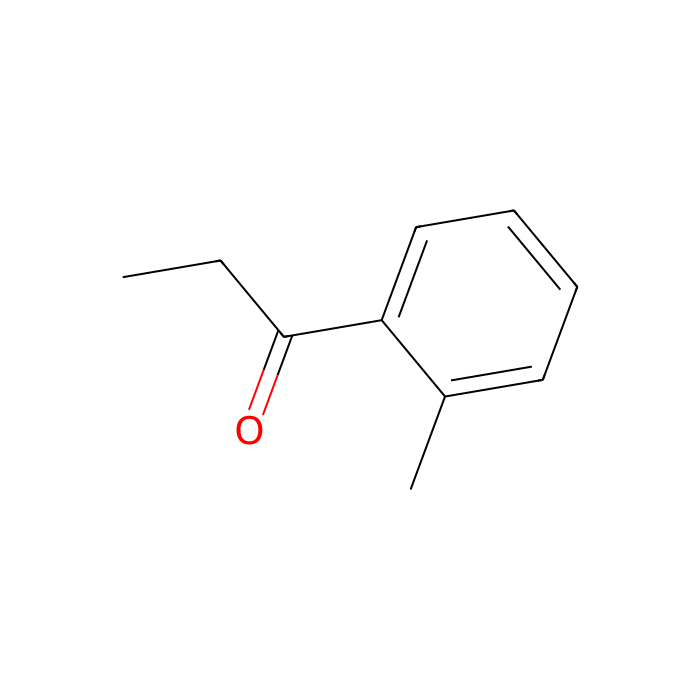
Structure and Identity
Aromatic aryl–alkyl ketone (o-tolyl–propanone) useful as a versatile building block for enolate chemistry and oxidative/ reductive transformations.
Item-specific identifiers from Product Data:
SKU: M182612
CAS: 2040-14-4
InChIKey: Not specified for this item; refer to CoA/Spec Sheet. (Product data field shows an internal code only.)
SMILES: Not specified for this item; refer to CoA/Spec Sheet.
Literature/typical identifiers for 2'-Methylpropiophenone (for reference only):
Core: benzene ring bearing an ortho-methyl substituent and an acyl (propanoyl) group para to each other relative to ring carbonyl attachment site.
Functional groups: aromatic ring; aryl–alkyl ketone (propiophenone motif) with an enolizable α-methylene (–CO–CH2–) adjacent to carbonyl.
Stereochemistry: achiral as a molecule; prochiral carbonyl carbon; enol/enolate tautomers possible under basic/acidic conditions.
2D description: a phenyl ring substituted at adjacent positions by –CO–CH2–CH3 and –CH3; the carbonyl is conjugated with the aromatic ring, enhancing thermodynamic stability and influencing UV absorption and reactivity.
Synthetic Utility
Key functional elements and their synthetic leverage (literature-based):
Carbonyl electrophilicity: Enables formation of oximes/hydrazones/semicarbazones, reductive aminations (via imine formation), and nucleophilic additions (e.g., Grignard to give tertiary alcohols if the ketone is further elaborated).
α-Position reactivity: The α-methylene supports enolization—allowing:
Alkylation (LDA/LiHMDS; THF, −78 to 0 °C)
Halogenation (NBS/NCS in AcOH or under photolysis)
Formation of silyl enol ethers (TMSCl/Et3N or TMSOTf/pyridine) for Mukaiyama aldol.
Aromatic ring reactivity: The carbonyl is meta-directing for EAS, while the ortho-methyl is ortho/para-directing; combined, this enables selective functionalization strategies after temporary modification/protection.
Rearrangements/oxidations: Baeyer–Villiger to o-tolyl propionate; subsequent transesterification or hydrolysis diversifies scaffolds.
Deoxygenation routes: Wolff–Kishner (NH2NH2/KOH, high-boiling solvent) or Clemmensen (Zn(Hg)/HCl) afford o-ethyltoluene, enabling access to alkylated aromatics otherwise challenging by direct EAS.
Retrosynthetic note: 2′-Methylpropiophenone arises from Friedel–Crafts acylation of toluene with propionyl chloride/anhydride under Lewis acid catalysis, typically giving ortho/para isomers separable by distillation or chromatography—useful for isomer-selective studies.
Target Specificity
Not applicable. This product is a small-molecule chemical reagent and does not possess biological target specificity parameters (e.g., antigen, epitope, clone, isotype).
Perguntas frequentes
What is the purity of this product?
This product is supplied at ≥97% purity (chemical assay). Lot-specific values are stated on the Certificate of Analysis.
How should this product be stored?
Store at 2–8 °C under argon. It is supplied under an argon blanket; reseal under inert gas after each use.
How is this product shipped?
This product ships chilled on wet ice. Unpack on arrival and transfer it to the storage condition stated above.
What are the CAS number, molecular formula and molecular weight?
The CAS Number is 2040-14-4, the molecular formula is C10H12O, and the molecular weight is 148.2 g/mol. InChIKey VQHKICGSBBPFFJ-UHFFFAOYSA-N.
What documentation is provided?
Available product documentation, including Certificates of Analysis (COA), Safety Data Sheets (SDS), and specification sheets, is shown in the product document area. Document availability and access follow the current site policy.
Usamos cookies para garantir o funcionamento adequado do site e, quando permitido, para melhorar a sua experiência. Você pode gerenciar suas preferências a qualquer momento nas Configurações. Saiba mais em nossa Política de Cookies.
Deseja que lhe enviemos uma mensagem quando tivermos descontos disponíveis?
Lembrar-me mais tarde
Obrigado! Por favor, verifique a sua caixa de entrada de e-mail para confirmar.
Products are supplied to verified businesses, institutions, and qualified professionals for research and development use only. Not for use in humans, animals, diagnosis, or therapy.

 B2303402