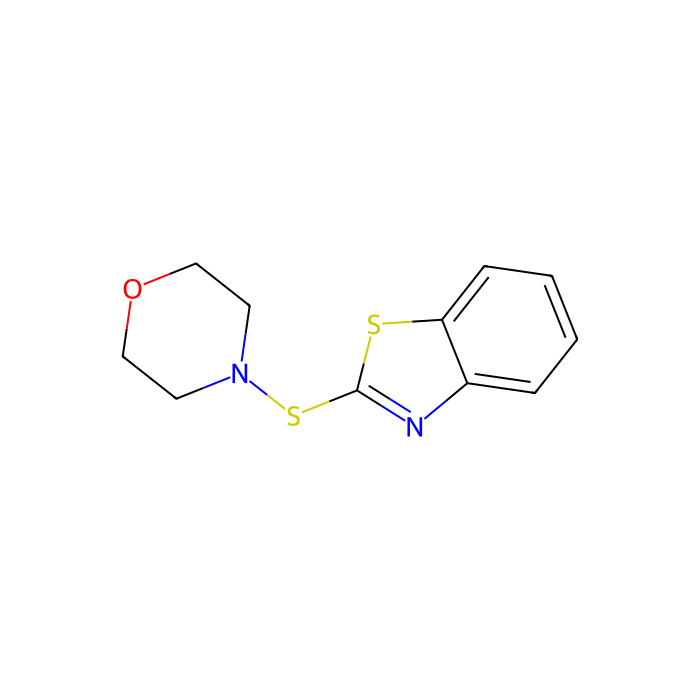
2-(Morpholinothio)benzothiazole - ≥97% , CAS No.102-77-2

CAS: 102-77-2 Cat. No.: M158491 Fórmula: C11H12N2OS2 Peso molecular: 252.35 Número CE: 203-052-4
Disponível para encomenda
GRAU & PUREZA ≥97%
Synonyms
N-(Oxydiethylene)benzothiazylsulfenamide|N,N-(Oxydiethylene)benzothiazole-2-sulfenamide|OBTS|(2-Morpholinothio)benzothiazole|2-(Morpholinothio)benzothiazole|2-(MORPHOLINOTHIO)-BENZOTHIAZOLE|2-morpholinosulphenyl-benzothiazole|NOBS Special|2-Benzothiazolesulfenemorpholide|Morpholine, 4-(2-benzothiazolylthio)-|BENZOTHIAZOLE, 2-(MORPHOLINOTHIO)-|N-Oxydiethylene-2-benzothiazolesulfenamide|2-(morpholin-4-ylthio)-1,3-benzothiazole|2-Benzothiazolesulfenamide, N-morpholinyl-|Vulkacit MOZ|4-(2-benzothiazolylthio)-morpholin|NOBS|Morpholinylmercaptobenzothiazole|Morpholinylmercapto-benzo-thiazole|N,N-(Oxydiethylene)-2-benzothiazolesulfenamide|2-Morpholinothiobenzothiazole|N-Oxydiethylene-2-benzothiazylsulfenamide|Sulfenamide M|2-(4-Morpholinylthio)benzothiazole|Meramide M|AMAX|4-(2-Benzothiazolylthio)morpholine|4-(2-Benzothiazolylthio)-morpholine|2-Benzothiazolylsulfenylmorpholine|Sulfenax MOR|Usaf cy-7|Benzothiazolyl-2-sulfenmorpholide|N,N-(Oxydiethylene)-2-benzothiazylsulfenamide|Meramid M|N-Oxydiethylene-2-benzothiazole sulfenamide|2-(4-Morpholino)thiobenzothiazole|2-(4-Morpholinothio)benzothiazole|2-(4-morpholinothio)-benzothiazole|2-(4-Morpholinylmercapto)benzothiazole|2-(Morpholinthio)-benzothiazole|2-(morpholin-4-ylsulfanyl)-1,3-benzothiazole|Vulcafor SSM|2-Benzothiazolesulfenamide, N-morphol|2-Benzothiazolylsulfenyl morpholine|Accel NS|N-(Oxydiethylene)benzothiazole-2-sulfenamide|Delac MOR|4-(Benzo[d]thiazol-2-ylthio)morpholine|N-(Oxodiethylene)-2-benzothiazolesulfenamide|Santocure MOR|2-(4-Morpholinylthio)-1,3-benzothiazole|4-(1,3-benzothiazol-2-ylsulfanyl)morpholine|Benzothiazole, 2-(4-morpholinylthio)-|2-Benzothiazolyl N-morpholino sulfide|N-(Oxydiethylene)-2-benzothiazolesulfenamide|Accelerator NC
Storage
Room temperature
Shipped In
Normal
★
Tamanho
Alemanha (EU)
USA*
Preço
Qtd
5g
M158491-5g
—
4 Em stock
8,59€
25g
M158491-25g
—
3 Em stock
9,46€
500g
M158491-500g
1 Em stock
2 Em stock

44,17€

66,73€
Gravar 22,56 € (33.81%)
Enter a quantity for the sizes you want to add.

Especificações

Sinónimos
N-(Oxydiethylene)benzothiazylsulfenamide | N,N-(Oxydiethylene)benzothiazole-2-sulfenamide | OBTS | (2-Morpholinothio)benzothiazole | 2-(Morpholinothio)benzothiazole | 2-(MORPHOLINOTHIO)-BENZOTHIAZOLE | 2-morpholinosulphenyl-benzothiazole | NOBS Special | 2-Benzothiazolesulfenemorpholide | Morpholine, 4-(2-benzothiazolylthio)- | BENZOTHIAZ Show more
Especificações e pureza
≥97%
Condições de armazenamento de armazenamento
Room temperature
Enviado em
Normal
Pureza
≥97%
Nomes e identificadores
Pubchem Sid
Pubchem Sid Url
https://pubchem.ncbi.nlm.nih.gov/substance/504751410
SMILES
C1COCCN1SC2=NC3=CC=CC=C3S2
IUPAC Name
4-(1,3-benzothiazol-2-ylsulfanyl)morpholine
InChIKey
MHKLKWCYGIBEQF-UHFFFAOYSA-N
InChI
1S/C11H12N2OS2/c1-2-4-10-9(3-1)12-11(15-10)16-13-5-7-14-8-6-13/h1-4H,5-8H2
SMILES isoméricas
C1COCCN1SC2=NC3=CC=CC=C3S2
RTECS
DL5950000
Peso molecular
252.35
Reaxy-Rn
191684
Reaxys-RN_link_address
https://www.reaxys.com/reaxys/secured/hopinto.do?context=S&query=IDE.XRN=191684&ln=

Dados avançados

Taxonomic Classification

Taxonomy Tree

KingdomOrganic compounds
SuperclassOrganoheterocyclic compounds
ClasseBenzothiazoles
SubclassNot available
Intermediate Tree Nodes Not available
Direct ParentBenzothiazoles
Alternative Parents Morpholines  Benzenoids  Thiazoles  Heteroaromatic compounds  Sulfenyl compounds  Oxacyclic compounds  Organosulfenic acid amides  Dialkyl ethers  Azacyclic compounds  Organopnictogen compounds  Organonitrogen compounds  Hydrocarbon derivatives  
Molecular FrameworkAromatic heteropolycyclic compounds
Substituents 1,3-benzothiazole - Morpholine - Oxazinane - Benzenoid - Azole - Heteroaromatic compound - Thiazole - Dialkyl ether - Ether - Organosulfenic acid amide - Oxacycle - Sulfenyl compound - Azacycle - Organooxygen compound - Organonitrogen compound - Organosulfur compound - Hydrocarbon derivative - Organic oxygen compound - Organic nitrogen compound - Organopnictogen compound - Aromatic heteropolycyclic compound
DescriçãoThis compound belongs to the class of organic compounds known as benzothiazoles. These are organic compounds containing a benzene fused to a thiazole ring (a five-membered ring with four carbon atoms, one nitrogen atom and one sulfur atom).
External Descriptors Not available
Estrutura 3D
Modelo de Estrutura Química Interativa


Alvos associados (humanos)
VDR Tclin Vitamin D receptor (26531 Activities)
Activity TypeRelationActivity valueUnitsAction TypeJournalPubMed IddoiAssay Aladdin ID
PLK1 Tchem Serine/threonine-protein kinase PLK1 (28605 Activities)
Activity TypeRelationActivity valueUnitsAction TypeJournalPubMed IddoiAssay Aladdin ID
ALOX15B Tchem Arachidonate 15-lipoxygenase, type II (7244 Activities)
Activity TypeRelationActivity valueUnitsAction TypeJournalPubMed IddoiAssay Aladdin ID
ALDH1A1 Tchem Aldehyde dehydrogenase 1A1 (77053 Activities)
Activity TypeRelationActivity valueUnitsAction TypeJournalPubMed IddoiAssay Aladdin ID
ALOX15 Tchem Arachidonate 15-lipoxygenase (7108 Activities)
Activity TypeRelationActivity valueUnitsAction TypeJournalPubMed IddoiAssay Aladdin ID
HepG2 (196354 Activities)
Activity TypeRelationActivity valueUnitsAction TypeJournalPubMed IddoiAssay Aladdin ID
HSD17B10 Tchem Endoplasmic reticulum-associated amyloid beta-peptide-binding protein (20669 Activities)
Activity TypeRelationActivity valueUnitsAction TypeJournalPubMed IddoiAssay Aladdin ID
KDM4A Tchem Lysine-specific demethylase 4A (52245 Activities)
Activity TypeRelationActivity valueUnitsAction TypeJournalPubMed IddoiAssay Aladdin ID
EHMT2 Tchem Histone-lysine N-methyltransferase, H3 lysine-9 specific 3 (93046 Activities)
Activity TypeRelationActivity valueUnitsAction TypeJournalPubMed IddoiAssay Aladdin ID
TDP1 Tchem Tyrosyl-DNA phosphodiesterase 1 (345557 Activities)
Activity TypeRelationActivity valueUnitsAction TypeJournalPubMed IddoiAssay Aladdin ID
KDM4E Tchem Lysine-specific demethylase 4D-like (40243 Activities)
Activity TypeRelationActivity valueUnitsAction TypeJournalPubMed IddoiAssay Aladdin ID
HPGD Tchem 15-hydroxyprostaglandin dehydrogenase [NAD+] (24926 Activities)
Activity TypeRelationActivity valueUnitsAction TypeJournalPubMed IddoiAssay Aladdin ID
PMP22 Tbio Peripheral myelin protein 22 (699 Activities)
Activity TypeRelationActivity valueUnitsAction TypeJournalPubMed IddoiAssay Aladdin ID
CBX1 Tbio Chromobox protein homolog 1 (92434 Activities)
Activity TypeRelationActivity valueUnitsAction TypeJournalPubMed IddoiAssay Aladdin ID
RGS4 Tchem Regulator of G-protein signaling 4 (13867 Activities)
Activity TypeRelationActivity valueUnitsAction TypeJournalPubMed IddoiAssay Aladdin ID
Alvos associados (não humanos)
Hdac6 Histone deacetylase 6 (222 Activities)
Activity TypeRelationActivity valueUnitsAction TypeJournalPubMed IddoiAssay Aladdin ID
Pkm Pyruvate kinase isozymes M1/M2 (66 Activities)
Activity TypeRelationActivity valueUnitsAction TypeJournalPubMed IddoiAssay Aladdin ID
GCN5 Histone acetyltransferase GCN5 (89 Activities)
Activity TypeRelationActivity valueUnitsAction TypeJournalPubMed IddoiAssay Aladdin ID
Luciferin 4-monooxygenase (66902 Activities)
Activity TypeRelationActivity valueUnitsAction TypeJournalPubMed IddoiAssay Aladdin ID
rep Replicase polyprotein 1ab (378 Activities)
Activity TypeRelationActivity valueUnitsAction TypeJournalPubMed IddoiAssay Aladdin ID
Txnrd1 Thioredoxin reductase 1, cytoplasmic (45279 Activities)
Activity TypeRelationActivity valueUnitsAction TypeJournalPubMed IddoiAssay Aladdin ID
ddn Putative uncharacterized protein (49 Activities)
Activity TypeRelationActivity valueUnitsAction TypeJournalPubMed IddoiAssay Aladdin ID
TGR Thioredoxin glutathione reductase (28579 Activities)
Activity TypeRelationActivity valueUnitsAction TypeJournalPubMed IddoiAssay Aladdin ID
Rorc Nuclear receptor ROR-gamma (89407 Activities)
Activity TypeRelationActivity valueUnitsAction TypeJournalPubMed IddoiAssay Aladdin ID
NS1 Nonstructural protein 1 (33327 Activities)
Activity TypeRelationActivity valueUnitsAction TypeJournalPubMed IddoiAssay Aladdin ID
Mecanismos de ação
Certificados(CoA,COO,BSE/TSE e Mapa de Análise)
C of A & Other Certificates(BSE/TSE, COO):
Analytical Chart:

Find and download the COA for your product by matching the lot number on the packaging.

4 results found

Lot NumberCertificate TypeDataItem
G2614042G2614042Certificate of AnalysisJul 24, 2026 M158491
L2031490L2031490Certificate of AnalysisOct 12, 2024 M158491
L2031489L2031489Certificate of AnalysisOct 12, 2024 M158491
H2401030H2401030Certificate of AnalysisAug 13, 2024 M158491
Propriedades químicas e físicas
SolubilidadePractically insoluble in water ;soluble in Acetone,Chloroform,Toluene,Benzene
Ponto de fusão (°C)84.0 - 88.0 °C
Peso molecular252.400 g/mol
XLogP32.700
Hydrogen Bond Donor Count0
Hydrogen Bond Acceptor Count5
Rotatable Bond Count2
Exact Mass252.039 Da
Monoisotopic Mass252.039 Da
Topological Polar Surface Area78.900 Ų
Heavy Atom Count16
Formal Charge0
Complexity236.000
Isotope Atom Count0
Defined Atom Stereocenter Count0
Undefined Atom Stereocenter Count0
Defined Bond Stereocenter Count0
Undefined Bond Stereocenter Count0
The total count of all stereochemical bonds0
Covalently-Bonded Unit Count1
Citations of This Product
Calculadoras de soluções
Revisões

Avaliações dos Clientes

Application Protocols

Not applicable. No validated bioassay protocols (e.g., WB, IHC, IF, FC) are associated with this small-molecule reagent. For synthetic use, refer to the Reaction Conditions and Synthetic Utility tabs for general procedural guidance and then tailor to your substrate and setup.

Biological Roles

This compound is a synthetic organic sulfenamide and does not have a native biological role. Any interactions with biological systems are incidental to its chemical functionality.

General/literature context (non-clinical, research-only):

  • Reactivity with biomolecules: Sulfenamide S–N bonds can, under acidic or nucleophilic conditions, cleave to release thiophilic species. In biochemical systems, analogous sulfenylation chemistry is used to modify cysteine residues; however, 2-(morpholinothio)benzothiazole is not designed for biological labeling and lacks selectivity in complex media.
  • Environmental/occupational note: Benzothiazole derivatives and sulfenamides have been studied for environmental persistence and aquatic toxicity. Such findings are context-dependent and should not be generalized; handle responsibly and prevent environmental release.

Conclusion: Use is confined to chemical/materials research. For any work near biological systems, perform thorough compatibility and toxicity assessments and adhere strictly to institutional EHS policies. No medical or clinical uses are implied.

Buffer Applications

Not typically applicable. 2-(Morpholinothio)benzothiazole is not a buffering agent and is poorly soluble in water. For aqueous work, consider using it only as a reagent in biphasic systems or after organic stock solution preparation, and consult the Solvent Selection and Reaction & Applications tabs for relevant guidance.

Green Alternatives

Perspective: Selection of greener options focuses on solvent choice and, where applicable, the choice of sulfenylating reagent that minimizes hazardous byproducts while maintaining performance.

Greener solvent choices (general guidance):

  • Prefer ethyl acetate, 2-MeTHF, dimethyl carbonate, or Me-THF/EtOAc blends over chlorinated solvents (e.g., DCM) when solubility and selectivity permit.
  • For polar aprotic needs, consider propylene carbonate or Cyrene where compatible; verify stability of sulfenamides in these media.

Comparison snapshot (literature/general; not product specs):

  • DCM vs 2-MeTHF
    • EHS profile: 2-MeTHF is biorenewable, lower toxicity; DCM is chlorinated with higher EHS concerns.
    • Performance: DCM offers excellent low-temperature control; 2-MeTHF often affords similar selectivity in enolate sulfenylations with careful optimization.
  • MeCN vs EtOAc
    • EHS profile: EtOAc is greener (readily biodegradable, low toxicity); MeCN has toxicity and disposal considerations.
    • Performance: MeCN provides higher polarity; EtOAc may require longer reaction time or higher temperature.

Alternative sulfenylating reagents:

  • N-(Benzothiazol-2-ylthio)phthalimide (BTPI) and N-(Bzth)succinimide are solid, bench-stable electrophilic S-donors with benign leaving groups; they may reduce amine byproducts relative to morpholine-based sulfenamides.
  • Disulfide-based donors (e.g., benzothiazyl disulfide) under catalytic activation can be used to avoid tertiary amine residues.

Trade-offs:

  • Greener solvents or alternative donors may alter kinetics/selectivity and require re-optimization of base, temperature, and stoichiometry. Validate at small scale before full adoption.
Pharmaceutical Uses

No pharmacopeial or excipient role is indicated for this item.

General notes (non-therapeutic, research-only):

  • Function: A specialty organic reagent for C–S bond construction in synthetic chemistry; not intended for formulation as an excipient.
  • Manufacturing relevance: If used at all, it would be confined to early-stage medicinal chemistry route scouting for introducing benzothiazolylthio motifs or for protecting-group strategies on sulfur, with subsequent removal well before any GMP context.

Compliance reminder: This product is for research use only. It is not manufactured, tested, or qualified for human or veterinary use, drug substance, or excipient applications.

Physical Properties

Item-specific values (from Product Data):

  • Molecular formula: Not specified for this item; refer to CoA/Spec Sheet.
  • Molecular weight: Not specified for this item; refer to CoA/Spec Sheet.
  • Appearance: Not specified for this item; refer to CoA/Spec Sheet.

General/literature characteristics (reference only; not item specifications):

  • Physical state: Typically a low-melting solid or viscous solid typical of benzothiazole sulfenamides.
  • Polarity/solubility: Low water solubility; good solubility in many organic solvents (e.g., chlorinated solvents, aromatics, ethers, esters). Limited solubility in very nonpolar alkanes may require warming.
  • Volatility: Non-volatile; negligible vapor pressure at ambient conditions compared with common solvents.
  • Acid/base behavior: The morpholine nitrogen is a tertiary amine (basic), but its basicity is attenuated by the adjacent sulfenamide S–N linkage. The benzothiazole ring is weakly basic at the ring nitrogen.
  • Partitioning: Expected moderate hydrophobicity due to the benzothiazole core, countered by the heteroatoms in morpholine and the sulfenamide bond (qualitative logP: moderate; consult databases for numerical values, literature only).
  • Thermal behavior: Sulfenamides may undergo S–N bond cleavage or transformation under elevated temperatures or in the presence of nucleophiles/acids/bases; avoid excessive heating unless intended by the procedure.

For authoritative numerical constants (mp, bp, density, refractive index, pKa/logP), consult literature databases (e.g., PubChem CID 7619) and the CoA; do not treat literature values as product specifications.

Quality and Grades

Item-specific (from Product Data):

  • Grade/Purity: Not specified for this item; refer to CoA/Spec Sheet.

Guidance on interpreting grade (general information):

  • When provided, grades such as “analytical,” “purified,” or “technical” indicate intended use and impurity controls. For synthetic intermediates like sulfenamides, higher grades typically control residual amines, oxidized sulfur species (e.g., disulfides/sulfoxides), and moisture.
  • Chromatography-relevant grades (e.g., HPLC grade) are uncommon for solid organosulfur reagents, but a high-purity specification will reduce byproducts in electrophilic sulfenylation, radical substitutions, or accelerator formulations.
  • Stabilizers: Sulfenamides generally do not require added stabilizers when stored properly. If stabilizers are listed on the CoA, they are usually minimal and chosen not to interfere with S–N or S–C bond chemistry. None are specified for this item in the Product Data.

What to check on the CoA/Spec Sheet:

  • Assay/purity method (e.g., HPLC, GC, qNMR)
  • Identity confirmation (NMR, IR, MS)
  • Residual morpholine or benzothiazole; peroxide/sulfur-oxygen species; water content
  • Appearance, melting range, and any UV-Vis absorbance notes if relevant to your application

Recommendation: Align grade selection with your application—e.g., higher purity for fine chemical synthesis or mechanistic studies; technical grade may suffice for materials screening—verify by CoA.

Reaction and Applications

Overview: As a benzothiazole-based sulfenamide, 2-(Morpholinothio)benzothiazole serves both as a functional accelerator in sulfur vulcanization chemistry and as a versatile electrophilic benzothiazolylsulfenyl-transfer reagent in organic synthesis.

Representative applications (literature/general):

  • Electrophilic sulfenylation:
    • Enolates and silyl enol ethers: Introduction of –S–Bzth (benzothiazolylthio) under mild conditions to form thioethers; subsequent transformations (oxidation to sulfoxides/sulfones; displacement to diversify S-substituents).
    • Heteroarenes (e.g., indoles, pyrroles, anilines): Direct C–S bond formation at activated positions using Lewis/Brønsted acid or base mediation.
    • Thiol/disulfide chemistry: Trans-sulfenylation to form mixed disulfides or to generate benzothiazolylthiyl intermediates; useful in protecting group strategies on sulfur.
  • Radical and photochemical chemistry:
    • Generation of benzothiazolylthiyl radicals under thermal/photoredox conditions for selective C–S bond construction.
  • Precursor utility:
    • Access to 2-mercaptobenzothiazole derivatives (via S–N cleavage) and tailored sulfenamides by amine exchange (morpholine as a leaving group under acid activation).
  • Materials/industrial chemistry:
    • Rubber vulcanization accelerator (MOR-type): Controlled release of active sulfenyl sulfur under curing conditions affords balanced scorch safety and cure rate (literature context).

Practical considerations:

  • Maintain anhydrous, neutral to mildly basic conditions to preserve the sulfenamide prior to intended activation.
  • Monitor for over-oxidation (to sulfoxide/sulfone) if exposed to air/heat; include inert atmosphere for sensitive steps.
  • Byproduct control: Morpholine or benzothiazole derivatives can form upon cleavage—plan purification accordingly (acid/base extraction or silica gel chromatography).
Reaction Conditions

General literature guidance (optimize for your substrate; not product specifications):

Electrophilic sulfenylation of enolates/silyl enol ethers:

  • Solvent: THF, DCM, or MeCN (anhydrous)
  • Base: LDA or LiHMDS (for enolate formation); tertiary amines for milder cases
  • Temperature: –78 to 0 °C for enolate generation; 0 to 25 °C for sulfenylation
  • Stoichiometry: 1.0–1.2 equiv sulfenamide to nucleophile
  • Atmosphere: N2 or Ar
  • Time: 0.5–4 h, monitor by TLC/LCMS

Sulfenylation of electron-rich heteroarenes (e.g., indole):

  • Solvent: DCM or MeCN
  • Catalyst/promoter: Brønsted or Lewis acid (e.g., TFA 0.1–0.5 equiv) or mild base depending on mechanism
  • Temperature: 0–25 °C
  • Time: 1–6 h

Formation of mixed disulfides via trans-sulfenylation:

  • Solvent: MeCN, DCM, or EtOAc
  • Additive: Base (e.g., DIPEA) to promote S-transfer
  • Temperature: 0–25 °C
  • Time: 1–3 h

Workup/purification tips:

  • Quench with aqueous bicarbonate or dilute acid depending on byproducts; extract into organic phase.
  • Remove morpholine by aqueous acid wash; benzothiazole-containing residues may partition to organic and can be removed chromatographically.
  • Avoid silica pre-exposed to strong acid to limit premature cleavage.

Expected outcomes: High chemoselectivity for C–S bond formation under mild conditions; yields commonly moderate to high in literature, substrate-dependent. Always verify compatibility for base/acid-sensitive substrates.

Safety and Handling

Item-specific hazard information (from Product Data):

  • Signal word: Not specified for this item; refer to SDS.
  • H-statements: Not specified for this item; refer to SDS.
  • GHS classification: Not specified for this item; refer to SDS.
  • Pictograms: Not specified for this item; refer to SDS.

General safety profile for benzothiazole sulfenamides (literature/analog-based; consult SDS for authoritative guidance):

  • Hazards: May cause skin/eye irritation and sensitization; harmful if swallowed; harmful to aquatic life with long-lasting effects is common for rubber accelerators. Avoid inhalation of dust and contact with skin/eyes.
  • PPE: Wear lab coat, safety glasses or face shield, and appropriate chemical-resistant gloves (e.g., nitrile). Use in a fume hood to minimize exposure to dust/vapors and to control odors.
  • Incompatibilities: Strong acids (risk of decomposition and S–N cleavage), strong bases/nucleophiles (aminolysis or thiolysis), potent oxidizers (over-oxidation of sulfur), and strong reducing agents (undesired cleavage). Avoid prolonged exposure to moisture for best stability.
  • First aid (overview):
    • Inhalation: Move to fresh air; seek medical attention if symptoms persist.
    • Skin: Wash with soap and water; remove contaminated clothing.
    • Eyes: Rinse cautiously with water for several minutes; remove contacts if present; seek medical attention if irritation persists.
    • Ingestion: Rinse mouth; do not induce vomiting; seek medical attention.
  • Fire response: Use dry chemical, CO2, or foam. Decomposition may release sulfur and nitrogen oxides; firefighters should wear SCBA.

Always defer to the current Aladdin Scientific SDS for this specific SKU for exact classifications, limits, and handling recommendations.

Solvent Selection

Context: 2-(Morpholinothio)benzothiazole is an organic, moderately polar, heteroatom-rich sulfenamide. Solvent choice should balance solubility, reaction compatibility with the S–N linkage, and downstream workup.

General solubility/miscibility (literature/general):

  • Good: Dichloromethane, chloroform, ethyl acetate, acetone, acetonitrile, THF, toluene.
  • Moderate to variable: Alcohols (MeOH, EtOH) depending on temperature and water content.
  • Poor: Water; very nonpolar alkanes (hexanes) may require warming or co-solvent.

Selection guidance:

  • Electrophilic sulfenylation (of enolates, indoles, anilines): DCM, MeCN, or THF provide good solubility and control of reactivity. For base-promoted enolate chemistry, anhydrous THF/ether solvents are routine.
  • Metal-catalyzed S–N or S–C transformations: Polar aprotic solvents (DMF, DMA, NMP, DMSO) may be advantageous; ensure temperature stability of the sulfenamide.
  • Materials/formulation work: Aromatics (toluene, xylene) or esters (EtOAc) often dissolve the sulfenamide and are compatible with polymer matrices.

Practical tips:

  • Avoid strongly protic/acidic media that can cleave the S–N bond and liberate morpholine/benzothiazolylthio fragments unless that is the goal.
  • For low-temperature selectivity in sulfenylations, DCM/MeCN allow efficient cooling and predictable kinetics.
  • To aid dissolution without high boiling polar aprotics, use cosolvent systems (e.g., toluene/EtOAc or DCM/EtOAc) for crystallizations or loadings.
Storage and Reconstitution

Item-specific (from Product Data):

  • Storage conditions: Room temperature
  • Shipped in: Normal conditions

General storage guidance (for sulfenamides; supplement to item data):

  • Container: Keep tightly closed in a dry, inert atmosphere container (amber glass recommended) to limit oxidative degradation and moisture ingress.
  • Environment: Store away from strong acids, bases, and oxidizing agents. Avoid prolonged exposure to elevated temperatures and direct light.
  • Stability: Sulfenamides are generally stable solids at ambient conditions when dry; monitor for odor or discoloration as potential indicators of degradation (literature note).

Reconstitution/use:

  • This item is typically used as a neat solid. If a solution is required, prepare fresh anhydrous stock solutions in a compatible organic solvent (e.g., DCM, MeCN, THF, toluene, EtOAc) immediately prior to use.
  • Do not prepare aqueous solutions except for deliberate biphasic reactions, as hydrolytic cleavage of the S–N bond can occur under acidic or basic aqueous conditions.
  • For long experiments, consider blanketing opened containers with nitrogen to minimize oxidation.

Always consult the CoA and SDS for batch-specific guidance and shelf-life information.

Structure and Identity

Brief overview: 2-(Morpholinothio)benzothiazole is a benzothiazole-based sulfenamide bearing a morpholine substituent through an S–N linkage. It is widely known in rubber chemistry as a sulfenamide accelerator (often abbreviated MOR) and in synthesis as an electrophilic benzothiazolylsulfenyl donor.

Item-specific (from Product Data):

  • SKU: M158491
  • CAS: 102-77-2
  • PubChem CID: 7619
  • InChIKey: 219190 (as listed; see literature note below)
  • Storage: Room temperature; shipped under normal conditions
  • Research use: For research use only

Computed/Literature identity (for reference; not item-specific specs):

  • Synonyms: Benzothiazole-2-sulfenamide, morpholine; MOR
  • Core scaffold: Fused benzothiazole ring (benzene + thiazole) at the 2-position bearing a sulfenamide –S–N(morpholine) substituent
  • Functional groups: Benzothiazole heteroaromatic; sulfenamide (S–N); tertiary amine (in morpholine); cyclic ether (morpholine O)
  • Stereochemistry: None (achiral)
  • 2D description: A benzothiazole ring with the C2 carbon bonded to sulfur; that sulfur is bound to the morpholine nitrogen, forming an S–N sulfenamide. Morpholine is a six-membered ring containing one O and one tertiary N.
  • Typical identifiers (literature): Standard InChIKey and SMILES are widely published for CAS 102-77-2; consult major databases (PubChem CID 7619) for canonical strings.

Note: Where the Product Data differ or are incomplete (e.g., SMILES/InChIKey format), consult the CoA/Spec Sheet or authoritative databases for definitive string identifiers.

Synthetic Utility

Key reactivity features (general/literature):

  • Electrophilic sulfur donor: The benzothiazolylsulfenyl moiety transfers –S–Bzth to nucleophiles (enolates, heteroarenes, thiols, phosphines), enabling modular C–S and S–S bond formation.
  • Latent benzothiazole thiol source: Acidic or nucleophilic cleavage of the S–N bond can furnish 2-mercaptobenzothiazole derivatives, allowing two-directional elaboration (at sulfur or at the benzothiazole ring).
  • Selective activation: Lewis acids (e.g., BF3·OEt2) or mild bases (e.g., tertiary amines) tune the rate of sulfenylation while minimizing overreaction or decomposition.

Named/representative transformations:

  • Sulfenylation of silyl enol ethers and ketone enolates (e.g., LDA/THF, –78 to 0 °C), followed by oxidation to sulfones for Julia–type or Ramberg–Bäcklund-adjacent strategies.
  • Electrophilic functionalization of indoles at C3 using DCM/MeCN under mild catalysis.
  • Stepwise conversion to disulfides via trapping of benzothiazolylthio intermediates with thiols (thiol–disulfide exchange logic).

Practical advantages:

  • Bench-handleable solid reagent delivering reactive sulfenyl sulfur without gaseous H2S or malodorous thiols.
  • Orthogonality: The morpholine leaving group and benzothiazole tag can aid in purification (acid/base extraction or silica gel).

Considerations:

  • Avoid strong acids/bases unless aiming for cleavage; control temperature to preserve S–N integrity.
  • Monitor for oxidative side products; use inert atmosphere for sensitive substrates.
Target Specificity

Not applicable. This product is a small-molecule chemical reagent, not a biological targeting agent or antibody. No antigen/epitope, clone, isotype, or species reactivity information applies.

Perguntas frequentes

What is the purity of this product?
This product is supplied at ≥97% purity (chemical assay). Lot-specific values are stated on the Certificate of Analysis.
How should this product be stored?
Store at room temperature.
How is this product shipped?
This product ships under standard ambient conditions. No temperature-controlled packaging is required.
What are the CAS number, molecular formula and molecular weight?
The CAS Number is 102-77-2, the molecular formula is C11H12N2OS2, and the molecular weight is 252.35 g/mol. InChIKey MHKLKWCYGIBEQF-UHFFFAOYSA-N.
What documentation is provided?
Available product documentation, including Certificates of Analysis (COA), Safety Data Sheets (SDS), and specification sheets, is shown in the product document area. Document availability and access follow the current site policy.

Deseja que lhe enviemos uma mensagem quando tivermos descontos disponíveis?

Lembrar-me mais tarde

Obrigado! Por favor, verifique a sua caixa de entrada de e-mail para confirmar.

Ops! As notificações estão desativadas.