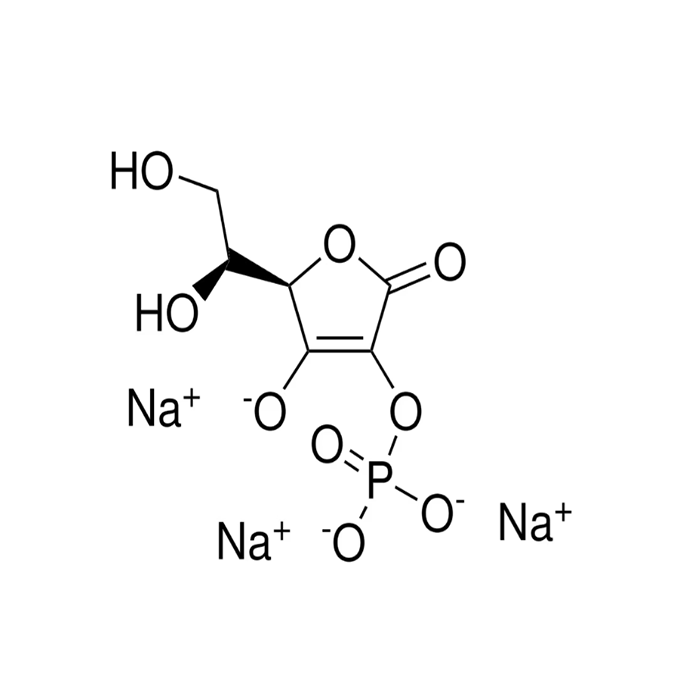
Determine the necessary mass, volume, or concentration for preparing a solution.
L-ascorbic acid-2-phosphate trisodium salt has been used as a supplement to Dulbecco's modified Eagle medium (DMEM) for the culture of adipose derived stem cells, human mesenchymal stem cells and osteoblasts.
Taxonomy Tree
| Kingdom | Organic compounds |
|---|---|
| Superclass | Organoheterocyclic compounds |
| Classe | Dihydrofurans |
| Subclass | Furanones |
| Intermediate Tree Nodes | Not available |
| Direct Parent | Butenolides |
| Alternative Parents | Phosphate esters Vinylogous acids Enoate esters Secondary alcohols Lactones 1,2-diols Oxacyclic compounds Monocarboxylic acids and derivatives Primary alcohols Organic sodium salts Organic oxides Hydrocarbon derivatives Carbonyl compounds Organic cations |
| Molecular Framework | Aliphatic heteromonocyclic compounds |
| Substituents | 2-furanone - Organic phosphoric acid derivative - Phosphoric acid ester - Enoate ester - Alpha,beta-unsaturated carboxylic ester - Vinylogous acid - 1,2-diol - Carboxylic acid ester - Lactone - Secondary alcohol - Monocarboxylic acid or derivatives - Carboxylic acid derivative - Oxacycle - Organic alkali metal salt - Organic oxygen compound - Primary alcohol - Hydrocarbon derivative - Organooxygen compound - Organic oxide - Alcohol - Carbonyl group - Organic salt - Organic sodium salt - Organic cation - Aliphatic heteromonocyclic compound |
| Descrição | This compound belongs to the class of organic compounds known as butenolides. These are dihydrofurans with a carbonyl group at the C2 carbon atom. |
| External Descriptors | Not available |
Find and download the COA for your product by matching the lot number on the packaging.
| Lot Number | Certificate Type | Data | Item |
|---|---|---|---|
| Certificate of Analysis | Jun 16, 2026 | S304311 | |
| Certificate of Analysis | Jun 16, 2026 | S304311 | |
| Certificate of Analysis | Jun 16, 2026 | S304311 | |
| Certificate of Analysis | Jun 16, 2026 | S304311 | |
| Certificate of Analysis | Jun 16, 2026 | S304311 | |
| Certificate of Analysis | Aug 18, 2025 | S304311 | |
| Certificate of Analysis | Aug 18, 2025 | S304311 | |
| Certificate of Analysis | Aug 18, 2025 | S304311 | |
| Certificate of Analysis | Aug 18, 2025 | S304311 | |
| Certificate of Analysis | Aug 18, 2025 | S304311 | |
| Certificate of Analysis | Aug 18, 2025 | S304311 | |
| Certificate of Analysis | Aug 18, 2025 | S304311 | |
| Certificate of Analysis | Aug 18, 2025 | S304311 | |
| Certificate of Analysis | Jun 05, 2025 | S304311 | |
| Certificate of Analysis | Jun 05, 2025 | S304311 | |
| Certificate of Analysis | Jun 05, 2025 | S304311 | |
| Certificate of Analysis | Jun 05, 2025 | S304311 | |
| Certificate of Analysis | Jun 05, 2025 | S304311 | |
| Certificate of Analysis | Jan 07, 2025 | S304311 | |
| Certificate of Analysis | Jan 07, 2025 | S304311 | |
| Certificate of Analysis | Jan 07, 2025 | S304311 | |
| Certificate of Analysis | Jan 07, 2025 | S304311 | |
| Certificate of Analysis | Jan 02, 2024 | S304311 | |
| Certificate of Analysis | Oct 21, 2022 | S304311 | |
| Certificate of Analysis | May 18, 2022 | S304311 | |
| Certificate of Analysis | Jan 20, 2022 | S304311 | |
| Certificate of Analysis | Jan 20, 2022 | S304311 | |
| Certificate of Analysis | Jan 20, 2022 | S304311 | |
| Certificate of Analysis | Jan 20, 2022 | S304311 | |
| Certificate of Analysis | Jan 20, 2022 | S304311 | |
| Certificate of Analysis | Jan 20, 2022 | S304311 | |
| Certificate of Analysis | Jan 20, 2022 | S304311 | |
| Certificate of Analysis | Jan 20, 2022 | S304311 | |
| Certificate of Analysis | Jan 20, 2022 | S304311 | |
| Certificate of Analysis | Jan 20, 2022 | S304311 | |
| Certificate of Analysis | Jan 20, 2022 | S304311 | |
| Certificate of Analysis | Jan 20, 2022 | S304311 | |
| Certificate of Analysis | Jan 20, 2022 | S304311 | |
| Certificate of Analysis | Jan 20, 2022 | S304311 | |
| Certificate of Analysis | Jan 20, 2022 | S304311 |
| Solubilidade | Solvent:water, Max Conc. mg/mL: 32.2, Max Conc. mM: 100 |
|---|---|
| Sensibilidade | Moisture sensitive |
| Ponto de fusão (°C) | 260℃ |
| Peso molecular | 322.05 |
| XLogP3 | |
| Hydrogen Bond Donor Count | 2 |
| Hydrogen Bond Acceptor Count | 9 |
| Rotatable Bond Count | 3 |
| Exact Mass | 321.944 Da |
| Monoisotopic Mass | 321.944 Da |
| Topological Polar Surface Area | 162.000 Ų |
| Heavy Atom Count | 19 |
| Formal Charge | 0 |
| Complexity | 357.000 |
| Isotope Atom Count | 0 |
| Defined Atom Stereocenter Count | 2 |
| Undefined Atom Stereocenter Count | 0 |
| Defined Bond Stereocenter Count | 0 |
| Undefined Bond Stereocenter Count | 0 |
| The total count of all stereochemical bonds | 0 |
| Covalently-Bonded Unit Count | 4 |
H315:Causes skin irritation
H319:Causes serious eye irritation
H335:May cause respiratory irritation
P261:Avoid breathing dust/fume/gas/mist/vapors/spray.
P305+P351+P338:IF IN EYES: Rinse cautiously with water for several minutes. Remove contact lenses if present and easy to do - continue rinsing.
Item-specific validated protocols: Not specified for this item; refer to CoA/Spec Sheet and SDS for any test methods provided.
General literature protocols (for research use; optimize for your system)
Notes
General biochemistry (literature)
Note: The above reflects biochemical roles observed in research contexts. No clinical or therapeutic claims are implied.
Applicability: This compound is not a dedicated buffering agent. It does not provide a defined buffering range suitable for pH control on its own.
Practical guidance (literature/general)
Summary: Employ this reagent as a functional additive within a well‑chosen buffer system; rely on established buffers for pH control and capacity.
Context: As a highly water‑soluble, nonvolatile inorganic–organic salt, 2‑Phospho‑L‑ascorbic acid trisodium salt already aligns with several green chemistry principles (safer solvents, inherently low volatility). However, greener choices can be considered at the system level.
Comparison (literature-based, qualitative)
Greener process tips
Conclusion: For aqueous redox and stability‑sensitive applications, the trisodium phosphate ester is a practical, low‑VOC choice; weigh phosphate footprint vs performance gains.
Scope and limitations
Formulation and manufacturing context (literature/general)
Regulatory note
Item-specific (Product Data)
Literature/general properties (for the trisodium salt of L‑ascorbic acid 2‑phosphate; indicative only)
Practical notes
Always rely on your CoA for item-specific numeric specifications.
Item-specific
Interpretation and guidance (general)
Recommendations
Scope (literature/general)
Practical tips
Always tailor conditions to your system and validate with controls.
General guidance (literature; adjust to your system)
Expected outcomes (literature)
Note: Numeric conditions are general literature guidance, not specifications for this item.
Authoritative data
General laboratory safety (literature/practice for inorganic–organic phosphate salts and ascorbate derivatives)
Always consult the product’s SDS for authoritative safety information.
Applicability: This compound is a highly polar, ionic phosphate salt. Solvent selection is straightforward for most uses.
General solvent behavior (literature)
Selection guidance
Quick comparison (literature trends)
Tips
Item-specific (from Product Data)
General best practices (literature/experience)
Reconstitution
In‑solution stability (guidance)
Always consult the lot‑specific CoA for any item‑specific limits on water content, assay, or stability.
Brief description: 2‑Phospho‑L‑ascorbic acid trisodium salt is the trisodium salt of L‑ascorbic acid (vitamin C) mono‑phosphate at the C2 position; a water‑soluble, phosphate‑protected antioxidant donor of L‑ascorbate under dephosphorylating conditions.
Item-specific (from Product Data)
Literature/structural description (general)
Notes
General synthetic perspective (literature)
Caveats
Overall: A niche but valuable hydrophilic synthon/additive when controlled release of ascorbate or phosphate tagging is desired.
This product is a small‑molecule reagent, not a biological targeting reagent (e.g., antibody, ligand with defined protein selectivity). No target specificity, clone, isotype, or species reactivity data apply.