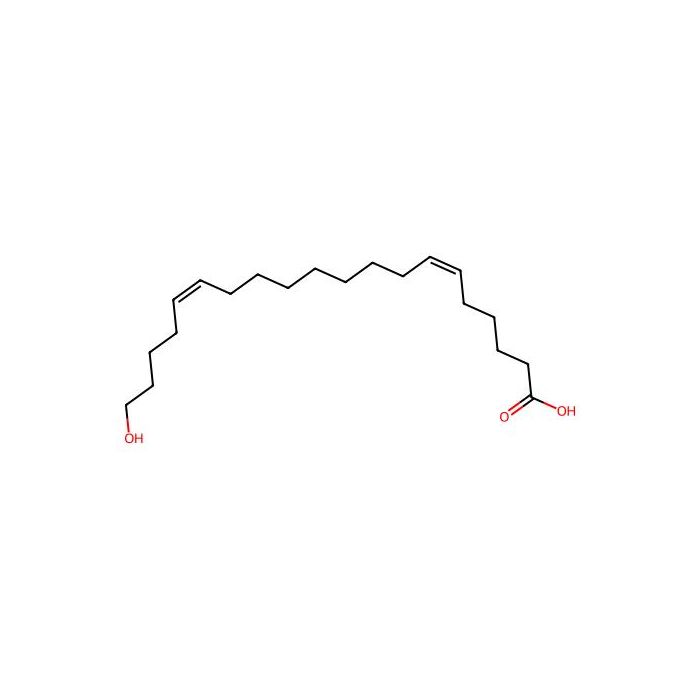
This compound belongs to the class of organic compounds known as long-chain fatty acids. These are fatty acids with an aliphatic tail that contains between 13 and 21 carbon atoms.
External Descriptors
Other Eicosanoids
1. Djoumbou Feunang Y, Eisner R, Knox C, Chepelev L, Hastings J, Owen G, Fahy E, Steinbeck C, Subramanian S, Bolton E, Greiner R, and Wishart DS. ClassyFire: Automated Chemical Classification With A Comprehensive, Computable Taxonomy. Journal of Cheminformatics, 2016, 8:61.
Determine the necessary mass, volume, or concentration for preparing a solution.
Dilution Calculator
Determine the dilution needed to prepare a stock solution.
Reconstitution Calculator
Revisões
Avaliações dos Clientes
Application Protocols
No tested application protocols are provided in the Product Data for this item.
General usage notes (research use only):
Prepare a fresh stock solution at a known concentration in a suitable solvent. Record solvent, concentration, lot number, and preparation date for traceability.
If used in biochemical assays, confirm absence of solvent artifacts by including vehicle controls matched to the highest solvent content in the test wells.
For analytical use, calibrate with at least 5 concentration levels and bracket unknowns; verify linearity and recovery in your sample matrix.
Please contact Aladdin Scientific technical support for any available in-house protocols or literature references specific to SKU H952042.
Biological Roles
No biological/biochemical role is provided in the Product Data for this item. Without a confirmed structure, it is not appropriate to ascribe metabolic pathways, receptor interactions, or cellular functions to this product.
General note (non-clinical context):
If the compound is intended as a biochemical research reagent (as suggested by the catalog category), users often employ such materials as reference standards, pathway probes, or substrates in enzymology and lipidomics studies. Confirm identity and purity from the CoA before use in any biological system.
Research Use Only: This product is designated for laboratory research; it is not for diagnostic or therapeutic use.
Buffer Applications
Buffer system guidance is not applicable without knowledge of the compound’s acid/base properties and solubility.
pKa, buffering range, and ionic compatibility: Not specified for this item; refer to CoA/Spec Sheet.
Practical advice (general):
If the compound must be used in aqueous media, first prepare a concentrated stock in a miscible organic solvent (e.g., DMSO or ethanol), then dilute into the desired buffer under stirring. Monitor for precipitation and adjust ionic strength or pH only after confirming the compound’s stability over the target pH range.
Filter sterilization (0.22 µm) should only be attempted after verifying solubility and chemical stability; adsorption losses can be significant for hydrophobic analytes.
Green Alternatives
Because the compound’s structure and use-pattern are not specified, it is not possible to identify direct greener substitutes for this item.
General guidance for greener practice (non-specific):
Prefer greener solvents for handling and sample prep when feasible: ethanol, isopropanol, ethyl acetate, 2-MeTHF, CPME, or water-based systems. Avoid chlorinated solvents unless technically necessary.
Minimize solvent volume via concentrated stocks and microscale workups. Employ closed-vial operations and low-temperature storage to extend shelf life and reduce waste from degradation.
Assess energy inputs: perform reactions at ambient temperature where possible and leverage flow chemistry or photochemical methods if compatible with the confirmed structure.
For a structure-matched green alternative recommendation, please request the full chemical identity for SKU H952042 from our support team.
Pharmaceutical Uses
No pharmacopeial status, excipient role, or formulation guidance is provided for this item.
Regulatory/designation: Not specified for this item; refer to CoA/Spec Sheet.
General formulation considerations (research context only; not for clinical use):
If the compound is employed as a research tool in preformulation studies, typical activities include solubility screening in cosolvent systems, stability profiling across pH and temperature, and compatibility with common excipients (e.g., cyclodextrins, lipids) — all contingent on the confirmed structure and purity.
Do not incorporate this product into any human or veterinary medicinal product. It is designated strictly for research use only.
Physical Properties
Item-specific physicochemical properties have not been provided in the Product Data. Do not use literature values as specifications for QC or regulatory purposes.
Appearance: Not specified for this item; refer to CoA/Spec Sheet.
Melting point: Not specified for this item; refer to CoA/Spec Sheet.
Boiling point: Not specified for this item; refer to CoA/Spec Sheet.
Density: Not specified for this item; refer to CoA/Spec Sheet.
Refractive index: Not specified for this item; refer to CoA/Spec Sheet.
Solubility profile: Not specified for this item; refer to CoA/Spec Sheet.
logP/logD: Not specified for this item; refer to CoA/Spec Sheet.
pKa: Not specified for this item; refer to CoA/Spec Sheet.
General guidance (non-specification):
For unfamiliar organic small molecules, initial dissolution trials commonly begin with analytical-grade solvents (e.g., acetonitrile, methanol, ethanol, DMSO) at 1–10 mg/mL, followed by dilution into assay buffers if compatible.
If the compound is hydrophobic, co-solvent systems (e.g., DMSO→buffer; ethanol→buffer; or aqueous solutions containing 0.1–1% non-ionic surfactant) may be required. Verify chemical compatibility first.
Quality and Grades
Item-specific grade and purity details are not provided in the Product Data.
Grade/Purity: Not specified for this item; refer to CoA/Spec Sheet.
Interpretation guidance (general):
If the item is supplied as “analytical standard” or “reference standard,” expect tight ID/assay criteria (e.g., NMR, HPLC/UPLC, MS) and documented impurity profiling. If designated “research grade,” the focus is fitness-for-purpose in discovery labs rather than regulatory submission.
If a stabilizer or antioxidant is present, it will be declared on the label or CoA; such additives can affect downstream assays (e.g., UV, MS ionization, bioassays). None are listed here; verify on receipt.
For chromatography-critical work (e.g., trace-level analytics), request the current CoA that lists residual solvents, water content (KF), and chromatographic purity specifications before use.
Reaction and Applications
Manufacturer application notes were not provided for this item. Without a confirmed structure, specific reactivity or application claims cannot be made for this product.
General possibilities (context-only, not item-specific specifications):
If this material is a specialized organic small molecule (e.g., a lipid-like analyte), common laboratory uses include serving as an analytical reference standard, a pathway probe in biochemical experiments, or a synthetic intermediate for derivatization. Validate suitability with your project lead and the CoA.
If used in synthesis, confirm functional groups and protection/stability requirements (sensitivity to acid/base, oxidation, light, or heat) prior to scale-up. Small pilot runs with analytical monitoring (TLC, LC–MS, NMR) are recommended.
Please contact Aladdin Scientific for structure-confirmed application notes tied to this specific SKU.
Reaction Conditions
No item-specific reaction condition data are available.
General best practices (non-specific):
Conduct small-scale scouting reactions (≤0.05 mmol) to evaluate solvent, base/acid sensitivity, temperature, and atmosphere. Use anhydrous conditions if moisture-sensitive functions are suspected.
Analytical monitoring: LC–MS and UPLC with UV/charged aerosol detection are effective for small molecules; for highly lipophilic materials, consider ELSD or APCI-MS.
Stability checks: Subject a trial solution to time-course analysis (e.g., 0, 2, 24 h at ambient vs refrigerated) to identify degradation pathways (oxidation, isomerization, hydrolysis). Add antioxidants or perform under inert gas only if compatible and justified by data.
For rigorously defined, literature-based conditions, the precise structure must be confirmed first.
Safety and Handling
Hazard and classification details are not supplied in the Product Data. Always consult the product SDS for authoritative safety information.
GHS Classification: Not specified for this item; refer to SDS.
Signal Word / H-Statements / Pictograms: Not specified for this item; refer to SDS.
General laboratory safety (non-specific guidance):
Handle in a chemical fume hood or well-ventilated area. Avoid inhalation, ingestion, and skin/eye contact.
Wear appropriate PPE: lab coat, nitrile gloves, and splash-resistant safety glasses. Upgrade to chemical-resistant gloves and face protection if handling larger quantities or aerosols.
Storage incompatibilities: Until the exact functional groups are known, segregate from strong oxidizers, strong acids/bases, and reducing agents. Avoid reactive metals if the compound contains acidic or halogenated functions (confirm via SDS/CoA).
Spill/first-aid overview: Contain small spills with inert absorbent; dispose per institutional protocols. In case of skin/eye contact, rinse with water for at least 15 minutes and seek medical attention. If inhaled, move to fresh air; if ingested, seek medical attention—do not induce vomiting unless instructed by medical personnel.
Solvent Selection
No item-specific solubility data are provided. Use a tiered dissolution strategy and verify compatibility with your application.
Practical approach (general, non-specification):
Start with small-scale trials (∼1–5 mg): test DMSO, methanol, ethanol, acetonitrile, ethyl acetate, and isopropanol. If insoluble, expand to dichloromethane, chloroform, or MTBE in a hood, observing safety and waste rules.
For aqueous use, prepare a concentrated stock in a water-miscible organic solvent (e.g., DMSO or ethanol), then dilute into buffer while stirring to avoid precipitation (final organic content typically ≤1–2% v/v where biologically acceptable).
If the compound proves highly lipophilic, consider co-solvent or micellar systems (e.g., 0.5–2% Tween 80 or Pluronic F127) after confirming no interference with your assay.
Selection notes:
Choose protic solvents (MeOH, EtOH, i-PrOH) for hydrogen-bonding solutes; choose dipolar aprotics (DMSO, DMF, MeCN) for polar non-protic solutes; use moderately nonpolar esters/ethers (EtOAc, MTBE) or chlorinated solvents for hydrophobic analytes.
Always confirm chemical stability in the chosen solvent by short-term test (e.g., LC–MS at 0 and 24 h).
Storage and Reconstitution
Item-specific storage conditions are provided in the Product Data. Additional notes below are general best practices and not specifications.
Storage temperature (Product Data): Store at -20°C.
Shipping (Product Data): Ice chest + Ice pads.
Light/moisture sensitivity: Not specified for this item; refer to CoA/Spec Sheet. As a precaution, store in a tightly closed container, protected from light and moisture.
Inert atmosphere: If the compound is air/oxidation sensitive (not specified), consider storing under nitrogen/argon and using septum-capped vials.
Reconstitution (general guidance):
Allow vial to equilibrate to room temperature in a desiccator before opening to minimize moisture condensation.
Prepare concentrated stocks in a compatible solvent (e.g., DMSO, MeOH, EtOH, or ACN), filter if appropriate, and aliquot to avoid repeated freeze–thaw cycles.
Short-term working solutions are best kept at 2–8°C; for longer-term storage, freeze at −20°C or below if the solvent remains stable at that temperature. Reassess stability by LC–MS/NMR after multiple freeze–thaw events.
Always defer to the latest CoA/SDS for definitive storage and handling instructions.
Structure and Identity
Overview: The specific structural identity details for this catalog item are limited in the provided Product Data. Where exact identifiers are missing, please consult the product CoA/SDS or contact Aladdin Scientific.
Product Name: 20-HeDE (catalog shorthand; full chemical name not provided)
CAS: 240427-90-1
PubChem CID: 10426436
InChIKey: 329256 (as provided; note this is not a standard-length InChIKey. Verify against the CoA/SDS.)
SMILES: Not specified for this item; refer to CoA/Spec Sheet.
Molecular Formula: Not specified for this item; refer to CoA/Spec Sheet.
Molecular Weight: Not specified for this item; refer to CoA/Spec Sheet.
Structural features (general notes):
The catalog name “20-HeDE” suggests a specialized organic molecule (potentially a lipid-like or eicosa-derived entity), but no definitive structural assignment is provided here. Do not assume functional groups or stereochemistry without the official specification.
2D structure description: Not available from Product Data. If you require a structural depiction, request the structure file (SDF/MOL/SMILES) from our technical support.
Synthetic Utility
Specific synthetic transformations for this item cannot be described without the confirmed structure and functional group inventory.
General retrosynthetic guidance (context-only):
Before planning derivatizations, obtain a current CoA and, if available, spectral data (1H/13C NMR, HRMS, FTIR) to confirm identity. Map reactive handles (e.g., alcohol, carboxyl, alkene, halide) and assess protecting-group needs relative to acid/base and redox sensitivity.
If the compound is a lipid-like scaffold, common manipulations may include esterification/transesterification, selective oxidations/reductions, and conjugations to reporter tags. Reaction conditions, yields, and purification strategies will depend on the exact substitution pattern and polarity.
Purification strategy should be matched to lipophilicity: normal-phase silica, silver nitrate-impregnated silica for unsaturated lipids, or reverse-phase preparative HPLC for high-purity needs.
Target Specificity
This section is primarily relevant to biologics (e.g., antibodies, enzymes) with defined binding/target profiles. The current item is supplied as a chemical reagent and no target-binding data are provided.
Antigen/epitope/clone/isotype: Not applicable.
Target specificity: Not specified for this item; refer to CoA/Spec Sheet if any bioassay characterization is available.
If your application involves receptor or enzyme assays, verify compound identity and purity prior to use and generate in-house target engagement data under your conditions.
We use cookies to ensure the website functions properly and, where permitted, to improve your experience. You can manage your preferences at any time in Settings. Learn more in our Cookie Policy.
Shall we send you a message when we have discounts available?
Remind me later
Thank you! Please check your email inbox to confirm.
Products are supplied to verified businesses, institutions, and qualified professionals for research and development use only. Not for use in humans, animals, diagnosis, or therapy.