Determine the necessary mass, volume, or concentration for preparing a solution.
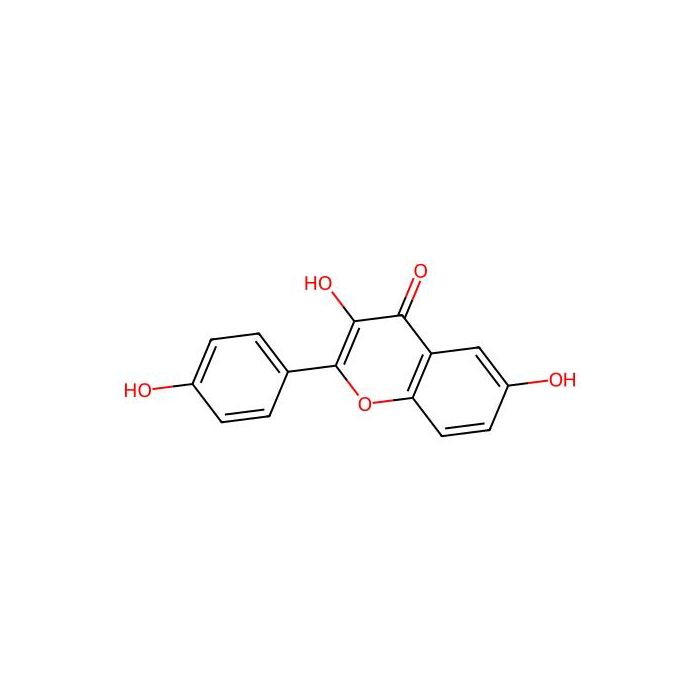
3,6,4'-Trihydroxyflavone - ≥95% , CAS No.253195-19-6
Disponível para encomenda
GRADE & PURITY ≥95%
Storage
Store at 2-8°C,Desiccated
Shipped In
Wet ice

≥95% for sensitive chromatographic and analytical workflows requiring minimal baseline interference.
Store at 2-8°C,Desiccated Ships Wet ice Check lot-specific COA for exact specifications.
SDS, COA, datasheet, and spec sheet available for download. Lot-specific COA accessible via lot number lookup.
Cited in 0 peer-reviewed publications across chromatography, organic synthesis, and cross-coupling reactions.
| Sorrisos canónicos | C1=CC(=CC=C1C2=C(C(=O)C3=C(O2)C=CC(=C3)O)O)O |
|---|---|
| IUPAC Name | 3,6-dihydroxy-2-(4-hydroxyphenyl)chromen-4-one |
| InChIKey | QUPHEKFURGDWME-UHFFFAOYSA-N |
| INCHI | 1S/C15H10O5/c16-9-3-1-8(2-4-9)15-14(19)13(18)11-7-10(17)5-6-12(11)20-15/h1-7,16-17,19H |
| SMILES isoméricas | C1=CC(=CC=C1C2=C(C(=O)C3=C(O2)C=CC(=C3)O)O)O |
| CAS alternativo | 253195-19-6 |
| Termos de entrada MeSH | C15H10O5 |
Comprehensive hazard, handling, storage, and regulatory compliance document.
Download SDS →Lot-specific quality data. Enter your lot number to retrieve the exact COA.
Look up COA →Full quality attributes and acceptance criteria for this grade.
View spec sheet →Taxonomy Tree
| Kingdom | Organic compounds |
|---|---|
| Superclass | Phenylpropanoids and polyketides |
| Classe | Flavonoids |
| Subclass | Flavones |
| Intermediate Tree Nodes | Not available |
| Direct Parent | Flavonols |
| Alternative Parents | 6-hydroxyflavonoids 4'-hydroxyflavonoids 3-hydroxyflavonoids Chromones Pyranones and derivatives 1-hydroxy-2-unsubstituted benzenoids Benzene and substituted derivatives Heteroaromatic compounds Oxacyclic compounds Organooxygen compounds Organic oxides Hydrocarbon derivatives |
| Molecular Framework | Aromatic heteropolycyclic compounds |
| Substituents | 3-hydroxyflavone - 3-hydroxyflavonoid - 4'-hydroxyflavonoid - 6-hydroxyflavonoid - Hydroxyflavonoid - Chromone - Benzopyran - 1-benzopyran - 1-hydroxy-2-unsubstituted benzenoid - Phenol - Pyranone - Monocyclic benzene moiety - Pyran - Benzenoid - Heteroaromatic compound - Organoheterocyclic compound - Oxacycle - Organic oxygen compound - Organooxygen compound - Hydrocarbon derivative - Organic oxide - Aromatic heteropolycyclic compound |
| Descrição | This compound belongs to the class of organic compounds known as flavonols. These are compounds that contain a flavone (2-phenyl-1-benzopyran-4-one) backbone carrying a hydroxyl group at the 3-position. |
| External Descriptors | trihydroxyflavone |
| Peso molecular | 270.240 g/mol |
|---|---|
| XLogP3 | 2.700 |
| Hydrogen Bond Donor Count | 3 |
| Hydrogen Bond Acceptor Count | 5 |
| Rotatable Bond Count | 1 |
| Exact Mass | 270.053 Da |
| Monoisotopic Mass | 270.053 Da |
| Topological Polar Surface Area | 87.000 Ų |
| Heavy Atom Count | 20 |
| Formal Charge | 0 |
| Complexity | 422.000 |
| Isotope Atom Count | 0 |
| Defined Atom Stereocenter Count | 0 |
| Undefined Atom Stereocenter Count | 0 |
| Defined Bond Stereocenter Count | 0 |
| Undefined Bond Stereocenter Count | 0 |
| The total count of all stereochemical bonds | 0 |
| Covalently-Bonded Unit Count | 1 |
No validated, item-specific application protocols are provided in the Product Data for this SKU. The following is general guidance for using 3,6,4'-trihydroxyflavone as a fluorescent ESIPT probe in solution; adjust to your system and instrumentation.
These steps are provided as general literature-based practices and are not validated performance specifications for this SKU.
Item-specific biological testing is not provided for this SKU. The following summarizes general, literature-based roles of flavonols like 3,6,4'-trihydroxyflavone in biochemistry; it is not a medical or clinical claim.
Important: This product is provided strictly for research use. Do not use in humans or animals, and do not interpret these roles as medical claims.
This compound is not a buffer reagent and does not define a specific buffering range. However, it is frequently used as a fluorescent probe in buffered aqueous assays. Practical guidance (general/literature):
Item-specific buffer compatibility data and precise solubility in given buffers are not specified for this SKU; consult CoA/Spec Sheet or perform small‑scale pretests.
Because 3,6,4'-trihydroxyflavone is a solid analyte/reagent rather than a process solvent, “greener alternatives” primarily concern solvent choice and synthesis planning rather than replacing the compound itself.
Greener solvent choices for handling and spectroscopy (literature/practice):
Comparison (general attributes; not item-specific):
Greener synthesis considerations (for those preparing derivatives):
Note: Validate that greener conditions do not compromise spectral integrity or purity. Item-specific green certifications are not provided for this SKU.
No pharmacopeial status, excipient role, or GMP grade is specified for this SKU; refer to the CoA/Spec Sheet for any regulatory information. The content below concerns general laboratory and formulation context only and makes no therapeutic claims.
Conclusion: While valuable as an analytical/fluid‑environment probe in research workflows, no pharmaceutical use is claimed or specified for this item.
Item-specific physicochemical specifications (e.g., melting point, water content, residual solvents) are not provided in the Product Data for this SKU. Always consult the CoA/Spec Sheet for certified values.
General/literature properties for 3,6,4'-trihydroxyflavone (reference only; not item specifications):
Not specified for this item; refer to CoA/Spec Sheet for: melting point, exact solubility limits, water content, heavy metals, UV cutoff, and any chromatographic purity metrics.
Context and guidance (general; not item-specific):
Recommendation: If you require low-background fluorescence or tight impurity control for mechanistic ESIPT studies, request HPLC chromatograms, UV–vis baseline data, and any residual metal analyses for the specific lot.
Applications (general/literature; expand your use cases as appropriate):
Photophysics/ESIPT probe:
Analytical/supramolecular:
Synthetic derivatization platform:
Practical tips (general):
Manufacturer Applications: Not specified in Product Data for this SKU. The above reflects common research uses of this chemical class.
No item-specific reaction condition recommendations are provided in the Product Data. The following summarizes general literature conditions for common manipulations of 3‑hydroxyflavones and related polyphenols; adapt to your substrate and safety requirements.
O‑Alkylation (to modulate solubility/photophysics):
O‑Acylation:
Demethylation (from methoxy precursors):
Flavonol formation (for analog synthesis):
Spectroscopy sample prep:
All conditions above are literature guidance and not specifications for this item.
Item-specific hazard classification is not provided in the Product Data for this SKU (no signal word, H‑statements, GHS classes, or pictograms listed). Always consult the product SDS for authoritative safety information.
General laboratory safety guidance for polyphenolic flavonols (literature/practice, not item-specific):
Note: This product is for research use only and not for human or animal consumption or diagnostic use.
As a polyphenolic, moderately conjugated flavonol, 3,6,4'-trihydroxyflavone dissolves best in polar organic solvents and exhibits solvent‑dependent spectroscopic behavior.
Small comparison (literature trends):
Note: For chromatography or analytical fluorescence, select solvent grades with low UV absorbance and minimal fluorescent impurities. Item-specific solvent compatibility limits are not specified for this SKU; consult CoA/Spec Sheet if needed.
Item-specific storage: Room temperature (per Product Data). If long-term storage is anticipated, protecting from light and moisture is recommended for polyphenolic chromophores.
Packaging and shipping: Not specified for this item; refer to CoA/Spec Sheet. As a low‑volatility solid, it is typically shipped at ambient conditions unless otherwise noted.
Reconstitution/preparation (general guidance):
Short- and long-term stability (general):
Disclaimers:
Brief overview: 3,6,4'-Trihydroxyflavone is a polyphenolic flavonol (a 3‑hydroxyflavone) bearing phenolic OH groups at the 3-position of the heterocycle, the 6-position of the A-ring, and the 4'‑position of the B‑ring. It is widely used as an ESIPT (excited‑state intramolecular proton transfer) fluorescent reporter in physical organic and biophysical studies.
Product Data (item-specific):
Literature identity (for reference; not item specifications):
Structural description in words (general):
Note: Where precise identifiers (SMILES, InChIKey) are required for informatics, consult the CoA/Spec Sheet or contact Aladdin Scientific for the exact registry data corresponding to this SKU.
From a synthetic perspective, 3,6,4'-trihydroxyflavone is both a versatile polyphenolic scaffold and a photophysically rich core for probe derivatization.
Guidance: Maintain ESIPT capability by preserving a free 3‑OH and the 4‑one; protect selectively during multistep sequences to retain desired photophysics.
Not applicable. This product is a small-molecule flavonol, not an antibody, enzyme, or biological that exhibits defined antigen/epitope specificity. No target binding specificity is provided in the Product Data.