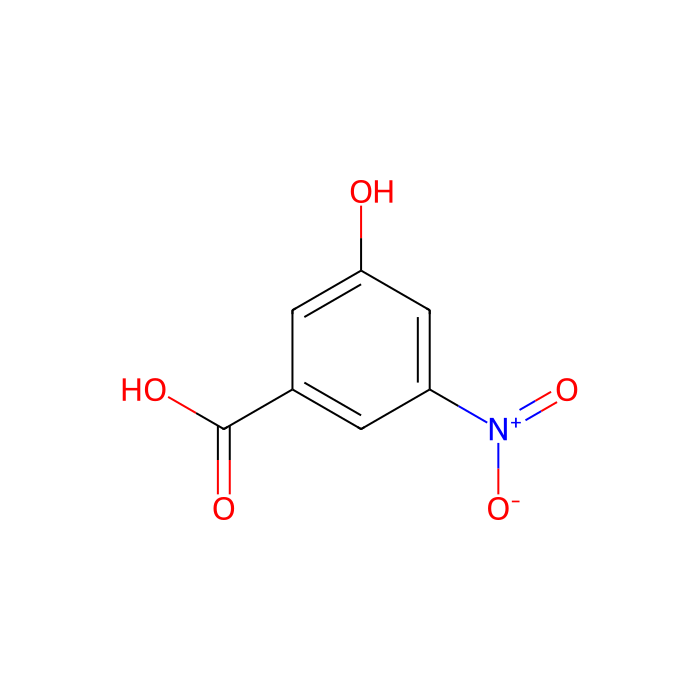
This compound belongs to the class of organic compounds known as nitrobenzoic acids and derivatives. These are compounds containing a nitrobenzoic acid moiety, which consists of a benzene ring bearing both a carboxylic acid group and a nitro group on two different ring carbon atoms.
External Descriptors
Not available
1. Djoumbou Feunang Y, Eisner R, Knox C, Chepelev L, Hastings J, Owen G, Fahy E, Steinbeck C, Subramanian S, Bolton E, Greiner R, and Wishart DS. ClassyFire: Automated Chemical Classification With A Comprehensive, Computable Taxonomy. Journal of Cheminformatics, 2016, 8:61.
1.Qian Li, Jing Yang, Wenzhan Yu, Liqiong He, Renlong Zhou, Changming Nie, Lifu Liao, Xilin Xiao. (2023) Two Fe(III)/Eu(III) Salophen complex-based optical sensors for determination of organophosphorus pesticide monocrotophos. Analytical Methods, 15 (19):(2334-2342). [PMID:37140268][10.1039/D3AY00255A]
Calculadoras de soluções
Molarity Calculator
Determine the necessary mass, volume, or concentration for preparing a solution.
Dilution Calculator
Determine the dilution needed to prepare a stock solution.
Reconstitution Calculator
Revisões
Avaliações dos Clientes
Application Protocols
Not applicable. No antibody or assay kit protocols apply to this small-molecule reagent. For synthetic use, see the “Reaction Conditions,” “Synthetic Utility,” and “Reaction & Applications” sections for practical guidance.
Biological Roles
This compound is a synthetic aromatic carboxylic acid and is not recognized as a natural metabolite. The following points reflect general biochemical considerations (literature/general knowledge) and are not product-specific claims:
Functional group behavior: The carboxylic acid can form salts with inorganic or organic bases, which can alter membrane permeability and protein binding in biochemical assays. The phenolic OH enables hydrogen bonding with enzyme or receptor sites in screening libraries, while the nitro group acts primarily as a strong electron-withdrawing substituent and potential bioisostere precursor (e.g., reduction to an aniline).
Probe/intermediate utility: After nitro reduction, the resultant aminophenol-benzoic acid motif can participate in diazotization/coupling to generate azo dyes or serve as a handle for bioconjugation (amide formation), which finds use in developing biochemical probes and affinity tags.
Caution in bioassays: Nitroaromatics may undergo reductive biotransformation in cellular systems (nitroreductases), potentially confounding readouts. Control experiments with reduced/acetylated analogs and proper vehicle controls (DMSO) are recommended.
No specific biological function or pathway association is ascribed to 3-hydroxy-5-nitrobenzoic acid itself. Use is limited to research and method development; not intended for diagnostic or therapeutic use.
Buffer Applications
This product is not a standard buffering agent. While aromatic carboxylic acids can, in principle, contribute to pH control near their pKa, 3-hydroxy-5-nitrobenzoic acid is not commonly used in classical laboratory buffer systems.
Practical guidance if considered for specialized purposes (general):
Aqueous use requires conversion to a soluble salt (e.g., sodium/potassium benzoate derivative) to achieve workable concentrations.
Expect significant UV absorbance in the near-UV region; this can interfere with spectrophotometric assays.
Established biochemical buffers (phosphate, HEPES, Tris, acetate) are preferred for routine applications.
For routine buffer preparation, select a validated buffering system with a pKa within ±1 unit of your target pH and known compatibility with your assay components.
Green Alternatives
Sustainability considerations depend on the transformation rather than the substrate itself. Options (literature/green-chemistry guidance):
Solvent substitution:
Replace DMF/DMAc/NMP with MeCN, 2-MeTHF, EtOAc, dimethyl carbonate, or propylene carbonate where solubility and reactivity allow.
For reductions, use ethanol or isopropanol as hydrogen-donor solvents; aqueous catalytic hydrogenations can be effective when the substrate is used as its salt.
Coupling chemistry:
Favor carbodiimide-free protocols (e.g., CDI or enzyme-inspired coupling) to reduce urea waste, or use EDC in water/EtOAc biphasic systems for easier workup.
Employ catalytic esterifications with solid acids or organocatalysts in green solvents (MeTHF, CPME) instead of halogenated media.
Energy and workup:
Utilize microwave or flow hydrogenation to cut reaction times and solvent volumes.
Crystallization-driven purifications (salt formation, selective esterification) reduce reliance on chromatography.
Comparison snapshot (general):
DMF/DMSO: Maximize solubility/reaction rates; high EHS burden, difficult removal.
2-MeTHF/EtOAc: Renewable, lower toxicity; may require activation/higher temperature.
Alcohols/water: Greenest for reductions/neutralizations; may need base to solubilize carboxylic acid.
Note: Select solvents and methods based on your reaction’s kinetics, selectivity, and required impurity profile.
Pharmaceutical Uses
Formulation or excipient use is not typical for this compound. The following reflects general industry context without therapeutic claims:
Role in development: 3-Hydroxy-5-nitrobenzoic acid is primarily a synthetic intermediate. It can be transformed into amide, ester, or aniline-containing derivatives that serve as building blocks in medicinal chemistry campaigns.
Excipient status: Not listed as a common pharmacopeial excipient. If an excipient-like role (e.g., counterion, pro-moiety) is contemplated in research, ensure thorough toxicological and regulatory evaluation.
Process chemistry considerations: The nitro group can be reduced under mild conditions, enabling convergent routes to aminobenzoic acid derivatives. Careful control of reduction conditions mitigates formation of hydroxylamine/azo impurities.
For GMP or regulatory pathways, source grade, impurity profile, and residual solvent limits must be established per ICH Q3 guidelines. This product is for research use only.
Physical Properties
Item-specific specifications (this lot):
Appearance: Not specified for this item; refer to CoA/Spec Sheet.
Grade/Purity: Not specified for this item; refer to CoA/Spec Sheet.
Literature/general properties for 3-hydroxy-5-nitrobenzoic acid (for context; not product specs):
State: Typically a crystalline aromatic carboxylic acid solid.
Acid-base character: Weak carboxylic acid; acidity is enhanced by the meta-nitro substituent relative to unsubstituted benzoic acid. The phenolic OH is much less acidic than the carboxyl group under most conditions.
Solubility profile: Sparingly soluble in water at neutral pH; solubility increases in basic aqueous media (formation of the benzoate). Readily soluble in polar aprotic organic solvents (e.g., DMSO, DMF, NMP) and in alcohols upon heating or with base. Poorly soluble in nonpolar hydrocarbons and chlorinated solvents unless converted to esters or salts.
Partitioning: Expected to exhibit low to moderate lipophilicity due to two strongly polar functional groups (CO2H, NO2) and one phenol.
Spectroscopic features: Aromatic UV absorption with additional bathochromic/auxochromic effects from the nitro and phenolic groups; strong IR bands for C=O (acid), O–H (broad), and asymmetric/symmetric NO2 stretches.
If precise numerical values (mp, bp, density, pKa, logP, refractive index) are required for your application, consult primary literature or request the CoA/Spec Sheet for this item.
Quality and Grades
Grade/Purity: Not specified for this item; refer to CoA/Spec Sheet.
Interpretation and guidance (general):
Without a declared grade (e.g., AR, ACS, HPLC, anhydrous, bioXtra), assume research-grade suitable for general synthetic use. For trace-analysis, catalysis-sensitive reactions, or photophysical studies, request impurity profiles (water, metals, UV cutoff) from the CoA.
Stabilizers: None indicated for this item. Phenolic/aromatic acids typically do not require stabilizers; however, headspace protection (argon charged per Product Data) minimizes oxidative discoloration or adventitious moisture uptake of ground powders.
Batch documentation: For method development or regulated work, obtain the lot-specific CoA (purity method, residual solvents, NMR/IR identity, and chromatographic assay). If you require a pharmacopeial match (USP/EP/JP), please inquire before purchase.
Suitability notes: If using as a coupling partner (after acid activation) in medicinal chemistry, monitor for trace inorganic residues and nitro reduction byproducts; these may influence reaction rates and color. For spectroscopy (e.g., UV studies), clarify the UV absorbance baseline and extinction coefficients with the supplier or measure empirically.
Reaction and Applications
Use this multifunctional aromatic acid as a versatile synthon in small-molecule and materials chemistry. Typical applications (literature/industry practice):
Nitro-to-amino conversion: Catalytic hydrogenation (H2, Pd/C or Pt/C) or chemoselective reductions (Fe/AcOH, SnCl2/HCl) to access 3-hydroxy-5-aminobenzoic acid. The resulting anilide/phenol/acid manifold enables dye, ligand, and medicinal scaffold elaboration.
Phenol derivatization: O-alkylation or O-acylation to form aryl ethers or esters (Williamson ether synthesis in DMF/DMSO with K2CO3/Cs2CO3; acylations with acid chlorides/anhydrides and base). Protect the phenol (e.g., as methyl ether) when subsequent steps require harsh conditions.
Carboxyl activation and coupling: Conversion to acid chlorides (SOCl2, oxalyl chloride; catalytic DMF) or in situ peptide-coupling (EDC/HOBt, HATU, DIC) affords amides/esters. The nitro group is generally stable to standard coupling conditions.
Electrophilic aromatic substitution: The ring is deactivated overall; the nitro and carboxyl groups are meta/strongly deactivating, and phenol is ortho/para directing but weakened by conjugation/acidic medium. Direct halogenation or Friedel–Crafts are disfavored; proceed via pre-functionalization strategies.
Metal complexation/materials: The hydroxy-carboxylate motif can bind metals after deprotonation, useful for coordination polymers or as chelating auxiliaries in analytical chemistry.
Practical tips:
Drying the substrate and using inert atmosphere (argon charged per Product Data) improves reproducibility in moisture-sensitive couplings.
For reductions, monitor for over-reduction (e.g., N–O bond cleavage to hydroxylamine) and phenolic hydrogenation under forcing conditions; adjust catalyst and solvent accordingly.
Reaction Conditions
General literature conditions (illustrative; adjust to your substrate and scale):
Nitro reduction to aniline:
H2 (1–5 bar), Pd/C (5–10 wt%), EtOH or i-PrOH, rt–50°C; monitor by TLC/HPLC. Acidic media (AcOH) can improve rates/solubility. Work up by filtration of catalyst and concentration; neutralize as needed.
Alternative: Fe powder (3–5 eq) in AcOH/H2O (3:1), 60–90°C; or SnCl2·2H2O (2–3 eq) in EtOH/HCl, reflux. Expect clean conversion with minimal over-reduction under controlled conditions.
Amide coupling (carboxyl activation):
EDC·HCl (1.1–1.5 eq), HOBt or Oxyma, DIPEA, DMF or MeCN, 0°C to rt, 2–16 h. For hindered amines, HATU/DIPEA often improves yields.
Acid chloride route: SOCl2 (3–5 eq), catalytic DMF, 0°C→reflux, then add amine base (NEt3) in DCM at 0–25°C.
Phenol O-alkylation:
Alkyl bromide (1.2–1.5 eq), K2CO3/Cs2CO3 (2–3 eq), DMF or acetone, 40–80°C, 2–12 h. For more challenging substrates, use NaH in THF at 0–25°C with careful addition.
Esterification (Fischer):
Alcohol solvent (MeOH/EtOH), catalytic H2SO4 or p-TsOH, reflux, Dean–Stark where applicable; monitor for concomitant etherification of the phenol and protect if necessary.
Notes:
The ring is deactivated; avoid harsh electrophilic aromatic substitutions. If aryl–aryl coupling is required, introduce a halogen handle via prior derivatization on a more activated intermediate.
Solubility often dictates success—pre-forming salts or using co-solvents (DMSO/DMF) can be decisive.
Safety and Handling
Item-specific hazard classification:
Signal word: Not specified for this item; refer to CoA/Spec Sheet and SDS.
H-statements: Not specified for this item; refer to SDS.
GHS classification/pictograms: Not specified for this item; refer to SDS.
General safety guidance for nitro- and hydroxy-substituted benzoic acids (literature/industry practice):
Likely hazards: Irritation to skin, eyes, and respiratory tract; harmful if swallowed or inhaled. Nitroaromatic compounds may present additional systemic toxicity upon significant exposure. Avoid dust formation and inhalation.
PPE: Use lab coat, safety glasses or goggles, and appropriate chemical-resistant gloves (e.g., nitrile). Handle in a fume hood to avoid inhalation of dust or vapors during heating.
Incompatibilities: Strong bases (react to form salts; exotherm in concentrated solutions), strong oxidizers or reducing agents (nitro group can undergo redox chemistry), reactive acylation/alkylation reagents (phenolic OH). Avoid contact with acyl chlorides or dehydrating agents unless intentional.
First aid (summary; defer to SDS): If inhaled—move to fresh air; seek medical attention if symptoms persist. Skin/eye contact—rinse with water for at least 15 minutes; remove contaminated clothing; obtain medical advice. If ingested—rinse mouth; do not induce vomiting; seek medical attention.
Fire safety: Organic solid; combustible. Use CO2, dry chemical, or foam. Avoid dust accumulation near ignition sources.
Always consult the product’s SDS and your institution’s EHS policies for authoritative instructions.
Solvent Selection
Polarity and miscibility (general/literature):
Nature: Polar aromatic carboxylic acid with a phenolic OH; strongly hydrogen-bonding donor/acceptor sites.
Good solvents: DMSO, DMF, DMAc, NMP—provide high solubility at room temperature. Alcohols (MeOH, EtOH, i-PrOH) often require warming or slight base. Aqueous solubility increases markedly above pH ~7 due to carboxylate formation.
Limited solvents: EtOAc, MeCN—moderate solubility depending on temperature; CH2Cl2 and toluene—typically poor unless esterified.
When to choose particular media:
Reaction media for acylation/esterification: Dry DCM, THF, MeCN, or toluene with coupling reagents; solubility may be improved by forming the acid chloride or in situ mixed anhydride.
Nucleophilic substitutions on the phenol (ether formation): Use polar aprotic solvents (DMF/DMSO) with base (e.g., K2CO3, Cs2CO3) and an alkyl halide.
Catalytic hydrogenation of the nitro group: Alcohols (EtOH, i-PrOH) or acetic acid/water mixtures are common; ensure substrate dissolution or use a co-solvent (THF, EtOAc) with stirring to maintain suspension.
Comparison guidance (general):
DMSO/DMF maximize solubility and rate in SN and coupling steps but pose challenging workups and EHS burdens; MeTHF/EtOAc are greener but may require activation or higher temperatures. Buffer-mediated aqueous reactions are feasible only when the acid is used as its salt.
Storage and Reconstitution
Item-specific handling:
Storage conditions: Store at 2–8°C, Argon charged (per Product Data).
Shipping: Shipped on wet ice (per Product Data).
General guidance for solids of this class:
Protect from moisture and prolonged light exposure to maintain color and purity. Keep container tightly closed; purge with inert gas after each use if possible to maintain the argon blanket.
If caking occurs, gently break up under dry atmosphere; avoid grinding that may induce static or dusting.
Reconstitution/stock solutions (research use only):
Recommended solvents: DMSO, DMF, or NMP for concentrated stocks; alcohols (MeOH/EtOH) for moderate concentrations; aqueous basic solutions (e.g., 0.01–0.1 M NaOH) to prepare the benzoate salt for biological assays.
Filtration: For particulate removal, filter stock solutions through 0.22 µm PTFE (organic) or PES (aqueous) syringe filters.
Storage of solutions: DMSO/DMF stocks are typically stable at −20°C for weeks to months when protected from moisture and air; prepare aliquots to avoid repeated freeze–thaw. Aqueous basic solutions may undergo slow oxidation/discoloration—prepare fresh as needed.
Always verify solution stability and concentration by analytical methods (HPLC/UV/NMR) before critical experiments.
Structure and Identity
A nitro- and hydroxy-substituted benzoic acid used as an aromatic building block for synthesis.
Benzoic acid core (carboxylic acid para to one ring C–C bond), substituted with a phenolic OH at the 3-position and a nitro group at the 5-position relative to the carboxyl.
The ring bears two strong electron-withdrawing substituents (CO2H, NO2) and one electron-donating substituent (phenolic OH), creating a deactivated yet regioselectively addressable aromatic platform.
2D description: A benzene ring with –CO2H at C1, –OH at C3, and –NO2 at C5; no stereocenters; planar conjugated system.
Notes:
Where “item-specific” is indicated, the value is taken from the Product Data. Other identifiers are provided as literature identifiers for reference only.
Synthetic Utility
Key reactivity handles and transformations (literature/general):
Carboxylic acid (–CO2H):
Activation: SOCl2/oxalyl chloride to acid chloride; CDI, EDCI/HOBt, HATU for amide/ester formation.
Decarboxylation: Less favorable on a deactivated ring; requires forcing conditions or transition-metal catalysis after prior activation.
Phenolic OH (–OH):
O-alkylation: Williamson ether synthesis using alkyl halides/tosylates (DMF/DMSO, K2CO3/Cs2CO3).
Protection: Methylation (MeI/Me2SO4; or TBS silylation) when subsequent steps are moisture/acid sensitive.
Ester/carbonate formation: Chloroformates or acid anhydrides for pro-moiety or solubility tuning.
Nitro group (–NO2):
Reduction: H2/Pd-C to aniline; chemoselective variants (SnCl2/HCl, Fe/AcOH). The aniline can undergo diazotization, coupling, or be converted to ureas/sulfonamides.
Nucleophilicity: Nitro serves as a strong EW group, modulating ring electronics; direct SNAr is unlikely without an additional leaving group.
Regioselectivity/platform value:
Orthogonal functional groups allow stepwise diversification. The acid can be coupled first (nitro/phenol tolerated), or the nitro group can be reduced later to unveil divergent routes.
Metal-binding potential upon deprotonation (phenolate/carboxylate) supports assembly of coordination polymers and MOF linkers after suitable derivatization.
Overall, 3-hydroxy-5-nitrobenzoic acid is a compact, highly functionalized platform for rapid library synthesis and materials precursors.
Target Specificity
Not applicable. This product is a small-molecule chemical and not an affinity reagent or biological targeting molecule. No antigen, epitope, clone, isotype, or species reactivity information applies.
We use cookies to ensure the website functions properly and, where permitted, to improve your experience. You can manage your preferences at any time in Settings. Learn more in our Cookie Policy.
Shall we send you a message when we have discounts available?
Remind me later
Thank you! Please check your email inbox to confirm.
Products are supplied to verified businesses, institutions, and qualified professionals for research and development use only. Not for use in humans, animals, diagnosis, or therapy.

 A2303347