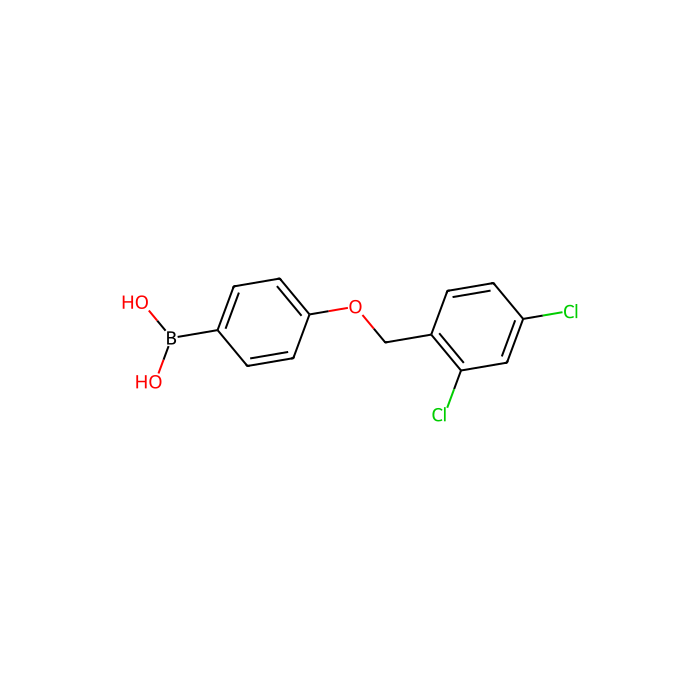
This compound belongs to the class of organic compounds known as dichlorobenzenes. These are compounds containing a benzene with exactly two chlorine atoms attached to it.
External Descriptors
Not available
1. Djoumbou Feunang Y, Eisner R, Knox C, Chepelev L, Hastings J, Owen G, Fahy E, Steinbeck C, Subramanian S, Bolton E, Greiner R, and Wishart DS. ClassyFire: Automated Chemical Classification With A Comprehensive, Computable Taxonomy. Journal of Cheminformatics, 2016, 8:61.
Determine the necessary mass, volume, or concentration for preparing a solution.
Dilution Calculator
Determine the dilution needed to prepare a stock solution.
Reconstitution Calculator
Revisões
Avaliações dos Clientes
Application Protocols
No assay or bioanalytical application protocols are specified for this item. For synthetic use, consult the Reaction Conditions section for representative setups for Suzuki–Miyaura and Chan–Lam couplings. Always optimize catalyst, base, solvent, and temperature for your specific electrophile and substrate set.
Biological Roles
This product is an organic synthetic building block and does not have an established biological role by itself.
General note: Arylboronic acids can interact with diols (e.g., saccharides) via reversible boronate ester formation; this property underlies certain sensor designs in chemical biology. However, no specific biological function is ascribed to 4-(2,4-dichlorophenylmethoxy)phenylboronic acid.
The dichloroaryl benzyloxy motif is common in exploratory medicinal chemistry scaffolds, but any biochemical activity would be target- and context-dependent and must be determined experimentally.
All uses are for research and laboratory development only. No clinical or diagnostic claims are made.
Buffer Applications
Not typically applicable. This compound is a hydrophobic organic building block rather than a buffering agent. It does not define a useful conjugate acid–base pair in the physiological pH range for buffering purposes. For practical work, see Solvent Selection and Reaction & Applications for guidance on preparing reaction media containing this reagent.
Green Alternatives
Greener strategies relate to solvent/catalyst choices and the boron protecting group.
Solvent alternatives for Suzuki couplings:
Replace dioxane/DMF with 2-MeTHF, CPME, or water-rich mixtures when feasible.
Ethanol/water and isopropanol/water can be effective with suitable bases and catalysts.
Catalyst and base selection:
Employ ligand-efficient Pd systems (ppm–low mol%) or Ni catalysts where appropriate to reduce precious metal usage.
Use inorganic carbonates or phosphates; avoid strong bases that drive protodeboronation.
Boron handling:
Use the pinacol boronate ester surrogate to improve stability and reduce hydrolytic loss during storage/transport; hydrolyze in situ as needed.
Comparison (general literature guidance):
Traditional: 1,4-dioxane/H2O, Pd(PPh3)4 (1–3 mol%), K2CO3, 80–100 C.
Greener: 2-MeTHF/H2O or EtOH/H2O, Pd/C or Pd-heterogeneous (0.1–0.5 mol%), room temp–60 C, aqueous base.
Trade-offs:
Greener solvents may alter solubility; ensure adequate dissolution or employ phase-transfer strategies.
Lower Pd loadings can slow reactions; optimize ligand and temperature.
Pinacol esters are less reactive than free boronic acids in some systems but offer superior shelf stability.
Pharmaceutical Uses
No pharmacopeial excipient status or formulation use is specified for this item. This compound is intended as a research-grade intermediate/building block.
Potential roles in process R&D (general): intermediate in the synthesis of biaryl APIs or advanced intermediates using Suzuki–Miyaura coupling.
Regulatory note: If material is to be used in GMP-related development, lot-specific CoA, impurity profile, and residual metal content should be evaluated against project requirements.
All uses are for research and laboratory synthesis only; not for human or veterinary use.
Physical Properties
Item-specific numerical specifications (appearance, purity, water, metals, UV cutoff, etc.): Not specified for this item; refer to CoA/Spec Sheet.
Literature/computed physical data for structural context (reference use only; not item specifications):
Physical state: typically a crystalline solid for comparable arylboronic acids (literature trend).
Molecular weight: ~296.94 g/mol (computed from C13H11BCl2O3).
Acid–base: boronic acids are weak Lewis acids; pKa of first OH in simple arylboronic acids typically ~8.5–9.2 (literature range). Electron-withdrawing chloro substituents can slightly increase acidity; the para ether can modestly decrease it; net pKa expected in the arylboronic-acid range (literature).
Solubility (qualitative, literature):
Often sparingly soluble in water as free boronic acids; solubility increases under basic aqueous conditions (boronate formation).
Soluble in common organic solvents such as DMSO, DMF, acetone, acetonitrile, ethyl acetate, dioxane, and moderately in alcohols; limited in nonpolar hydrocarbons.
Partitioning: aryl dichloro and benzyloxy motifs typically confer moderate hydrophobicity; logP expected >2 (literature expectation for analogous structures).
Melting point / boiling point / density / refractive index: Not specified for this item; consult primary literature or CoA if available.
Important: Use the CoA associated with your lot for definitive quality-control values and any assay-relevant properties.
Quality and Grades
Grade/Purity: Not specified for this item; refer to CoA/Spec Sheet.
Context for this compound type:
Arylboronic acids are commonly supplied as research grade building blocks. Key quality determinants include assay purity (by HPLC/GC/NMR), residual solvents, water content (Karl Fischer), and inorganic residues (B, Cl, metals) depending on synthesis route.
If your application is cross-coupling (e.g., Suzuki–Miyaura), pay attention to:
Assay (area % by HPLC): impacts coupling yield and byproduct profile.
Content of boroxines/anhydrides: reversible; may influence handling and solubility. Mild rehydration can reconvert boroxines to boronic acid when desired.
Residual palladium/nickel/copper: important if the material was prepared via catalytic arylation; check metals if downstream catalysis is metal-sensitive.
Water content: affects formation of boronate under basic conditions; typically controlled but not specified here.
Stabilizers/antioxidants: None indicated in Product Data. If present in a given lot, this will be declared on the CoA/Spec Sheet.
Recommendation: For chromatography-sensitive applications, request low-UV/HPLC-suitable grade if available. Always verify lot-specific data on the CoA.
Reaction and Applications
Primary role: arylboronic acid coupling partner for C–C bond formation.
Suzuki–Miyaura cross-coupling:
Couples with aryl/vinyl halides or pseudohalides (Br, I, OTf; activated Cl) to furnish para-benzyloxy-substituted biaryls bearing a 2,4-dichlorobenzyl ether. The para arrangement and benzylic ether can influence electronics and coupling rate.
The dichloro pattern on the benzylic ring enables orthogonal downstream substitution (e.g., SNAr on 2- or 4-chloro under strongly activating conditions) while the boronic acid site is consumed in coupling.
Chan–Lam coupling (Cu-mediated): formation of C–N or C–O bonds from the boronic acid under oxidative conditions to give aryl amines, amides, ethers, and carbamates.
Protodeboronation considerations: electron-rich/neutral arylboronic acids are generally stable; avoid prolonged heating in strongly basic aqueous media to limit side reactions.
Protection/derivatization:
Convert to pinacol boronate ester for enhanced stability/solubility in some couplings; reconvert by hydrolysis.
Boroxine formation on drying is reversible with small amounts of water.
Utility of the benzyloxy group:
Benzylic O–CH2–ArCl2 can be selectively manipulated (e.g., hydrogenolysis, oxidative cleavage) to reveal phenols or alter substitution on the dichloro ring.
Applications span medicinal chemistry and materials discovery where a para-benzyloxy handle and dichloro pattern are desired in final biaryl scaffolds. Research use only.
Reaction Conditions
General literature guidance for reactions using arylboronic acids like this product (optimize per substrate):
Suzuki–Miyaura cross-coupling:
Catalyst: Pd(PPh3)4 (1–3 mol%), Pd2(dba)3/XPhos (0.5–2 mol% Pd), Pd(dppf)Cl2·CH2Cl2 (1–3 mol%). Nickel catalysts with suitable ligands for aryl chlorides.
Reported yields for well-matched couplings are commonly 70–95% (literature), contingent on substrate/catalyst match.
Safety and Handling
Item-specific GHS details are not provided in the Product Data.
Signal word: Not specified for this item; refer to SDS.
H-statements / P-statements / Pictograms / GHS classification: Not specified for this item; refer to SDS.
General safety considerations for arylboronic acids and dichloroaryl ethers (general guidance; defer to SDS):
Hazards: Low volatility solids generally present low inhalation risk but may cause eye/skin irritation and respiratory tract irritation as dust. Avoid ingestion and prolonged contact.
PPE: Wear lab coat, safety glasses, and suitable gloves (e.g., nitrile). Handle powders in a fume hood to minimize dust exposure.
Incompatibilities: Strong oxidizers. Boronic acids can undergo transesterification with diols; avoid unintended contact with polyol-rich media if stoichiometry matters. Avoid strong bases/acids unless intended (may form boronates or hydrolyze protecting groups).
First aid (overview):
Inhalation: Move to fresh air; seek medical advice if symptoms persist.
Skin: Wash with soap/water; remove contaminated clothing.
Eyes: Rinse cautiously with water for several minutes; remove contact lenses if present and easy.
Ingestion: Rinse mouth; seek medical advice. Do not induce vomiting unless directed.
Fire: Organic solid; use CO2, dry chemical, or foam. Combustion may produce HCl and boron oxides; wear SCBA in fire conditions.
Spills: Avoid dust generation. Sweep up, place in suitable container, and dispose per regulations.
Always consult the official SDS for authoritative hazard, handling, and disposal guidance.
Solvent Selection
As a moderately hydrophobic arylboronic acid, this compound dissolves best in polar aprotic organic solvents and in basic aqueous/organic mixtures that form boronates.
Moderate: methanol, ethanol, isopropanol (enhanced with base), THF (especially with a small amount of water/base for coupling).
Limited: nonpolar hydrocarbons (toluene/hexanes), unless warmed or with phase-transfer/base.
Typical use scenarios:
Suzuki–Miyaura couplings: 1,4-dioxane/water, THF/water, toluene/ethanol/water, or MeCN/water with base (K2CO3, Cs2CO3, K3PO4, Na2CO3). A co-solvent system aids dissolution and boronate formation.
Stock solutions for screening: DMSO (10–100 mM) for HTS or parallel synthesis; dilute into reaction media.
Selection guidance vs alternatives:
Use DMSO/DMF for maximum solubility in small-scale assays or when dosing precisely.
Prefer 2-MeTHF or CPME (with water/base) for greener coupling solvent systems.
If substrate or catalyst is moisture sensitive, use rigorously dried organic solvents and add base as solid/slurry.
Note: Exact solubilities are not specified for this item; determine experimentally at your working temperature and composition.
Storage and Reconstitution
Item-specific storage: Room temperature (per Product Data). Shipped under normal conditions.
General storage guidance for arylboronic acids:
Keep tightly closed in a dry container. Protect from prolonged exposure to moisture to limit boroxine formation or hydrolysis, although these processes are usually reversible.
Store away from strong oxidizers and strong acids/bases.
Solution handling:
Prepare stock solutions in dry organic solvents (e.g., DMSO, DMF, MeCN) just prior to use. For coupling, co-solvent mixtures with water/base are typical.
If long-term solution storage is needed, prefer the pinacol boronate ester derivative; otherwise, store solutions at low temperature (e.g., 2–8 C) and protect from air/moisture. Inspect for precipitation or degradation before use.
Reconstitution: If supplied as a solid, dissolve to desired concentration using a suitable solvent from Solvent Selection. Gentle warming and sonication can aid dissolution. Record exact solvent and concentration for reproducibility.
Research use only. Refer to the CoA/SDS for lot-specific stability information and any additional handling instructions.
Structure and Identity
A bifunctional arylboronic acid bearing a para-benzyloxy substituent with a 2,4-dichlorophenyl ring. The molecule features two aromatic rings connected via an ether–methylene (–O–CH2–) linkage, and a boronic acid [–B(OH)2] group para to the benzyloxy substituent on one ring.
Computed/literature identifiers and features (for reference; verify via CoA/SDS):
Structural features: two phenyl rings, para-substituted; one ether oxygen; benzylic methylene; boronic acid functionality (trigonal planar boron with two hydroxyls)
Proposed 2D description: A phenyl ring bearing –B(OH)2 and –O–CH2–Ar substituents in para relationship; the benzylic aryl is 2,4-dichloro-substituted.
Approximate molecular formula (structure-based): C13H11BCl2O3 (literature/computed)
Cross-coupling linchpin for forming C(sp2)–C(sp2)/C(sp2)–C(sp3) bonds (Suzuki–Miyaura) under Pd or Ni catalysis.
Amenable to Chan–Lam couplings to forge C–N/C–O bonds oxidatively.
Can be transformed to other functionalities (e.g., via oxidative coupling, ipso-substitution, or halodeboronation).
Benzyloxy substituent (–O–CH2–ArCl2):
Acts as an electron-donating para substituent, modulating aryl reactivity and coupling rates.
Provides a handle for post-coupling manipulations: hydrogenolysis to liberate phenols, or oxidation to aldehydes/acids (via benzylic oxidation pathways) depending on conditions.
Dichloro pattern on the benzylic aryl:
Orthogonal reactivity through SNAr (with strong nucleophiles on activated rings) or through selective metal-catalyzed C–Cl activation, enabling sequential diversification.
Retrosynthetic value:
Enables convergent assembly of complex biaryls where this fragment contributes a para-benzyloxy motif and a chlorinated aryl for downstream editing.
Protection/derivatives:
Pinacol boronate ester variant can be used for improved handling and then hydrolyzed in situ. Boroxine formation is reversible and sometimes leveraged for crystallinity and purification.
Target Specificity
Not applicable. This product is a small-molecule building block and is not an antibody, enzyme, or biological probe with defined target specificity. No target, epitope, or isotype information is relevant.
Perguntas frequentes
What is the purity of this product?
This product is supplied at ≥97% purity (chemical assay). Lot-specific values are stated on the Certificate of Analysis.
How should this product be stored?
Store at room temperature.
How is this product shipped?
This product ships under standard ambient conditions. No temperature-controlled packaging is required.
What are the CAS number, molecular formula and molecular weight?
The CAS Number is 1256355-75-5, the molecular formula is C13H11BCl2O3, and the molecular weight is 296.9 g/mol. InChIKey OCZXYAVYBZVAJM-UHFFFAOYSA-N.
What documentation is provided?
Available product documentation, including Certificates of Analysis (COA), Safety Data Sheets (SDS), and specification sheets, is shown in the product document area. Document availability and access follow the current site policy.
We use cookies to ensure the website functions properly and, where permitted, to improve your experience. You can manage your preferences at any time in Settings. Learn more in our Cookie Policy.
Shall we send you a message when we have discounts available?
Remind me later
Thank you! Please check your email inbox to confirm.
Products are supplied to verified businesses, institutions, and qualified professionals for research and development use only. Not for use in humans, animals, diagnosis, or therapy.