This compound belongs to the class of organic compounds known as pyridinecarboxylic acids. These are compounds containing a pyridine ring bearing a carboxylic acid group.
External Descriptors
Pyridine alkaloids
1. Djoumbou Feunang Y, Eisner R, Knox C, Chepelev L, Hastings J, Owen G, Fahy E, Steinbeck C, Subramanian S, Bolton E, Greiner R, and Wishart DS. ClassyFire: Automated Chemical Classification With A Comprehensive, Computable Taxonomy. Journal of Cheminformatics, 2016, 8:61.
Determine the necessary mass, volume, or concentration for preparing a solution.
Dilution Calculator
Determine the dilution needed to prepare a stock solution.
Reconstitution Calculator
Revisões
Avaliações dos Clientes
Application Protocols
No tested bioanalytical application protocols (e.g., WB, IHC, IF, FC) are applicable to this small-molecule reagent. For synthetic or materials workflows, see the Reaction & Applications, Synthetic Utility, and Reaction Conditions tabs for practical guidance on use in chemical transformations and coordination chemistry.
Biological Roles
This product is supplied strictly for research use (non-clinical). The following information provides biochemical context from the literature and does not imply biological use claims for this SKU.
Pathway intermediate (literature): 6‑Hydroxynicotinic acid is reported as a microbial intermediate in nicotinic acid (vitamin B3/niacin) catabolism. Enzymes such as 6‑hydroxynicotinate 3‑monooxygenase convert it to 2,5‑dihydroxypyridine in certain bacteria.
Structural motif: As a hydroxylated nicotinate, it relates to metabolites involved in NAD/NADP biosynthetic and degradative routes, though it is not itself a standard human metabolite.
Metal chelation: The O,O/N,O donor set can chelate metal ions in biological systems; this underlies its utility in model coordination complexes studied for enzymatic active-site mimicry (literature concept).
Acid–base behavior: Multiple ionizable centers lead to pH-dependent speciation (carboxylate, phenolate, pyridinium), influencing transport and binding in biological matrices (general principle for hydroxynicotinates).
No medical, diagnostic, or therapeutic uses are claimed or supported for this catalog item. Any biological experiments must be confined to appropriate in vitro/in vivo research protocols and approved by institutional oversight.
Buffer Applications
6‑Hydroxynicotinic Acid is not a standard buffering agent. While it possesses multiple ionizable groups, it is not commonly used to prepare defined buffer systems in biochemical assays.
Practical note: If dissolution in aqueous media is required, adjust pH with NaOH/KOH to form the corresponding salt for stock solutions; then back‑titrate after dilution if necessary. For true buffering capacity, prefer established buffers (e.g., phosphate, HEPES, Tris) with well‑characterized pKa and low spectral/background interferences.
For work where the compound is present in aqueous systems, manage pH using a conventional buffer and add 6‑Hydroxynicotinic Acid as a solute or ligand under controlled pH conditions.
Green Alternatives
As a solid heteroaromatic acid, 6‑Hydroxynicotinic Acid itself is not readily “replaced,” but its use can be made greener by solvent/reagent choices and process design.
Greener choices (literature-based guidance):
Solvents:
Prefer water/ethanol media with in situ base (e.g., Na2CO3) for salt formation, crystallization, or simple derivatizations; avoid chlorinated solvents when feasible.
For amidation/esterification, consider ethyl acetate or 2‑MeTHF in combination with coupling reagents compatible with greener media (e.g., CDI in EtOAc for certain substrates).
Coupling reagents:
Replace DCC with EDC·HCl (water-tolerant) or CDI to reduce urea waste handling; use catalytic DMAP where appropriate to lower reagent loadings.
Energy/pH integration:
Use pH‑swing crystallizations (base dissolve → acid precipitate) to minimize solvent volumes.
Illustrative comparison (general):
Traditional: DCC/DMAP in DCM or DMF for ester/amide formation → effective but hazardous solvent and urea waste.
Greener: EDC or CDI in EtOAc/2‑MeTHF/MeOH → reduced hazard profile; easier workup and lower environmental impact.
Trade-offs:
Greener solvents may reduce substrate solubility; mild heating or salt formation can compensate.
Water-tolerant couplings can suffer hydrolysis; ensure adequate stoichiometry and control of pH and temperature.
Pharmaceutical Uses
No pharmacopeial or excipient status is specified for this item; it is provided for research use only.
Context from literature (non-clinical):
Synthetic intermediate: Hydroxynicotinic acids serve as building blocks for discovery chemistry, enabling access to amides, esters, and heterocyclic scaffolds relevant to medicinal chemistry campaigns.
Coordination probes: Metal complexes of hydroxynicotinates are studied as models or tools in bioinorganic research; this is academic/preclinical in nature.
Formulation note:
If used in screening formulations, solubilize as the sodium/potassium salt or in DMSO before aqueous dilution. Confirm solubility limits and compatibility with excipients; remove residual high-boiling solvents prior to biological evaluation.
No therapeutic, diagnostic, or clinical use is claimed or implied for this catalog item.
Physical Properties
Item-specific physicochemical specifications are not provided in the Product Data for this SKU; consult the CoA/Spec Sheet for authoritative numbers.
Literature/computed values (for general reference only; not specifications for this item):
Molecular formula: C6H5NO3 (literature)
Molecular weight: ~139.11 g/mol (literature)
Appearance: typically an off-white to tan crystalline solid (literature)
Melting point: commonly reported in the ~230–260 °C range with possible decomposition, depending on form and purity (literature)
Acid–base properties: carboxylic acid pKa typically ~2.5–3.0; phenolic OH pKa often ~9–10; pyridine N conjugate acid pKaH typically ~1–2 (literature, approximate ranges for substituted hydroxynicotinic acids)
Partitioning: expected low logP/negative cLogP due to dual acidity and hydrogen-bonding capacity (literature/estimates)
Solubility profile: sparingly soluble in neutral water; high solubility in basic aqueous media (formation of pyridine-oxide/phenolate/carboxylate salts is pH-dependent); soluble in polar aprotic solvents such as DMSO and DMF; limited in alcohols unless heated or ionized (literature, general behavior of hydroxynicotinic acids)
Notes for practitioners:
Multiple ionizable sites strongly influence pH-dependent solubility and tautomer distributions (phenol/pyridone forms). Adjust pH to ≥8–10 for rapid dissolution in water as the sodium or potassium salt.
Hygroscopicity is typically low-to-moderate for analogous acids, but handle quickly in humid environments to avoid surface wetting (general guidance).
Quality and Grades
Grade/Purity: Not specified for this item; refer to CoA/Spec Sheet.
Guidance on interpreting grade (general):
If provided as “Reagent” or “AR grade,” expect suitability for general synthesis and analytical work; trace metals/UV cutoff typically not controlled to chromatographic standards.
If provided as “99%+” or higher, the assay reflects organic purity by titration, HPLC, or NMR. Residual water, inorganic salts, or polymorph content may not be captured unless stated.
“HPLC grade” typically refers to solvents; for solids, “HPLC tested” may indicate low UV-absorbing impurities relevant to chromatographic applications.
Stabilizers and form:
No stabilizer is listed in Product Data. Phenolic/pyridinecarboxylic acids generally do not require stabilizers. If hydrates/solvates exist, the CoA will indicate form and loss-on-drying.
What to check on receipt (best practice):
Confirm identity by NMR/FTIR against literature spectra (aromatic pyridine signals, broad phenolic OH, and carboxyl C=O around ~170–175 ppm in 13C NMR).
Verify water content (Karl Fischer) and assay/purity from CoA if critical to your application.
For metal-sensitive catalysis or coordination studies, consider a prewash or recrystallization and request a metals screen if needed.
Note: Where specific numeric specifications are required (e.g., trace metals, water content, melting range), consult the item’s CoA/Spec Sheet—these are Not specified for this item.
Reaction and Applications
Representative research applications (literature; expand/guide use):
Coordination chemistry/MOFs: 6‑Hydroxynicotinate acts as an O,O- or N,O-donor bridging ligand. Deprotonation of –CO2H/–OH enables construction of coordination polymers and metal–organic frameworks; metal choices (e.g., Zn(II), Cu(II), lanthanides) tune topology and properties.
Building block in heteroaromatic synthesis: The carboxyl group enables amide/ester libraries; the phenolic OH allows O‑alkylation/acylation to phenolic ethers/esters; the ring N supports N‑oxidation (pyridine N‑oxides) or quaternization to pyridinium salts.
Decarboxylative functionalization: Under photoredox or thermal conditions, pyridine‑3‑carboxylic acids can undergo decarboxylative cross‑couplings or radical additions after activation (e.g., N‑hydroxyphthalimide esters; literature precedents guide condition choice).
Directed C–H functionalization: The pyridine N (and/or N‑oxide) can direct ortho C–H activation, enabling halogenation, borylation, or metalation sequences.
Protecting group strategies: Temporary O‑acylation of the phenol controls chemoselectivity during amidation at the carboxyl.
Practical tips:
Orthogonal reactivity: prioritize transformations: (1) protect/activate –OH if chemoselectivity is an issue; (2) couple at –CO2H; (3) manipulate the ring via N‑oxide or directed lithiation.
Salt formation improves handling: convert to its sodium/potassium salt for aqueous-phase transformations and for templating metal–organic assemblies.
Drying: For coupling chemistry, dry under high vacuum at mild temperature to remove adventitious moisture before using carbodiimides or acid chlorides.
Research-only note: The compound is sold for research and laboratory use only (per Product Data).
Reaction Conditions
General laboratory conditions observed in the literature for functionally related transformations of 6‑hydroxynicotinic acid (guidance only; optimize per system):
Amide coupling (EDC/HOBt or HATU):
Solvent: DMF, DCM, or MeCN (anhydrous)
Base: DIPEA or NMM (2–3 equiv)
Temp/time: 0–25 °C, 2–16 h
Notes: Protect phenol if O‑acylation competes; monitor by LC–MS.
Steglich esterification (DCC/DMAP):
Solvent: DCM or THF (dry)
Catalyst: DMAP (0.1 equiv)
Temp/time: 0 °C to RT, 4–18 h
Workup: Filter DCU, wash, and purify by column/crystallization.
O‑alkylation of phenol:
Base: K2CO3 or Cs2CO3 (2–3 equiv)
Solvent: DMF, MeCN; alternatively acetone/MeCN under phase-transfer
Electrophile: alkyl halide or sulfate (1.1–1.5 equiv)
Temp: 25–80 °C; 2–24 h
Note: Competing N‑alkylation possible; choose conditions/electrophile to favor O‑ vs N‑.
N‑oxidation (to pyridine N‑oxide):
Oxidant: m‑CPBA (1.1–1.5 equiv)
Solvent: DCM or CHCl3, 0–25 °C
Quench: sodium sulfite; purify avoiding overoxidation of phenol.
Formation of metal complexes/MOFs:
Medium: aqueous/ethanolic with base (pH 6–9) or hydrothermal conditions (80–180 °C)
Metal salts: Zn(II), Cu(II), Ln(III); stoichiometry and pH dictate topology
Notes: Slow evaporation or solvothermal growth yields crystalline materials.
Catalyst: Ir/Ru polypyridyl or organic dyes; base: NEt3
Solvent: MeCN or DMF; blue LEDs, RT–40 °C
Caution: Protect phenol or adjust conditions to avoid side reactions.
All conditions above are literature-style guidance and not specifications for this item.
Safety and Handling
Hazard classification details (GHS pictograms, H-statements, signal word) are not specified for this item in the Product Data. Always consult the product SDS for authoritative safety information.
General laboratory safety guidance (for structurally related pyridinecarboxylic acids; not a substitute for SDS):
Likely hazards: may cause skin/eye irritation and respiratory tract irritation as dust. Avoid inhalation of particulates; minimize dust generation.
PPE: wear lab coat, suitable gloves (e.g., nitrile), and safety glasses or splash goggles. Use a dust mask/respirator if airborne dust cannot be controlled (per institutional risk assessment).
Handling: work in a fume hood when weighing to control dust. Avoid contact with strong oxidizers. Acids/bases will alter speciation; exotherm possible upon neutralization.
Incompatibilities: strong oxidizing agents, strong bases/acids (for storage segregate as a weak organic acid). Avoid reactive acylation/alkylation agents unless intended for synthesis.
First aid (overview):
Inhalation: move to fresh air; seek medical attention if symptoms persist.
Skin contact: wash with soap and water; remove contaminated clothing.
Eye contact: rinse cautiously with water for several minutes; remove contact lenses if present and easy; seek medical attention if irritation continues.
Ingestion: rinse mouth; do not induce vomiting; seek medical advice.
Spill response: avoid dust; collect mechanically; clean residue with damp disposable towels or HEPA vacuum.
Fire: use water spray, CO2, dry chemical, or foam. Combustion may produce NOx/CO2/CO.
Storage and shipping (from Product Data):
Storage Conditions: Room temperature.
Shipped In: Normal.
Always defer to the SDS and institutional EHS protocols for risk assessment and controls.
Solvent Selection
6‑Hydroxynicotinic Acid is a polar, multifunctional heteroaromatic acid whose solubility is strongly pH-dependent.
Polarity class: polar protic/ionic character upon deprotonation; neutral form is moderately polar and hydrogen-bond rich.
Miscibility/solubility (literature, general):
Water: low at neutral pH; increases markedly in basic media (formation of carboxylate/phenolate salts). Acidic media may protonate the ring nitrogen, reducing basicity and altering solubility.
Polar aprotic: good in DMSO, DMF, NMP; moderate in hot alcohols.
Nonpolar solvents (hexane, toluene): poor.
When to choose which solvent:
Method development and bioassays (non-biological): prepare concentrated stocks in DMSO (e.g., 100–500 mM), then dilute into buffered systems while monitoring pH.
Aqueous reactions/purifications: dissolve by adjusting to pH 8–10 with NaOH/KOH, then back-titrate for precipitation or crystallization.
Esterification/amidation: dry polar aprotics (DCM/DMF/MeCN) with coupling reagents; remove traces of water to minimize hydrolysis.
Quick comparison (general behavior):
DMSO: highest solvating power; easiest for stock solutions; high boiling complicates removal.
DMF/NMP: good balance of solvation and processability; consider residual solvent limits.
MeOH/EtOH: greener choices; solubility improved with gentle heating or base.
Tip: Consider forming soluble salts (e.g., sodium 6‑hydroxynicotinate) for aqueous workflows; regenerate the free acid by acidification post-process.
Storage and Reconstitution
Storage conditions (Product Data): Room temperature. Store tightly closed in a cool, dry, well-ventilated place. Protect from prolonged exposure to humidity and strong light.
Shipping (Product Data): Normal.
Reconstitution and solution preparation (general guidance; not item-specific specs):
Aqueous stocks: Dissolve by adjusting to pH 8–10 with NaOH or KOH to form the corresponding salt (e.g., 50–200 mM). Filter sterilize if required for certain assays. Record final pH.
Organic stocks: Readily soluble in DMSO (e.g., 100–500 mM). Also soluble in DMF/NMP; moderate in hot MeOH/EtOH.
Order of addition: Add solvent to solid gradually with stirring. For aqueous solutions, adjust pH slowly to avoid local over‑basification.
Storage of solutions: DMSO stocks generally stable at −20 °C for weeks to months in aliquots; minimize freeze–thaw. Aqueous basic solutions may undergo slow oxidation/hydrolysis—prepare fresh when possible.
Compatibility: Avoid mixing concentrated solutions with strong oxidizers. For metal-complexation work, use metal-free water/solvents and plastic/glassware validated for low metal background.
Item-specific parameters such as water content, exact solubility limits, and stability constants are Not specified for this item; refer to CoA/Spec Sheet and SDS for definitive guidance.
Structure and Identity
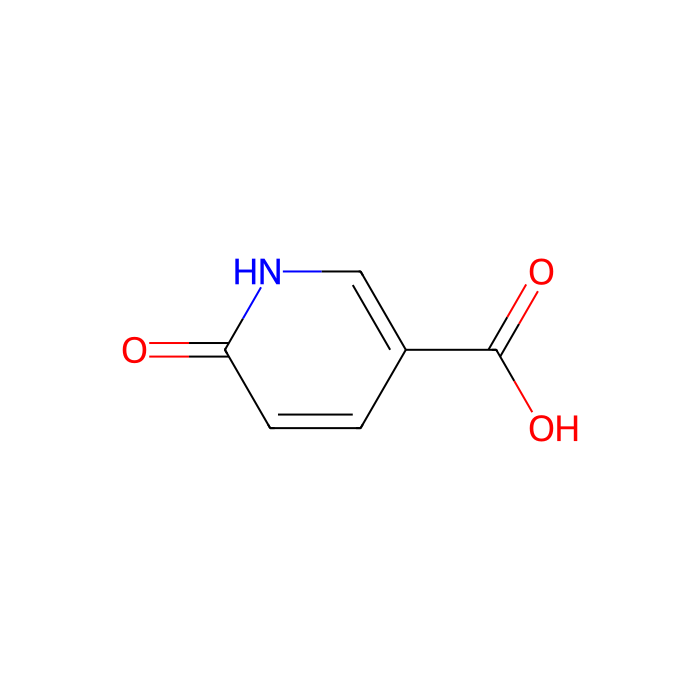
A pyridinecarboxylic acid bearing a phenolic hydroxyl, 6‑Hydroxynicotinic Acid is a heteroaromatic building block useful in coordination chemistry and synthesis.
SKU: H108017
Product Name: 6-Hydroxynicotinic Acid
CAS: 5006-66-6 (literature)
PubChem CID: 72924 (literature)
InChIKey: Not specified for this item; refer to CoA/Spec Sheet. (Product Data lists: 27827; consult SDS/CoA for confirmation.)
SMILES: Not specified for this item; refer to CoA/Spec Sheet. (Typical literature representations exist for 6-hydroxypyridine-3-carboxylic acid.)
Molecular Formula: Not specified for this item; refer to CoA/Spec Sheet. (Literature: C6H5NO3.)
Molecular Weight: Not specified for this item; refer to CoA/Spec Sheet. (Literature: ~139.11 g/mol.)
Structural features (general description):
Ring system: six-membered aromatic pyridine with one ring nitrogen (sp2), para/meta relationships defined by pyridine numbering (N at position 1).
Substituents: carboxylic acid at the 3-position (nicotinic acid motif) and phenolic hydroxyl at the 6-position relative to the ring nitrogen.
Functional groups: heteroaromatic nitrogen (basic site), phenolic OH (weakly acidic/nucleophilic), and carboxylic acid (acidic, H-bond donor/acceptor, readily derivatized to esters/amides).
2D description: an electron-deficient pyridine ring bearing –CO2H meta to N and –OH ortho to N on the opposite side; no stereogenic centers (achiral).
Synthetic Utility
6‑Hydroxynicotinic Acid is a versatile bifunctional heteroaromatic building block.
Key reactive handles:
Carboxylic acid (at C3):
Amide formation via EDC/HOBt, HATU, or CDI; acid chloride formation (SOCl2, oxalyl chloride) for acylations.
Esterification: Fischer (MeOH/EtOH, acid catalysis) or Steglich (DCC/DMAP) for sensitive substrates.
Phenolic OH (at C6):
O‑alkylation (alkyl halides, base: K2CO3/DMF) to ethers; O‑acylation to aryl esters.
As a directing/anchoring site in metalation or complexation.
Pyridine nitrogen:
N‑oxidation (m‑CPBA) to pyridine N‑oxide, enabling ortho C–H activation or Meisenheimer-type reactivity.
Quaternization (alkyl halides) to pyridinium salts, altering solubility/electronics.
Strategic applications:
Cross-coupling after prefunctionalization: Halogenate the ring (e.g., via N‑oxide activation) to access Suzuki/Negishi products.
Decarboxylative couplings: Convert to NHPI ester for photoredox-enabled C–C formations.
Coordination frameworks: Use its dianionic form for assembling metal–organic architectures with controlled connectivity.
Selectivity tips:
Mask the phenol during amide couplings to suppress undesired O‑acylation; catalytic DMAP accelerates O‑acylation more than amidation—tune conditions accordingly.
Control pH/ionic state to direct solubility and phase behavior during crystallizations and extractions.
Target Specificity
Not applicable. This product is a small-molecule chemical (heteroaromatic acid), not a biological antibody, enzyme, or probe with defined biomolecular targets. No antigen/epitope, clone, isotype, or species reactivity information applies.
Perguntas frequentes
What is the purity of this product?
This product is supplied at ≥98% purity (chemical assay). Lot-specific values are stated on the Certificate of Analysis.
How should this product be stored?
Store at room temperature.
How is this product shipped?
This product ships under standard ambient conditions. No temperature-controlled packaging is required.
What are the CAS number, molecular formula and molecular weight?
The CAS Number is 5006-66-6, the molecular formula is C6H5NO3, and the molecular weight is 139.11 g/mol. InChIKey BLHCMGRVFXRYRN-UHFFFAOYSA-N.
What documentation is provided?
Available product documentation, including Certificates of Analysis (COA), Safety Data Sheets (SDS), and specification sheets, is shown in the product document area. Document availability and access follow the current site policy.
Usamos cookies para garantir o funcionamento adequado do site e, quando permitido, para melhorar a sua experiência. Você pode gerenciar suas preferências a qualquer momento nas Configurações. Saiba mais em nossa Política de Cookies.
Deseja que lhe enviemos uma mensagem quando tivermos descontos disponíveis?
Lembrar-me mais tarde
Obrigado! Por favor, verifique a sua caixa de entrada de e-mail para confirmar.
Products are supplied to verified businesses, institutions, and qualified professionals for research and development use only. Not for use in humans, animals, diagnosis, or therapy.

 K2103365