MW 10000 Da for sensitive chromatographic and analytical workflows requiring minimal baseline interference.
🌡
Storage & shipping
Store at -20°C,Argon charged Ships Ice chest + Ice pads Check lot-specific COA for exact specifications.
📋
Quality documents
SDS, COA, datasheet, and spec sheet available for download. Lot-specific COA accessible via lot number lookup.
📚
Literature proof
Cited in 0 peer-reviewed publications across chromatography, organic synthesis, and cross-coupling reactions.
Visão geral
8 arm PEG derivatives have multiple reactive groups that can be used to modify proteins, peptides and other materials via their functional groups. PEGylation can increase solubility and stability and reduce immunogenicity of peptides and proteins. It can also suppress the non-specific binding of charged molecules to the modified surfaces. .
Specifications
Especificações e pureza
MW 10000 Da
Condições de armazenamento de armazenamento
Store at -20°C,Argon charged
Enviado em
Ice chest + Ice pads
Este produto requer transporte de cadeia fria. Serviços terrestres e outros serviços econômicos não estão disponíveis.
Documentation
📋 Safety Data Sheet (SDS)
Comprehensive hazard, handling, storage, and regulatory compliance document.
Determine the necessary mass, volume, or concentration for preparing a solution.
Dilution Calculator
Determine the dilution needed to prepare a stock solution.
Reconstitution Calculator
Revisões
Avaliações dos Clientes
Application Protocols
The following generic protocols illustrate common research uses of 8-Arm PEG Amine. Optimize per substrate and refer to the CoA/SDS for item-specific guidance.
Protein conjugation via NHS ester coupling (general)
Dissolve protein (e.g., 1–5 mg/mL) and 8-Arm PEG Amine (calculate mmol of amine from mmol/g if provided; Not specified for this item; refer to CoA/Spec Sheet).
Add NHS-activated ligand (fresh) at 1–3 equiv per available amine on PEG for full substitution, or lower for partial.
React 1–2 h at 22–25°C with gentle mixing.
Quench residual NHS with ethanolamine (50 mM, pH 8.0) and purify by size-exclusion chromatography or ultrafiltration.
Reductive amination to aldehyde-bearing ligands (general)
Combine PEG amine and aldehyde-bearing partner in 50 mM acetate buffer, pH 6.0.
Incubate 1 h, then add picoline borane (10–20 mM) or NaBH3CN carefully.
React 2–16 h at room temperature; purify by dialysis/UF.
Hydrogel formation with multi-NHS crosslinker (general)
Prepare equal-mass solutions (e.g., 5–10 wt%) of 8-Arm PEG Amine and multi-NHS partner in PBS, pH 8.0.
Mix rapidly at desired stoichiometry (r ≈ 1 for balanced networks); cast immediately.
Gelation typically occurs within seconds–minutes; allow curing before use.
All procedures are for research use only.
Biological Roles
This section describes general, literature-based biological considerations of PEG polymers; it does not assign therapeutic or clinical properties to this product.
PEG behavior in biological systems (general)
Poly(ethylene glycol) is widely regarded as biologically inert and hydrophilic, reducing nonspecific protein adsorption (“stealth” character) and minimizing aggregation when grafted onto surfaces or biomolecules.
Terminal primary amines enable covalent attachment to biomolecules (e.g., proteins, oligonucleotides, polysaccharides) through amide or reductive amination chemistry in research settings.
Multivalency and architecture
The 8-arm star format provides high local density of functional groups, facilitating multivalent attachment, crosslinking, and formation of hydrogel networks for biomaterials research (e.g., cell encapsulation models, adhesion tuning). These uses remain strictly for research purposes.
Buffer and pH dependence
At physiological pH, terminal amines are partially protonated; charge state influences solubility, electrostatic interactions, and conjugation selectivity (e.g., lysine targeting by NHS esters competes with free amines in solution).
Degradation and stability
PEG backbones are generally non-biodegradable under mild physiological conditions; long-term stability depends on oxidative environment and end-group integrity. Amines can undergo acylation/alkylation; oxidative deamination is typically minimal under research conditions.
No medical or clinical claims are implied; for laboratory research use only.
Buffer Applications
8-Arm PEG Amine is not a buffer reagent itself. However, buffer choice critically impacts its conjugation and crosslinking performance (general guidance):
Amide coupling with NHS esters
Preferred buffers: Phosphate (50–100 mM), HEPES, or bicarbonate/carbonate, pH 7.5–8.5.
Avoid: Primary amine-containing buffers (Tris, glycine) as they compete with the amine termini.
Ionic strength: Moderate salt (e.g., 100–150 mM NaCl) can improve solubility and reduce nonspecific interactions.
Reductive amination with aldehydes
Buffers: Sodium phosphate or acetate, pH 5.5–6.5 for imine formation; add reducing agent (e.g., picoline borane or NaBH3CN) after initial condensation.
Note: Lower pH favors imine formation but may reduce amine nucleophilicity; balance via catalyst (anilines) if compatible.
Use buffered saline at pH 7.5–8.5 for NHS systems; for epoxy systems, pH 8–9 can accelerate ring opening.
Practical tips
Degas buffers to limit oxidative side reactions and CO2 uptake.
Filter (0.22 µm) to remove particulates before sensitive bioconjugations.
All parameters above are general, literature-based recommendations; optimize empirically for your substrates.
Green Alternatives
While 8-Arm PEG Amine itself is often chosen for its aqueous compatibility and low toxicity profile of the PEG backbone, greener choices can be made in solvents, reagents, and processes.
Greener solvent choices (general)
Prefer water or buffered aqueous media for coupling when compatible (e.g., NHS ester couplings at pH 7.5–8.5). Minimize DMF/NMP; if needed, consider partial replacement with water, ethanol, or 2-methyltetrahydrofuran (2-MeTHF) where solubility allows (note: PEG amines have limited solubility in 2-MeTHF).
DMSO can be a safer alternative to DMF/NMP for some couplings, though it may interfere with certain oxidations/reductions.
Reagent selection
Use water-soluble carbodiimides (EDC) with NHS or sulfo-NHS to enable predominantly aqueous coupling and reduce reliance on chlorinated/amide solvents.
Favor benign reducing agents (e.g., picoline borane) over cyanoborohydride for reductive amination when applicable, balancing efficiency and safety.
Process improvements
Conduct reactions at ambient temperature to reduce energy use; design high solids-content formulations to minimize solvent volume.
Implement solvent recovery for DMF/DMSO streams; use ultrafiltration/diafiltration for purification to minimize organic waste.
Trade-offs
Aqueous systems can accelerate hydrolysis of activated esters, lowering coupling efficiency; optimize by adjusting pH and using sulfo-NHS.
Replacing DMF with DMSO may affect reaction rates and downstream drying; evaluate on small scale before scale-up.
Pharmaceutical Uses
No pharmacopeial status, excipient grade, or clinical application is specified for this item; refer to CoA/Spec Sheet. The following comments are general and for research/manufacturing development contexts only, without therapeutic claims.
Role of PEG amines in formulation science (general)
As hydrophilic linkers, multi-arm PEG amines can be derivatized to produce multi-functional excipient-like materials (e.g., crosslinkers, surface modifiers) to modulate viscosity, hydration, and fouling resistance in prototype formulations.
Star-PEG scaffolds can be converted to amide/urea/urethane derivatives with tailored mechanical and rheological properties for research models of depot matrices and coatings.
Surface and device research
Aminated PEGs are frequently investigated for covalent grafting onto device surfaces to reduce protein adsorption in preclinical materials research.
Considerations
Endotoxin/bioburden limits, residual solvents/metals, and biocompatibility testing are critical for any translational use; these attributes are not specified for this item and must be verified independently if needed.
All uses are strictly for research use only unless otherwise stated by applicable regulatory documentation.
Physical Properties
Item-specific physicochemical specifications are not provided in the Product Data.
Appearance: Not specified for this item; refer to CoA/Spec Sheet.
Molecular weight: Not specified for this item; refer to CoA/Spec Sheet.
Solubility (general, literature)
Typically soluble in water (neutral to slightly acidic), aqueous buffers, DMSO, DMF, and other polar aprotic solvents.
Often insoluble or only sparingly soluble in nonpolar solvents (hexanes, toluene) due to PEG polarity.
Protonation of amine termini (e.g., with dilute HCl) can increase aqueous solubility at low ionic strength.
Density, melting range/softening point, viscosity, and refractive index: Not specified for this item; refer to CoA/Spec Sheet. (For PEGs, these vary strongly with Mn and temperature; polymeric softening rather than a sharp MP is typical.)
pKa (terminal amines; literature, general): Primary aliphatic amines typically have conjugate acid pKa around 9–10; microenvironment and spacer can shift values.
Hygroscopicity (general): PEGs and amine-terminated PEGs are hygroscopic and readily absorb atmospheric moisture and CO2; handle under inert gas as indicated.
Peroxide formation (general for ethers): Polyethers can slowly form peroxides upon extended air/oxygen exposure; risk increases with heating/drying. Check literature guidance if applying high-temperature processing.
Quality and Grades
Item-specific grade/purity: Not specified for this item; refer to CoA/Spec Sheet.
How multi-arm PEG amines are typically qualified (general, for context)
Molecular weight distribution: Reported as Mn (or Mw) and dispersity (Đ). Lower Đ indicates tighter control over chain length distribution and more uniform performance in conjugations and materials.
End-group fidelity: Degree of functionalization (DoF) close to 8.0 for an 8-arm product is desirable; verified by NMR, titration of amines, or HPLC/LC–MS of derivatives.
Residuals: Low levels of solvents, catalysts, salts, and inorganic particulates are preferred for bioconjugation. If “bioconjugation grade” or “low endotoxin” is required, confirm on the CoA.
UV background: Typically low for PEGs; beneficial for label-free monitoring. HPLC-grade claims (if present) would indicate low UV-absorbing impurities; none are specified here.
Stabilizers/additives
PEG amines are generally supplied without stabilizers; any additive or counterion (e.g., HCl salt) would be listed on the CoA/Spec Sheet. Not specified for this item; refer to CoA/Spec Sheet.
Documentation
For regulated or highly reproducible work, request: CoA with Mn/Mw/Đ, amine content (mmol/g), residual solvent/metals (if applicable), water content (Karl Fischer), and endotoxin/bioburden if relevant. Not specified for this item; refer to CoA/Spec Sheet.
Reaction and Applications
8-Arm PEG Amine serves as a multi-valent nucleophilic scaffold for conjugation, crosslinking, and materials construction.
Amide formation: Reaction with activated carboxyls (NHS esters, anhydrides, acid chlorides) to yield eight amide linkages; used for attaching acids, peptides, or polymers.
Urea/thiourea formation: Coupling with isocyanates/isothiocyanates (e.g., dyes, linkers) under mild conditions.
Reductive amination: Schiff base formation with aldehydes/ketones followed by NaBH3CN or picoline borane reduction to secondary amines.
Epoxide opening and alkylation: Reaction with epoxides or alkyl halides to functionalize arms further (control over mono- vs multi-substitution via stoichiometry).
Crosslinking/hydrogelation: Multifunctional amines react with multi-NHS, multi-epoxy, or multi-aldehyde precursors to form 3D networks; gelation kinetics depend on pH, temperature, and concentration.
Use cases
Protein/biomolecule PEGylation via NHS esters (avoid amine buffers); site selectivity depends on substrate lysines and pH.
Surface modification of particles, membranes, and microfluidic devices to impart hydrophilicity and fouling resistance.
Formation of star-PEG-based hydrogels for cell encapsulation studies (research use only) and for controlled-release matrices in model systems.
Practical tips
Maintain anhydrous conditions for moisture-sensitive electrophiles; pre-dry PEG under vacuum at ambient or mild temperature to remove water.
Use inert atmosphere (argon) as specified to limit CO2 uptake and oxidative degradation.
Control degree of substitution by limiting equivalents and reaction time; verify by amine titration or 1H NMR of derivatized samples.
Reaction Conditions
Guidance below is general, literature-based, and should be optimized per system. No item-specific specifications are provided.
Amide coupling (amine + NHS ester)
Solvent: Aqueous buffer (phosphate/HEPES, pH 7.5–8.5) or anhydrous DMF/DMSO for small molecules.
Temperature/time: 20–25°C, 0.5–4 h typical; higher pH and temperature accelerate but increase hydrolysis of NHS esters.
Stoichiometry: 1.0–1.2 equiv NHS per amine for full conversion; for partial substitution, limit to 0.1–0.5 equiv per amine.
Reductive amination (amine + aldehyde)
Buffer: Phosphate or acetate, pH 5.5–6.5.
Reductant: NaBH3CN (0.5–2 equiv per imine) or picoline borane.
Temperature/time: 20–25°C, 2–16 h depending on substrate.
Solvent: Anhydrous DMF/DMSO or mixed aqueous-organic (if stable).
Base: Often not required; triethylamine (0.1–0.5 equiv) can scavenge HCl with acid chlorides.
Temperature/time: 0–25°C, 1–6 h.
Epoxide opening
Solvent: Water, ethanol/water, or DMF.
Conditions: pH 8–9 (aqueous) or add base (e.g., Na2CO3) to accelerate.
Hydrogelation (crosslinking with multi-NHS partner)
Concentration: 2–20 wt% polymer per component (literature typical range) in buffered saline.
pH: 7.5–8.5; gel times from seconds to minutes depending on stoichiometry and DoF.
Always verify conversion and functionality by titration or NMR; adjust conditions to balance rate vs side reactions.
Safety and Handling
GHS/CLP status for this specific item
Signal word, hazard statements, pictograms, and classification: Not specified for this item; refer to the SDS for authoritative information.
General hazards (literature, polymeric PEG amines)
May cause skin/eye irritation. Amines can be corrosive at high concentrations and can form ammonium salts with acids and carbamate species with CO2.
Polyether matrices can form trace peroxides on prolonged air exposure; avoid distillation to dryness and high-temperature processing without testing.
Handling practices
Use in a fume hood with appropriate PPE: lab coat, safety glasses, and chemical-resistant gloves (e.g., nitrile). Avoid inhalation of dust/aerosols.
Minimize exposure to air and moisture; keep containers tightly closed and argon-charged as indicated in Product Data.
Avoid contact with strong oxidizers, strong acids (may form ammonium salts), acid chlorides/anhydrides (acylation), and isocyanates/epoxides unless intended for reaction.
First-aid overview (general)
Skin/eye contact: Rinse with water for several minutes; remove contaminated clothing; seek medical attention if irritation persists.
Ingestion/inhalation: Move to fresh air; rinse mouth; seek medical attention as appropriate.
Spill and disposal
Collect solids/liquids with inert absorbent; dispose of according to institutional and local regulations. Consult SDS for waste classification.
Always defer to the product-specific SDS for definitive safety and regulatory guidance.
Solvent Selection
Given its polyether backbone and terminal amines, 8-Arm PEG Amine exhibits high polarity and hydrogen-bonding capability.
Polarity and miscibility (general, literature)
Miscible/soluble: Water (especially when termini are protonated), methanol/ethanol, DMSO, DMF, NMP.
Limited/poor solubility: Nonpolar solvents (hexanes, cyclohexane) and many chlorinated solvents; solubility can improve in chloroform/methylene chloride for lower-MW PEGs but often remains limited for higher MW.
Salt effects: High ionic strength may reduce aqueous solubility of PEG amines at neutral pH (salting-out). Slight acidification (e.g., pH 5–6) increases solubility by ammonium formation.
Selection guidance
Bioconjugation to proteins: Use aqueous buffers (e.g., phosphate, HEPES) with minimal organic cosolvent; avoid amine-containing buffers when coupling NHS esters.
Small-molecule coupling: Anhydrous DMF/DMSO or aqueous-organic mixtures are typical to maintain solubility and suppress hydrolysis of activated esters.
Hydrogel formation (e.g., with NHS- or epoxy-functional partners): Choose water or buffered saline for cytocompatible systems; for purely synthetic gels, anhydrous polar aprotics may give better control.
Comparison (general)
Water vs DMF: Water favors biocompatibility and easy workup; DMF maximizes solubility and suppresses premature hydrolysis for activated electrophiles.
DMSO vs NMP: DMSO offers excellent solvency and low volatility; NMP similar but with higher boiling point and potential regulatory restrictions in some settings.
Storage and Reconstitution
Item-specific storage and shipping
Storage conditions: Store at -20°C, Argon charged. Protect from moisture and air exposure.
Shipped in: Ice chest + Ice pads.
General storage guidance (polymeric PEG amines)
Keep tightly sealed under inert gas (argon or nitrogen). If available, store in moisture-barrier, amber containers to minimize oxidative and moisture ingress.
Avoid repeated warming/cooling of the bulk container; dispense single-use aliquots in a dry glovebox or under dry inert purge.
For long-term storage, avoid exposure to acids/oxidizers; store away from CO2 sources to limit carbamate formation on amines.
Reconstitution and solution handling (general)
Solvents: Water, PBS, HEPES, DMSO, or DMF according to application. Use anhydrous solvents for moisture-sensitive reactions.
Concentration: Determine by weight and, if available, verify by amine titration or UV after derivatization; item-specific mmol/g Not specified for this item; refer to CoA/Spec Sheet.
Filtration: Pass solutions through 0.22 µm filters for bioconjugation workflows.
Aqueous solutions: Store refrigerated (2–8°C) for short term; freeze at −20°C for longer-term only if compatible with your application. Avoid multiple freeze–thaw cycles; aliquot.
Always refer to the product’s CoA and SDS for definitive specifications and handling instructions.
Structure and Identity
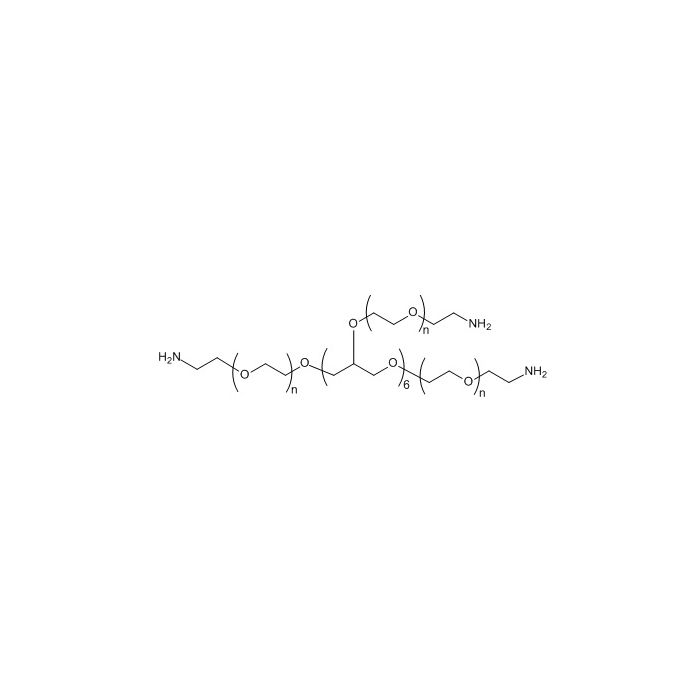
8-Arm PEG Amine is a star-shaped, multi-functional poly(ethylene glycol) (PEG) macromolecule bearing eight terminal primary amine groups for conjugation and crosslinking.
Item-specific identifiers
Molecular formula: Not specified for this item; refer to CoA/Spec Sheet.
Molecular weight (Mn or Mw): Not specified for this item; refer to CoA/Spec Sheet.
CAS, InChIKey, SMILES: Not applicable/Not specified for this polymeric material; refer to CoA/Spec Sheet.
Structural features (general, literature)
Core–arm architecture: A central core (commonly small polyol or dendritic core in literature) radiating eight PEG chains terminating in –NH2 groups. Exact core type for this item is not specified.
Functional groups: Polyether backbone [–CH2–CH2–O–]n and eight terminal primary amines (–CH2–CH2–NH2 or analogous link depending on spacer; exact spacer not specified).
Polymer descriptors: Star polymer; typically reported with number-average molecular weight (Mn) and dispersity (Đ). Values for this item are not specified.
2D structural description (general)
Central node linked to eight flexible PEG chains (repeating ethylene oxide units), each ending in a primary amine handle. No defined stereocenters; backbone is achiral and conformationally flexible.
Notes
As a macromolecule, conventional single-molecule identifiers (single SMILES/InChI) are not uniquely defined; characterization typically relies on Mn/Mw, Đ, end-group analysis, and NMR/FTIR.
Synthetic Utility
As an 8-functional primary amine scaffold, this material is a versatile hub for assembling complex architectures and networks.
Functional group reactivity (general)
Nucleophilicity: Primary amines add to activated carboxyls (NHS esters, anhydrides, acid chlorides), isocyanates/isothiocyanates, epoxides, and aldehydes/ketones (via imines) enabling diverse C–N bond formations.
Salt formation: Readily forms ammonium salts with acids to tune solubility and processability.
Polymer/materials synthesis
Network formation: Reaction with multi-functional electrophiles (di-/tri-/multi-NHS, epoxies, aldehydes) yields hydrogels/elastomers; gel point governed by functionality, stoichiometry (r), and conversion (p) consistent with Flory–Stockmayer theory (literature).
Star–star coupling: Builds high-MW architectures by linking to complementary multi-arm partners (e.g., 8-arm NHS-PEG) for dense networks.
Bioconjugation platform
Multivalent attachment to biomacromolecules for cluster effects or crosslinking in assay development. Control over substitution via limiting equivalents or protecting groups on a subset of arms.
Analytical characterization
End-group analysis by 1H/13C NMR after derivatization, TNBS or ninhydrin titration for amine content, SEC-MALS for Mn/Mw and Đ, FTIR for amide/urethane formation.
Practical notes
Use inert, dry conditions for moisture-sensitive electrophiles; pre-dry PEG under vacuum.
Verify DoF after reactions; incomplete functionalization can strongly impact mechanical properties and conjugate valency.
Target Specificity
Not applicable. This product is a synthetic polymeric reagent, not a biological affinity reagent (no antigen/epitope, clone, or isotype). No target specificity data are provided.
We use cookies to ensure the website functions properly and, where permitted, to improve your experience. You can manage your preferences at any time in Settings. Learn more in our Cookie Policy.
Shall we send you a message when we have discounts available?
Remind me later
Thank you! Please check your email inbox to confirm.
Products are supplied to verified businesses, institutions, and qualified professionals for research and development use only. Not for use in humans, animals, diagnosis, or therapy.
 A1831134
