This compound belongs to the class of organic compounds known as anthracenes. These are organic compounds containing a system of three linearly fused benzene rings.
External Descriptors
Not available
1. Djoumbou Feunang Y, Eisner R, Knox C, Chepelev L, Hastings J, Owen G, Fahy E, Steinbeck C, Subramanian S, Bolton E, Greiner R, and Wishart DS. ClassyFire: Automated Chemical Classification With A Comprehensive, Computable Taxonomy. Journal of Cheminformatics, 2016, 8:61.
Determine the necessary mass, volume, or concentration for preparing a solution.
Dilution Calculator
Determine the dilution needed to prepare a stock solution.
Reconstitution Calculator
Revisões
Avaliações dos Clientes
Application Protocols
No manufacturer-tested protocols are provided in the Product Data. Below are general, literature-style outlines for common uses; adjust to your system and consult primary sources.
Representative protocol: Singlet oxygen trapping with DMA (analytical scale)
Prepare a 10–100 µM solution of DMA in toluene or dichloromethane in a quartz cuvette or photoreactor vial. Protect stock from ambient light.
Add photosensitizer (e.g., Rose Bengal, 0.5–5 µM) and equilibrate the solution with oxygen (gentle O2 sparge or air saturation).
Irradiate at the sensitizer absorption maximum using a band-pass filter. Record spectral changes (UV–Vis decrease of anthracene bands; fluorescence quenching) or sample for NMR to detect endoperoxide.
Include dark and no-sensitizer controls. Avoid prolonged irradiation to limit secondary photo-products.
Dissolve DMA in toluene (0.05–0.1 M). Add NBS (1.1–2.0 equiv) and catalytic AIBN (5–10 mol%). Heat to 85–95 °C or irradiate with 365 nm LED under inert atmosphere.
Monitor by TLC/LC–MS for mono- vs bis-brominated products. Quench, filter off succinimide, and purify by column chromatography.
Note
These are general literature-style procedures for experienced chemists. Optimize conditions and consult the SDS. For research use only (per Product Data).
Biological Roles
Applicability
DMA is a synthetic PAH; it does not serve a natural biological role. This section focuses on how it is used in biochemical research systems (not medical/clinical claims).
Literature-based research context
Singlet oxygen reporting: DMA reacts selectively with singlet oxygen to form a 9,10-endoperoxide. This transformation can be tracked by UV–Vis/fluorescence changes, enabling quantitation of 1O2 production from photosensitizers in model biological media (with suitable organic co-solvents or micellar systems).
Photodynamic mechanism studies: DMA helps benchmark photosensitizer performance and oxygen dependence by providing a chemical sink for 1O2, allowing kinetic analysis of type II photooxidation pathways.
Membrane/micelle models: Due to its hydrophobicity, DMA partitions into lipid phases; researchers may use it in liposome or detergent micelles to probe localized 1O2 formation. Care must be taken to avoid cytotoxicity studies or biological exposure outside controlled in vitro systems.
Caveats
Solubility constraints in aqueous buffers often necessitate co-solvents, surfactants, or encapsulation, which themselves influence ROS dynamics.
Avoid extrapolating in vitro probe behavior to biological efficacy; DMA content here is strictly for research use only, as per Product Data.
Buffer Applications
Not typically applicable.
DMA is hydrophobic and essentially insoluble in water; it is not used as a buffer component. For experiments in buffered systems, DMA may be delivered via water-miscible co-solvents (e.g., small percentages of acetonitrile or ethanol) or encapsulated (micelles, liposomes), but the buffer itself is unrelated to DMA.
Refer instead to Solvent Selection and Reaction & Applications for guidance on using DMA in mixed solvent or colloidal systems.
Green Alternatives
Context
DMA is a PAH with low aqueous solubility and persistence concerns typical of aromatic hydrocarbons. Greener choices depend on the function you need (singlet oxygen trapping, fluorescence probe, or synthetic diene).
Alternatives by use case (literature; balance of pros/cons)
Singlet oxygen trapping
2,5-Dimethylfuran (bio-derived): Rapid 1O2 [4+2] cycloaddition; more biodegradable; volatile and flammable; products are less persistent.
Coumarin or fluorescein derivatives: Often used in greener, aqueous or alcoholic media; avoid PAH persistence. However, different photophysics and 1O2 chemistry.
Diene in Diels–Alder
Cyclopentadiene or bio-derived furans: Higher reactivity; less persistent; but different selectivity and thermal behavior.
Compact comparison (qualitative)
DMA: high photostability; strong fluorescence; hydrophobic; persistent PAH.
2,5-Dimethylfuran: renewable, fast 1O2 trap; lower persistence; high volatility, peroxide risk on storage.
ADPA: aqueous-compatible; larger, potentially more expensive; different readouts.
Greener practice with DMA
Use safer solvents (toluene, ethyl acetate, cyclopentyl methyl ether) instead of chlorinated when feasible.
Minimize mass used in screening; implement light shielding to prevent byproduct formation and waste.
Ensure proper waste segregation and avoid environmental release.
Pharmaceutical Uses
Not an excipient or active ingredient.
There are no pharmacopeial monographs for 9,10-dimethylanthracene to our knowledge. It is not employed as a formulation excipient. Content is provided strictly for research and development use (per Product Data: For research use only).
Research-adjacent utility (literature; not item specifications)
Reference standard: May be used as an internal or external reference in fluorescence instrument qualification or photostability studies due to characteristic emission in nonpolar media.
Photochemical controls: In process R&D, DMA can serve as a singlet oxygen trap to validate photosensitizer output in photoreactors, but it is not part of final pharmaceutical products.
Physical Properties
Item-specific (from Product Data)
Molecular formula: Not specified for this item; refer to CoA/Spec Sheet.
Molecular weight: Not specified for this item; refer to CoA/Spec Sheet.
Appearance: Not specified for this item; refer to CoA/Spec Sheet.
Literature/General values (indicative; not item specifications)
Melting point: commonly reported ~118–122 °C (literature)
Boiling point/decomposition: very high; thermal lability before true distillation; sublimation reported on heating under reduced pressure (literature)
Density: on the order of ~1.1 g/cm3 at 20–25 °C (literature)
Solubility: Insoluble in water; soluble in nonpolar and moderately polar organic solvents (toluene, benzene, chlorinated solvents, ethers). Solubility decreases in very polar protic media (literature)
Partitioning: Hydrophobic; high logP expected for PAHs of this size (literature)
Spectroscopy: Strong UV absorption (typical structured PAH bands) and blue fluorescence; useful as a fluorescence probe/standard in nonpolar solvents (literature)
Practical notes
Finely divided solids may show different apparent melting behavior due to fluorescence/absorption and heat transfer. Confirm lot-specific data on the CoA if you require strict specifications.
Quality and Grades
Item-specific (from Product Data)
Grade/Purity: Not specified for this item; refer to CoA/Spec Sheet.
Guidance on grades and what to check
If a “purity” or “grade” is stated on the CoA (e.g., ≥98%, ≥99%), it typically refers to area percent by GC/HPLC or assay by qNMR. For fluorescent PAHs such as DMA, low-level fluorescent impurities can affect photophysical measurements; chromatographic purity is often more critical than elemental analysis for spectroscopy work.
UV/Fluorescence suitability: HPLC or spectrophotometric grades generally control background absorbance/fluorescence. If you plan to use DMA as a fluorescence standard or 1O2 trap, request UV-Vis trace and impurity profile.
Stabilizers: None are listed in Product Data. If any stabilizer or inhibitor is used to mitigate photo-oxidation, it will be declared on the CoA. Absence of a stabilizer implies you should protect from light to avoid gradual formation of endoperoxides in air.
Lot-specific documents: For methods development or quantitative work, consult the CoA for exact assay method, residual solvents, and impurity limits. Where specific values are not provided here, they are Not specified for this item; refer to CoA/Spec Sheet.
Reaction and Applications
Manufacturer Applications (from Product Data)
Not specified.
Expanded, literature-based applications (for reference; not item specifications)
Singlet oxygen probe/trap: DMA undergoes a stereospecific [4+2] cycloaddition with 1O2 at the 9,10-positions to form a stable endoperoxide. This reaction is widely used to detect/quantify 1O2 generation in photochemical systems and to study sensitizer efficiency. The endoperoxide can thermally revert, enabling cyclic studies.
Pericyclic chemistry: Like anthracene, the 9,10-diene segment participates in Diels–Alder reactions with electron-deficient dienophiles (e.g., maleic anhydride). The two methyl groups modulate reactivity and sterics compared to anthracene.
Photophysics/fluorescence: DMA displays strong blue fluorescence in nonpolar media and can serve as a reference fluorophore or as a component in organic electronics studies (e.g., triplet–singlet energy transfer models).
Benzylic functionalization: The 9- and 10-methyls are benzylic. Radical bromination (e.g., NBS/AIBN or photochemical) affords bis(bromomethyl) derivatives useful as crosslinkable handles. Oxidations (e.g., to aldehydes/acids) expand derivatization space for materials.
Mechanistic probes: Because the 9,10 core is sensitive to oxygenation and cycloadditions, DMA is employed as a mechanistic “reporter” of reactive oxygen species in solution.
Practical tips
Protect DMA solutions from air and light during handling to avoid unintended endoperoxide formation in photosensitized systems.
For Diels–Alder work, remove oxygen (degassing) to suppress competing photo-oxidation; monitor by TLC/fluorescence quenching.
Reaction Conditions
General conditions from literature (guidance only; not item specifications)
Singlet oxygen trapping
Typical setup: Oxygenated solution of DMA with photosensitizer (e.g., Rose Bengal, meso-tetraphenylporphyrin). Solvents: toluene, dichloromethane, or acetonitrile/toluene mixtures. Temperature: 0–25 °C. Illumination at sensitizer absorption band; monitor by UV–Vis/fluorescence or NMR. Degas if you need dark controls; otherwise saturate with O2 for maximal rates.
Diels–Alder at 9,10-positions
Dienophiles: maleic anhydride, N-substituted maleimides, benzoquinone. Solvents: xylene, o-dichlorobenzene, chlorobenzene. Temperature: 80–180 °C depending on partner; hours to overnight. Often reversible—thermolysis liberates DMA.
Benzylic bromination of methyl groups
Reagents: NBS (1.1–2.2 equiv), radical initiator (AIBN or benzoyl peroxide), hv or reflux. Solvents: CCl4 (classic, less preferred), safer alternatives include MeCN, toluene, or benzotrifluoride with careful control. Temperature: 70–110 °C. Monitor for mono- vs bis-bromination.
Oxidation of benzylic methyls
Oxidants: KMnO4 (phase transfer), CAN, or catalytic systems (e.g., Co/Mn with oxygen). Solvents and temperatures vary; aim for controlled conditions to avoid ring oxidation.
Yields and workup
Yields depend strongly on substrate and conditions; pericyclic adducts often form in moderate to high conversion but can equilibrate. Benzylic functionalizations require careful stoichiometry and light/temperature control to manage selectivity.
Safety
Protect setups from unintended light if 1O2 chemistry is not desired; control oxygen carefully in radical processes.
Safety and Handling
Item-specific (from Product Data)
GHS classification, signal word, pictograms, H-Statements: Not specified for this item; refer to SDS.
Storage conditions: Room temperature (Product Data)
Shipping: Normal (Product Data)
General safety guidance (consult the SDS for authoritative instructions)
Hazard profile: 9,10-Dimethylanthracene (DMA) is a polycyclic aromatic hydrocarbon. PAHs are typically harmful if swallowed and irritating to skin/eyes; dust may be respiratory irritant. Many PAHs are hazardous to aquatic life. Avoid generating dust and environmental release.
Light/oxidant sensitivity: Anthracene derivatives can undergo photo-oxidation (notably singlet oxygen [4+2] cycloaddition to form endoperoxides). Minimize exposure to strong light and oxygen during photochemical work; use amber glass, inert gas purge when appropriate.
PPE: Wear safety glasses, lab coat, and appropriate chemically resistant gloves. Use local exhaust or fume hood to control dust and solvent vapors.
Incompatibilities: Strong oxidizers (risk of exothermic reaction/oxidation), halogenating agents, nitrating systems. Combustible; keep away from ignition sources.
First aid overview: Eyes—rinse cautiously with water for several minutes. Skin—wash with soap and water, remove contaminated clothing. Inhalation—move to fresh air; seek medical attention if symptoms persist. Ingestion—rinse mouth; do not induce vomiting; seek medical attention.
Spill response: Avoid dust formation, collect mechanically, and dispose in accordance with local regulations.
Waste: Treat as halogen-free organic aromatic waste unless your process introduces halogens; follow institutional and regional disposal requirements.
Solvent Selection
Applicability
DMA is a hydrophobic PAH solid; solvent choice is relevant for dissolution, spectroscopy, and pericyclic/photochemical reactions.
General solvent behavior (literature; not item specifications)
Polarity: Nonpolar aromatic hydrocarbon; dissolves well in aromatic solvents (toluene, xylene) and chlorinated solvents (CH2Cl2, CHCl3). Moderate solubility in ethers (THF, diethyl ether). Poor solubility in alcohols and negligible in water.
Dielectric considerations: For fluorescence or singlet-oxygen trapping, nonpolar solvents (cyclohexane, toluene) minimize solvatochromic shifts and quenching. More polar solvents can influence intersystem crossing of sensitizers rather than DMA directly.
Photochemistry: For 1O2 trapping, oxygen solubility of the solvent matters—use solvents with good O2 solubility (e.g., toluene, CH2Cl2) and that are transparent at the excitation wavelength of the photosensitizer.
When to choose what
Spectroscopy/quantum yield standards: Cyclohexane or toluene provide low background and stable fluorescence.
Synthesis (Diels–Alder or benzylic functionalization): High-boiling aromatics (xylene, o-dichlorobenzene) or chlorinated solvents for moderate temperatures; ethers for radical chemistry if compatible.
Quick comparison (literature trends)
Toluene: good solubility; inert; suitable for photochemistry.
CH2Cl2: excellent solubility; easy removal; good for room-temp photo-oxidations.
THF: moderate solubility; peroxide-former—monitor in photochemical work.
Acetonitrile: limited solubility; used if pairing with polar photosensitizers; consider co-solvent.
Storage and Reconstitution
Item-specific (from Product Data)
Storage conditions: Room temperature.
Shipped in: Normal conditions.
General handling recommendations (not item specifications)
Protect from light: Anthracene derivatives can photo-oxidize; store in amber bottles or protect from UV/strong visible light, especially for long-term storage or if frequent opening is expected.
Atmosphere: For sensitive photochemical studies, consider storing under inert gas or minimizing headspace oxygen to reduce slow endoperoxide formation; however, this is not required by Product Data.
Solid handling: Keep container tightly closed in a dry place. Avoid grinding to fine powders that increase dusting and photoreactivity.
Reconstitution/dissolution: Prepare solutions in suitable organic solvents (see Solvent Selection). For analytical use, filter solutions (PTFE syringe filter) to remove particulates. Prepare fresh solutions for photochemical experiments to ensure consistent baseline.
Freeze–thaw: Not applicable to solids; if solutions are stored, use amber vials at low temperature and avoid repeated thaw cycles to limit degradation.
Documentation
For any lot-specific stability or impurity information, consult the CoA/Spec Sheet. Where values are not provided above, they are Not specified for this item; refer to CoA/Spec Sheet.
Structure and Identity
Item-specific (from Product Data)
Product: 9,10-Dimethylanthracene (SKU: D106357)
CAS: 781-43-1; PubChem CID: 13076
InChIKey: Not specified for this item; refer to CoA/Spec Sheet. (Product Data lists: 169485, which is not a standard InChIKey format; see CoA.)
SMILES: Not specified for this item; refer to CoA/Spec Sheet.
Literature/General description (for reference; not item specifications)
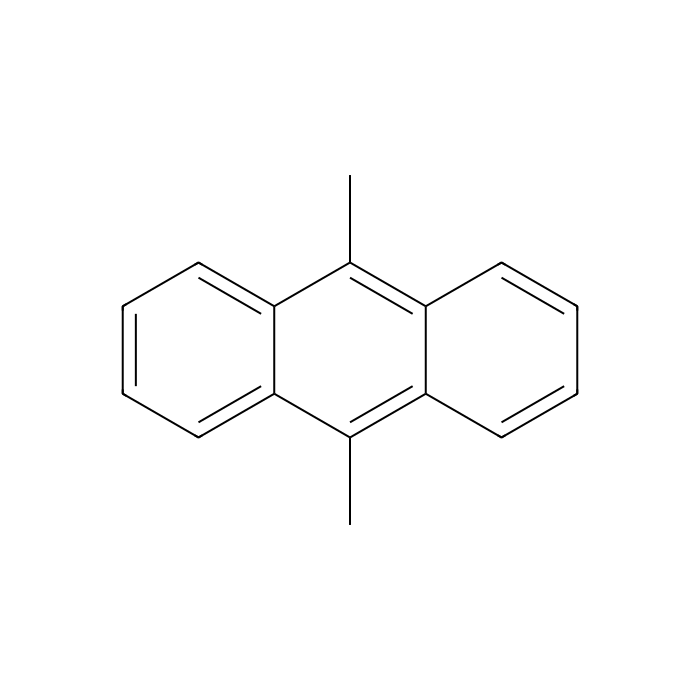
Compound class: Polycyclic aromatic hydrocarbon (PAH); anthracene core bearing two methyl substituents at the 9- and 10-positions (central ring).
Structural features: Three linearly fused benzene rings; planar, fully conjugated π-system; two benzylic methyl groups at the bridgehead-like 9,10 positions. Aromatic sextets delocalized across the framework; 9,10 positions act as a reactive diene site in pericyclic additions.
2D description in words: An anthracene backbone (three fused rings in a straight row) with one –CH3 on each of the two central ring carbons (positions 9 and 10), opposite each other across the short axis of the middle ring.
Notes
Research use only (per Product Data). Always confirm structural identifiers (SMILES/InChIKey) on the CoA or SDS for the shipped lot.
Synthetic Utility
Literature-based reactivity profile (for reference; not item specifications)
Diene character: The 9,10 positions of anthracene behave as a conjugated diene; DMA participates in Diels–Alder reactions with electron-poor dienophiles. Methyl substituents tune reactivity and can impart steric bias.
Benzylic handles: The 9- and 10-methyl groups enable:
Radical bromination (NBS/AIBN or photochemical) to furnish 9,10-bis(bromomethyl)anthracene—useful for polymer crosslinkers or further nucleophilic substitutions.
Oxidation to aldehydes/acids (e.g., via chromium-free conditions like TEMPO/hypohalite or benzylic C–H oxidation catalysts), creating linkers.
Dehydrogenation/benzylic functionalization under photoredox catalysis to diversify substituents.
Endoperoxide chemistry: Controlled formation and thermolysis of the 9,10-endoperoxide provides access to oxygenated anthracene frameworks and can act as an O2 carrier model.
Electrophilic substitution: The outer rings of anthracenes are activated toward EAS at 1,5,8 positions; methyl groups modestly influence directing/activation patterns for halogenation or Friedel–Crafts acylation.
Retrosynthetic value
DMA is a versatile midpoint: either elaborate the benzylic sites to append functionality or exploit the anthracene π-system for pericyclic assembly. It frequently appears in materials chemistry syntheses where rigid, fluorescent scaffolds are desired.
Target Specificity
Not applicable.
This product is a small-molecule PAH, not a biological targeting reagent, antibody, or inhibitor. There are no antigen/epitope or isotype details to report. For its use as a chemical probe of singlet oxygen, see Reaction & Applications and Application Protocols.
Perguntas frequentes
What is the purity of this product?
This product is supplied at ≥94% purity (chemical assay). Lot-specific values are stated on the Certificate of Analysis.
How should this product be stored?
Store at room temperature.
How is this product shipped?
This product ships under standard ambient conditions. No temperature-controlled packaging is required.
What are the CAS number, molecular formula and molecular weight?
The CAS Number is 781-43-1, the molecular formula is C16H14, and the molecular weight is 206.28 g/mol. InChIKey JTGMTYWYUZDRBK-UHFFFAOYSA-N.
What documentation is provided?
Available product documentation, including Certificates of Analysis (COA), Safety Data Sheets (SDS), and specification sheets, is shown in the product document area. Document availability and access follow the current site policy.
Usamos cookies para garantir o funcionamento adequado do site e, quando permitido, para melhorar a sua experiência. Você pode gerenciar suas preferências a qualquer momento nas Configurações. Saiba mais em nossa Política de Cookies.
Deseja que lhe enviemos uma mensagem quando tivermos descontos disponíveis?
Lembrar-me mais tarde
Obrigado! Por favor, verifique a sua caixa de entrada de e-mail para confirmar.
Products are supplied to verified businesses, institutions, and qualified professionals for research and development use only. Not for use in humans, animals, diagnosis, or therapy.

 D2607214