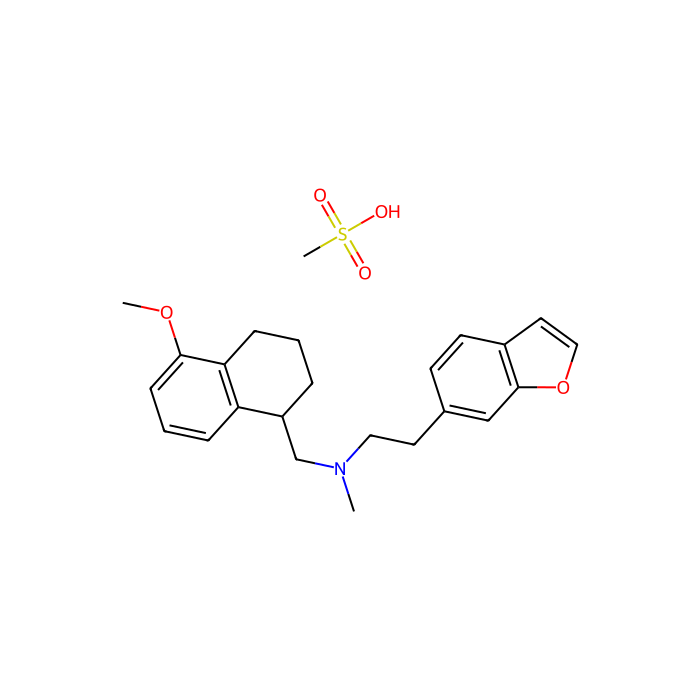
High affinityα2-adrenoceptor antagonist and selective 5-HT uptake inhibitor (Kivalues are 2.01 and 3.77 nM respectively). Displays low affinity at a variety of structurally homologous GPCRs.
Condições de armazenamento de armazenamento
Store at 2-8°C,Desiccated
Enviado em
Wet ice
Este produto requer transporte de cadeia fria. Serviços terrestres e outros serviços econômicos não estão disponíveis.
This compound belongs to the class of organic compounds known as tetralins. These are polycyclic aromatic compounds containing a tetralin moiety, which consists of a benzene fused to a cyclohexane.
External Descriptors
Not available
1. Djoumbou Feunang Y, Eisner R, Knox C, Chepelev L, Hastings J, Owen G, Fahy E, Steinbeck C, Subramanian S, Bolton E, Greiner R, and Wishart DS. ClassyFire: Automated Chemical Classification With A Comprehensive, Computable Taxonomy. Journal of Cheminformatics, 2016, 8:61.
Solvent:water, Max Conc. mg/mL: 4.46, Max Conc. mM: 10; Solvent:DMSO, Max Conc. mg/mL: 44.56, Max Conc. mM: 100
Peso molecular
445.600 g/mol
XLogP3
Hydrogen Bond Donor Count
1
Hydrogen Bond Acceptor Count
6
Rotatable Bond Count
6
Exact Mass
445.192 Da
Monoisotopic Mass
445.192 Da
Topological Polar Surface Area
88.400 Ų
Heavy Atom Count
31
Formal Charge
0
Complexity
534.000
Isotope Atom Count
0
Defined Atom Stereocenter Count
1
Undefined Atom Stereocenter Count
0
Defined Bond Stereocenter Count
0
Undefined Bond Stereocenter Count
0
The total count of all stereochemical bonds
0
Covalently-Bonded Unit Count
2
Calculadoras de soluções
Molarity Calculator
Determine the necessary mass, volume, or concentration for preparing a solution.
Dilution Calculator
Determine the dilution needed to prepare a stock solution.
Reconstitution Calculator
Revisões
Avaliações dos Clientes
Application Protocols
Item-specific (from Product Data)
Tested applications, recommended dilutions, and positive controls: Not specified for this item; refer to CoA/Spec Sheet.
General recommendations for small-molecule screening (literature/general)
Stock preparation: dissolve in DMSO to 10 mM; vortex and, if needed, sonicate briefly. Filter-sterilize for cell assays.
Plating: dispense by acoustic transfer or pin tools to achieve final DMSO ≤0.5–1% v/v. Include matched vehicle controls.
Serial dilution: perform in polypropylene plates to minimize adsorption; use assay buffer with 0.01–0.05% nonionic surfactant (e.g., Tween 20 or Pluronic F-68) if aggregation is suspected.
Stability checks: confirm integrity by LC–MS after assay incubation conditions (time/temperature) to ensure the parent compound remains intact.
Data reporting: specify salt form, stock solvent, and final solvent percentage; report concentrations as free-base equivalents when possible.
These are generic protocols intended to complement, not replace, lot-specific guidance from the CoA/SDS.
Biological Roles
Item-specific (from Product Data)
Target, pathway, and mode of action: Not specified for this item; refer to CoA/Spec Sheet and primary literature specific to “A 80426.”
General context for small-molecule salts (literature/general)
Many “A-XXXX” series compounds are catalogued bioactive molecules used as reference ligands or modulators in receptor, ion-channel, enzyme, or transporter studies. The mesylate counterion is pharmacologically inert and primarily influences physicochemical properties (solubility, crystallinity) rather than intrinsic biological activity.
Biological role in assays: typically serves as a probe to interrogate signaling pathways, validate targets, or benchmark assay performance.
Data reporting: when publishing biological potencies (IC50/EC50/Ki), clearly indicate the salt form used and whether concentrations are expressed as salt mass or free-base equivalents to ensure comparability across studies.
Formulation for in vitro studies (general)
Prepare sterile-filtered stock solutions (DMSO or aqueous, as solubility allows) and maintain final DMSO ≤0.5–1% to minimize solvent effects on cells.
Evaluate stability in assay buffer (time-course LC–MS) to rule out rapid hydrolysis or adsorption to plastics.
No clinical or therapeutic claims are made for this product. It is supplied strictly for research use only, as stated in the Product Data.
Buffer Applications
This product is not a buffering reagent and is not intended to define or maintain solution pH.
Item-specific (from Product Data)
No buffer-system guidance is provided.
Practical notes (general)
When used in biochemical or cell-based assays, prepare in a compatible buffer (e.g., PBS, HEPES, Tris) selected for your biological system. The mesylate salt form often dissolves more readily in neutral aqueous buffers than the free base would.
Verify that the chosen buffer does not interact with the compound (e.g., amine-reactive buffers for compounds containing reactive electrophiles). Since the structure is not specified, perform a small compatibility test.
Maintain consistent ionic strength and pH across control and treated samples. Include vehicle controls if using organic cosolvents (e.g., DMSO at matched percentages).
For details such as pH range and recipes of common buffers, refer to standard buffer preparation references; these are external to this item.
Green Alternatives
For this small-molecule salt, the principal environmental consideration is solvent choice during handling and analysis rather than substitution of the active itself.
Item-specific (from Product Data)
No green-specific guidance or restrictions are provided.
Greener solvent choices for common operations (general)
Stock preparation: consider water or buffered saline if solubility permits; ethanol can be a greener alternative to DMF. DMSO, while not “green,” is acceptable with low toxicity and ready biodegradability data; use minimal volumes.
Chromatography: aqueous acetonitrile with formic acid or ammonium formate is standard; consider methanol in place of acetonitrile when method performance allows.
Work-up/conversion (if freeing base): use aqueous bicarbonate and minimal organic solvent (EtOAc or 2-MeTHF) rather than chlorinated solvents.
Comparison snapshot (general)
DMSO vs DMF: DMSO preferred for lower toxicity and easier handling; DMF is a reproductive toxin and should be avoided where possible.
2-MeTHF/EtOAc vs DCM: 2-MeTHF and ethyl acetate offer better environmental profiles than dichloromethane for extractions of liberated free bases.
Waste minimization
Prepare single-use aliquots to avoid repeated thawing and disposal of partially used solutions.
Employ microscale assay formats (384/1536-well) to reduce solvent consumption.
These are general recommendations; validate solvent substitutions with your assay performance criteria.
Pharmaceutical Uses
Item-specific (from Product Data)
No pharmacopeial status or excipient role is specified for this item; it is labeled For research use only.
General notes on mesylate salts in pharmaceutical science (literature/general; not claims for this item)
Methanesulfonate (mesylate) salts are frequently employed during drug development to enhance crystallinity, improve aqueous solubility, and enable consistent solid-state forms for manufacturing.
Typical development activities include salt screening, polymorph selection, and evaluation of hygroscopicity—parameters that can influence bioavailability and stability profiles of candidate APIs.
For preclinical formulation development (in vitro/in vivo research only), mesylate salts may allow simpler aqueous vehicles (e.g., saline with minimal cosolvent). Nevertheless, confirm osmolality and pH suitability for the biological system under study.
Compliance and restrictions
This product is not intended for human or veterinary use, diagnostics, or clinical applications. No therapeutic or clinical claims are made.
If used as a reference standard in regulated environments, qualify against an internal primary standard and document purity, potency, and salt equivalence per your quality system.
Consult the lot-specific CoA for any available characterization supportive of research-only applications.
Physical Properties
Item-specific (from Product Data)
Appearance: Not specified for this item; refer to CoA/Spec Sheet.
Molecular weight: Not specified for this item; refer to CoA/Spec Sheet.
Not provided (do not treat as specifications for this item)
Melting point, boiling point, density, refractive index, UV cutoff, water/peroxide/metal limits: Not specified for this item; refer to CoA/Spec Sheet.
General expectations for mesylate salts (literature/general; not item specifications)
Physical state: often a crystalline solid; many mesylate salts are hygroscopic to mildly hygroscopic.
Solubility: mesylate salts commonly show improved solubility in polar media (water, aqueous buffers, methanol, ethanol) and excellent solubility in DMSO; exact values depend on the cation and are not provided here.
Ionization: as salts of basic amines, they exist predominantly as cation–anion pairs in water; pKa of the conjugate acid/base pair depends on the parent amine and is not available for this item.
Partitioning: conversion to a mesylate typically lowers apparent logP vs the free base in aqueous systems; no numeric logP/logD available for this item.
Practical handling implications (general)
Hygroscopic tendency suggests storing desiccated, minimizing open-air exposure, and equilibrating in a dry box when weighing.
When preparing analytical solutions, record the exact salt form to report concentrations on a free-base- or salt-equivalent basis as required.
Quality and Grades
Item-specific (from Product Data)
Grade/purity: Not specified for this item; refer to CoA/Spec Sheet.
Research use note: For research use only.
What the absence of a stated grade implies (general guidance)
Without a declared grade (e.g., “analytical,” “HPLC,” or “bioactive screening grade”), end-users should verify suitability via the CoA/SDS and, when necessary, perform incoming QC (HPLC/UPLC purity, NMR identity, water content by KF, residual solvents, and salt stoichiometry).
For bioactive small molecules, documenting salt form and counterion equivalence is essential for dose reporting. Confirm whether content is reported as free-base equivalents or salt mass.
Stabilizers/antioxidants
No stabilizers are listed for this item. If your application is oxidation-sensitive, consider nitrogen backfill and amber containment as standard good practice. Any stabilizer presence would be declared on the CoA; none is specified here.
Practical QC recommendations (general)
Identity: 1H/13C NMR and HRMS; confirm mesylate presence via characteristic 1H singlet near 3 ppm (–SO3CH3) and sulfate signals in 13C.
Purity: HPLC at multiple wavelengths; check for counterion-related late/early eluters; LC–MS for mass balance.
Solid-state: XRPD or DSC for polymorph assessment if reproducibility in assays is critical.
Always defer to the lot-specific CoA for definitive grade, purity, and analytical acceptance criteria.
Reaction and Applications
Item-specific (from Product Data)
Manufacturer applications: Not specified for this item; refer to CoA/Spec Sheet.
Research application context (general for bioactive mesylate salts)
Primary use: small-molecule reference standard or screening probe in biochemical and cell-based assays. Typical workflows include target engagement studies, functional readouts, and SAR comparisons if analog series are available.
Analytical applications: use as a calibrant or positive control in LC–MS/MS quantification methods (method development requires knowledge of UV/ESI response; not specified here).
Not typically used as a reagent in synthesis
Mesylate salts of amines are infrequently used directly as synthetic reagents. If the free base is needed for organic transformations (e.g., coupling, alkylation), it is commonly liberated by basification and extraction.
Practical assay tips (general)
Prepare concentrated DMSO stocks (e.g., 10 mM), dispense via acoustic or pin tools to minimize DMSO carryover.
Confirm solubility at working concentrations in your assay buffer; include vehicle controls (DMSO only). Monitor for aggregation artifacts using detergent controls or orthogonal readouts when feasible.
Track salt form carefully when reporting IC50/EC50 values to maintain comparability across lots.
For target-specific applications of “A 80426,” consult primary literature or the CoA; target details are not provided in the Product Data.
Reaction Conditions
This product is not supplied as a general synthetic reagent, and no reaction conditions are provided in the Product Data.
Item-specific (from Product Data)
Reaction conditions: Not specified for this item; refer to CoA/Spec Sheet.
General operations relevant to salt handling (literature/general)
Free-base liberation (if required): dissolve the mesylate salt in minimal water; basify to pH 9–11 with NaHCO3/Na2CO3; extract with EtOAc or 2-MeTHF; dry (Na2SO4) and use the free base immediately in anhydrous organic solvent. Keep temperatures ambient to avoid base-catalyzed degradation of sensitive scaffolds.
Re-salting: dissolve the free base in anhydrous ether/EtOH and add methanesulfonic acid (MsOH) in ether dropwise at 0–5°C; isolate the mesylate salt as a solid. This is general guidance and must be tailored to the specific structure’s stability.
Analytical/assay solution preparation (general)
DMSO stock: 10–50 mM, sterile-filtered (0.22 µm); store aliquots at ≤–20°C to minimize degradation from repeated freeze–thaw.
Aqueous working solutions: prepare fresh; verify absence of precipitation at working concentrations over the assay timeframe.
These generalized conditions are not specifications for this item; validate experimentally with small-scale trials.
Safety and Handling
Item-specific (from Product Data)
Storage conditions: Store at 2–8°C, desiccated.
Shipped on: Wet ice.
GHS classification, signal word, pictograms, H-statements: Not specified for this item; refer to SDS.
General precautions (literature/general; always defer to SDS)
Personal protective equipment: laboratory coat, safety glasses or face shield, and appropriate disposable gloves (e.g., nitrile). Use in a fume hood to avoid inhalation of dust/aerosols.
Avoid contact with skin, eyes, and clothing. Prevent ingestion and inhalation. Wash thoroughly after handling.
Spill/accidental release: avoid raising dust; collect with inert absorbent, place in a suitable container for disposal per local regulations.
Fire fighting: many organic salts are combustible; use CO2, dry chemical, or foam as appropriate. Thermal decomposition can form SOx and other irritants.
Incompatibilities: strong oxidizers and strong bases/acids may degrade the organic cation or the methanesulfonate counterion; avoid moisture for hygroscopic salts.
First-aid overview (general)
Inhalation: move to fresh air; seek medical attention if symptoms occur.
Skin/eye contact: rinse with water for at least 15 minutes; remove contaminated clothing; obtain medical advice if irritation persists.
Ingestion: rinse mouth; do not induce vomiting; seek medical attention.
Consult the Safety Data Sheet (SDS) for authoritative hazard classification, exposure limits, and disposal guidance for this specific item.
Solvent Selection
Because this product is a mesylate salt of an organic base, dissolution behavior generally favors polar solvents.
Item-specific (from Product Data)
No solvent recommendations are specified for this item; refer to CoA/Spec Sheet.
General selection guidance (literature/general)
Stock solutions for screening: DMSO is commonly used for 10–50 mM stocks due to broad solubilizing power and compatibility with biological assays at low final DMSO percentages (≤0.5–1%).
Aqueous media: the mesylate form often improves water/buffer solubility versus the free base. If needed, gentle warming and sonication can help; avoid high pH that may free the base and reduce solubility.
Alcohols: methanol or ethanol can be effective co-solvents. For LC analysis, acetonitrile/water with acid modifier (e.g., 0.1% formic acid) is typical.
Less suitable media: nonpolar solvents (hexanes, toluene) generally provide poor solubility for salts; if the free base is required for organic reactions, convert the salt under controlled conditions (see Synthetic Utility).
Polarity and dielectric context (general)
Polar aprotic (DMSO, DMF, acetonitrile): high solvating power for ionic species.
Polar protic (water, methanol, ethanol): often good for mesylates; watch for hydrolytic sensitivity of the parent cation (unknown for this item).
Practical tips
Filter 0.22 µm prior to cell-based assays.
Prepare single-use aliquots to avoid precipitation upon repeated freeze–thaw.
Record concentrations as salt or free-base equivalents consistently.
Storage and Reconstitution
Item-specific (from Product Data)
Storage: Store at 2–8°C, desiccated.
Shipping: Wet ice.
General good practices for mesylate salts (literature/general)
Hygroscopicity: minimize exposure to ambient humidity. Allow the sealed container to equilibrate to room temperature before opening to prevent condensation.
Light/air: if the compound is light-sensitive (not specified here), store in amber vials under inert gas. In the absence of item-specific data, protecting from light is a prudent precaution.
Reconstitution (general)
Solvents: DMSO is recommended for concentrated stocks (e.g., 10–50 mM). If water/buffer solubility is adequate, prepare aqueous stocks fresh and filter (0.22 µm) for sterile applications.
Aliquoting: prepare single-use aliquots to avoid repeated freeze–thaw. Label aliquots clearly with concentration, solvent, date, and salt/free-base basis.
Storage of solutions: DMSO stocks can typically be kept at –20°C to –80°C; avoid frost-free freezers that cycle temperatures. Aqueous working solutions should be prepared immediately before use unless stability has been verified.
Stability
Formal shelf-life, degradation pathways, and solution stability: Not specified for this item; refer to CoA/Spec Sheet and SDS.
Always consult the lot-specific CoA for any additional storage and handling instructions unique to this product.
Structure and Identity
A 80426 mesylate is supplied as a research-use small-molecule salt entry; detailed structure identifiers are not fully provided in the Product Data.
Item-specific (from Product Data)
SKU: A288175
Product name: A 80426 mesylate
CAS: 152148-64-6
PubChem CID: 10366248
InChIKey: 318888 (as provided; consult COA/SDS for the complete identifier)
Molecular formula: Not specified for this item; refer to CoA/Spec Sheet.
Molecular weight: Not specified for this item; refer to CoA/Spec Sheet.
SMILES: Not specified for this item; refer to CoA/Spec Sheet.
General chemistry notes (literature/general)
“Mesylate” denotes the methanesulfonate salt (–OSO2CH3−) of a basic compound, most commonly a protonated amine. The salt form typically enhances aqueous solubility and solid-state stability versus the corresponding free base.
Structural features for mesylate salts usually include: a cationic organic moiety (e.g., protonated tertiary or secondary amine) paired with the methanesulfonate anion. Without the base structure, ring systems/functional groups cannot be specified.
2D description (general template for mesylates)
Organic cation: unknown scaffold (not specified).
Counterion: methanesulfonate anion (CH3–SO3−).
Please consult the Certificate of Analysis (CoA) for definitive identifiers (full InChIKey, exact MF/MW, and structural representation) of this specific lot.
Synthetic Utility
Item-specific (from Product Data)
No synthetic reactivity or functional-group details are provided for this item.
General considerations for mesylate salts of amines (literature/general)
Direct use in synthesis: aminium mesylate salts are typically not nucleophilic; to employ the parent amine in coupling or alkylation, first liberate the free base by basification (e.g., aqueous NaHCO3/Na2CO3) and extract into an organic solvent (e.g., EtOAc, MTBE, 2-MeTHF). Dry and use promptly.
Stoichiometry: confirm the salt ratio (mono- vs di-mesylate for polyamines) by NMR or titration to calculate equivalents accurately in subsequent reactions.
Purification: if converting back to a salt for isolation, choose a non-nucleophilic acid (HCl, HBr, TsOH, MsOH) suitable for the target’s stability and crystallinity.
Analytical verification
1H NMR: mesylate typically shows a singlet near δ ~3.0 ppm (–SO3CH3). Quantify the integral to assess salt stoichiometry.
Ion chromatography or argentometric titration can quantify anion content if needed.
Without the explicit structure of “A 80426,” further retrosynthetic or transformation-specific advice cannot be provided for this item.
Target Specificity
Item-specific (from Product Data)
Target/epitope, species reactivity, clone/isotype: Not applicable; this product is a small-molecule salt, not a biological macromolecule.
Specific molecular target for “A 80426”: Not specified for this item; refer to CoA/Spec Sheet and primary literature.
No additional target-binding or selectivity information is available in the provided Product Data.
We use cookies to ensure the website functions properly and, where permitted, to improve your experience. You can manage your preferences at any time in Settings. Learn more in our Cookie Policy.
Shall we send you a message when we have discounts available?
Remind me later
Thank you! Please check your email inbox to confirm.
Products are supplied to verified businesses, institutions, and qualified professionals for research and development use only. Not for use in humans, animals, diagnosis, or therapy.