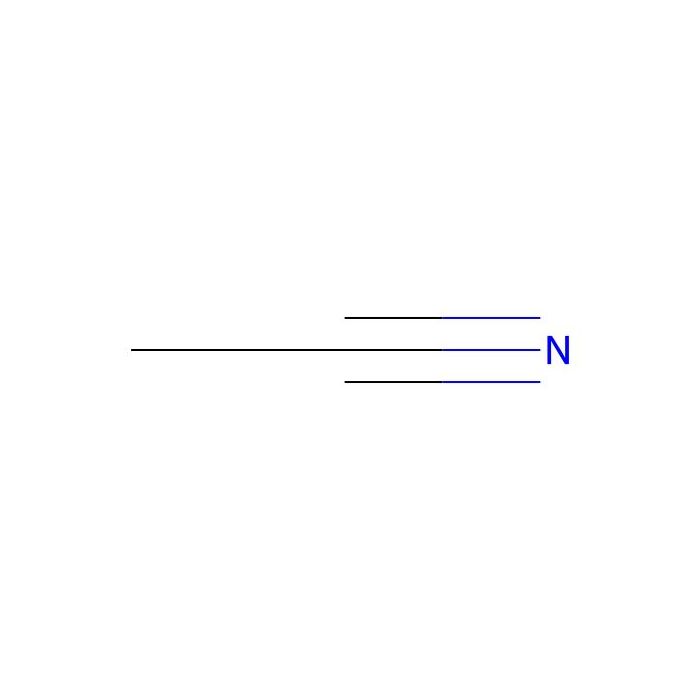
Acetonitrile(ACN) - PureSpectra™, Spectrum pure, ≥99.8% , CAS No.75-05-8

CAS: 75-05-8 Cat. No.: A104444 Fórmula: C2H3N Peso molecular: 41.05 Beilstein Registry Number: 741857 Número CE: 200-835-2
Disponível para encomenda
GRADE & PURITY PureSpectra™ ? PureSpectra™ — Aladdin's premium line for spectroscopy applications. Use where low spectral background ensures clean UV/Vis/IR measurements. Spectrum pure ? Spectrum-pure grade with impurities controlled to a spectroscopically clean baseline. Use for spectroscopy where background signals must be minimal. ≥99.8%
Synonyms
ACN | Acetonitril (GERMAN, DUTCH) | ACETONITRILE | ace-tonitrile | aceto-nitrile | acetonitrile- | DTXCID909 | acetonitnle | Acetonitrile 1000 microg/mL in Methanol | Acetonitrile, puriss., 95% | Acetonitrile, Environmental Grade | Acetonitrile, for DNA s
Storage
Room temperature
Shipped In
FedEx DG Service
★
Size
Alemanha (EU)
USA*
Price
Qty
500ml
A104444-500ml
—
6 Em stock

24,21€

36,36€
Gravar 12,15 € (33.41%)
Enter a quantity for the sizes you want to add.
🧪
Why this grade

PureSpectra™, Spectrum pure, ≥99.8% PureSpectra™,Spectrum pure for sensitive chromatographic and analytical workflows requiring minimal baseline interference.

🌡

Storage & shipping

Room temperature Ships FedEx DG Service Check lot-specific COA for exact specifications.

📋

Quality documents

SDS, COA, datasheet, and spec sheet available for download. Lot-specific COA accessible via lot number lookup.

📚

Literature proof

Cited in 3316 peer-reviewed publications across chromatography, organic synthesis, and cross-coupling reactions.

Specifications

Sinónimos
ACN | Acetonitril (GERMAN, DUTCH) | ACETONITRILE | ace-tonitrile | aceto-nitrile | acetonitrile- | DTXCID909 | acetonitnle | Acetonitrile 1000 microg/mL in Methanol | Acetonitrile, puriss., 95% | Acetonitrile, Environmental Grade | Acetonitrile, for DNA s
Especificações e pureza
PureSpectra™, Spectrum pure, ≥99.8%
Condições de armazenamento de armazenamento
Room temperature
Enviado em
FedEx DG Service
Grau
PureSpectra™, Spectrum pure
Pureza
≥99.8%
Nomes e identificadores
Pubchem Sid
Pubchem Sid Url
https://pubchem.ncbi.nlm.nih.gov/substance/508811846
Sorrisos canónicos
CC#N
IUPAC Name
acetonitrile
InChIKey
WEVYAHXRMPXWCK-UHFFFAOYSA-N
INCHI
1S/C2H3N/c1-2-3/h1H3
SMILES isoméricas
CC#N
WGK Alemanha
2
Número UN
1648
Grupo de embalagem
II
Peso molecular
41.05
Beilstein
741857

Documentation

📋 Safety Data Sheet (SDS)

Comprehensive hazard, handling, storage, and regulatory compliance document.

Download SDS →

✅ Certificate of Analysis (COA)

Lot-specific quality data. Enter your lot number to retrieve the exact COA.

Look up COA →

📊 Datasheet

Quick-reference summary of product specifications and applications.

View datasheet →

🔬 Specification Sheet

Full quality attributes and acceptance criteria for this grade.

View spec sheet →

Advanced Data

Taxonomic Classification

Taxonomy Tree

KingdomOrganic compounds
SuperclassOrganic nitrogen compounds
ClasseOrganonitrogen compounds
SubclassOrganic cyanides
Intermediate Tree Nodes Not available
Direct ParentNitriles
Alternative Parents Organopnictogen compounds  Hydrocarbon derivatives  
Molecular FrameworkAliphatic acyclic compounds
Substituents Nitrile - Carbonitrile - Organopnictogen compound - Hydrocarbon derivative - Aliphatic acyclic compound
DescriçãoThis compound belongs to the class of organic compounds known as nitriles. These are compounds having the structure RC#N; thus C-substituted derivatives of hydrocyanic acid, HC#N.
External Descriptors aliphatic nitrile
Estrutura 3D
Modelo de Estrutura Química Interativa


Alvos associados (não humanos)
Nfe2l2 Nuclear factor erythroid 2-related factor 2 (214 Activities)
Activity TypeRelationActivity valueUnitsAction TypeJournalPubMed IddoiAssay Aladdin ID
Mecanismos de ação
Certificados(CoA,COO,BSE/TSE e Mapa de Análise)
C of A & Other Certificates(BSE/TSE, COO):
Analytical Chart:

Find and download the COA for your product by matching the lot number on the packaging.

44 results found

Lot NumberCertificate TypeDataItem
G2623423Certificate of AnalysisJun 30, 2026 A104444
G2623415Certificate of AnalysisJun 30, 2026 A104444
G2616590Certificate of AnalysisJun 30, 2026 A104444
G2616591Certificate of AnalysisJun 30, 2026 A104444
G2616589Certificate of AnalysisJun 30, 2026 A104444
G2203010Certificate of AnalysisApr 03, 2026 A104444
A2621206Certificate of AnalysisJan 09, 2026 A104444
A2621217Certificate of AnalysisJan 09, 2026 A104444
A2621218Certificate of AnalysisJan 09, 2026 A104444
A2621219Certificate of AnalysisJan 09, 2026 A104444
F2610081Certificate of AnalysisJan 09, 2026 A104444
F2525191Certificate of AnalysisJun 17, 2025 A104444
F2525181Certificate of AnalysisJun 17, 2025 A104444
F2525189Certificate of AnalysisJun 17, 2025 A104444
L2418651Certificate of AnalysisDec 10, 2024 A104444
L2418632Certificate of AnalysisDec 10, 2024 A104444
I2404084Certificate of AnalysisAug 23, 2024 A104444
I2404083Certificate of AnalysisAug 23, 2024 A104444
I2404066Certificate of AnalysisAug 23, 2024 A104444
A2415033Certificate of AnalysisJan 04, 2024 A104444
A2415034Certificate of AnalysisJan 04, 2024 A104444
A2415035Certificate of AnalysisJan 04, 2024 A104444
L2320194Certificate of AnalysisDec 15, 2023 A104444
E2317073Certificate of AnalysisMay 04, 2023 A104444
E2317068Certificate of AnalysisMay 04, 2023 A104444
J2307161Certificate of AnalysisMay 04, 2023 A104444
E2317065Certificate of AnalysisMay 04, 2023 A104444
E2317059Certificate of AnalysisMay 04, 2023 A104444
K2201256Certificate of AnalysisNov 03, 2022 A104444
K2201125Certificate of AnalysisNov 03, 2022 A104444
J2220122Certificate of AnalysisOct 27, 2022 A104444
J2220121Certificate of AnalysisOct 27, 2022 A104444
J2220107Certificate of AnalysisOct 27, 2022 A104444
J2220123Certificate of AnalysisOct 24, 2022 A104444
J2209018Certificate of AnalysisOct 11, 2022 A104444
J2209017Certificate of AnalysisOct 11, 2022 A104444
H2202037Certificate of AnalysisAug 04, 2022 A104444
H2202033Certificate of AnalysisAug 03, 2022 A104444
G2203009Certificate of AnalysisJul 06, 2022 A104444
G2203011Certificate of AnalysisJul 06, 2022 A104444
G2203012Certificate of AnalysisJul 06, 2022 A104444
D2230231Certificate of AnalysisMay 04, 2022 A104444
C2226668Certificate of AnalysisMar 29, 2022 A104444
C2226682Certificate of AnalysisMar 29, 2022 A104444
Propriedades químicas e físicas
Índice de refração1.343-1.345
Ponto de inflamação (°C)2 °C
Ponto de ebulição (°C)81-82°C
Ponto de fusão (°C)-46°C
Peso molecular41.050 g/mol
XLogP30.000
Hydrogen Bond Donor Count0
Hydrogen Bond Acceptor Count1
Rotatable Bond Count0
Exact Mass41.0265 Da
Monoisotopic Mass41.0265 Da
Topological Polar Surface Area23.800 Ų
Heavy Atom Count3
Formal Charge0
Complexity29.300
Isotope Atom Count0
Defined Atom Stereocenter Count0
Undefined Atom Stereocenter Count0
Defined Bond Stereocenter Count0
Undefined Bond Stereocenter Count0
The total count of all stereochemical bonds0
Covalently-Bonded Unit Count1
FAQs e artigos
Diisopropyl azodicarboxylate (DIAD)
PureSpectra™: Premium Quality for Spectroscopy Applications
What is Spectrum Pure Grade? A Complete Guide
Peptide Mapping for Protein Structure Identification
How do I load a hydrophobic drug into liposomes?
A New Esterification Method — Rapid Esterification Mediated by the Coupling Reagent NDTP
Distillation Grade Reagents: Definition, Quality Control and Representative Aladdin Products
Hesperidin: A Multifunctional Flavonoid Hidden in Citrus Peels
One-Stop Handbook for Palladium-Catalyzed Reactions: Catalytic Cycles, Deactivation Troubleshooting, Ligand/Precatalyst Selection, and an Aladdin Reference List
Minute-Scale Construction of Fluorinated Nitrogen-Bridged Bicycles: Pd(II)/Pd(IV) Cascade Chemistry and a Pd(IV) “Dyotropic (Paired-Migration)” Rearrangement Driving Strain-Release Ring Expansion
TEMPO-Catalyzed Oxidation Quick Reference (Alcohol Oxidation Focus): Three Regeneration Routes (NaOCl / Cu–O₂ / PIDA) + Selection & Troubleshooting
Research Progress in Detection Technologies for Soluble Sugars in Plants
Paeoniflorin: Structural Features, Physicochemical Properties, and Key Considerations for Analytical Quality Control
A Complete Guide to Choosing Resins for SPPS (Solid-Phase Peptide Synthesis): Fmoc/Boc Routes, C-Terminal Acid/Amide, and a Key-Parameter Navigator
Installing a Redox Switch on Biomolecules: Principles, Conjugation Essentials, and an Application Guide for ATTO MB2 NHS ester
A Practical Guide to Small-Molecule Chemical Probes: Concept Clarification, Causal Validation, and Experimental Selection (with Product Navigation and Tables A–D)
Late-Stage Fluorination Toolbox: “Minimally Invasive Upgrades” for Lead Candidates: Four “Fluorine Knobs” → Two major routes (electrophilic vs nucleophilic) → An ¹⁸F-PET tracer branch → Selection navigation & representative product list
OSF/ASF Dual-Channel Toolbox: Divergent Reactions of Four-Membered Ring Sulfonyl Fluorides, Condition “Knobs,” and Selection Navigation
From Piperidine to Pyridine: The “Most Common N-Heterocycle” Shift in FDA Small-Molecule New Drugs (2013–2023) and a Selection Guide (Tables 1–4)
Structural–Functional Analysis of the Methoxy Group (–OCH₃) in Approved Small-Molecule Drugs: Mechanisms, Evidence Chains, and Product-Selection Navigation (with Related Product Tables)
A Practical Guide to Organozinc Reagents for Synthesis (Organozinc Reagents): Structural Features, Key Reactions, and a Practical Selection Navigation (Including Aladdin Product Tables)
Why Acridine Can Turn “Trace Molecules” into a Measurable Light Signal: A Mechanistic, Selection, and Troubleshooting Guide to Acridinium Ester Chemiluminescent Immunoassays (Including Product Tables 1–4)
16 Frequently Asked Questions About Nourseothricin
Plant Omics Panorama: Workflow Frameworks and Multi-Omics Integration from Genomics to Transcriptomics, Proteomics, and Metabolomics
Amino Acid Oxidases: Oxygen-Dependent Oxidative Deamination Systems and Their Analytical and Applied Uses
How to Make the Suzuki–Miyaura Reaction Robust: Pinpoint the Bottleneck and Lock in a Reproducible Operating Window (with Selection Navigation and Product Tables 1–5)
Angiotensin-Converting Enzyme (ACE): A Review of Molecular Features, Catalytic Functions, and Research and Translational Applications
Chymosin: A Review of Molecular Features, Coagulation Kinetics, and Activity Evaluation
Phytase: Enzymological Properties, Mechanism of Action, and Applications in Feed and Food
Chlorophyll: Structural Features, Physicochemical Properties, and Key Points for Research and Industrial Applications
Azithromycin: Physicochemical Features, Mechanism of Action, and Key Points for Research Applications
Ferulic Acid: Structural Features, Preparation Routes, and Key Points for Research Applications
Paeonol: Physicochemical Features, Uses, and Key Points for Research Applications
Famotidine: Physicochemical Features, Mechanism of Action, and Key Points for Research Applications
Flavones: Structural Features, Physicochemical Properties, and Key Points for Research and Applications
Methodological Studies on Glycoprotein Structural Characterization and Quality Attribute Analysis
From Analytical Instrument to Synthetic Platform: A New Strategy for Reconstructing Automated Flow Solid-Phase Peptide Synthesis with Standard Analytical HPLC
TCFH–NMI Amidation in Highly Aqueous Media: Research Value, Methodological Understanding, and Experimental Insights
From “Reduction First, Then Acylation” to “Direct Amidation”: An Unconventional Route to Amide Bond Formation from Nitro and Nitroso Substrates with α-Keto Carboxylic Acids
Reassessing Trimethylaluminum: Method Design and Experimental Value of One-Pot Peptide Elongation from Unprotected Amino Acids
The Methodological Value of DSC: Building NHS-Type Activated Intermediates and Deciding When to Use Them
Research Framework for Multi-Enzyme Digestion Strategies and Optimization of Proteomic Coverage
The Methodological Value of TCFH: Advantages in Challenging Amidation and the Switching Logic of Carboxylic Acid Activation Pathways
Decision Logic for Peptide Synthesis Routes: Applicability and Criteria for Choosing among SPPS, LPPS, and Recombinant Expression
Triphenylphosphine Dibromide (PPh₃Br₂) Is More Than Just a Brominating Reagent: Experimental Selection Logic from Alcohol-to-Alkyl Bromide Conversion to Carboxylic Acid Activation and One-Pot Esterification, Vinyl Bromide Formation, and Nitrile Constructi
DMAP Is More Than Just an Organic Base: Experimental Judgment from Nucleophilic Acyl Transfer to Esterification and Macrolactonization
Experimental Judgment for Differential Deprotection of Double Boc and Related N-Boc Systems: Substrate Type, Site-Response Differences, and Initial Condition Selection
Experimental Selection of Burgess Reagent: A Decision Framework for Alcohol Dehydration, Primary Amide/Aldoxime Dehydration, and Oxazoline/Thiazoline Cyclization
Experimental Considerations for the Use of ADMP in the Conversion of Primary Amines to Organic Azides: Substrate Nucleophilicity, Base Matching, and Medium Selection
Experimental Assessment of Fmoc Introduction Routes: Impurity Profile Differences, Raw Material Carryover, and Quality Control
Experimental Judgment for TFPN in Carboxylic Acid Activation: Suitable Scenarios, Intermediate Distribution, and Nucleophile Compatibility
Preparation Methods and Precautions for Silane Coupling Agent Primer Solutions
Coupling Activators, Nucleoside Building Blocks, and Modification Design in Oligonucleotide Chemical Synthesis: Their Effects on Synthetic Efficiency, Purity, and Product Properties
Selective Acylation of Less Reactive Amines in Complex Substrates: Strategies for N/O and N/N Selectivity Control This article draws on the work of Li et al. on the TCFH/catalytic Oxyma system and transient imine protection, and summarizes design strateg
How to Troubleshoot Abnormal Impurities in Peptide Synthesis? Locating Process Issues Through Amino-Related Side Reactions
Peptide Intermediates Difficult to Dissolve and Separate? Route Design and Workup Strategies for Tag-Assisted Liquid-Phase Peptide Synthesis (TAG-LPPS)
Porous Graphitic Carbon (PGC) Chromatography Columns: Creating New Selectivity for Challenging Separations through Molecular Shape and the π-Electron Cloud on the Graphitic Surface
AITF-Mediated Carboxylic Acid Activation for the Synthesis of Amides, Peptides, and Esters: Activation Mechanism and Applicable Scenarios
Formation and Control of Carboxyl- and Hydroxyl-Related Impurities in Peptide Synthesis — Using Asp/Glu and Ser/Thr Residue Side Reactions as Examples
β-Hydroxybutyrate Detection Methods and Metabolic Significance: Comparative Applications of Enzymatic Assays, Blood Ketone Meters, and LC-MS
Comparison of Reducing Sugar Detection Methods: Selection of Fehling’s Reagent, Benedict’s Method, DNS Method, and HPLC
CTSOBt Benzotriazole–Sulfonate Coupling Reagent: Carboxylic Acid Activation and Synthetic Application Value
From Nitroarenes to Pharmaceutically Relevant Pyridines: A Photochemically Induced Aryl Nitrene-Mediated Skeletal Editing Strategy
Logic for Selecting Amidation Reagents in Aqueous Media: Competing Reactions, Activated Intermediates, and Substrate Effects
Discovery and Structural Optimization of the Noncovalent 3CL Protease Inhibitor S-217622
How Cyclization Changes Peptide Behavior: Conformational Preorganization, Skin Delivery, and Integrin Binding, Using Cyclopeptide-5 as an Example
The Logic of Biomimetic Peptide Action in Skin: Sequence and Conformation, Skin Delivery, Stability, and Target Matching
How Coenzyme Q10 Acts on the Skin: Mitochondrial Electron Transfer, Antioxidant Protection of Membrane Lipids, and Lipid-Carrier Delivery
Build the Three-Membered Ring First, or Form the Carbon–Nitrogen Bond First?—Retrosynthetic Strategies, Route Selection, and Stereochemical Control in Cyclopropylamine Synthesis
Why Primary and Secondary Amines Have Difficulty Participating Directly in the Classical Mitsunobu Reaction: Mechanism, Inversion of Configuration, and Reaction Scope of BEHT-Mediated Alcohol Amination
Mechanistic Basis of Acetyl Hexapeptide-8 in the Management of Expression Lines: SNARE Complex Interference, Constraints on Percutaneous Delivery, and Combination Strategies
Storage Stability and Deoxyfluorination Reactivity of ImCl[H₂F₃]—Reactivity Modulation of the H₂F₃⁻ Fluoride Source and Substrate Activation by 2-Chloroimidazolium
Selectivity Mechanism of the Triple Aryne–Tetrazine Cascade Reaction: Reaction-Pathway Switching and Intermediate Transformations
Direct Construction of Methylsulfonyl-Containing Heterocycles: Synthesis and Applications of Prefunctionalized Three-Carbon Vinamidinium Salts
Synthetic Route Design for Azaheterocyclic Phosphonates: Timing of C–P Bond Formation and Three Route Strategies
Structural Elucidation of Unknown Flavonoid O-Glycosides—Molecular Formula, Aglycone and Sugar Composition, Linkage Positions, and Anomeric Configurations
Kinetic Matching in Photoredox/Nickel C(sp²)–C(sp³) Coupling: Radical Generation, Nickel-Species Stability, and Photon Flux
Construction of the Key α-Bromoketone Intermediate for LY3509754: A β-Keto Ester Strategy and Concomitant Decarboxylation Following Enzymatic Ester Hydrolysis
Tether Effects in Intramolecular [2+2] Photocycloadditions: Straight and Crossed Regioselectivity and Stepwise C–C Bond Formation
Desaturative Amination for the Synthesis of Amino Heteroarenes: Carbonyl-Site Predefinition of the C–N Bond-Forming Position and Subsequent Desaturative Aromatization
Photoinduced Alkane C(sp³)–H Functionalization in the Absence of an Added Photocatalyst: Trace-Iron Effects
Fundamentals of the Reactivity of 9,10-Phenanthrenequinone and Its Derivatives: Vicinal Dicarbonyl Electronic Structure, Electron Transfer, and Photochemical Reactions
Aminative Suzuki–Miyaura Coupling: Bond-Formation Order and Chemoselectivity Control in the Transformation from Ar–Ar′ to Ar–NH–Ar′
Citations of This Product
Calculadoras de soluções
Revisões

Avaliações dos Clientes

Shall we send you a message when we have discounts available?

Remind me later

Thank you! Please check your email inbox to confirm.

Oops! Notifications are disabled.