
Determine the necessary mass, volume, or concentration for preparing a solution.
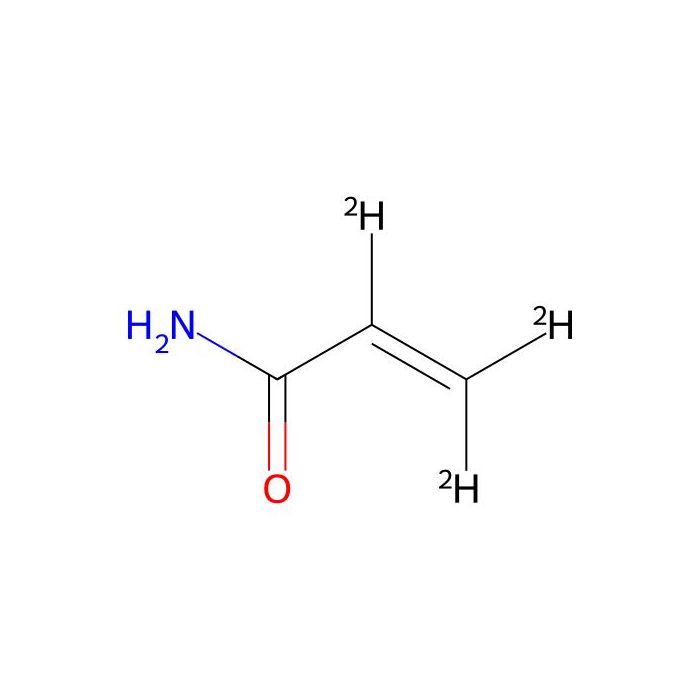
Acrylamide-d , CAS No.122775-19-3
Disponível para encomenda
Storage
Store at -20°C
Shipped In
Ice chest + Ice pads
Acrylamide-d3 is the deuterium labeled Acrylamide.
Taxonomy Tree
| Kingdom | Organic compounds |
|---|---|
| Superclass | Organic acids and derivatives |
| Classe | Carboxylic acids and derivatives |
| Subclass | Acrylic acids and derivatives |
| Intermediate Tree Nodes | Not available |
| Direct Parent | Acrylic acids and derivatives |
| Alternative Parents | Primary carboxylic acid amides Organonitrogen compounds Organic oxides Hydrocarbon derivatives Carbonyl compounds |
| Molecular Framework | Aliphatic acyclic compounds |
| Substituents | Acrylic acid or derivatives - Primary carboxylic acid amide - Carboxamide group - Organic nitrogen compound - Organic oxygen compound - Organic oxide - Hydrocarbon derivative - Organooxygen compound - Organonitrogen compound - Carbonyl group - Aliphatic acyclic compound |
| Descrição | This compound belongs to the class of organic compounds known as acrylic acids and derivatives. These are organic compounds containing acrylic acid CH2=CHCO2H or a derivative thereof. |
| External Descriptors | Not available |
| Ponto de inflamação (°F) | 280.4 °F |
|---|---|
| Ponto de inflamação (°C) | 138 °C |
H315:Causes skin irritation
H319:Causes serious eye irritation
H301:Toxic if swallowed
H317:May cause an allergic skin reaction
H312:Harmful in contact with skin
H332:Harmful if inhaled
H372:Causes damage to organs through prolonged or repeated exposure
H340:May cause genetic defects
H350:May cause cancer
H361:Suspected of damaging fertility or the unborn child
P261:Avoid breathing dust/fume/gas/mist/vapors/spray.
P305+P351+P338:IF IN EYES: Rinse cautiously with water for several minutes. Remove contact lenses if present and easy to do - continue rinsing.
P280:Wear protective gloves/protective clothing/eye protection/face protection.
P302+P352:IF ON SKIN: wash with plenty of water.
P321:Specific treatment (see ... on this label).
P405:Store locked up.
P501:Dispose of contents/container to an approved waste disposal plant.
P264:Wash hands [and …] thoroughly after handling.
P260:Do not breathe dust/fume/gas/mist/vapors/spray.
P281:Use personal protective equipment as required.
P271:Use only outdoors or in a well-ventilated area.
P270:Do not eat, drink or smoke when using this product.
P304+P340:IF INHALED: Remove person to fresh air and keep comfortable for breathing.
P272:Contaminated work clothing should not be allowed out of the workplace.
P333+P313:IF SKIN irritation or rash occurs: Get medical advice/attention.
P362+P364:Take off contaminated clothing and wash it before reuse.
P330:Rinse mouth.
P203:Obtain, read and follow all safety instructions before use.
P264+P265:Wash hands [and …] thoroughly after handling. Do not touch eyes.
P301+P316:IF SWALLOWED: Get emergency medical help immediately.
P318:if exposed or concerned, get medical advice.
P317:Get emergency medical help.
P337+P317:If eye irritation persists: Get medical help.
P332+P317:If skin irritation occurs: Get medical help.
P319:Get medical help if you feel unwell.
No item-specific, validated application protocols are provided in the Product Data. The following general procedures illustrate typical uses; adapt and validate for your system.
Example: Casting a 10% polyacrylamide resolving gel (Laemmli system)
Example: Preparing an LC–MS internal standard solution
Note: Control oxygen for polymerizations, verify isotopic enrichment and label position to ensure suitability for the analytical method, and validate any protocol changes with pilot tests.
This product is a deuterium-labeled small molecule monomer intended for research use; it has no intrinsic biological role or function as supplied.
General biochemical context (literature):
Applications in life science workflows:
Note: The above reflects general literature knowledge. This product is for research use only and is not intended for diagnostic, therapeutic, or other clinical purposes.
Acrylamide-d is not a buffering agent and is not used to control pH directly. However, it is a key monomer for preparing polyacrylamide gels, which are employed alongside defined buffer systems in electrophoresis.
Electrophoresis context (general/literature):
Recipes and concentrations should be selected according to the electrophoretic method; acrylamide concentration (%T) and crosslinker (%C) determine pore size, while the buffer determines separation mechanism and resolution.
Context: Acrylamide-based polymerizations are widespread in research; environmental and safety considerations often center on monomer toxicity, aqueous processing, and initiator choices. Deuteration does not materially change the EHS profile versus protiated acrylamide.
Options to improve greenness (general guidance):
Comparison snapshot (literature/general):
Note: For regulated waste, unreacted acrylamide should be captured and disposed of as hazardous waste; complete polymerization to polyacrylamide prior to disposal reduces monomer release.
This product is supplied for research use only and is not intended for human or veterinary use.
Formulation/analytical roles (general, literature):
Manufacturing/process analytical technology (PAT):
Excipient status: acrylamide monomer itself is not used as a pharmaceutical excipient; its polymer, polyacrylamide, finds uses in non-pharmaceutical applications. Any use in regulated environments must be supported by appropriate reference standards, validated methods, and compliance with applicable pharmacopeial/ICH guidelines.
Note: No medical, therapeutic, or clinical claims are made or implied for this product.
Item-specific numerical specifications are not provided in the Product Data for this SKU. Refer to CoA/Spec Sheet for verified values.
General/literature properties for unlabeled acrylamide (for context only; deuteration slightly increases molecular weight and can subtly shift thermal constants):
Notes on isotopic effects (general):
For experimental planning with this product, use literature values only as qualitative guides and rely on the item’s CoA/SDS for quantitative specifications.
Guidance on interpreting grades for acrylamide isotopologues (general):
What to check on receipt (best practices):
This deuterated acrylamide is primarily used where isotopic labeling is advantageous:
Analytical/biophysical uses:
Polymer chemistry (general, acrylamide):
Organic reactivity (general, acrylamide):
Practical tips:
Guidance below is based on general literature for acrylamide polymerizations and conjugate additions; adapt to your scale and verify with small trials. These are not item-specific specifications.
Radical polymerization (aqueous PAGE-type gels):
RAFT polymerization (controlled):
Conjugate additions (Michael):
Note on isotopic integrity: If the deuterium is at exchangeable sites (e.g., –ND2), avoid strong acid/base and protic solvents at elevated temperatures to minimize H/D exchange. Non-exchangeable vinyl deuterium labels are substantially more robust.
Hazard information fields in the Product Data are not populated for this SKU. Always consult the SDS for authoritative, item-specific safety and regulatory information.
General/literature safety profile (acrylamide and its isotopologues):
Handling and PPE (good laboratory practice):
Storage/incompatibilities:
First aid (overview; consult SDS):
Acrylamide-d is a small, highly polar monomer (amide + conjugated alkene), typically used in aqueous or polar organic media.
General solvent behavior (literature, acrylamide):
Selection guidance by application:
Comparison (general):
Storage conditions (item-specific):
General storage guidance (small-molecule acrylamide isotopologues):
Reconstitution/preparation (general):
Shelf life: Not specified for this item; refer to CoA/Spec Sheet.
Always refer to the product’s CoA and SDS for definitive storage, handling, and stability information.
Acrylamide-d is a deuterium-labeled isotopologue of acrylamide intended for research and analytical applications (e.g., isotope tracing, internal standards, and specialized polymerizations).
Structural features (general/literature description):
2D structure in words (general acrylamide): a three-carbon chain with a terminal C=C double bond (C1–C2) conjugated to a carbonyl at C3; the carbonyl carbon is bound to –NH2. Deuterated variants maintain this topology with D substituting for selected H positions.
Functional highlights (general, acrylamide framework):
Isotopic utility (deuterated variant):
Retrosynthetic value:
Not applicable. This product is a small-molecule monomer and does not possess antigen/epitope specificity, clone identity, isotype, or species reactivity. For application-relevant information, see Reaction & Applications and Application Protocols.