This compound belongs to the class of organic compounds known as dipeptides. These are organic compounds containing a sequence of exactly two alpha-amino acids joined by a peptide bond.
External Descriptors
dipeptide
1. Djoumbou Feunang Y, Eisner R, Knox C, Chepelev L, Hastings J, Owen G, Fahy E, Steinbeck C, Subramanian S, Bolton E, Greiner R, and Wishart DS. ClassyFire: Automated Chemical Classification With A Comprehensive, Computable Taxonomy. Journal of Cheminformatics, 2016, 8:61.
Determine the necessary mass, volume, or concentration for preparing a solution.
Dilution Calculator
Determine the dilution needed to prepare a stock solution.
Reconstitution Calculator
Revisões
Avaliações dos Clientes
Application Protocols
The following are general, literature-based example workflows for Ala-Ala; they are not validated specifications for this SKU.
Preparation of aqueous stock solution
Dissolve in ultrapure water to 100 mM; adjust pH to 7.4 with minimal NaOH/HCl; filter 0.22 µm; store aliquots at 2–8 °C for short term or freeze for longer term.
Dipeptidase activity assay (endpoint HPLC)
Incubate 1–5 mM Ala-Ala in 50 mM phosphate buffer pH 7.4 at 37 °C with enzyme. Quench at defined times with 0.4% TFA. Analyze by RP-HPLC (C18, water/acetonitrile + 0.1% TFA), quantifying alanine release against standards.
Transporter uptake (cells)
Equilibrate cells in HBSS pH 7.4; add Ala-Ala (0.1–10 mM). Incubate 2–5 min at 37 °C. Wash rapidly with ice-cold buffer. Lyse and quantify uptake by LC-MS/MS.
Fragment coupling (solution phase, example)
Activate Boc-Ala-Ala-OH (1.0 equiv) with HATU (1.1 equiv) and DIPEA (3 equiv) in DMF at 0–5 °C, add H-AA-OR’ (1.2 equiv). Stir 2 h at 0–25 °C. Work up and purify by preparative RP-HPLC.
Adjust concentrations and conditions to your system. For lot-specific constraints (purity, salt form), consult the CoA/Spec Sheet.
Biological Roles
General biochemistry (literature)
Ala-Ala is a dipeptide product of proteolysis and a substrate for dipeptidases. It exists primarily as a zwitterion at physiological pH.
Taken up by proton-coupled oligopeptide transporters (PEPT1/PEPT2) in mammalian systems and analogous transporters in bacteria/yeast; often used as a model cargo to assess transporter kinetics and specificity.
Hydrolysis yields two molecules of L-alanine (assuming L,L dipeptide), which feeds into central metabolism via transamination to pyruvate.
Biophysical relevance
Serves as a minimal hydrophobic-neutral peptide motif to study backbone hydrogen bonding, peptide dipoles, and retention behavior in chromatography.
Useful in NMR and computational benchmarks for peptide conformational analysis due to its simplicity and absence of ionizable side chains.
Notes
Specific stereochemistry and salt state influence uptake and enzyme kinetics; verify the form supplied on the CoA/Spec Sheet for quantitative biological studies.
Buffer Applications
Ala-Ala is not a dedicated buffering agent and is rarely used to prepare buffer systems.
Practical guidance (literature)
With terminal pKa values near ~2.3 (COOH) and ~8.0–8.5 (NH3+), solutions show limited buffering capacity near those ranges, but this is inferior to standard buffers (phosphate, HEPES, Tris).
If used as a matrix component or osmolyte, maintain ionic strength with appropriate salts; do not rely on Ala-Ala for pH control.
Recommended approach
Prepare buffers with established systems (e.g., 10–50 mM phosphate pH 6–8; 25 mM HEPES pH 7.2–7.6), then dissolve Ala-Ala into the buffer. Filter (0.22 µm) if sterility is required.
For robust pH control and reproducibility, choose standard buffering agents; see Solvent Selection for dissolution tips.
Green Alternatives
Ala-Ala itself is benign and typically handled in aqueous media, aligning with green chemistry principles.
Greener solvent considerations (general)
Prefer water or aqueous buffers for dissolution and reactions (enzyme assays, analytics). Avoid high-boiling polar aprotics unless necessary.
If organic cosolvent is needed, small percentages of ethanol or isopropanol are generally greener choices than DMF/NMP.
Process alternatives
Enzymatic couplings (protease-catalyzed peptide bond formation) in water can replace carbodiimide/uronium coupling reagents for certain model reactions.
Pharmacopeial listing/monograph: Not specified for this item; refer to CoA/Spec Sheet.
General, non-clinical roles (literature)
Frequently used as a model dipeptide in preformulation, permeability, and transporter studies (e.g., PEPT1/PEPT2 screening) under research conditions.
Can serve as an analytical system suitability standard in peptide assay development (HPLC, LC-MS), and in method transfer/validation exercises to evaluate retention and detection consistency.
Occasionally used as a process development surrogate for peptide handling (solubility, filtration, lyophilization) due to its stability and low hazard profile.
No therapeutic or clinical claims are made for this product. It is supplied strictly for research and laboratory use (per Product Data).
Physical Properties
Item-specific measurements (specs for this lot)
Appearance: Not specified for this item; refer to CoA/Spec Sheet.
Grade/Purity: Not specified for this item; refer to CoA/Spec Sheet.
Literature/general reference values (for context; not item specifications)
Physical form: typically a white to off-white crystalline solid (literature)
Melting point: ~226–230 °C (decomposition) (literature)
Solubility: highly soluble in water; sparingly soluble in alcohols; low solubility in nonpolar solvents (literature)
Acid–base properties: zwitterionic near neutral pH; pKa (carboxyl terminus) ~2.3; pKa (amino terminus) ~8.0–8.5 (literature, values vary slightly by ionic strength and temperature)
Hygroscopicity: peptides can absorb moisture depending on salt state and residual solvent content (general observation)
Practical notes
Aqueous solubility is enhanced by mild heating and pH adjustment away from the isoelectric point.
For precise solubility, residual solvent, water content, or ash/metal levels for this lot, consult the CoA/Spec Sheet (not specified here).
Quality and Grades
Item-specific quality fields
Grade/Purity: Not specified for this item; refer to CoA/Spec Sheet.
Stabilizers, salt form, residual solvent: Not specified for this item; refer to CoA/Spec Sheet.
How to interpret typical grades (general guidance)
Research grade dipeptides are commonly assessed by HPLC purity (e.g., area %), identity (MS/HRMS), and sometimes optical rotation or chiral HPLC to confirm stereochemistry.
Low-UV/LC-MS grades emphasize low non-volatile residues and minimal UV-absorbing impurities for analytics.
Peptide content vs. counter-ions/water: Reported “purity” may refer to chromatographic purity, while peptide content (on anhydrous, acetate-free basis) can be lower. Check assay basis on the CoA.
Implications for use
Enzymology/transport studies may demand high purity and defined stereochemistry (e.g., L,L). If diastereomeric purity is critical, confirm on the CoA.
Trace inorganic content and water can influence lyophilized mass and solution molarity; calculate concentrations using peptide content when available.
Documentation
For this SKU (A113991), obtain the current CoA/Spec Sheet for exact purity grade, counter-ion/salt state, water content, and analytical methods. These are not specified in the provided Product Data.
Reaction and Applications
Biochemical/analytical applications (literature)
Model substrate/standard for peptide transporters (PEPT1/PEPT2) and for dipeptidase/peptidyl peptidase studies; hydrolysis to alanine can be monitored by HPLC or ninhydrin.
Chromatographic system suitability standard in amino acid/peptide HPLC methods; useful for retention mechanism studies on RP, HILIC, and ion-exchange phases.
Reference compound for calibration of ninhydrin/OPA derivatization responses in amino acid analysis.
Synthetic/method-development roles
Fragment coupling studies: Ala-Ala serves as a minimal dipeptide to probe coupling efficiency, racemization, and epimerization in peptide chemistry (after temporary protection of termini when required).
Enzymatic synthesis/hydrolysis benchmarking using proteases, peptidases, or transpeptidases; kinetic parameters (Km, kcat) can be extracted with standard progress curves.
Practical notes
Unprotected Ala-Ala is zwitterionic; to incorporate into longer peptides, protect N-terminus (e.g., Boc/Fmoc) and/or C-terminus (e.g., methyl/tert-butyl ester) prior to coupling.
For enzyme assays, maintain ionic strength and pH to avoid shifts near the pI that can alter apparent solubility or binding.
Monitor for potential diketopiperazine formation only under forcing dehydrating conditions; simple aqueous handling is typically benign.
This item is for research use only (per Product Data).
Reaction Conditions
General literature guidance for working with Ala-Ala in synthetic and enzymatic contexts (not item-specific specifications):
Fragment coupling to form tripeptides
Typical reagents: HATU or HBTU (1.0–1.2 equiv), DIPEA (2–3 equiv), in DMF or NMP; substrate commonly protected (e.g., Boc-Ala-Ala-OH + H-AA-OR’).
Temperature/time: 0–25 °C, 1–4 h, monitor by LC-MS/HPLC.
Additives: OxymaPure to reduce racemization; avoid excess base to protect stereocenters.
Carbodiimide-mediated activation (solution phase)
Reagents: EDC·HCl (1.1–1.5 equiv) + NHS or HOAt; aqueous-organic (water/DMF) at pH 5.0–6.0 to limit O→N acyl transfer.
Enzymatic hydrolysis assays
Buffers: 50 mM phosphate or HEPES, pH 7.0–7.5; 25–37 °C.
Use isotonic buffer at physiological pH; time points 0.5–10 min; quantify intracellular/extravesicular levels by LC-MS/MS.
Expected outcomes (typical literature)
Peptide couplings of protected Ala-Ala fragments often provide 70–95% isolated yields under optimized conditions with minimal epimerization.
Always adapt to substrate protecting groups and enzyme/source system; validate conditions empirically.
Safety and Handling
Classification and hazards (item-specific)
GHS classification: Not specified for this item; refer to SDS.
Pictograms: Not specified for this item; refer to SDS.
Signal word / H-statements: Not specified for this item; refer to SDS.
General safety guidance (literature/best practice)
Likely low acute hazard typical of small, neutral amino acid dipeptides; nonetheless, handle as a laboratory chemical.
Avoid inhalation of dust and contact with eyes/skin. Use appropriate PPE: lab coat, safety glasses, nitrile gloves.
Work in a clean, dry area; peptides can be hygroscopic and may cake upon moisture uptake.
Incompatibilities: strong oxidizers, strong acids/bases may cause degradation (hydrolysis) under forcing conditions.
Thermal stability: decomposes on strong heating; avoid high-temperature drying that can promote diketopiperazine formation (intramolecular cyclization) in some peptide contexts.
First aid (overview; defer to SDS)
Inhalation: move to fresh air; seek medical advice if symptoms persist.
Skin/eye contact: rinse with water for several minutes; remove contaminated clothing.
Ingestion: rinse mouth; seek medical advice if unwell.
Storage and handling (from Product Data)
Store at 2–8 °C under argon; keep container tightly closed and desiccated.
Shipments are on wet ice; allow to equilibrate in a desiccator before opening to minimize condensation.
Always consult the Aladdin SDS for authoritative safety information for this specific SKU.
Solvent Selection
Ala-Ala is a small, highly polar dipeptide that is readily solvated in protic and strongly polar aprotic media.
Polarity and miscibility (literature)
Highly hydrophilic; dissolves well in water and aqueous buffers across a broad pH range (best away from pI ~5.6).
Soluble in polar aprotic solvents like DMSO and formamide; limited in MeOH/EtOH; negligible in acetone, acetonitrile (without water), ethyl acetate, or hydrocarbons.
Practical selection tips
For biochemical assays: use ultrapure water or buffered saline (e.g., phosphate, HEPES) at pH 6–8. Filter-sterilize if needed.
For preparative work: dissolve in minimal water, adjust pH, and co-evaporate with tert-butanol or lyophilize to remove water gently.
For organic couplings after protection: employ DMF, NMP, or DCM depending on protecting groups; unprotected Ala-Ala is not soluble in these media.
Comparison (general)
Water (green, non-toxic): best for bioassays and standards.
DMSO (excellent solvator): use for stock concentrates; dilute into aqueous media to avoid precipitation at pI.
Methanol/ethanol: may permit modest solubility or be used as cosolvents with water.
Tip: Warm gently (≤40 °C) and adjust pH 7–8 to accelerate dissolution while minimizing hydrolysis.
Storage and Reconstitution
Item-specific storage and shipping (from Product Data)
Store at 2–8 °C, argon charged, in a tightly sealed container.
Shipped on wet ice.
General handling guidance (literature/best practice)
Protect from moisture; allow vial to warm to room temperature in a desiccator before opening to prevent condensation.
After opening, promptly recap under inert gas and return to 2–8 °C. For extended storage, consider desiccation.
Reconstitution (general)
Solvents: Water or suitable buffer (e.g., phosphate, HEPES). DMSO can be used to prepare concentrated stocks, followed by dilution into aqueous media.
Procedure: Add calculated volume to achieve desired molarity; gently vortex and, if needed, warm to 25–37 °C. Adjust pH slightly (7–8) to expedite dissolution; avoid extremes that may promote hydrolysis.
Sterile use: Filter through 0.22 µm PES or PTFE membrane.
Aliquoting and stability (general)
Prepare single-use aliquots to avoid repeated freeze–thaw. For refrigerated aqueous solutions, use within days; for frozen stocks, stability is typically longer, but verify by HPLC.
For any lot-specific reconstitution notes (salt form, counter-ions, peptide content), and definitive stability limits, refer to the CoA/Spec Sheet for SKU A113991.
Structure and Identity
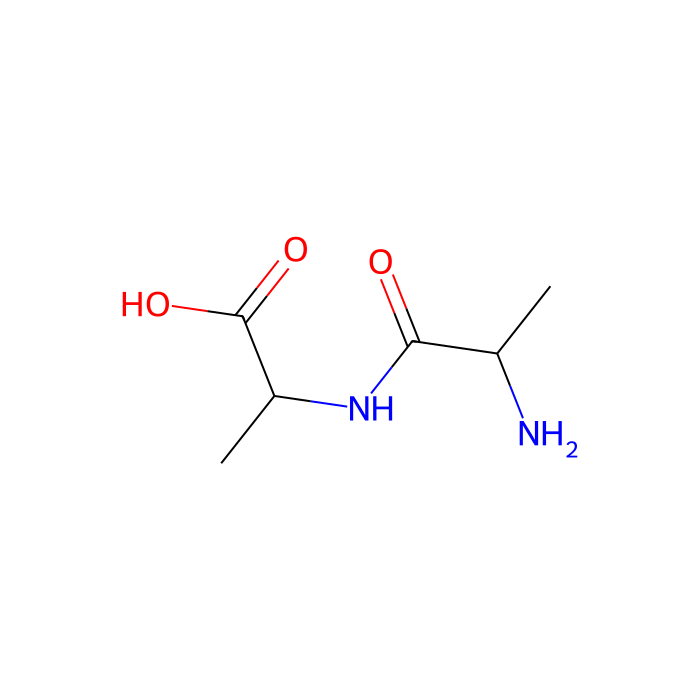
Ala-Ala (alanyl-alanine) is the simplest homodipeptide composed of two alanine residues linked by a single peptide (amide) bond.
Item-specific (from Product Data)
SKU: A113991
CAS: 1948-31-8
CID (PubChem): 5484352
InChIKey: 61134 (as provided)
Category: Life Science reagents (研究/实验用)
Storage note: Store at 2–8°C, argon charged; shipped on wet ice
Literature/computed identity (informational, not item-specific specs)
Common name: Alanyl-alanine (often L-Ala–L-Ala when stereochemistry is specified)
2D structure description: A linear backbone of –NH–CH(CH3)–CO–NH–CH(CH3)–COOH, where each α-carbon bears a methyl side chain (alanine). One peptide bond connects the two residues; no rings or heteroaromatic features; two stereocenters at the α-carbons (commonly both S for L,L).
Notes
If stereochemistry of this catalog item is critical to your application, verify on the CoA/Spec Sheet (L,L vs other diastereomers is not specified here).
Synthetic Utility
Functional group chemistry
Contains a free N-terminus (nucleophilic amine), a peptide bond (amide), and a free C-terminal carboxylic acid (electrophilic as activated ester/anhydride). No side-chain functionality.
Applications in synthesis (literature)
Fragment condensation: After N- and/or C-terminal protection (e.g., Boc-Ala-Ala-OMe), used to assemble longer peptides with reduced step counts and minimized racemization.
Kinetic/epimerization probes: Serves as a minimal system to study base-induced racemization at α-centers during coupling, and to benchmark coupling reagents (HATU, HBTU, EDC/HOBt, DIC/oxyma).
Cyclization studies: Model for diketopiperazine formation under dehydrating/basic conditions; useful to optimize conditions that suppress undesired cyclization during SPPS or solution-phase synthesis.
Retrosynthetic perspective
Accessible via coupling of protected alanine derivatives (e.g., Boc-Ala-OH with H-Ala-OMe) followed by deprotection; or enzymatic synthesis using proteases/transpeptidases in water.
Practical tip
For efficient couplings, carefully control base (e.g., DIPEA equivalents), temperature (0–25 °C), and use racemization-suppressing additives (oxymaPure) when extending Ala-Ala fragments.
Target Specificity
This product is a small-molecule dipeptide, not an antibody, probe, or targeted biological. There are no antigen/epitope or clone/isotype attributes.
Item-specific note: Target specificity data are not applicable to this compound type.
Perguntas frequentes
What is the purity of this product?
This product is supplied at ≥98% purity (chemical assay). Lot-specific values are stated on the Certificate of Analysis.
How should this product be stored?
Store at 2–8 °C under argon. It is supplied under an argon blanket; reseal under inert gas after each use.
How is this product shipped?
This product ships chilled on wet ice. Unpack on arrival and transfer it to the storage condition stated above.
What are the CAS number, molecular formula and molecular weight?
The CAS Number is 1948-31-8, the molecular formula is C6H12N2O3, and the molecular weight is 160.17 g/mol. InChIKey DEFJQIDDEAULHB-IMJSIDKUSA-N.
What documentation is provided?
Available product documentation, including Certificates of Analysis (COA), Safety Data Sheets (SDS), and specification sheets, is shown in the product document area. Document availability and access follow the current site policy.
Usamos cookies para garantir o funcionamento adequado do site e, quando permitido, para melhorar a sua experiência. Você pode gerenciar suas preferências a qualquer momento nas Configurações. Saiba mais em nossa Política de Cookies.
Deseja que lhe enviemos uma mensagem quando tivermos descontos disponíveis?
Lembrar-me mais tarde
Obrigado! Por favor, verifique a sua caixa de entrada de e-mail para confirmar.
Products are supplied to verified businesses, institutions, and qualified professionals for research and development use only. Not for use in humans, animals, diagnosis, or therapy.

 D2609008