
Determine the necessary mass, volume, or concentration for preparing a solution.
| Activity Type | Relation | Activity value | Units | Action Type | Journal | PubMed Id | doi | Assay Aladdin ID |
|---|
Taxonomy Tree
| Kingdom | Organic compounds |
|---|---|
| Superclass | Lipids and lipid-like molecules |
| Classe | Fatty Acyls |
| Subclass | Fatty acid esters |
| Intermediate Tree Nodes | Not available |
| Direct Parent | Fatty acid esters |
| Alternative Parents | Carboxylic acid esters Monocarboxylic acids and derivatives Organic oxides Hydrocarbon derivatives Carbonyl compounds |
| Molecular Framework | Aliphatic acyclic compounds |
| Substituents | Fatty acid ester - Carboxylic acid ester - Monocarboxylic acid or derivatives - Carboxylic acid derivative - Organic oxygen compound - Organic oxide - Hydrocarbon derivative - Organooxygen compound - Carbonyl group - Aliphatic acyclic compound |
| Descrição | This compound belongs to the class of organic compounds known as fatty acid esters. These are carboxylic ester derivatives of a fatty acid. |
| External Descriptors | Not available |
| Activity Type | Relation | Activity value | Units | Action Type | Journal | PubMed Id | doi | Assay Aladdin ID |
|---|
| Activity Type | Relation | Activity value | Units | Action Type | Journal | PubMed Id | doi | Assay Aladdin ID |
|---|
Find and download the COA for your product by matching the lot number on the packaging.
| Lot Number | Certificate Type | Data | Item |
|---|---|---|---|
 J2630081 | Certificate of Analysis | Nov 03, 2026 | A109767 |
| E2311076 | Certificate of Analysis | Oct 09, 2026 | A109767 |
| E2311085 | Certificate of Analysis | Oct 09, 2026 | A109767 |
| F1920007 | Certificate of Analysis | Aug 13, 2026 | A109767 |
| H2218027 | Certificate of Analysis | Feb 04, 2026 | A109767 |
| H2218029 | Certificate of Analysis | Feb 04, 2026 | A109767 |
| H2218028 | Certificate of Analysis | May 07, 2024 | A109767 |
| Solubilidade | Insoluble in water; Soluble in Ether,Alcohol |
|---|---|
| Índice de refração | 1.424 |
| Ponto de inflamação (°F) | 150.8 °F |
| Ponto de inflamação (°C) | 66°C |
| Ponto de ebulição (°C) | 75-76°C |
| Peso molecular | 156.22 |
| XLogP3 | 2.700 |
| Hydrogen Bond Donor Count | 0 |
| Hydrogen Bond Acceptor Count | 2 |
| Rotatable Bond Count | 7 |
| Exact Mass | 156.115 Da |
| Monoisotopic Mass | 156.115 Da |
| Topological Polar Surface Area | 26.300 Ų |
| Heavy Atom Count | 11 |
| Formal Charge | 0 |
| Complexity | 119.000 |
| Isotope Atom Count | 0 |
| Defined Atom Stereocenter Count | 0 |
| Undefined Atom Stereocenter Count | 0 |
| Defined Bond Stereocenter Count | 0 |
| Undefined Bond Stereocenter Count | 0 |
| The total count of all stereochemical bonds | 0 |
| Covalently-Bonded Unit Count | 1 |
H301:Toxic if swallowed
H311:Toxic in contact with skin
H315:Causes skin irritation
H319:Causes serious eye irritation
H331:Toxic if inhaled
H400:Very toxic to aquatic life
H410:Very toxic to aquatic life with long lasting effects
H411:Toxic to aquatic life with long lasting effects
H412:Harmful to aquatic life with long lasting effects
P261:Avoid breathing dust/fume/gas/mist/vapors/spray.
P264:Wash hands [and …] thoroughly after handling.
P270:Do not eat, drink or smoke when using this product.
P271:Use only outdoors or in a well-ventilated area.
P273:Avoid release to the environment.
P280:Wear protective gloves/protective clothing/eye protection/face protection.
P321:Specific treatment (see ... on this label).
P330:Rinse mouth.
P391:Collect spillage.
P302+P352:IF ON SKIN: wash with plenty of water.
P304+P340:IF INHALED: Remove person to fresh air and keep comfortable for breathing.
P305+P351+P338:IF IN EYES: Rinse cautiously with water for several minutes. Remove contact lenses if present and easy to do - continue rinsing.
P361+P364:Take off immediately all contaminated clothing and wash it before reuse.
P362+P364:Take off contaminated clothing and wash it before reuse.
P405:Store locked up.
P403+P233:Store in a well-ventilated place. Keep container tightly closed.
P501:Dispose of contents/container to an approved waste disposal plant.
P264+P265:Wash hands [and …] thoroughly after handling. Do not touch eyes.
P301+P316:IF SWALLOWED: Get emergency medical help immediately.
P337+P317:If eye irritation persists: Get medical help.
P332+P317:If skin irritation occurs: Get medical help.
P316:Get emergency medical help immediately.
Item-specific, tested application protocols are not provided for this product.
General protocol outlines (literature-inspired; adapt to your system):
Pd-catalyzed allylation using allyl hexanoate:
Acid-catalyzed transesterification to allylate an alcohol:
Basic hydrolysis (saponification):
Note: These are generalized literature-style procedures provided for research planning; they are not validated methods for this specific catalog item.
Item-specific biological roles are not designated; this product is for research use only.
General/literature context (non-clinical):
Caution: Do not extrapolate these general biological notes to any medical or clinical utility. Handle exclusively as a research chemical and consult institutional biosafety protocols where applicable.
This compound is a hydrophobic allylic ester and is not used as a buffer component or pH control reagent.
Perspective: When using allyl hexanoate as an allylating agent or model ester, consider greener surrogates that improve safety, environmental fate, or process efficiency. The best choice depends on the transformation.
Comparison (literature/general; not item-specific):
Allyl acetate
Allyl carbonates (e.g., allyl methyl carbonate, allyl ethyl carbonate)
Dimethyl carbonate (as solvent/reagent adjunct)
Bio-based esters with shorter chains (e.g., allyl acetate from bio-acetic acid)
Process greening tips:
Item-specific pharmacopeial/excipient status is not provided for this product.
General formulation context (non-therapeutic, literature/general):
Compliance note:
Item-specific specifications (from Product Data):
Literature/general values (for reference; not product specifications):
Practical notes (general knowledge):
Item-specific quality information:
Guidance on interpreting grades for this compound class (general information):
Stabilizers and inhibitors:
Quality control suggestions (general):
This compound is an allyl ester, combining an allylic electrophile with a medium-chain carboxylate. Its dual reactivity underpins several uses in organic synthesis and materials work.
Allylic substitution (Tsuji–Trost, literature):
Transesterification and interesterification (literature):
Hydrolysis (literature):
Radical and polymer chemistry (literature/general):
Flavor/fragrance materials science (general):
General literature guidance for common transformations involving allyl hexanoate (reference ranges; optimize per substrate):
Pd-catalyzed allylic substitution (Tsuji–Trost):
Transesterification:
Hydrolysis:
Yield expectations: Highly substrate- and condition-dependent; consult primary literature for specific transformations. All ranges above are typical literature conditions and are not product specifications.
GHS/SDS information for this specific item:
General safety guidance for allylic aliphatic esters (literature/general information; not a substitute for the SDS):
Always consult the item-specific SDS for authoritative safety, toxicology, and regulatory information.
Context: Allyl hexanoate is typically used as a reagent/building block rather than as a bulk solvent.
Polarity and miscibility (literature/general):
Selecting a medium when using allyl hexanoate as a substrate:
Comparison to alternatives (general):
Note: This section addresses solvent/media selection for reactions involving allyl hexanoate; the compound itself is not typically chosen as a process solvent.
Item-specific storage and shipping:
Additional handling guidance (general):
Reconstitution:
Shelf-life and QC:
Note: Follow institutional chemical hygiene plans and consult the SDS for full storage and incompatibility details.
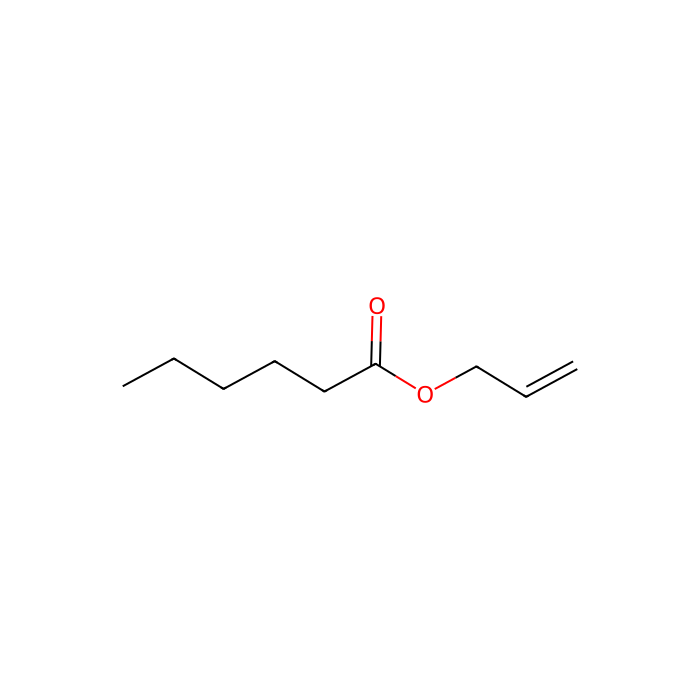
Brief: Allyl hexanoate (allyl caproate) is a linear aliphatic ester featuring an allylic ether moiety conjugated to a hexanoyl carbonyl.
Item-specific identifiers (from Product Data):
Literature/typical identifiers and composition (for reference only; not item-specific):
Structural features (general description):
Allyl hexanoate is a useful bifunctional substrate: an allylic electrophile coupled to a medium-chain carboxylate leaving group. This combination enables multiple synthetic strategies.
Allylic substitution chemistry (literature):
Ester transformations (literature):
Polymer and materials chemistry (general):
Retrosynthetic value:
Practical notes:
Not applicable. This product is a small-molecule ester, not a biological targeting reagent or antibody.