10mM in DMSO for sensitive chromatographic and analytical workflows requiring minimal baseline interference.
🌡
Storage & shipping
Store at -80°C Ships Dry ice packs + Cold packs Check lot-specific COA for exact specifications.
📋
Quality documents
SDS, COA, datasheet, and spec sheet available for download. Lot-specific COA accessible via lot number lookup.
📚
Literature proof
Cited in 0 peer-reviewed publications across chromatography, organic synthesis, and cross-coupling reactions.
Visão geral
Information
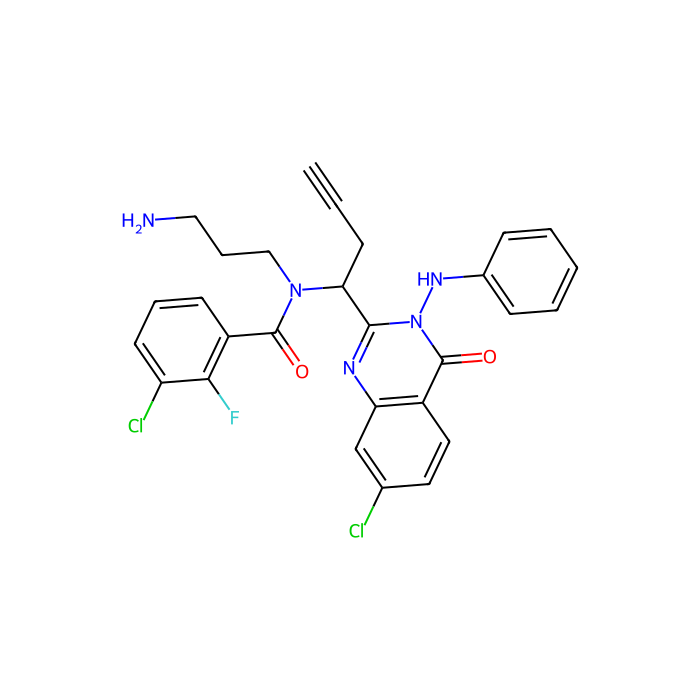
ARQ 621 ARQ 621 is an allosteric, and selective Eg5 mitotic motor protein inhibitor. Phase 1.
Targets
Eg5 mitotic motor protein
In vitro
ARQ 621 demonstrates anti-tumor activity against a wide range of human cancer cell lines including colon, lung, endometrial, bladder, and hematologic cancer cell lines, with significantly less cytotoxicity against hematopoietic cells.
In vivo
ARQ 621, as a novel clinical stage drug candidate, inhibits a number of xenografts grown in athymic mice, such as pancreatic, breast, prostate, and ovarian carcinomas with no hematological changes. Furthermore, for ARQ 621, there is no envidence of bone marrow toxicity in pre-clinical mouse efficacy models or safety studies in rats and dogs.
This compound belongs to the class of organic compounds known as quinazolines. These are compounds containing a quinazoline moiety, which is made up of two fused six-member aromatic rings, a benzene ring and a pyrimidine ring.
External Descriptors
Not available
1. Djoumbou Feunang Y, Eisner R, Knox C, Chepelev L, Hastings J, Owen G, Fahy E, Steinbeck C, Subramanian S, Bolton E, Greiner R, and Wishart DS. ClassyFire: Automated Chemical Classification With A Comprehensive, Computable Taxonomy. Journal of Cheminformatics, 2016, 8:61.
Determine the necessary mass, volume, or concentration for preparing a solution.
Dilution Calculator
Determine the dilution needed to prepare a stock solution.
Reconstitution Calculator
Revisões
Avaliações dos Clientes
Application Protocols
Only item-specific tested applications and conditions may be listed here; none are provided in the Product Data.
Item-specific
Tested applications (e.g., WB, IHC, IF, FC, enzymatic assays), recommended dilutions, and positive controls: Not specified for this item; refer to CoA/Spec Sheet.
Please consult your internal SOPs and the SDS/CoA for protocol development. General handling tips for small molecules (stock solution preparation, dilution schemes) are provided in other sections.
Biological Roles
Item-specific (from Product Data)
No biological function, pathway, or target information has been provided for ARQ 621.
General guidance (not item-specific claims)
Small-molecule screening compounds may interact with enzymes, receptors, transporters, or structural proteins. Without validated target data and structure, no specific biological role can be assigned here.
Any exploration of biological activity should begin with orthogonal assays, counter-screens for PAINS/reactivity, solubility/aggregation checks (e.g., detergent controls), and careful vehicle controls.
Assay design cautions (general)
Keep final DMSO below assay tolerance (often ≤0.5–1% v/v for biochemical and ≤0.1–0.5% for cell-based, lab-dependent).
Verify compound integrity in assay medium (stability over the assay window; adsorption to plastic; light sensitivity) before drawing conclusions.
All item-specific biological role details (mechanism, targets, pathways) are: Not specified for this item; refer to primary literature and the CoA/SDS. Research use only.
Buffer Applications
This product is a discrete small-molecule compound, not a buffering agent. As such, classical buffer preparation/use cases do not apply.
Item-specific
No buffer system or pKa data: Not specified for this item; refer to CoA/Spec Sheet.
Practical notes (general)
When dosing from DMSO stocks into biological buffers (e.g., PBS, HEPES, Tris), maintain DMSO at assay-compatible levels and pre-mix to avoid localized precipitation.
Filter-sterilize assay buffers independently; do not sterilize compound stocks by filtration if adsorption losses are a concern—prepare aseptically instead.
For true buffer preparation guidance, refer to dedicated buffering agents (HEPES, MOPS, Tris, phosphate).
Green Alternatives
Green chemistry discussion is not directly applicable to the compound itself (a discrete screening molecule), but applies to the solvents and workflows around it.
Considerations (general guidance)
Prefer water-miscible, lower-toxicity solvents when preparing dilutions (e.g., DMSO over DMF/NMP; ethanol over methanol when compatible).
Minimize organic solvent volumes by using high-concentration DMSO stocks and microplate-based assays.
For LC method development, optimize gradients to reduce run time and solvent consumption; consider ACN–water systems and smaller ID columns.
Comparison of common stock solvents (general; not item-specific)
DMSO: High solvency, broad assay compatibility; higher boiling point complicates removal; relatively favorable EHS profile compared with DMF/NMP.
DMF/NMP: Powerful solvents but with greater reproductive toxicity concerns; avoid where possible or contain within closed systems.
Ethanol: Renewable routes available; good EHS profile; may perturb some biological assays at modest % v/v.
Employ miniaturized screening (384/1536-well) to reduce chemical usage.
Item-specific environmental fate, degradability, and hazard data are: Not specified for this item; refer to SDS.
Pharmaceutical Uses
No pharmaceutical or excipient use is claimed or provided for this item.
Item-specific (from Product Data)
Research Use Note: For research use only. Not for human or veterinary use.
General context (not item-specific claims)
Small molecules in screening collections are often employed in discovery research, assay development, and non-clinical studies. They are not supplied under GMP, and are not suitable as APIs or excipients without substantial additional qualification.
If formulation studies are performed in vitro (e.g., solubilization screening), document any vehicles/excipients used and verify that materials meet the purity requirements for the intended non-clinical context.
Any pharmacopeial status, GMP compliance, or formulation role for ARQ 621 is: Not specified for this item; refer to CoA and regulatory guidance.
Physical Properties
Given the absence of a structure and item-specific specifications, only general guidance can be provided.
Item-specific (from Product Data)
Appearance: Not specified for this item; refer to CoA/Spec Sheet.
Molecular weight: Not specified for this item; refer to CoA/Spec Sheet.
Molecular formula: Not specified for this item; refer to CoA/Spec Sheet.
Typical physicochemical data for small-molecule screening compounds (literature/general; NOT specific to this item)
Melting point: Often observed for solids; value not available here.
Boiling point: Typically not used; thermal decomposition may occur before boiling for complex molecules.
LogP/logD, pKa, and polar surface area (PSA): Critical for solubility and permeability, but not available here.
Aqueous solubility: Unknown; many screening compounds require DMSO stock solutions.
Stability considerations: Many heteroaromatic amides/ureas/sulfonamides are bench-stable as solids but may be moisture/light/air sensitive in solution. No item-specific data available.
Practical notes (general)
Start with DMSO stock (e.g., 10–50 mM) to evaluate solubility; visually inspect for haze/precipitate.
If needed, co-solvents for assay dilution can include PEG-400, ethanol, or cyclodextrins; maintain final DMSO ≤1–2% v/v in biochemical assays to avoid vehicle effects.
All numeric values not explicitly provided above are: Not specified for this item; refer to CoA/Spec Sheet.
Quality and Grades
Item-specific (from Product Data)
Grade/purity: Not specified for this item; refer to CoA/Spec Sheet.
What this typically means for small-molecule screening compounds (general guidance)
Screening library compounds are commonly supplied at ≥95% purity by HPLC/UPLC; exact specification, test method (UV/ELSD/charged aerosol), and acceptance criteria must be confirmed on the CoA.
Identity testing often includes HRMS (mass accuracy), with optional 1H NMR to verify structural integrity and assess residual solvents.
Salt/solvate form (e.g., HCl salt vs. free base) materially affects mass, solubility, and assay preparation; verify on the CoA/label.
Stabilizers and additives
No stabilizer is indicated for this item. If stabilizers/antioxidants are present, they will be listed on the CoA and may affect UV background or bioassay performance.
Practical QC recommendations (general)
On receipt, record lot number, confirm labeling (CAS, mass, storage), and archive the CoA/SDS.
For critical studies, perform incoming verification: analytical HPLC purity, HRMS, and, if relevant, water content by Karl Fischer. For long studies, re-check purity of aged DMSO stocks.
All item-specific quality metrics not explicitly stated above are: Not specified for this item; refer to CoA/Spec Sheet.
Reaction and Applications
This product is classified as a small-molecule library compound for research screening rather than as a synthetic reagent. Accordingly, classical synthetic reaction applications are limited.
Item-specific (from Product Data)
Manufacturer applications: Not specified for this item.
General research applications for screening compounds (not item-specific claims)
Use as a reference material in method development (HPLC/LC–MS calibration, retention-time indexing) after confirming identity.
Incorporation into primary/secondary screening cascades to probe SAR trends, provided target relevance is established independently.
Potential use as a spiking control in stability-indicating method validation (stress studies) to exercise chromatographic resolution.
Not typically applicable (synthetic reactions)
Named reactions, catalyst roles, or reagent functions are not generally relevant without structural functionality data. If ARQ 621 is repurposed as a building block, verify reactive handles, protecting-group profile, and stability first.
All item-specific application claims beyond the above are: Not specified for this item; refer to CoA/Spec Sheet and primary literature.
Reaction Conditions
Classical reaction condition guidance is not applicable because ARQ 621 is a final small-molecule screening compound rather than a reagent or substrate with declared functionality.
Item-specific reaction parameters (solvent, temperature, catalysts, yields): Not specified for this item; refer to CoA/Spec Sheet.
General recommendation
If using the compound as an analytical standard or in stability studies, handle solutions at ambient temperature, avoid prolonged exposure to strong light, and minimize freeze–thaw cycles to limit degradation. Validate any stress conditions (acid/base/oxidative/thermal) experimentally as part of method development.
Safety and Handling
Safety information in the Product Data is incomplete; treat ARQ 621 as a laboratory chemical of unknown hazards and follow prudent handling practices.
Item-specific (from Product Data)
GHS/Signal word/H-statements/Pictograms: Not specified for this item; refer to SDS.
Storage: Store at −80°C.
Shipping: Dry ice packs + cold packs.
General laboratory precautions (not item-specific; defer to SDS for authoritative guidance)
PPE: Lab coat, safety glasses, and suitable disposable nitrile gloves. Use a chemical fume hood to avoid inhalation exposure.
Avoid: Ingestion, inhalation of dust/aerosols, and skin/eye contact. Do not pipette by mouth. Wash hands thoroughly after handling.
Incompatibilities (general): Strong oxidizers and strong acids/bases may cause degradation for many organic small molecules; segregate accordingly.
Hygroscopicity/photolability: Unknown for this item. Protect solutions from light and moisture as a precaution.
First-aid overview (general)
Skin/eye contact: Rinse with water for at least 15 minutes; remove contaminated clothing; seek medical attention if irritation persists.
Inhalation: Move to fresh air; seek medical attention if symptoms occur.
Ingestion: Rinse mouth; do not induce vomiting unless directed by medical personnel; seek immediate medical attention.
Waste disposal (general)
Collect in halogenated or non-halogenated organic waste stream as appropriate per your institutional chemical hygiene plan; incineration via licensed contractor is typical.
Always consult the product’s SDS and institutional EHS guidance before use.
Solvent Selection
With no structural data provided, solvent guidance is based on standard practices for small-molecule screening compounds.
Primary stock solvent (general best practice)
DMSO is the default due to broad solvency, chemical inertness for many compounds, and compatibility with biochemical/cellular assays at ≤1–2% v/v final.
Secondary solvents/co-solvents (general)
If DMSO solubility is insufficient, test: DMF, NMP, ethanol, methanol, acetonitrile, or PEG-400. For aqueous compatibility, consider Captisol/cyclodextrins.
For hydrophobic compounds, limited solubility may be improved by gentle warming (<40°C) and sonication; avoid prolonged heating to prevent degradation.
Polarity and miscibility (general)
DMSO, DMF, NMP: polar aprotic; fully miscible with water and many organics.
Ethanol/methanol: protic; miscible with water; may affect some enzyme assays.
Acetonitrile: polar aprotic; miscible with water; low viscosity; useful for LC method development.
Small comparison (general)
DMSO vs. DMF: DMSO is typically less toxic and more assay-compatible; DMF has higher volatility/odor concerns and may interfere with some bioassays.
ACN vs. MeOH in LC: ACN offers lower backpressure and better peak shape for many analytes; MeOH provides different selectivity and stronger hydrogen-bonding interactions.
Item-specific solubility, partitioning, and pKa are: Not specified for this item; refer to CoA/Spec Sheet.
Storage and Reconstitution
Item-specific (from Product Data)
Storage conditions: Store at −80°C.
Shipping: Dry ice packs + Cold packs.
Appearance/physical state: Not specified for this item; refer to CoA/Spec Sheet.
Reconstitution and handling (general guidance; verify experimentally)
Prepare a concentrated DMSO stock solution (e.g., 10–50 mM) if compatible; vortex and, if needed, sonicate briefly. Filter only if adsorption losses are acceptable.
Aliquot stocks into low-bind vials or plates to avoid repeated freeze–thaw; flush headspace with inert gas if oxidation is a concern (unknown for this item).
Store aliquots at −80°C; minimize light exposure. Record preparation date and concentration.
For aqueous working solutions, add to buffer with vigorous mixing to prevent precipitation; keep final DMSO within assay tolerance.
Stability (item-specific data)
Solution/solid-state stability, shelf life, and thaw stability: Not specified for this item; refer to CoA/Spec Sheet.
Always defer to the product’s CoA and SDS for definitive instructions on storage, reconstitution, and stability.
Structure and Identity
Brief overview: ARQ 621 is listed as a small-molecule screening compound. The structural identifiers in the Product Data are incomplete; therefore detailed structure-based commentary is limited.
Item-specific (from Product Data)
Product name: ARQ 621 (SKU A420571)
CAS: 1095253-39-6
PubChem CID: 25110841
InChIKey: 365819 (note: this appears incomplete vs. the standard 27-character InChIKey format)
SMILES: Not specified for this item; refer to CoA/Spec Sheet.
Molecular formula: Not specified for this item; refer to CoA/Spec Sheet.
Molecular weight: Not specified for this item; refer to CoA/Spec Sheet.
Literature/general notes (no item-specific assertion)
Without a valid SMILES/InChIKey or structure diagram, functional groups, ring systems, stereochemistry, and heteroatom content cannot be described here.
For precise structural identity and salt/solvate state (free base vs. salt form, hydrate content), consult the Certificate of Analysis (CoA) accompanying the lot.
Recommended orthogonal ID tests for small molecules include: HPLC/UPLC retention time vs. reference, HRMS (m/z for [M+H]+ / [M−H]−), 1H/13C NMR, and, where relevant, optical rotation and melting point.
Cross-reference: CAS 1095253-39-6 and CID 25110841 should match the same canonical structure across databases before method development or screening deployment.
Synthetic Utility
This product is offered as a finished small molecule for screening; it is not positioned as a synthetic building block.
Item-specific reactive functionality, protecting-group profile, and derivatization handles: Not specified for this item; refer to CoA/Spec Sheet.
General note
Without structural information (SMILES/InChI), we cannot recommend transformations or named-reaction contexts. If repurposed for synthesis, first establish functional group identity via NMR/HRMS and assess compatibility with standard conditions (acid/base/oxidant/reductant).
Target Specificity
Target information is not provided for this product.
Item-specific
Antigen/target, epitope, species reactivity, clone/isotype: Not applicable/Not specified for this item; refer to CoA/Spec Sheet.
No target specificity can be asserted without validated data. Research use only.
We use cookies to ensure the website functions properly and, where permitted, to improve your experience. You can manage your preferences at any time in Settings. Learn more in our Cookie Policy.
Shall we send you a message when we have discounts available?
Remind me later
Thank you! Please check your email inbox to confirm.
Products are supplied to verified businesses, institutions, and qualified professionals for research and development use only. Not for use in humans, animals, diagnosis, or therapy.

 J2613693