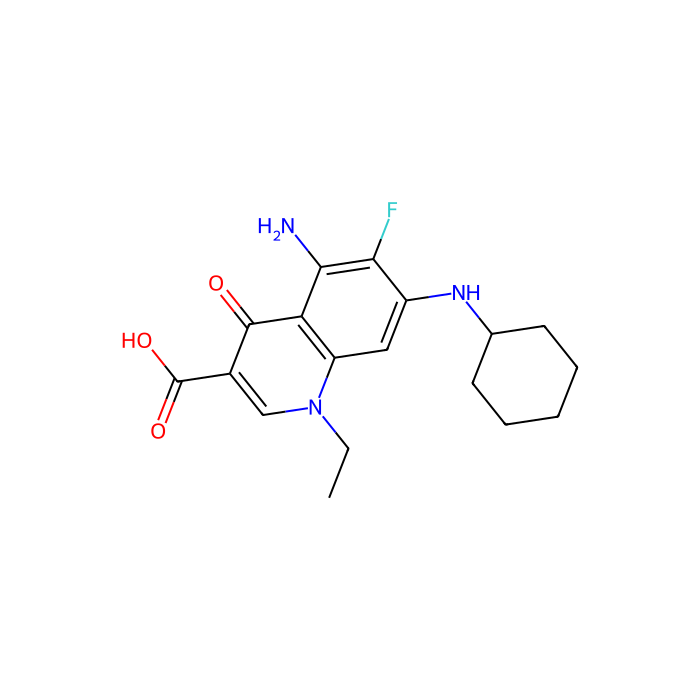
Potent and selective Foxo1 inhibitor (IC50values are 33 nM at Foxo1 and >1 μM at Foxo3a and Foxo4); decreases Foxo-mediated promoter activity by 70%, 20% and 3% at Foxo1, Foxo4 and Foxo3, respectively. Regulates gluconeogenesis bothin vitroandin vivo. Att
Condições de armazenamento de armazenamento
Store at -20°C
Enviado em
Ice chest + Ice pads
Este produto requer transporte de cadeia fria. Serviços terrestres e outros serviços econômicos não estão disponíveis.
This compound belongs to the class of organic compounds known as quinoline carboxylic acids. These are quinolines in which the quinoline ring system is substituted by a carboxyl group at one or more positions.
External Descriptors
Not available
1. Djoumbou Feunang Y, Eisner R, Knox C, Chepelev L, Hastings J, Owen G, Fahy E, Steinbeck C, Subramanian S, Bolton E, Greiner R, and Wishart DS. ClassyFire: Automated Chemical Classification With A Comprehensive, Computable Taxonomy. Journal of Cheminformatics, 2016, 8:61.
1.Yongkang Zhang, Haiyu Qin, Bowen Zu, Zichen Yu, Chunsheng Liu, Jianbo Shi, Bingsheng Zhou. (2025) Maternal Exposure to Environmentally Relevant Concentrations of Tris(2,4-di-tert-butylphenyl) Phosphate-Induced Developmental Toxicity in Zebrafish Offspring via Disrupting foxO1/ripor2 Signaling. ENVIRONMENTAL SCIENCE & TECHNOLOGY, [PMID:40087148][10.1021/acs.est.4c14581]
Calculadoras de soluções
Molarity Calculator
Determine the necessary mass, volume, or concentration for preparing a solution.
Dilution Calculator
Determine the dilution needed to prepare a stock solution.
Reconstitution Calculator
Revisões
Avaliações dos Clientes
Application Protocols
No tested or validated application protocols are provided for this item in the catalog entry.
Recommended dilutions, assay types (WB, IHC, IF, FC), or positive controls: Not specified for this item.
General guidance (non-validated, for planning only)
Stock preparation: Prepare a concentrated DMSO stock (e.g., 10–50 mM as solubility permits). Record exact concentration by weight-in-volume and, if needed, verify by UV or LC–MS.
Working solutions: Dilute into assay buffer or culture medium immediately before use; maintain constant vehicle concentration in all wells/samples.
Controls: Include vehicle controls and, where relevant, orthogonal reference compounds described in the literature. Predefine acceptance criteria (e.g., Z′ > 0.5 for HTS assays).
Please consult the primary literature for AS 1842856 and perform pilot experiments to optimize conditions for your specific model. These notes are general and not product-validated.
Biological Roles
Item-specific biological target or mechanism is not provided in this listing. The following remarks are general to small-molecule research probes and should be validated against primary literature before use.
Research probes are employed to modulate biochemical pathways transiently, enabling structure–function studies, pathway mapping, and phenotypic interrogation in cells or cell-free systems (general/literature).
Typical study designs include dose–response characterization, temporal profiling of downstream biomarkers, and orthogonal validation with genetic perturbations to confirm on-target effects (general practice).
When used in complex matrices (cell culture, lysates), consider plasma protein binding and membrane permeability as determinants of free concentration; employ controls such as P-gp/BCRP inhibitors only where justified and compliant with experimental design.
Off-target assessment: Parallel profiling in panels (kinases, receptors, enzymes) or chemoproteomic pulldown can help quantify selectivity and reduce misannotation of phenotypes (general guidance).
Note: No clinical/medical claims are made. For AS 1842856 specifically, consult primary references and the product CoA/SDS to confirm identity, purity, and any reported biological interactions relevant to your research question.
Buffer Applications
This product is not a buffering reagent. However, practical guidance is provided for incorporating small-molecule stocks into assay buffers.
Vehicle preparation (general): Dissolve the compound in dry DMSO to prepare a 10–50 mM stock (concentration as solubility permits). Filter if necessary through a low-protein-binding 0.2 µm PTFE syringe filter.
Buffer dilution: Add the DMSO stock to pre-equilibrated assay buffer (e.g., HEPES-, Tris-, or phosphate-buffered saline systems) to the desired final concentration while maintaining constant vehicle percentage across controls.
Surfactant use: If precipitation is observed upon dilution, add 0.01% v/v non-ionic surfactant (e.g., Tween-20) or increase protein carrier (e.g., 0.1% BSA) where compatible.
pH considerations: Avoid large pH changes upon dosing; add small volumes of concentrated stock to well-buffered systems to preserve pH and ionic strength.
Item-specific buffer compatibility and solubility limits are not provided here; verify experimentally for your assay conditions.
Green Alternatives
Green chemistry considerations are most relevant to the choice of solvent/vehicle and waste minimization when handling small-molecule probes.
Preferred vehicles (general): Where feasible, minimize DMSO volume and consider ethanol or aqueous-compatible formulations that reduce hazardous waste load, provided assay performance is maintained.
Micro-scale workflows: Utilize microplate formats and miniaturized dosing (nL–µL) to reduce solvent usage without sacrificing data quality.
Work-up and disposal: Consolidate organic waste streams; avoid halogenated solvents unless specifically required by the assay detection method.
Note: No item-specific solvent or stabilizer data are provided for AS 1842856 in this listing; select greener options only after confirming solubility/stability and assay compatibility.
Pharmaceutical Uses
No pharmacopeial or excipient status is provided for this item. This product is supplied strictly for research use only.
Formulation role: Not established for this listing; not intended for human or veterinary use.
Regulatory status: Not specified; not offered under GMP or pharmacopeial monographs via this listing. For any translational work, obtain appropriate grade and regulatory documentation from qualified suppliers.
Preformulation (general research context): If conducting in vitro ADME or formulation feasibility studies, characterize solubility (kinetic/thermodynamic), stability across pH 2–9, and compatibility with common excipients (e.g., cyclodextrins) as applicable to your laboratory research. These activities remain non-clinical and are outside the scope of this product’s intended use.
Physical Properties
Item-specific physicochemical specifications are not included in this listing.
Appearance: Not specified for this item; refer to CoA/Spec Sheet.
Melting point / Boiling point / Density / Refractive index: Not specified for this item; refer to CoA/Spec Sheet.
Solubility: Not specified for this item; refer to CoA/Spec Sheet.
LogP, pKa, UV cutoff: Not specified for this item; refer to CoA/Spec Sheet.
Research probes of this class are commonly supplied as dry solids for preparation of concentrated stock solutions in polar aprotic solvents (e.g., DMSO) for in vitro studies (literature/common practice).
Many bioactive small molecules exhibit limited aqueous solubility; co-solvents (DMSO) or surfactants (0.01–0.1% v/v non-ionic) are sometimes used to aid dispersion into aqueous buffers for biochemical assays (literature). Verify compatibility with your assay system and controls.
Hygroscopicity, polymorph behavior, and hydrate formation can influence measured physical constants; confirm against the batch CoA when critical to your protocol.
Quality and Grades
Item-specific grade/purity details are not listed here.
Grade/Purity: Not specified for this item; refer to CoA/Spec Sheet.
Appearance: Not specified for this item; refer to CoA/Spec Sheet.
How to interpret grades (general guidance)
Research-use small molecules are commonly offered as: screening grade, ≥95% by HPLC, or higher-purity research grades for mechanistic studies. The appropriate choice depends on assay sensitivity to trace impurities (literature/market norms).
If low UV background or analytical work is required, request a chromatogram and residual solvent profile from the CoA to ensure suitability.
Trace water/peroxide/metal specifications are not provided for this item; consult the CoA if your application is impurity-sensitive (e.g., biophysical binding assays).
Documentation and batch control
Each lot should be referenced by batch number on the label/CoA. Verify identity by orthogonal methods where critical (e.g., LC–MS, 1H NMR, HRMS) against the supplied identifiers.
If stability is a concern, request retest/expiry information and recommended thaw–freeze limits relevant to −20 °C storage.
Reaction and Applications
This catalog entry is positioned within a small-molecule/compound library and is typically used as a biochemical research probe rather than as a synthetic reagent.
Manufacturer application notes: Not provided for this item.
Typical research uses (literature/general):
Tool compound studies for pathway interrogation in cell-free or cellular assays; includes titration studies for concentration–response relationships and time-course experiments.
Orthogonal validation in combination with genetic perturbations (e.g., siRNA/CRISPR) to strengthen mechanism hypotheses.
Reference control in screening cascades to benchmark assay performance (Z′ factor, S/B) when an appropriate literature control exists.
Practical considerations (general)
Prepare fresh working solutions from frozen DMSO stocks to minimize degradation and adsorption losses.
Include vehicle controls at matching solvent percentages and, when relevant, non-specific control compounds to detect assay artifacts.
Use low-bind plastics or silanized glassware to mitigate nonspecific binding of hydrophobic analytes.
Note: No specific reaction chemistry (e.g., named synthetic reactions) is associated with this listing; for synthetic applications, consider dedicated building blocks with defined functional handles.
Reaction Conditions
No synthetic reaction conditions are associated with this listing. The product is intended for use as a small-molecule research probe rather than as a reagent or substrate in chemical transformations.
Item-specific catalytic systems, solvents, temperature ranges, or yields: Not specified for this item; refer to CoA/Spec Sheet if needed.
General notes (for handling in assays rather than synthesis)
Prepare stocks in dry, anhydrous solvents (commonly DMSO) and avoid prolonged exposure to ambient moisture if hygroscopic behavior is suspected.
Protect from light if the compound is reported in literature to be photosensitive; use amber vials and minimal light exposure during dosing (general precaution, not item-specific).
Validate stability over the assay timeframe (e.g., 0–24 h at 25–37 °C) using LC–MS where signal fidelity is critical.
For chemical reactions or derivatizations, select reagents from our synthetic reagents portfolio that include detailed reactivity and condition guidance.
Safety and Handling
Hazard classification details are not provided in this listing; always consult the SDS for authoritative safety information.
GHS classification / Signal word / H-statements / Pictograms: Not specified for this item; refer to SDS.
Primary storage guidance (item-specific): Store at −20 °C. Shipments are sent in an ice chest with ice pads to maintain a cold chain.
General laboratory precautions (good practice)
Handle in a fume hood or well-ventilated area; avoid inhalation of dusts/aerosols and contact with skin/eyes.
Wear appropriate PPE: lab coat, eye protection, and chemically resistant gloves (e.g., nitrile). Change gloves regularly when preparing DMSO concentrates.
Avoid uncontrolled heating; if thermal decomposition data are unknown, minimize exposure to elevated temperatures and ignition sources.
Prevent environmental release; collect waste in labeled, compatible containers for disposal according to institutional and regulatory requirements.
First-aid overview (general)
Skin/eye contact: Rinse with water for at least 15 minutes; remove contaminated clothing; seek medical attention if irritation persists.
Inhalation: Move to fresh air; seek medical attention if symptoms occur.
Ingestion: Rinse mouth; do not induce vomiting; seek medical attention.
Incompatibilities
Unknown for this specific item; as general practice, segregate from strong oxidizers/acids/bases until SDS confirms compatibility.
Solvent Selection
This product is a research-use small molecule typically prepared as a concentrated stock for in vitro use. Item-specific solubility data are not provided.
General/literature guidance for small-molecule probe preparation
Primary vehicle: Dimethyl sulfoxide (DMSO) is commonly used due to broad solvating power and compatibility with many biochemical assays.
Aqueous delivery: Dilute DMSO stocks into assay buffers immediately before use; maintain final DMSO at ≤0.1–0.5% v/v where assays are DMSO-sensitive (literature norms).
Alternative co-solvents: For systems intolerant to DMSO, consider ethanol or DMF in minimal amounts; validate compatibility with proteins/cells beforehand.
Surfactants: Low levels (e.g., 0.01% Tween-20) can help maintain dispersion in high-protein buffers; include vehicle controls to deconvolute surfactant effects.
Comparison (general)
DMSO vs ethanol: DMSO offers higher solvency for lipophilic probes; ethanol may be preferable for membrane studies but can perturb lipid phases at >0.5–1%.
Aqueous buffers: Use only after pre-dissolving in a miscible organic vehicle; direct addition of dry solids to buffer can yield heterogeneous dosing.
Note: For this item, specific solubility limits and solvent stability have not been established in this listing—confirm empirically or consult the CoA.
Storage and Reconstitution
Item-specific storage and shipping
Storage Conditions: Store at −20 °C (per product data).
Shipped In: Ice chest with ice pads to maintain cold conditions during transit (per product data).
Reconstitution (general guidance; not item-specific specification)
Allow the container to equilibrate to room temperature in a desiccated environment before opening to prevent condensation.
Prepare a concentrated stock in dry DMSO (typical 10–50 mM, as solubility allows). Vortex and, if necessary, brief sonication to aid dissolution. Use PTFE filters if sterile/particle-free solutions are required.
Aliquot stocks into low-bind microtubes to minimize freeze–thaw cycles. Label with concentration, solvent, date, and lot.
Stability management (general)
Store aliquots at −20 °C or below; avoid repeated freeze–thaw. Many small-molecule stocks are stable for months at −20 °C when protected from moisture and light; verify empirically by LC–MS/LC–UV for critical work (literature practice).
Thaw on ice or at room temperature just prior to use; refreeze promptly. Discard aliquots showing precipitation, discoloration, or unexpected assay behavior.
Note: No item-specific stability, hygroscopicity, or light-sensitivity data are provided here. For definitive instructions, consult the lot-specific CoA and SDS.
Structure and Identity
Brief overview: AS 1842856 is listed as a research-use-only small molecule in our small-molecule/compound library category.
SKU: A288204
Product Name: AS 1842856
CAS: 836620-48-5
PubChem CID (catalog reference): 72193864
InChIKey (as provided): 224441
SMILES: Not specified for this item; refer to CoA/Spec Sheet.
Molecular Formula: Not specified for this item; refer to CoA/Spec Sheet.
Molecular Weight: Not specified for this item; refer to CoA/Spec Sheet.
Structural notes
Item-specific structural representation is not provided in this listing. Please consult the product CoA/SDS for definitive identifiers.
Literature/general: AS 1842856 is described in the scientific literature as a small-molecule research probe. Specific ring systems, functional groups, and stereochemistry vary by the disclosed structure in primary sources; users should verify against their intended reference before use (literature).
Synthetic Utility
AS 1842856, as listed here, is intended as a research probe rather than a synthetic building block.
Functional group–based transformations: Not specified for this item; no reactive handle or protecting-group strategy is provided in this listing.
Use as coupling partner or intermediate: Not typical. For route development or library synthesis, prefer well-defined building blocks that carry orthogonally addressable functionalities (e.g., boronate esters, halides, carboxylic acids, amines) with documented reactivity and purity specifications.
Analytical verification: If derivatization is attempted for bioconjugation or immobilization studies, independently confirm structure and purity of both starting material and product using orthogonal techniques (LC–MS, NMR, HRMS), as no item-specific reactivity data are provided.
Conclusion: This item is not generally positioned for synthetic methodology development; consult our building-block categories for suitable reagents.
Target Specificity
Target or selectivity data are not provided for this item in the product listing.
Primary target/mechanism: Not specified for this item; refer to primary literature and the product CoA where applicable.
Off-target profile/panel data: Not specified for this item.
Species applicability and cross-reactivity: Not specified for this item.
Note: Any use as a biochemical probe should be supported by independent verification of identity, purity, and target engagement in your system of interest.
We use cookies to ensure the website functions properly and, where permitted, to improve your experience. You can manage your preferences at any time in Settings. Learn more in our Cookie Policy.
Shall we send you a message when we have discounts available?
Remind me later
Thank you! Please check your email inbox to confirm.
Products are supplied to verified businesses, institutions, and qualified professionals for research and development use only. Not for use in humans, animals, diagnosis, or therapy.

 C2624098