≥97% for sensitive chromatographic and analytical workflows requiring minimal baseline interference.
🌡
Storage & shipping
Store at -20°C Ships Ice chest + Ice pads Check lot-specific COA for exact specifications.
📋
Quality documents
SDS, COA, datasheet, and spec sheet available for download. Lot-specific COA accessible via lot number lookup.
📚
Literature proof
Cited in 0 peer-reviewed publications across chromatography, organic synthesis, and cross-coupling reactions.
Visão geral
Information
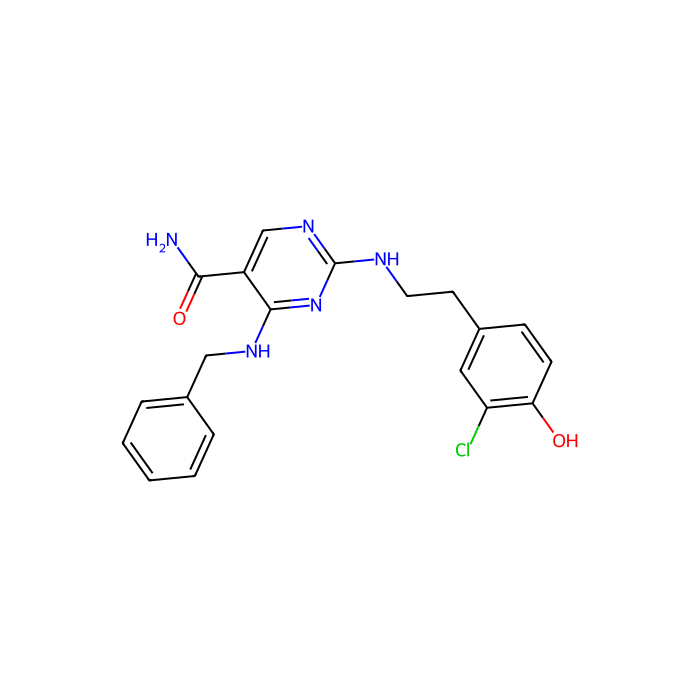
AS1517499 AS1517499 is a novel and potent STAT6 inhibitor with an IC50 value of 21 nM.
Targets
STAT6 (Cell-free assay) 21 nM
In vitro
AS1517499 inhibit IL-4-induced Th2 differentiation of mouse spleen T cells, but has no influence on Th1 differentiation induced by IL-12. AS1517499 is able to prevent the IL-4-activated STAT6-mediated increase of the clonogenic potential of primary PCa cells. At a dose of 300\u2009nM, AS1517499 decreases the clonogenic potential of primary basal PCa cells.
In vivo
In vivo treatment with AS1517499 ameliorates the antigen-induced bronchial smooth muscle (BSM) hyperresponsiveness by inhibiting the RhoA up-regulation in BSMs and, at least in part, by reducing the IL-13 production in the airways in mice. AS1517499 reduces preventive effects of apoptotic cell instillation on bleomycin-induced lung fibrosis by suppressing PPARγ.
This compound belongs to the class of organic compounds known as pyrimidinecarboxamides. These are compounds containing a pyrimidine ring which bears a carboxamide.
External Descriptors
Not available
1. Djoumbou Feunang Y, Eisner R, Knox C, Chepelev L, Hastings J, Owen G, Fahy E, Steinbeck C, Subramanian S, Bolton E, Greiner R, and Wishart DS. ClassyFire: Automated Chemical Classification With A Comprehensive, Computable Taxonomy. Journal of Cheminformatics, 2016, 8:61.
Determine the necessary mass, volume, or concentration for preparing a solution.
Dilution Calculator
Determine the dilution needed to prepare a stock solution.
Reconstitution Calculator
Revisões
Avaliações dos Clientes
Application Protocols
Validated application types, recommended dilutions, and positive controls are not specified for this product.
General workflow for using small-molecule library compounds in assays:
Stock solution: Prepare 10–50 mM in anhydrous DMSO. Record exact concentration by weight-in or by quantitative NMR/UV if needed.
Plate handling: Dispense by acoustic or pin tool transfer to minimize DMSO and improve precision. Include vehicle controls matching the highest DMSO level.
Titration: Use 8–12 point serial dilutions (e.g., 1:3 or 1:2) to define concentration–response; pre-wet tips/lines to reduce adsorption.
Incubation: Optimize time and temperature per assay format; confirm compound stability across the incubation window by LC–MS.
Data quality: Include Z′ controls, replicate wells, and orthogonal readouts to flag assay interference (e.g., fluorescence quenchers, redox cyclers). Apply counterscreens if applicable.
These steps are general recommendations and not product specifications.
Biological Roles
Item-specific biological target information is not provided in the Product Data. The compound is supplied strictly for research use.
General considerations for small-molecule research tools:
Small molecules may serve as chemical probes in pathway interrogation, phenotypic screening, or as controls in biochemical assays. Any putative biological roles or targets must be confirmed from primary literature or validated in-house assays for your specific system.
Prior to use in cell-based studies, determine cytotoxicity windows and vehicle tolerability. Perform dose–response evaluations over a broad concentration range (e.g., 10-point, 3-fold serial dilutions) and include appropriate positive/negative controls.
Evaluate stability in biological matrices (e.g., serum-containing media) and potential nonspecific binding to serum proteins or plastics, which can shift apparent potency.
Avoid extrapolating to clinical or therapeutic relevance; this product is not intended for human or veterinary use.
Buffer Applications
This product is a discrete small molecule rather than a buffering agent. It does not define buffer capacity or a specific pH range.
Practical notes for use of small molecules in buffers (general):
Prepare concentrated DMSO stocks and dilute into assay buffer with vigorous mixing to target final DMSO ≤0.5–1% v/v (assay-dependent).
If precipitation occurs, consider:
Adjusting ionic strength or adding a modest percentage of co-solvent (e.g., 1–5% DMSO or 5–20% acetonitrile), consistent with assay tolerance.
Titrating pH if an ionizable functionality is present (verify from structure) to enhance solubility near the ionized state.
Filter if particulate matter persists (0.2 µm) and confirm no adsorption losses for low-concentration studies.
Green Alternatives
When working with small-molecule library compounds, the main environmental lever is solvent choice and process minimization rather than substitution of the compound itself.
Greener solvent considerations (general):
Prefer lower-toxicity, biodegradable, or biorenewable solvents for preparative handling when compatible with solubility and assay constraints.
Comparison (general guidance):
DMSO vs. alternatives
Advantages: exceptional solvency, miscible with water, thermally stable.
Tradeoffs: persistence and high boiling point complicate waste handling.
Greener co-solvents to consider (where compatible):
Ethanol or isopropanol (biobased grades available) for intermediate solubility and ease of removal.
Water-buffer systems with minimal organic content when solubility allows.
Acetonitrile has favorable environmental metrics relative to DMF/NMP for analytical workflows, though not biorenewable.
Avoid where possible: DMF and NMP due to reproductive toxicity classifications; use only if necessary and with engineering controls.
Operational measures:
Minimize stock volumes; centralize “mother plates” and replicate by acoustic or pin transfer to reduce solvent use.
Consolidate and segregate solvent waste streams to enable recovery/recycling programs.
Use energy-efficient cold storage (−20 °C) with inventory management to limit freeze–thaw cycles and losses.
Pharmaceutical Uses
No pharmacopeial status, excipient role, or formulation specifications are provided for this item. It is supplied strictly for research use only.
General R&D context (non-clinical):
Small-molecule research compounds may be used to prototype dosage forms for preformulation studies (e.g., solubility screening, salt/co-crystal scouting) or to evaluate analytical methods (HPLC/LC–MS) in development labs.
Any activities related to GMP manufacturing, clinical use, or human/animal administration are out of scope for this product. Do not use in diagnostic, therapeutic, or veterinary applications.
If formulation-like work is performed for in vitro studies, record excipient compatibility, solvent residues, and stability indicating methods; none of these parameters are specified for this SKU and must be established by the user.
Physical Properties
Item-specific values are not provided in the Product Data for this catalog entry.
Appearance: Not specified for this item; refer to CoA/Spec Sheet.
Melting point, boiling point, density, refractive index: Not specified for this item; refer to CoA/Spec Sheet.
Solubility: Not specified for this item; refer to CoA/Spec Sheet.
LogP, pKa: Not specified for this item; refer to CoA/Spec Sheet.
Practical guidance (general/literature-based for small-molecule screening compounds):
For initial handling, prepare a 10–50 mM DMSO stock solution; many drug-like small molecules show good solubility in anhydrous DMSO. If precipitation occurs, sonication and gentle warming (≤40 °C water bath) can help dissolution.
For aqueous assays, dilute DMSO stocks into buffer while keeping final DMSO ≤0.5–1% v/v when compatible with your biology/assay system. Add compound solution last while mixing to minimize local supersaturation.
If the compound contains ionizable groups (to be confirmed from structure), solubility can be adjusted by pH within 1–2 units of the pKa (literature concept). Use volatile bases/acids (e.g., NH4OH, HOAc) when LC–MS readout is planned.
Hygroscopicity, polymorphism, and hydrate/solvate states can influence measured properties; verify against lot-specific CoA where available.
Quality and Grades
Grade/Purity: Not specified for this item; refer to CoA/Spec Sheet.
Interpretation and general guidance for small-molecule screening compounds:
Screening/Discovery-grade small molecules are commonly supplied at ≥95% HPLC purity with LC–MS identity confirmation; however, this cannot be assumed for this SKU without the CoA. Always verify assay-critical attributes (purity, identity, counter‑ion content, residual solvents) from the lot-specific CoA.
UV/Vis background and fluorescence: For bioassays with optical readouts, confirm UV cutoff and intrinsic fluorescence where relevant. Low-UV/low-fluorescence grades may be preferred for HTS, but values are not specified for this item.
Metal content/residual reagents: Not specified for this item; refer to CoA/Spec Sheet. If the compound will be used in metal-sensitive applications (e.g., cell-based assays impacted by trace metals), consider additional purification or metal scavenging as needed.
Stabilizers: Not specified for this item; refer to CoA/Spec Sheet. If a stabilizer is present, assess assay compatibility before use.
Recommended qualification steps: Record lot number; check identity by LC–MS; verify purity by analytical HPLC; document water content by Karl Fischer if hygroscopic behavior is suspected in your workflow.
Reaction and Applications
This catalog entry is positioned as a small-molecule/compound-library member. It is typically applied as a chemical probe or reference standard in discovery workflows rather than as a synthetic reagent.
Typical research applications (general):
Assay development and screening: Use as a test article in biochemical or biophysical assays, high-throughput or focused screening, and SAR benchmarking. Prepare accurately quantified DMSO stocks and include vehicle controls.
Analytical reference: Employ for retention-time matching and qualitative LC–MS confirmation where an authenticated standard is desired.
Mechanistic and target engagement studies: Suitable for orthogonal readouts (e.g., DSF, SPR, MST) when solubility and optical properties permit; confirm compatibility to avoid signal artifacts.
Not typically applicable:
This item is not primarily used as a general-purpose reagent for named synthetic reactions; if a building-block role is intended, consult structural data to identify functional handles and standard coupling conditions.
Good practices:
Verify identity/purity by LC–MS prior to critical experiments.
Assess compound stability in assay buffer over the test window (e.g., 0–24 h) by LC–UV/LC–MS; track potential adsorption to plastics at low nM dosing.
Implement serial dilution using intermediate plates to minimize DMSO carryover and concentration errors.
Reaction Conditions
Not directly applicable: this product is not provided as a reagent for named organic transformations, and no structure is specified to derive reactivity. Consequently, item-specific reaction conditions cannot be recommended.
General notes (only if derivatization is undertaken after structure confirmation):
Solvents: Choose per functional group reactivity (e.g., DMF/DCM/MeCN for couplings; toluene/1,4-dioxane for elevated-temperature cross-couplings). When feasible, use greener alternatives such as Me-THF or CPME.
Temperatures: Ambient to reflux depending on transformation and stability profile; monitor by TLC/LC–MS.
Catalysts/bases: Pd catalysts for cross-coupling, carbodiimides or uronium salts for amidation, etc.—strictly contingent on confirmed functional groups.
Workup/purification: Quench carefully, extract with appropriate solvents, and purify by flash chromatography or preparative HPLC as required. Validate identity by NMR and HRMS.
For most users, application will center on assay work rather than synthesis; see Solvent Selection and Application Protocols for practical use.
Safety and Handling
GHS classification, signal word, hazard statements, and pictograms: Not specified for this item; refer to the product SDS for authoritative safety information.
General laboratory PPE: lab coat, safety glasses or goggles, and suitable chemical-resistant gloves (e.g., nitrile). Work in a fume hood to avoid inhalation of dust or aerosols.
Handling: Avoid dust generation. Do not breathe dust, vapors, or spray. Avoid contact with skin and eyes. Wash hands thoroughly after handling.
Storage conditions (item-specific): Store at −20 °C (per Product Data). Keep container tightly closed, in a dry, well-ventilated place. Protect from light and moisture as good practice for small molecules unless CoA indicates otherwise.
Incompatibilities (general): Strong oxidizers, strong acids/bases, and reactive reducing agents may be incompatible depending on functional groups (confirm from SDS/structure). Segregate accordingly.
First aid (general): If inhaled, move to fresh air; seek medical advice if symptoms persist. On skin contact, wash with soap and water. On eye contact, rinse cautiously with water for several minutes; remove contact lenses if present and easy to do. If swallowed, rinse mouth; obtain medical attention.
Spill/leak response: Avoid dust, absorb with inert material, and place in chemical waste container. Decontaminate area following institutional procedures.
Disposal: Dispose of contents/container in accordance with local/regional regulations. Defer to SDS for EHS specifics.
Solvent Selection
Given this product is a small-molecule library compound and item-specific solubility data are not provided, select solvents empirically based on assay needs and general best practices.
Primary stock solvent (common practice):
DMSO (anhydrous) for 10–50 mM stocks; broad solvating power for drug-like molecules; compatible with most biochemical assays at ≤0.5–1% v/v final.
Alternative organic solvents (as needed):
DMF, NMP for challenging solubility; ensure assay and material compatibility.
Ethanol or isopropanol for cases requiring miscibility with aqueous buffers and reduced DMSO content.
Acetonitrile for LC applications or when rapid evaporation is desired.
Aqueous use:
Prepare concentrated organic stock; dilute into buffered media under vigorous mixing to minimize precipitation. If necessary, include a co-solvent system (e.g., 10–20% ACN or 1–5% DMSO) verified against assay tolerance.
Dielectric/polarity notes (general):
DMSO and DMF (high dielectric) solvate polar/ionizable functionalities; alcohols offer intermediate polarity; ACN provides high polarity with lower viscosity.
Practical tips:
Filter through 0.2 µm PTFE if particles are observed (verify no adsorption losses for low-dose assays).
Avoid plasticizer extraction: use glass vials for concentrated DMSO stocks and storage at −20 °C.
Document solvent lot and water content for reproducibility in screening.
Storage and Reconstitution
Storage (item-specific): Store at −20 °C (per Product Data). Shipments are provided in an ice chest with ice pads; promptly place into −20 °C storage upon receipt.
Container: Keep tightly closed in the original container. Protect from moisture and light as a precaution for small molecules unless otherwise indicated by the CoA.
Reconstitution (general guidance):
Prepare concentrated stocks in anhydrous DMSO (e.g., 10–50 mM). If needed, warm gently (≤40 °C) and sonicate briefly to aid dissolution.
For aqueous use, dilute the DMSO stock into buffer with vigorous mixing; maintain final DMSO at an assay-compatible level (commonly ≤0.5–1% v/v).
Freeze–thaw: Minimize cycles by aliquoting stocks into single-use volumes. Avoid repeated warming; store working aliquots at −20 °C in sealed, inert-atmosphere vials when feasible.
Stability: Item-specific stability, hygroscopicity, and light sensitivity are not specified for this item; refer to CoA/Spec Sheet and perform in-house stability checks (e.g., LC–MS after 1–2 weeks at storage conditions).
Research Use Note: For research use only.
Structure and Identity
Product name: AS1517499 (SKU: A414116)
CAS: 919486-40-1
PubChem CID: 10340781
InChIKey (as provided): 271734
SMILES: Not specified for this item; refer to CoA/Spec Sheet.
Molecular formula: Not specified for this item; refer to CoA/Spec Sheet.
Molecular weight: Not specified for this item; refer to CoA/Spec Sheet.
Structural description (general):
This product is listed under “small molecules and compound libraries,” indicating a discrete organic small-molecule research compound rather than a polymer, biopolymer, or inorganic salt.
Without an item-specific structure (SMILES/InChI), functional groups, ring systems, and stereochemistry cannot be confirmed for this lot. Users should consult the accompanying CoA/SDS or authoritative databases keyed by CAS 919486-40-1 for definitive structural details.
Notes on identifiers (general guidance):
CAS and PubChem CID are typically sufficient to retrieve a fully annotated structure if needed for cheminformatics, docking, or LIMS registration. Ensure that any derived properties are recorded as “literature/computed” rather than item specifications for compliance.
Synthetic Utility
This catalog entry is positioned as a screening/compound-library molecule rather than a synthetic building block; specific functional handles are not provided in the Product Data. Accordingly, item-directed synthetic transformations cannot be recommended without the confirmed structure.
General guidance if synthetic modification is intended:
Retrieve the definitive structure from CoA/SDS or authoritative databases using CAS 919486-40-1 before planning derivatization.
Map potential functional groups (e.g., amides, heteroaromatics, halides) to standard transformations such as cross-couplings (Suzuki–Miyaura, Buchwald–Hartwig), amide couplings (EDC/HATU), or reductive alkylations as applicable.
Establish stability toward acids/bases, oxidants/reductants, and heat prior to late-stage diversification or bioconjugation.
For SAR exploration, consider parallel synthesis constraints (solubility, purification strategy, UV response). Develop orthogonal LC methods if the scaffold is weakly UV-active.
If no synthetic work is planned, treat the compound as a fixed chemical probe and focus on analytical verification, solubility, and stability for your assays.
Target Specificity
Target, pathway, or enzyme specificity is not provided for this item in the Product Data. No claims are made regarding biological targets or selectivity.
Any target engagement, selectivity profile, or off-target assessment should be established by the user via appropriate biochemical, biophysical, or cellular assays.
Cite results as “in-house data” or “literature values” as appropriate, and do not treat them as product specifications.
We use cookies to ensure the website functions properly and, where permitted, to improve your experience. You can manage your preferences at any time in Settings. Learn more in our Cookie Policy.
Shall we send you a message when we have discounts available?
Remind me later
Thank you! Please check your email inbox to confirm.
Products are supplied to verified businesses, institutions, and qualified professionals for research and development use only. Not for use in humans, animals, diagnosis, or therapy.

 I2208474