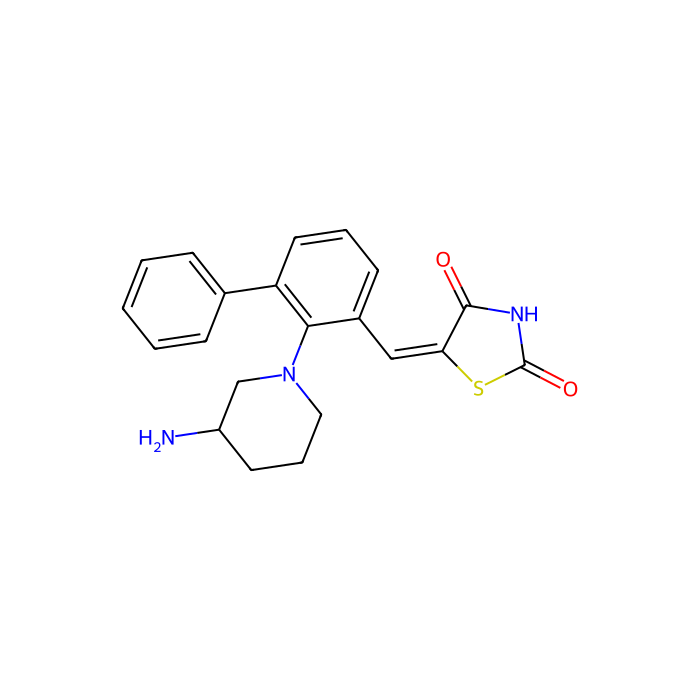
AZD1208 - Moligand™, 10mM in DMSO , Inhibitor of Pim-1 proto-oncogene; serine/threonine kinase;Inhibitor of Pim-2 proto-oncogene; serine/threonine kinase;Inhibitor of Pim-3 proto-oncogene; serine/threonine kinase, CAS No.1204144-28-4, Inhibitor of Pim-1 proto-oncogene; serine/threonine kinase;Inhibitor of Pim-2 proto-oncogene; serine/threonine kinase;Inhibitor of Pim-3 proto-oncogene; serine/threonine kinase

CAS: 1204144-28-4 Cat. No.: A420898 Fórmula: C21H21N3O2S Peso molecular: 379.48
Disponível para encomenda
GRADE & PURITY Moligand™ ? Moligand™ — Aladdin's line of ligands and bioactive small molecules. Use for receptor, pathway, and binding studies needing defined small-molecule tools. 10mM in DMSO
Synonyms
AZD 1208 [WHO-DD] | Q27074698 | FT-0633869 | J-013789 | HY-15604 | S98NFM1378 | SW219766-1 | 1204144-28-4 | AZ-1208 | (R,Z)-5-((2-(3-Aminopiperidin-1-yl)biphenyl-3-yl)methylene)thiazolidine-2,4-dione | AZD1208 | AZD-1208 | NSC776066 | NSC-776066 | (R,Z)-5
Storage
Store at -80°C
Shipped In
Dry ice packs + Cold packs
★
Size
Alemanha (EU)
USA*
Price
Qty
1ml
A420898-1ml
Sob encomenda · 8–12 semanas

163,92€

209,91€
Gravar 45,99 € (21.91%)
Enter a quantity for the sizes you want to add.
🧪
Why this grade

Moligand™, 10mM in DMSO Moligand™ for sensitive chromatographic and analytical workflows requiring minimal baseline interference.

🌡

Storage & shipping

Store at -80°C Ships Dry ice packs + Cold packs Check lot-specific COA for exact specifications.

📋

Quality documents

SDS, COA, datasheet, and spec sheet available for download. Lot-specific COA accessible via lot number lookup.

📚

Literature proof

Cited in 0 peer-reviewed publications across chromatography, organic synthesis, and cross-coupling reactions.

Visão geral

AZD1208 is a potent, and orally available Pim kinase inhibitor with IC50 of 0.4 nM, 5 nM, and 1.9 nM for Pim1, Pim2, and Pim3 in cell-free assays, respectively.

Specifications

Sinónimos
AZD 1208 [WHO-DD] | Q27074698 | FT-0633869 | J-013789 | HY-15604 | S98NFM1378 | SW219766-1 | 1204144-28-4 | AZ-1208 | (R,Z)-5-((2-(3-Aminopiperidin-1-yl)biphenyl-3-yl)methylene)thiazolidine-2,4-dione | AZD1208 | AZD-1208 | NSC776066 | NSC-776066 | (R,Z)-5
Especificações e pureza
Moligand™, 10mM in DMSO
Mecanismos bioquímicos e fisiológicos
Potent pan Pim kinase inhibitor (IC50values are 0.4, 1.9 and 5.0 nM for Pim-1, 3 and 2, respectively). Exhibits >43-fold higher affinity for Pim kinases over a range of other kinases. Induces cell cycle arrest and apoptosis in AML cell linesin vitroand in
Condições de armazenamento de armazenamento
Store at -80°C
Enviado em
Dry ice packs + Cold packs
Este produto requer transporte de cadeia fria. Serviços terrestres e outros serviços econômicos não estão disponíveis.
Grau
Moligand™
Tipo de ação
INHIBITOR
Mecanismo de ação
Inhibitor of Pim-1 proto-oncogene; serine/threonine kinase;Inhibitor of Pim-2 proto-oncogene; serine/threonine kinase;Inhibitor of Pim-3 proto-oncogene; serine/threonine kinase
Nomes e identificadores
Sorrisos canónicosC1CC(CN(C1)C2=C(C=CC=C2C3=CC=CC=C3)C=C4C(=O)NC(=O)S4)N
IUPAC Name(5Z)-5-[[2-[(3R)-3-aminopiperidin-1-yl]-3-phenylphenyl]methylidene]-1,3-thiazolidine-2,4-dione
InChIKeyMCUJKPPARUPFJM-UWCCDQBKSA-N
INCHI1S/C21H21N3O2S/c22-16-9-5-11-24(13-16)19-15(12-18-20(25)23-21(26)27-18)8-4-10-17(19)14-6-2-1-3-7-14/h1-4,6-8,10,12,16H,5,9,11,13,22H2,(H,23,25,26)/b18-12-/t16-/m1/s1
SMILES isoméricas C1C[C@H](CN(C1)C2=C(C=CC=C2C3=CC=CC=C3)/C=C\4/C(=O)NC(=O)S4)N
Peso molecular 379.48
Reaxy-Rn 30682637
Reaxys-RN_link_address https://www.reaxys.com/reaxys/secured/hopinto.do?context=S&query=IDE.XRN=30682637&ln=

Documentation

📋 Safety Data Sheet (SDS)

Comprehensive hazard, handling, storage, and regulatory compliance document.

Download SDS →

✅ Certificate of Analysis (COA)

Lot-specific quality data. Enter your lot number to retrieve the exact COA.

Look up COA →

📊 Datasheet

Quick-reference summary of product specifications and applications.

View datasheet →

🔬 Specification Sheet

Full quality attributes and acceptance criteria for this grade.

View spec sheet →

Advanced Data

Taxonomic Classification

Taxonomy Tree

KingdomOrganic compounds
SuperclassOrganoheterocyclic compounds
ClassePiperidines
SubclassPhenylpiperidines
Intermediate Tree Nodes Not available
Direct ParentPhenylpiperidines
Alternative Parents Biphenyls and derivatives  Dialkylarylamines  Aniline and substituted anilines  Thiazolidinediones  Aminopiperidines  Dicarboximides  Thiocarbamic acid derivatives  Amino acids and derivatives  Azacyclic compounds  Organic oxides  Monoalkylamines  Hydrocarbon derivatives  Carbonyl compounds  
Molecular FrameworkAromatic heteromonocyclic compounds
Substituents Biphenyl - Phenylpiperidine - Aniline or substituted anilines - Dialkylarylamine - Tertiary aliphatic/aromatic amine - 3-aminopiperidine - Thiazolidinedione - Monocyclic benzene moiety - Benzenoid - Thiazolidine - Dicarboximide - Amino acid or derivatives - Thiocarbamic acid derivative - Tertiary amine - Azacycle - Carboxylic acid derivative - Amine - Organonitrogen compound - Primary aliphatic amine - Organooxygen compound - Primary amine - Carbonyl group - Hydrocarbon derivative - Organic oxide - Organic oxygen compound - Organic nitrogen compound - Aromatic heteromonocyclic compound
DescriçãoThis compound belongs to the class of organic compounds known as phenylpiperidines. These are compounds containing a phenylpiperidine skeleton, which consists of a piperidine bound to a phenyl group.
External Descriptors Not available
Estrutura 3D
Modelo de Estrutura Química Interativa


Alvos associados (humanos)
PIM1 Tchem Serine/threonine-protein kinase pim-1 (7 Activities)
Activity TypeActivity Value -log(M)Mechanism of ActionActivity ReferencePublications (PubMed IDs)
PIM2 Tchem Serine/threonine-protein kinase pim-2 (5 Activities)
Activity TypeActivity Value -log(M)Mechanism of ActionActivity ReferencePublications (PubMed IDs)
PIM3 Tchem Serine/threonine-protein kinase pim-3 (6 Activities)
Activity TypeActivity Value -log(M)Mechanism of ActionActivity ReferencePublications (PubMed IDs)
ABL1 Tclin Tyrosine-protein kinase ABL (18331 Activities)
Activity TypeRelationActivity valueUnitsAction TypeJournalPubMed IddoiAssay Aladdin ID
EGFR Tclin Epidermal growth factor receptor erbB1 (33727 Activities)
Activity TypeRelationActivity valueUnitsAction TypeJournalPubMed IddoiAssay Aladdin ID
INSR Tclin Insulin receptor (5558 Activities)
Activity TypeRelationActivity valueUnitsAction TypeJournalPubMed IddoiAssay Aladdin ID
TOP2A Tclin DNA topoisomerase II alpha (6317 Activities)
Activity TypeRelationActivity valueUnitsAction TypeJournalPubMed IddoiAssay Aladdin ID
IMPDH2 Tclin Inosine-5'-monophosphate dehydrogenase 2 (1326 Activities)
Activity TypeRelationActivity valueUnitsAction TypeJournalPubMed IddoiAssay Aladdin ID
KCNH2 Tclin HERG (29587 Activities)
Activity TypeRelationActivity valueUnitsAction TypeJournalPubMed IddoiAssay Aladdin ID
PDGFRB Tclin Platelet-derived growth factor receptor beta (5195 Activities)
Activity TypeRelationActivity valueUnitsAction TypeJournalPubMed IddoiAssay Aladdin ID
IGF1R Tclin Insulin-like growth factor I receptor (8605 Activities)
Activity TypeRelationActivity valueUnitsAction TypeJournalPubMed IddoiAssay Aladdin ID
DCK Tchem Deoxycytidine kinase (530 Activities)
Activity TypeRelationActivity valueUnitsAction TypeJournalPubMed IddoiAssay Aladdin ID
MAPK11 Tchem MAP kinase p38 beta (2785 Activities)
Activity TypeRelationActivity valueUnitsAction TypeJournalPubMed IddoiAssay Aladdin ID
LCK Tclin Tyrosine-protein kinase LCK (9212 Activities)
Activity TypeRelationActivity valueUnitsAction TypeJournalPubMed IddoiAssay Aladdin ID
NQO2 Tchem Quinone reductase 2 (885 Activities)
Activity TypeRelationActivity valueUnitsAction TypeJournalPubMed IddoiAssay Aladdin ID
ADK Tchem Adenosine kinase (1481 Activities)
Activity TypeRelationActivity valueUnitsAction TypeJournalPubMed IddoiAssay Aladdin ID
MAPK14 Tchem MAP kinase p38 alpha (12866 Activities)
Activity TypeRelationActivity valueUnitsAction TypeJournalPubMed IddoiAssay Aladdin ID
AK2 Tbio Adenylate kinase 2 (264 Activities)
Activity TypeRelationActivity valueUnitsAction TypeJournalPubMed IddoiAssay Aladdin ID
GSK3B Tclin Glycogen synthase kinase-3 beta (11785 Activities)
Activity TypeRelationActivity valueUnitsAction TypeJournalPubMed IddoiAssay Aladdin ID
PRKACB Tchem cAMP-dependent protein kinase beta-1 catalytic subunit (589 Activities)
Activity TypeRelationActivity valueUnitsAction TypeJournalPubMed IddoiAssay Aladdin ID
MAP2K6 Tchem Dual specificity mitogen-activated protein kinase kinase 6 (1284 Activities)
Activity TypeRelationActivity valueUnitsAction TypeJournalPubMed IddoiAssay Aladdin ID
MYLK Tchem Myosin light chain kinase, smooth muscle (1267 Activities)
Activity TypeRelationActivity valueUnitsAction TypeJournalPubMed IddoiAssay Aladdin ID
CSNK1G1 Tchem Casein kinase I gamma 1 (2496 Activities)
Activity TypeRelationActivity valueUnitsAction TypeJournalPubMed IddoiAssay Aladdin ID
FGFR1 Tclin Fibroblast growth factor receptor 1 (9149 Activities)
Activity TypeRelationActivity valueUnitsAction TypeJournalPubMed IddoiAssay Aladdin ID
STK3 Tchem Serine/threonine-protein kinase MST2 (3069 Activities)
Activity TypeRelationActivity valueUnitsAction TypeJournalPubMed IddoiAssay Aladdin ID
PRKAG1 Tchem AMP-activated protein kinase, gamma-1 subunit (254 Activities)
Activity TypeRelationActivity valueUnitsAction TypeJournalPubMed IddoiAssay Aladdin ID
CSNK1D Tchem Casein kinase I delta (4546 Activities)
Activity TypeRelationActivity valueUnitsAction TypeJournalPubMed IddoiAssay Aladdin ID
MAP2K5 Tchem Dual specificity mitogen-activated protein kinase kinase 5 (650 Activities)
Activity TypeRelationActivity valueUnitsAction TypeJournalPubMed IddoiAssay Aladdin ID
SRC Tclin Tyrosine-protein kinase SRC (10310 Activities)
Activity TypeRelationActivity valueUnitsAction TypeJournalPubMed IddoiAssay Aladdin ID
MAP2K3 Tchem Dual specificity mitogen-activated protein kinase kinase 3 (632 Activities)
Activity TypeRelationActivity valueUnitsAction TypeJournalPubMed IddoiAssay Aladdin ID
PRKAG2 Tchem AMP-activated protein kinase, gamma-2 subunit (243 Activities)
Activity TypeRelationActivity valueUnitsAction TypeJournalPubMed IddoiAssay Aladdin ID
AKT2 Tchem Serine/threonine-protein kinase AKT2 (4301 Activities)
Activity TypeRelationActivity valueUnitsAction TypeJournalPubMed IddoiAssay Aladdin ID
AKT3 Tchem Serine/threonine-protein kinase AKT3 (3157 Activities)
Activity TypeRelationActivity valueUnitsAction TypeJournalPubMed IddoiAssay Aladdin ID
GRK2 Tchem G-protein coupled receptor kinase 2 (1019 Activities)
Activity TypeRelationActivity valueUnitsAction TypeJournalPubMed IddoiAssay Aladdin ID
PYGB Tchem Brain glycogen phosphorylase (474 Activities)
Activity TypeRelationActivity valueUnitsAction TypeJournalPubMed IddoiAssay Aladdin ID
AURKB Tchem Serine/threonine-protein kinase Aurora-B (6805 Activities)
Activity TypeRelationActivity valueUnitsAction TypeJournalPubMed IddoiAssay Aladdin ID
RPS6KA4 Tchem Ribosomal protein S6 kinase alpha 4 (2104 Activities)
Activity TypeRelationActivity valueUnitsAction TypeJournalPubMed IddoiAssay Aladdin ID
ROCK1 Tclin Rho-associated protein kinase 1 (4723 Activities)
Activity TypeRelationActivity valueUnitsAction TypeJournalPubMed IddoiAssay Aladdin ID
PIM1 Tchem Serine/threonine-protein kinase PIM1 (9629 Activities)
Activity TypeRelationActivity valueUnitsAction TypeJournalPubMed IddoiAssay Aladdin ID
PKN2 Tchem Protein kinase N2 (1991 Activities)
Activity TypeRelationActivity valueUnitsAction TypeJournalPubMed IddoiAssay Aladdin ID
CSK Tchem Tyrosine-protein kinase CSK (2395 Activities)
Activity TypeRelationActivity valueUnitsAction TypeJournalPubMed IddoiAssay Aladdin ID
RPS6KA5 Tchem Ribosomal protein S6 kinase alpha 5 (3355 Activities)
Activity TypeRelationActivity valueUnitsAction TypeJournalPubMed IddoiAssay Aladdin ID
PRKD3 Tchem Protein kinase C nu (2315 Activities)
Activity TypeRelationActivity valueUnitsAction TypeJournalPubMed IddoiAssay Aladdin ID
PRKCI Tchem Protein kinase C iota (2821 Activities)
Activity TypeRelationActivity valueUnitsAction TypeJournalPubMed IddoiAssay Aladdin ID
SYK Tclin Tyrosine-protein kinase SYK (7372 Activities)
Activity TypeRelationActivity valueUnitsAction TypeJournalPubMed IddoiAssay Aladdin ID
PLK1 Tchem Serine/threonine-protein kinase PLK1 (28605 Activities)
Activity TypeRelationActivity valueUnitsAction TypeJournalPubMed IddoiAssay Aladdin ID
JAK1 Tclin Tyrosine-protein kinase JAK1 (8569 Activities)
Activity TypeRelationActivity valueUnitsAction TypeJournalPubMed IddoiAssay Aladdin ID
RPS6KA1 Tchem Ribosomal protein S6 kinase alpha 1 (2796 Activities)
Activity TypeRelationActivity valueUnitsAction TypeJournalPubMed IddoiAssay Aladdin ID
RPS6KA6 Tchem Ribosomal protein S6 kinase alpha 6 (2027 Activities)
Activity TypeRelationActivity valueUnitsAction TypeJournalPubMed IddoiAssay Aladdin ID
PFKP Tbio Phosphofructokinase platelet type (224 Activities)
Activity TypeRelationActivity valueUnitsAction TypeJournalPubMed IddoiAssay Aladdin ID
CSNK1E Tclin Casein kinase I epsilon (1412 Activities)
Activity TypeRelationActivity valueUnitsAction TypeJournalPubMed IddoiAssay Aladdin ID
GSK3A Tclin Glycogen synthase kinase-3 alpha (3764 Activities)
Activity TypeRelationActivity valueUnitsAction TypeJournalPubMed IddoiAssay Aladdin ID
PRKG1 Tchem cGMP-dependent protein kinase 1 beta (2814 Activities)
Activity TypeRelationActivity valueUnitsAction TypeJournalPubMed IddoiAssay Aladdin ID
Alvos associados (não humanos)
Cdk4 Cyclin-dependent kinase 4 (3 Activities)
Activity TypeRelationActivity valueUnitsAction TypeJournalPubMed IddoiAssay Aladdin ID
Pygl Liver glycogen phosphorylase (81 Activities)
Activity TypeRelationActivity valueUnitsAction TypeJournalPubMed IddoiAssay Aladdin ID
Prkcd Protein kinase C delta (192 Activities)
Activity TypeRelationActivity valueUnitsAction TypeJournalPubMed IddoiAssay Aladdin ID
Prkcb Protein kinase C beta (2 Activities)
Activity TypeRelationActivity valueUnitsAction TypeJournalPubMed IddoiAssay Aladdin ID
Mapk1 MAP kinase ERK2 (650 Activities)
Activity TypeRelationActivity valueUnitsAction TypeJournalPubMed IddoiAssay Aladdin ID
Hdac6 Histone deacetylase 6 (222 Activities)
Activity TypeRelationActivity valueUnitsAction TypeJournalPubMed IddoiAssay Aladdin ID
Fgfr3 Fibroblast growth factor receptor 3 (21 Activities)
Activity TypeRelationActivity valueUnitsAction TypeJournalPubMed IddoiAssay Aladdin ID
Camk2g CaM kinase II gamma (1 Activities)
Activity TypeRelationActivity valueUnitsAction TypeJournalPubMed IddoiAssay Aladdin ID
Tec Tyrosine-protein kinase TEC (25 Activities)
Activity TypeRelationActivity valueUnitsAction TypeJournalPubMed IddoiAssay Aladdin ID
AIRC Multifunctional protein ADE2 (8 Activities)
Activity TypeRelationActivity valueUnitsAction TypeJournalPubMed IddoiAssay Aladdin ID
rep Replicase polyprotein 1ab (378 Activities)
Activity TypeRelationActivity valueUnitsAction TypeJournalPubMed IddoiAssay Aladdin ID
Septin9 Septin-9 (1 Activities)
Activity TypeRelationActivity valueUnitsAction TypeJournalPubMed IddoiAssay Aladdin ID
Acadvl Very long-chain specific acyl-CoA dehydrogenase, mitochondrial (1 Activities)
Activity TypeRelationActivity valueUnitsAction TypeJournalPubMed IddoiAssay Aladdin ID
Mecanismos de ação
Certificados(CoA,COO,BSE/TSE e Mapa de Análise)
C of A & Other Certificates(BSE/TSE, COO):
Analytical Chart:
Propriedades químicas e físicas
Peso molecular379.500 g/mol
XLogP33.600
Hydrogen Bond Donor Count2
Hydrogen Bond Acceptor Count5
Rotatable Bond Count3
Exact Mass379.135 Da
Monoisotopic Mass379.135 Da
Topological Polar Surface Area101.000 Ų
Heavy Atom Count27
Formal Charge0
Complexity602.000
Isotope Atom Count0
Defined Atom Stereocenter Count1
Undefined Atom Stereocenter Count0
Defined Bond Stereocenter Count1
Undefined Bond Stereocenter Count0
The total count of all stereochemical bonds1
Covalently-Bonded Unit Count1
FAQs e artigos
Calculadoras de soluções
Revisões

Avaliações dos Clientes

Application Protocols

Only information from Product Data may be listed here.

  • Tested applications (e.g., WB, IHC, IF, FC) and recommended dilutions: Not specified for this item; refer to CoA/Spec Sheet.

General guidance for use (non-validated, for planning only):

  • For biochemical assays, prepare serial dilutions from DMSO stocks; include vehicle controls; consider triplicate wells per concentration.
  • For cell-based assays, confirm solubility and absence of precipitation upon dilution into media; maintain consistent final DMSO.

Note: Follow your lab’s validated protocols. This product is supplied without application-specific validation data in the Product Data.

Biological Roles

Context (literature/probe information; no clinical claims):

  • AZD1208 is widely cited as a pan-PIM kinase inhibitor (PIM1, PIM2, PIM3) used to interrogate the roles of these constitutively active serine/threonine kinases in cellular signaling. PIM kinases are implicated in regulation of cell cycle, apoptosis pathways (e.g., BAD phosphorylation), and metabolism.
  • As a chemical probe, AZD1208 is applied to dissect the contribution of PIM signaling to transcriptional regulation, protein translation (e.g., via 4E-BP1 pathways), and survival signaling. It enables cause–effect studies by pharmacological perturbation alongside genetic methods (RNAi/CRISPR).
  • In biochemical systems, AZD1208 typically competes at the ATP-binding site of PIM kinases, allowing potency and selectivity mapping across the kinome in standardized panels (literature use).

Practical use in discovery biology:

  • Dose–response studies in enzymatic or cellular assays to establish potency (IC50/EC50) and functional consequences on downstream phosphorylation events (quantified by phospho-specific antibodies or MS-based phosphoproteomics).
  • Combination perturbations with synergistic pathways (e.g., PI3K/AKT/mTOR) are frequently explored in research to map network dependencies; ensure proper controls to attribute effects correctly.

Note: Exact potency values, selectivity matrices, and assay outcomes are assay-dependent and should be determined under your conditions or sourced from peer-reviewed literature.

Buffer Applications

AZD1208 is not a buffering agent. It does not define buffer capacity or pH ranges. For biological assays, it is typically diluted from DMSO stocks into standard assay buffers (e.g., HEPES-, Tris-, or phosphate-based).

Practical notes:

  • Maintain consistent final DMSO content across treated and control wells to avoid confounding effects on enzyme or cell behavior.
  • Use buffers compatible with your detection modality (e.g., low autofluorescence for fluorescence readouts; volatile components for LC–MS sample prep).
  • If adsorption or precipitation is observed at low concentrations, add minimal non-ionic surfactant (e.g., 0.01% Tween-20) when compatible with the assay, or increase protein carrier (e.g., BSA) as appropriate.

Specifications such as pKa, isoelectric point, or buffering range are not applicable to this small-molecule inhibitor.

Green Alternatives

Because AZD1208 is a fixed structure small-molecule tool compound, “green alternatives” pertain mainly to solvent and process choices rather than replacing the compound itself.

Greener handling strategies (general):

  • Prefer water-miscible solvents with safer profiles where feasible. DMSO is broadly accepted in screening for its comparatively favorable safety profile versus DMF/NMP.
  • For chromatography, use water–acetonitrile with volatile buffers instead of halogenated solvents. Optimize gradients to reduce solvent consumption.
  • Minimize DMSO usage by preparing higher-concentration stocks when solubility permits and dispensing with acoustic or low-volume pipetting.
  • Implement microplate formats and miniaturized assays to reduce reagent and solvent waste.

Comparison (general solvent considerations):

  • DMSO vs DMF/NMP: DMSO offers lower volatility and a more favorable EHS profile; DMF/NMP may increase solubility for some hydrophobic compounds but carry stricter hazard classifications.
  • Acetonitrile vs methanol for LC: acetonitrile typically provides lower backpressure and improved peak shape; methanol is less toxic but can reduce MS sensitivity for some analytes.

Note: No alternative “green” compound can substitute AZD1208’s specific target engagement profile; sustainability gains should focus on solvent selection, scale minimization, and proper waste management.

Pharmaceutical Uses

This product is supplied strictly for research use only and is not manufactured under GMP. No clinical or therapeutic claims are made.

Relevant research/formulation contexts (general):

  • Reference standard in method development and validation for discovery-stage bioanalytical assays (e.g., LC–MS quantitation in in vitro ADME systems).
  • Tool compound for preclinical discovery to evaluate target engagement, permeability, and stability in model systems.
  • Potential use in formulation screening at micro-scale to evaluate solubilization strategies (co-solvents, pH modifiers, amorphous dispersions) for in vitro testing; results are method-development data only.

Regulatory notes:

  • Not compendial (no pharmacopeial monograph known for AZD1208); not suitable for human use.
  • For any regulated studies, obtain materials under the appropriate quality system and with complete characterization packages beyond the scope of this Moligand™ listing.

Item-specific excipient or formulation data: Not specified for this item; refer to CoA/Spec Sheet.

Physical Properties

Item-specific specifications are not provided in the Product Data for this listing. For exact values (e.g., mp, solubility, water content), consult the CoA/Spec Sheet.

  • Appearance: Not specified for this item; refer to CoA/Spec Sheet.
  • Molecular weight: Not specified for this item; refer to CoA/Spec Sheet.
  • Molecular formula: Not specified for this item; refer to CoA/Spec Sheet.
  • Melting point: Not specified for this item; refer to CoA/Spec Sheet. (Literature values for AZD1208 vary by polymorph and supplier; verify experimentally.)
  • Solubility (practical guidance, literature/general):
    • Often formulated for screening as DMSO stock solutions (e.g., 10–50 mM) due to limited aqueous solubility typical of kinase inhibitors.
    • Aqueous solubility may be enhanced with co-solvents (DMSO, DMF), surfactants, or pH adjustment if ionizable groups are present (verify with CoA/SDS before use).
  • LogP/logD, pKa, refractive index, density: Not specified for this item; refer to CoA/Spec Sheet. (Use literature or computational tools for preliminary estimates, then confirm experimentally.)

Practical notes (general):

  • For HTS use, prepare concentrated DMSO stocks and dilute into assay buffer to minimal final DMSO (e.g., ≤0.5–1% v/v) to limit vehicle effects.
  • Filter sterilization (0.22 μm PTFE) may be used for biological assays if compatible with the solvent system.
Quality and Grades
  • Grade/Purity: Moligand™

About Moligand™ (general description of intent):

  • Moligand™ products are curated for use as small-molecule tool compounds in screening, target-validation, and medicinal chemistry workflows. While not equivalent to GMP or clinical grades, Moligand™ emphasizes identity confirmation and suitability for discovery research.

What this means for AZD1208 (this item):

  • Intended for research and screening applications where consistent identity and convenient formulation are important.
  • UV cutoffs, water/peroxide/metal impurities, and stabilizers: Not specified for this item; refer to CoA/Spec Sheet.
  • Chromatographic suitability (e.g., HPLC/LC–MS reference use): feasible as a research standard; confirm purity and counterion/solvate state on the CoA before quantitative work.

Documentation and testing (expectations):

  • Identity confirmation typically by NMR/LC–MS/HRMS where applicable (verify on CoA).
  • Purity reporting (area % by HPLC) and residual solvent content may be provided on the CoA; verify acceptance criteria align with your assay sensitivity.

When to choose Moligand™:

  • Early discovery assays (biochemical/biophysical), cell-based target engagement, orthogonal confirmation studies, or as a comparator in SAR series. For regulated uses or clinical development, source under appropriate quality systems (not supplied here).
Reaction and Applications

This product is provided as a research-grade small-molecule tool compound rather than a synthetic reagent.

Applications (research use, literature/general):

  • Widely utilized as a chemical probe for PIM kinases (PIM1/2/3) in biochemical assays, biophysical binding studies (e.g., thermal shift/DSF, SPR), and cell-based target engagement experiments.
  • Employed in kinase selectivity profiling panels to benchmark off-target interactions and assess structure–activity relationships relative to other PIM inhibitors.
  • Useful as a reference standard in LC–MS and HPLC method development for quantifying exposure, stability, or permeability in discovery workflows.

Practical considerations:

  • Prepare DMSO stocks (light-protect as appropriate) and aliquot to avoid multiple freeze–thaw cycles.
  • Include vehicle controls matched to the final DMSO percentage in assays.
  • For enzyme assays, preincubation with protein may affect observed potency depending on binding kinetics; standardize preincubation times and temperature.
  • Adsorptive losses can occur at low nM concentrations; minimize plastic contact or use low-binding labware.

Not typically applicable:

  • This compound is not generally used as a reagent in named organic reactions; it is better treated as a bioactive small molecule for screening and analytical purposes.
Reaction Conditions

Not typically applicable. AZD1208 is provided as a research tool compound rather than a substrate/reagent for carrying out chemical reactions.

Assay-related conditions (general research practice):

  • Stock preparation: dissolve in DMSO (e.g., 10–50 mM), vortex/sonicate if needed, and sterile-filter if required by the assay.
  • Storage/handling: keep stocks at low temperature and protected from light/moisture as appropriate; minimize freeze–thaw cycles by aliquoting.
  • Biochemical assays: incubate with target kinase under standard assay buffer conditions (e.g., HEPES/Tris, Mg2+, ATP at Km) and measure inhibition via ADP-coupled or radiometric readouts. Optimize preincubation time if slow-binding kinetics are suspected.
  • Cellular assays: titrate to define concentration–response; monitor cytotoxicity of vehicle and compound; maintain consistent solvent percentages across conditions.

Reminder: Exact reaction or assay parameters (temperature, time, cofactors) are system- and method-specific and should be optimized empirically.

Safety and Handling
  • GHS classification, signal word, pictograms, and H-statements: Not specified for this item; refer to SDS.
  • Research Use: For research use only. Not for human or veterinary use.

General laboratory safety guidance (defer to SDS as authoritative):

  • PPE: laboratory coat, safety glasses, and appropriate chemical-resistant gloves. Handle powders/solids in a fume hood to avoid inhalation.
  • Avoid ingestion, inhalation, and skin/eye contact. Wash thoroughly after handling. Prevent dust/aerosol formation during weighing.
  • Storage incompatibilities (general): keep away from strong oxidizers and strong acids/bases unless compatibility is known. Avoid prolonged exposure to light and moisture if the compound is known or suspected to be photosensitive/hygroscopic (check CoA/SDS).
  • First aid (general):
    • Inhalation: move to fresh air; seek medical attention if symptoms persist.
    • Skin: wash with soap and water; remove contaminated clothing.
    • Eyes: rinse cautiously with water for several minutes; remove contact lenses if present and easy to do; seek medical advice.
    • Ingestion: rinse mouth; seek medical advice.
  • Spill/accidental release: avoid dust; collect with inert absorbent; dispose in accordance with local regulations.
  • Waste: treat as organic laboratory chemical waste; follow institutional and regulatory disposal procedures.

Note: Specific toxicological and ecotoxicological information should be obtained from the SDS for AZD1208.

Solvent Selection

AZD1208 is a hydrophobic, heteroaromatic small molecule commonly handled as a concentrated DMSO stock for screening.

  • Primary solvent for stocks: DMSO (high-boiling, polar aprotic; excellent solubilizer for kinase inhibitors). Typical stock concentrations: 10–50 mM (general guidance; adjust based on actual solubility from CoA/tests).
  • Alternative solvents (general): DMF, NMP, or ethanol may dissolve AZD1208 to varying degrees; test for stability and assay compatibility. For LC–MS, acetonitrile with 0.1% formic acid is commonly used in mobile phases for detection/quantitation.
  • Aqueous work: Dilute DMSO stocks into assay buffer immediately before use. Maintain final DMSO at the lowest workable level (e.g., ≤0.5–1% v/v) to minimize effects on protein stability and cells.
  • Solvent selection for analytics:
    • HPLC: water/acetonitrile or water/methanol gradients with volatile modifiers (formic acid or ammonium formate) support MS detection.
    • Stability: assess compound stability in chosen solvent over time (freeze–thaw, bench-top stability, and light exposure). Some kinase inhibitors can slowly degrade in basic media—prefer neutral to slightly acidic conditions for storage and analysis.

Note: Exact solubility, extinction coefficients, and pKa are not specified for this item; verify empirically and consult CoA/Spec Sheet.

Storage and Reconstitution
  • Storage conditions (Product Data): Store at -80°C.
  • Shipping (Product Data): Shipped on dry ice packs + cold packs to maintain low temperature.
  • Appearance: Not specified for this item; refer to CoA/Spec Sheet.

Reconstitution (general guidance for research use):

  • Solvent: Use anhydrous DMSO to prepare concentrated stock solutions (e.g., 10–50 mM). If another solvent is preferred (DMF, ethanol), confirm compatibility with intended assays.
  • Procedure: Allow container to equilibrate briefly to reduce condensation, open under dry conditions, and weigh quickly. Add solvent to achieve desired concentration; vortex and, if needed, brief sonication. Optionally, sterile-filter through 0.22 μm PTFE for cell-based work.
  • Aliquoting: Dispense into single-use aliquots to avoid repeated freeze–thaw cycles.
  • Storage of solutions: Store aliquots at -80°C (preferred) or -20°C for short term. Protect from light if the compound is photosensitive (verify on CoA/SDS). Record preparation date and concentration.
  • Stability: Solution stability and solid-state stability are not specified for this item; perform periodic QC (e.g., LC–MS/HPLC) to confirm integrity.

Always consult the CoA/Spec Sheet and SDS for item-specific handling, stability, and storage details.

Structure and Identity
  • Product name: AZD1208 (SKU: A420898)
  • CAS: 1204144-28-4
  • PubChem CID: 58423153
  • InChIKey (from Product Data): 215747 (note: this does not follow the canonical 27-character InChIKey format; consult CoA/SDS for the exact identifier)
  • Molecular formula: Not specified for this item; refer to CoA/Spec Sheet.
  • Molecular weight: Not specified for this item; refer to CoA/Spec Sheet.
  • SMILES: Not specified for this item; refer to CoA/Spec Sheet.

Structural features (general, literature description):

  • AZD1208 is a small-molecule, heteroaromatic kinase-inhibitor chemotype designed as a pan-PIM kinase inhibitor (literature/probe information). It typically features multiple nitrogen-rich heterocycles arranged to engage the ATP-binding site via hydrogen-bonding and π-stacking interactions.
  • 2D structure (verbal description, literature): an aromatic core linked to one or more azine/azole motifs that present H-bond acceptors toward the hinge region, with appended aryl/heteroaryl substituents that occupy hydrophobic pockets. Stereochemistry is generally not a driver (commonly an achiral scaffold).

Notes:

  • The definitive structure identifiers (SMILES/InChI/InChIKey) and empirical formula for this specific lot should be confirmed from the CoA/Spec Sheet or authoritative databases. The above descriptive features are provided as general literature context for AZD1208 as a research chemical probe.
Synthetic Utility

AZD1208 is a finished small-molecule tool compound and is not typically employed as a reagent or synthon in organic synthesis.

Context (general):

  • Chemically, AZD1208 comprises nitrogen-rich heteroaromatic motifs optimized for kinase hinge binding. Such scaffolds are typically assembled via heteroaryl–heteroaryl couplings, nucleophilic aromatic substitutions, or amide/urea formations during route development. However, once assembled, the molecule’s functionality is not commonly leveraged as a building block for further synthesis.

Practical guidance for chemists handling the compound:

  • If analog generation or SAR expansion is desired, synthetic routes should target upstream intermediates (e.g., halogenated heteroaryl precursors, protected diamines) rather than derivatization of AZD1208 itself.
  • For analytical derivatization (e.g., isotopic labeling for internal standards), route redevelopment is typically required at the intermediate stage rather than post-synthesis modification of the final inhibitor.

Conclusion: Treat AZD1208 as a terminal probe compound suited for biological and analytical studies, not as a general-purpose reagent.

Target Specificity

Only information from Product Data may be listed here.

  • Item-specific target, clone, epitope, species reactivity: Not specified for this item; refer to CoA/Spec Sheet.

General note: Although AZD1208 is widely cited in the literature as a pan-PIM kinase inhibitor, this section lists only product-specific target validation, which has not been provided in the Product Data.

Need help choosing the grade?

Our grade selection guide covers purity, stabilizer status, and application suitability for all variants in our catalog.

View Moligand™ grade guide →

Shall we send you a message when we have discounts available?

Remind me later

Thank you! Please check your email inbox to confirm.

Oops! Notifications are disabled.