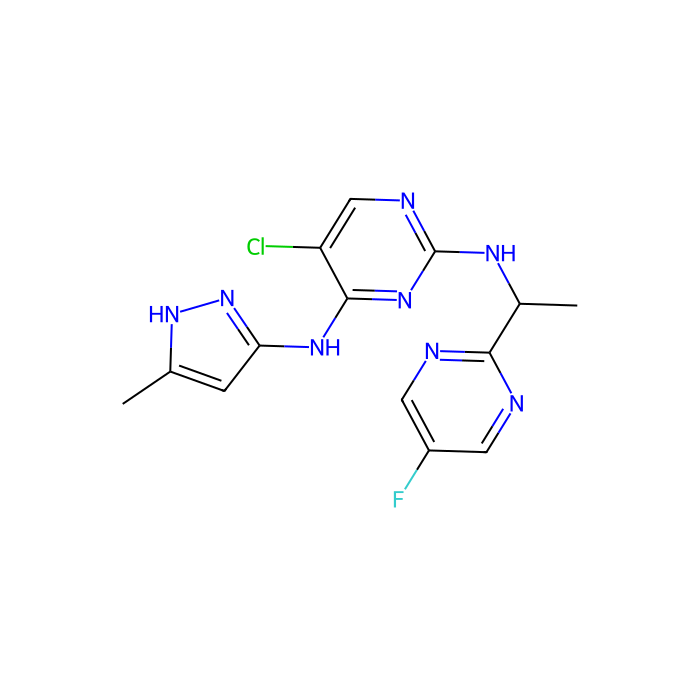
AZD1480 - Moligand™, ≥98% , Tyrosine-protein kinase JAK2 inhibitor, CAS No.935666-88-9, Tyrosine-protein kinase JAK2 inhibitor

CAS: 935666-88-9 Cat. No.: A126326 Fórmula: C14H14ClFN8 Peso molecular: 348.77 Número CE: 641-076-0
Disponível para encomenda
GRADE & PURITY Moligand™ ? Moligand™ — Aladdin's line of ligands and bioactive small molecules. Use for receptor, pathway, and binding studies needing defined small-molecule tools. ≥98%
Synonyms
5-Chloro-N2-[(1S)-1-(5-fluoro-2-pyrimidinyl)ethyl]-N4-(5-methyl-1H-pyrazol-3-yl)-2,4-pyrimidinediamine | 5-Chloro-N2-[(1s)-1-(5-Fluoropyrimidin-2-Yl)ethyl]-N4-(5-Methyl-1h-Pyrazol-3-Yl)pyrimidine-2,4-Diamine | AKOS027322548 | GTPL5933 | AM85979 | BCPP0003
Storage
Store at -20°C
Shipped In
Ice chest + Ice pads
★
Size
Alemanha (EU)
USA*
Price
Qty
1mg
A126326-1mg
—
2 Em stock

50,24€

75,41€
Gravar 25,16 € (33.37%)
5mg
A126326-5mg
—
3 Em stock

114,45€

171,73€
Gravar 57,27 € (33.35%)
10mg
A126326-10mg
—
2 Em stock

137,88€

207,30€
Gravar 69,42 € (33.49%)
25mg
A126326-25mg
—
1 Em stock

152,64€

229,00€
Gravar 76,36 € (33.35%)
50mg
A126326-50mg
—
1 Em stock

166,52€

249,82€
Gravar 83,30 € (33.34%)
100mg
A126326-100mg
—
1 Em stock

331,39€

497,13€
Gravar 165,74 € (33.34%)
Enter a quantity for the sizes you want to add.
🧪
Why this grade

Moligand™, ≥98% Moligand™ for sensitive chromatographic and analytical workflows requiring minimal baseline interference.

🌡

Storage & shipping

Store at -20°C Ships Ice chest + Ice pads Check lot-specific COA for exact specifications.

📋

Quality documents

SDS, COA, datasheet, and spec sheet available for download. Lot-specific COA accessible via lot number lookup.

📚

Literature proof

Cited in 0 peer-reviewed publications across chromatography, organic synthesis, and cross-coupling reactions.

Visão geral

AZD1480 has been used as an inhibitor of janus kinase 2 (JAK2) and signal transducer and activator of transcription 3 (STAT3) in an in vitro cell model of upper gastrointestinal adenocarcinoma. It has also been used in combination with bortezomib to study tumor-associated macrophage-mediated survival of myeloma cells.

Specifications

Sinónimos
5-Chloro-N2-[(1S)-1-(5-fluoro-2-pyrimidinyl)ethyl]-N4-(5-methyl-1H-pyrazol-3-yl)-2,4-pyrimidinediamine | 5-Chloro-N2-[(1s)-1-(5-Fluoropyrimidin-2-Yl)ethyl]-N4-(5-Methyl-1h-Pyrazol-3-Yl)pyrimidine-2,4-Diamine | AKOS027322548 | GTPL5933 | AM85979 | BCPP0003
Especificações e pureza
Moligand™, ≥98%
Mecanismos bioquímicos e fisiológicos
AZD1480 demonstrated significant immunoregulatory effects by downregulating T-helper 2 cytokines and chemokines, including IL-13 and thymus- and activation-regulated chemokine, and the surface expression of the immunosuppressive programmed death ligands 1
Condições de armazenamento de armazenamento
Store at -20°C
Enviado em
Ice chest + Ice pads
Este produto requer transporte de cadeia fria. Serviços terrestres e outros serviços econômicos não estão disponíveis.
Grau
Moligand™
Tipo de ação
INHIBITOR
Mecanismo de ação
Tyrosine-protein kinase JAK2 inhibitor
Nota
Toxic, refer to SDS for further information Need more advice on solubility, usage and handling? Please visit our frequently asked questions (FAQ) page for more details.
Pureza
≥98%
Propriedades do produto
ALogP
2.4
Nomes e identificadores
Pubchem Sid
Pubchem Sid Url
https://pubchem.ncbi.nlm.nih.gov/substance/488199394
Sorrisos canónicos
CC1=CC(=NN1)NC2=NC(=NC=C2Cl)NC(C)C3=NC=C(C=N3)F
IUPAC Name
5-chloro-2-N-[(1S)-1-(5-fluoropyrimidin-2-yl)ethyl]-4-N-(5-methyl-1H-pyrazol-3-yl)pyrimidine-2,4-diamine
InChIKey
PDOQBOJDRPLBQU-QMMMGPOBSA-N
INCHI
1S/C14H14ClFN8/c1-7-3-11(24-23-7)21-13-10(15)6-19-14(22-13)20-8(2)12-17-4-9(16)5-18-12/h3-6,8H,1-2H3,(H3,19,20,21,22,23,24)/t8-/m0/s1
SMILES isoméricas
CC1=CC(=NN1)NC2=NC(=NC=C2Cl)N[C@@H](C)C3=NC=C(C=N3)F
Peso molecular
348.77
Reaxy-Rn
12890501
Reaxys-RN_link_address
https://www.reaxys.com/reaxys/secured/hopinto.do?context=S&query=IDE.XRN=12890501&ln=

Documentation

📋 Safety Data Sheet (SDS)

Comprehensive hazard, handling, storage, and regulatory compliance document.

Download SDS →

✅ Certificate of Analysis (COA)

Lot-specific quality data. Enter your lot number to retrieve the exact COA.

Look up COA →

📊 Datasheet

Quick-reference summary of product specifications and applications.

View datasheet →

🔬 Specification Sheet

Full quality attributes and acceptance criteria for this grade.

View spec sheet →

Advanced Data

Taxonomic Classification

Taxonomy Tree

KingdomOrganic compounds
SuperclassOrganoheterocyclic compounds
ClasseDiazines
SubclassPyrimidines and pyrimidine derivatives
Intermediate Tree Nodes Not available
Direct ParentHalopyrimidines
Alternative Parents Aminopyrimidines and derivatives  Imidolactams  Aryl fluorides  Aryl chlorides  Pyrazoles  Heteroaromatic compounds  Azacyclic compounds  Organofluorides  Organochlorides  Hydrocarbon derivatives  Amines  
Molecular FrameworkAromatic heteromonocyclic compounds
Substituents Aminopyrimidine - Halopyrimidine - Aryl chloride - Aryl fluoride - Aryl halide - Imidolactam - Azole - Pyrazole - Heteroaromatic compound - Azacycle - Organonitrogen compound - Organofluoride - Organochloride - Organohalogen compound - Hydrocarbon derivative - Organic nitrogen compound - Amine - Aromatic heteromonocyclic compound
DescriçãoThis compound belongs to the class of organic compounds known as halopyrimidines. These are aromatic compounds containing a halogen atom linked to a pyrimidine ring. Pyrimidine is a 6-membered ring consisting of four carbon atoms and two nitrogen centers at the 1- and 3- ring positions.
External Descriptors Not available
Estrutura 3D
Modelo de Estrutura Química Interativa


Alvos associados (humanos)
STAT3 Tchem Signal transducer and activator of transcription 3 (2 Activities)
Activity TypeActivity Value -log(M)Mechanism of ActionActivity ReferencePublications (PubMed IDs)
JAK3 Tclin Tyrosine-protein kinase JAK3 (1 Activities)
Activity TypeActivity Value -log(M)Mechanism of ActionActivity ReferencePublications (PubMed IDs)
JAK1 Tclin Tyrosine-protein kinase JAK1 (1 Activities)
Activity TypeActivity Value -log(M)Mechanism of ActionActivity ReferencePublications (PubMed IDs)
STAT5A Tchem Signal transducer and activator of transcription 5A (2 Activities)
Activity TypeActivity Value -log(M)Mechanism of ActionActivity ReferencePublications (PubMed IDs)
NTRK1 Tclin High affinity nerve growth factor receptor (1 Activities)
Activity TypeActivity Value -log(M)Mechanism of ActionActivity ReferencePublications (PubMed IDs)
JAK2 Tclin Tyrosine-protein kinase JAK2 (1 Activities)
Activity TypeActivity Value -log(M)Mechanism of ActionActivity ReferencePublications (PubMed IDs)
ABL1 Tclin Tyrosine-protein kinase ABL (18331 Activities)
Activity TypeRelationActivity valueUnitsAction TypeJournalPubMed IddoiAssay Aladdin ID
EGFR Tclin Epidermal growth factor receptor erbB1 (33727 Activities)
Activity TypeRelationActivity valueUnitsAction TypeJournalPubMed IddoiAssay Aladdin ID
INSR Tclin Insulin receptor (5558 Activities)
Activity TypeRelationActivity valueUnitsAction TypeJournalPubMed IddoiAssay Aladdin ID
TOP2A Tclin DNA topoisomerase II alpha (6317 Activities)
Activity TypeRelationActivity valueUnitsAction TypeJournalPubMed IddoiAssay Aladdin ID
IMPDH2 Tclin Inosine-5'-monophosphate dehydrogenase 2 (1326 Activities)
Activity TypeRelationActivity valueUnitsAction TypeJournalPubMed IddoiAssay Aladdin ID
PDGFRB Tclin Platelet-derived growth factor receptor beta (5195 Activities)
Activity TypeRelationActivity valueUnitsAction TypeJournalPubMed IddoiAssay Aladdin ID
IGF1R Tclin Insulin-like growth factor I receptor (8605 Activities)
Activity TypeRelationActivity valueUnitsAction TypeJournalPubMed IddoiAssay Aladdin ID
DCK Tchem Deoxycytidine kinase (530 Activities)
Activity TypeRelationActivity valueUnitsAction TypeJournalPubMed IddoiAssay Aladdin ID
MAPK11 Tchem MAP kinase p38 beta (2785 Activities)
Activity TypeRelationActivity valueUnitsAction TypeJournalPubMed IddoiAssay Aladdin ID
LCK Tclin Tyrosine-protein kinase LCK (9212 Activities)
Activity TypeRelationActivity valueUnitsAction TypeJournalPubMed IddoiAssay Aladdin ID
NQO2 Tchem Quinone reductase 2 (885 Activities)
Activity TypeRelationActivity valueUnitsAction TypeJournalPubMed IddoiAssay Aladdin ID
ADK Tchem Adenosine kinase (1481 Activities)
Activity TypeRelationActivity valueUnitsAction TypeJournalPubMed IddoiAssay Aladdin ID
MAPK14 Tchem MAP kinase p38 alpha (12866 Activities)
Activity TypeRelationActivity valueUnitsAction TypeJournalPubMed IddoiAssay Aladdin ID
AK2 Tbio Adenylate kinase 2 (264 Activities)
Activity TypeRelationActivity valueUnitsAction TypeJournalPubMed IddoiAssay Aladdin ID
GSK3B Tclin Glycogen synthase kinase-3 beta (11785 Activities)
Activity TypeRelationActivity valueUnitsAction TypeJournalPubMed IddoiAssay Aladdin ID
PRKACB Tchem cAMP-dependent protein kinase beta-1 catalytic subunit (589 Activities)
Activity TypeRelationActivity valueUnitsAction TypeJournalPubMed IddoiAssay Aladdin ID
PRKCZ Tchem Protein kinase C zeta (2414 Activities)
Activity TypeRelationActivity valueUnitsAction TypeJournalPubMed IddoiAssay Aladdin ID
MAP2K6 Tchem Dual specificity mitogen-activated protein kinase kinase 6 (1284 Activities)
Activity TypeRelationActivity valueUnitsAction TypeJournalPubMed IddoiAssay Aladdin ID
MYLK Tchem Myosin light chain kinase, smooth muscle (1267 Activities)
Activity TypeRelationActivity valueUnitsAction TypeJournalPubMed IddoiAssay Aladdin ID
CSNK1G1 Tchem Casein kinase I gamma 1 (2496 Activities)
Activity TypeRelationActivity valueUnitsAction TypeJournalPubMed IddoiAssay Aladdin ID
FGFR1 Tclin Fibroblast growth factor receptor 1 (9149 Activities)
Activity TypeRelationActivity valueUnitsAction TypeJournalPubMed IddoiAssay Aladdin ID
STK3 Tchem Serine/threonine-protein kinase MST2 (3069 Activities)
Activity TypeRelationActivity valueUnitsAction TypeJournalPubMed IddoiAssay Aladdin ID
PRKAG1 Tchem AMP-activated protein kinase, gamma-1 subunit (254 Activities)
Activity TypeRelationActivity valueUnitsAction TypeJournalPubMed IddoiAssay Aladdin ID
CSNK1D Tchem Casein kinase I delta (4546 Activities)
Activity TypeRelationActivity valueUnitsAction TypeJournalPubMed IddoiAssay Aladdin ID
MAP2K5 Tchem Dual specificity mitogen-activated protein kinase kinase 5 (650 Activities)
Activity TypeRelationActivity valueUnitsAction TypeJournalPubMed IddoiAssay Aladdin ID
SRC Tclin Tyrosine-protein kinase SRC (10310 Activities)
Activity TypeRelationActivity valueUnitsAction TypeJournalPubMed IddoiAssay Aladdin ID
MAP2K3 Tchem Dual specificity mitogen-activated protein kinase kinase 3 (632 Activities)
Activity TypeRelationActivity valueUnitsAction TypeJournalPubMed IddoiAssay Aladdin ID
CDK6 Tclin Cyclin-dependent kinase 6 (1724 Activities)
Activity TypeRelationActivity valueUnitsAction TypeJournalPubMed IddoiAssay Aladdin ID
PRKAG2 Tchem AMP-activated protein kinase, gamma-2 subunit (243 Activities)
Activity TypeRelationActivity valueUnitsAction TypeJournalPubMed IddoiAssay Aladdin ID
AKT2 Tchem Serine/threonine-protein kinase AKT2 (4301 Activities)
Activity TypeRelationActivity valueUnitsAction TypeJournalPubMed IddoiAssay Aladdin ID
AKT3 Tchem Serine/threonine-protein kinase AKT3 (3157 Activities)
Activity TypeRelationActivity valueUnitsAction TypeJournalPubMed IddoiAssay Aladdin ID
GRK2 Tchem G-protein coupled receptor kinase 2 (1019 Activities)
Activity TypeRelationActivity valueUnitsAction TypeJournalPubMed IddoiAssay Aladdin ID
PYGB Tchem Brain glycogen phosphorylase (474 Activities)
Activity TypeRelationActivity valueUnitsAction TypeJournalPubMed IddoiAssay Aladdin ID
AURKB Tchem Serine/threonine-protein kinase Aurora-B (6805 Activities)
Activity TypeRelationActivity valueUnitsAction TypeJournalPubMed IddoiAssay Aladdin ID
RPS6KA4 Tchem Ribosomal protein S6 kinase alpha 4 (2104 Activities)
Activity TypeRelationActivity valueUnitsAction TypeJournalPubMed IddoiAssay Aladdin ID
ROCK1 Tclin Rho-associated protein kinase 1 (4723 Activities)
Activity TypeRelationActivity valueUnitsAction TypeJournalPubMed IddoiAssay Aladdin ID
PIM1 Tchem Serine/threonine-protein kinase PIM1 (9629 Activities)
Activity TypeRelationActivity valueUnitsAction TypeJournalPubMed IddoiAssay Aladdin ID
PKN2 Tchem Protein kinase N2 (1991 Activities)
Activity TypeRelationActivity valueUnitsAction TypeJournalPubMed IddoiAssay Aladdin ID
CSK Tchem Tyrosine-protein kinase CSK (2395 Activities)
Activity TypeRelationActivity valueUnitsAction TypeJournalPubMed IddoiAssay Aladdin ID
JAK3 Tclin Tyrosine-protein kinase JAK3 (8349 Activities)
Activity TypeRelationActivity valueUnitsAction TypeJournalPubMed IddoiAssay Aladdin ID
RPS6KA5 Tchem Ribosomal protein S6 kinase alpha 5 (3355 Activities)
Activity TypeRelationActivity valueUnitsAction TypeJournalPubMed IddoiAssay Aladdin ID
PRKD3 Tchem Protein kinase C nu (2315 Activities)
Activity TypeRelationActivity valueUnitsAction TypeJournalPubMed IddoiAssay Aladdin ID
PRKCI Tchem Protein kinase C iota (2821 Activities)
Activity TypeRelationActivity valueUnitsAction TypeJournalPubMed IddoiAssay Aladdin ID
SYK Tclin Tyrosine-protein kinase SYK (7372 Activities)
Activity TypeRelationActivity valueUnitsAction TypeJournalPubMed IddoiAssay Aladdin ID
PLK1 Tchem Serine/threonine-protein kinase PLK1 (28605 Activities)
Activity TypeRelationActivity valueUnitsAction TypeJournalPubMed IddoiAssay Aladdin ID
JAK1 Tclin Tyrosine-protein kinase JAK1 (8569 Activities)
Activity TypeRelationActivity valueUnitsAction TypeJournalPubMed IddoiAssay Aladdin ID
RPS6KA1 Tchem Ribosomal protein S6 kinase alpha 1 (2796 Activities)
Activity TypeRelationActivity valueUnitsAction TypeJournalPubMed IddoiAssay Aladdin ID
JAK2 Tclin Tyrosine-protein kinase JAK2 (12915 Activities)
Activity TypeRelationActivity valueUnitsAction TypeJournalPubMed IddoiAssay Aladdin ID
RPS6KA6 Tchem Ribosomal protein S6 kinase alpha 6 (2027 Activities)
Activity TypeRelationActivity valueUnitsAction TypeJournalPubMed IddoiAssay Aladdin ID
PFKP Tbio Phosphofructokinase platelet type (224 Activities)
Activity TypeRelationActivity valueUnitsAction TypeJournalPubMed IddoiAssay Aladdin ID
Alvos associados (não humanos)
Cdk4 Cyclin-dependent kinase 4 (3 Activities)
Activity TypeRelationActivity valueUnitsAction TypeJournalPubMed IddoiAssay Aladdin ID
Pygl Liver glycogen phosphorylase (81 Activities)
Activity TypeRelationActivity valueUnitsAction TypeJournalPubMed IddoiAssay Aladdin ID
Prkcd Protein kinase C delta (192 Activities)
Activity TypeRelationActivity valueUnitsAction TypeJournalPubMed IddoiAssay Aladdin ID
Prkcb Protein kinase C beta (2 Activities)
Activity TypeRelationActivity valueUnitsAction TypeJournalPubMed IddoiAssay Aladdin ID
Mapk1 MAP kinase ERK2 (650 Activities)
Activity TypeRelationActivity valueUnitsAction TypeJournalPubMed IddoiAssay Aladdin ID
Hdac6 Histone deacetylase 6 (222 Activities)
Activity TypeRelationActivity valueUnitsAction TypeJournalPubMed IddoiAssay Aladdin ID
Camk2g CaM kinase II gamma (1 Activities)
Activity TypeRelationActivity valueUnitsAction TypeJournalPubMed IddoiAssay Aladdin ID
Tec Tyrosine-protein kinase TEC (25 Activities)
Activity TypeRelationActivity valueUnitsAction TypeJournalPubMed IddoiAssay Aladdin ID
Canis familiaris (36305 Activities)
Activity TypeRelationActivity valueUnitsAction TypeJournalPubMed IddoiAssay Aladdin ID
Mus musculus (284745 Activities)
Activity TypeRelationActivity valueUnitsAction TypeJournalPubMed IddoiAssay Aladdin ID
Rattus norvegicus (775804 Activities)
Activity TypeRelationActivity valueUnitsAction TypeJournalPubMed IddoiAssay Aladdin ID
AIRC Multifunctional protein ADE2 (8 Activities)
Activity TypeRelationActivity valueUnitsAction TypeJournalPubMed IddoiAssay Aladdin ID
rep Replicase polyprotein 1ab (378 Activities)
Activity TypeRelationActivity valueUnitsAction TypeJournalPubMed IddoiAssay Aladdin ID
Septin9 Septin-9 (1 Activities)
Activity TypeRelationActivity valueUnitsAction TypeJournalPubMed IddoiAssay Aladdin ID
Acadvl Very long-chain specific acyl-CoA dehydrogenase, mitochondrial (1 Activities)
Activity TypeRelationActivity valueUnitsAction TypeJournalPubMed IddoiAssay Aladdin ID
Mecanismos de ação
Certificados(CoA,COO,BSE/TSE e Mapa de Análise)
C of A & Other Certificates(BSE/TSE, COO):
Analytical Chart:

Find and download the COA for your product by matching the lot number on the packaging.

14 results found

Lot NumberCertificate TypeDataItem
I2616132Certificate of AnalysisSep 28, 2026 A126326
C2321423Certificate of AnalysisSep 22, 2026 A126326
C2321434Certificate of AnalysisSep 22, 2026 A126326
C2321491Certificate of AnalysisSep 22, 2026 A126326
C2321496Certificate of AnalysisSep 22, 2026 A126326
C2321794Certificate of AnalysisSep 22, 2026 A126326
C2321799Certificate of AnalysisSep 22, 2026 A126326
C2321800Certificate of AnalysisSep 22, 2026 A126326
C2321802Certificate of AnalysisSep 22, 2026 A126326
C2321804Certificate of AnalysisSep 22, 2026 A126326
C2321805Certificate of AnalysisSep 22, 2026 A126326
C2321806Certificate of AnalysisSep 22, 2026 A126326
C2321811Certificate of AnalysisSep 22, 2026 A126326
I2603068Certificate of AnalysisSep 16, 2026 A126326
Propriedades químicas e físicas
SolubilidadeDMSO ≥68mg/mL Water <1.2mg/mL Ethanol ≥4.7mg/mL
Índice de refração1.7
Ponto de ebulição (°C)~575.2 °C at 760 mmHg
Ponto de fusão (°C)213.39°C
Peso molecular348.760 g/mol
XLogP32.400
Hydrogen Bond Donor Count3
Hydrogen Bond Acceptor Count8
Rotatable Bond Count5
Exact Mass348.101 Da
Monoisotopic Mass348.101 Da
Topological Polar Surface Area104.000 Ų
Heavy Atom Count24
Formal Charge0
Complexity397.000
Isotope Atom Count0
Defined Atom Stereocenter Count1
Undefined Atom Stereocenter Count0
Defined Bond Stereocenter Count0
Undefined Bond Stereocenter Count0
The total count of all stereochemical bonds0
Covalently-Bonded Unit Count1
FAQs e artigos
Calculadoras de soluções
Revisões

Avaliações dos Clientes

Application Protocols

Only information from Product Data may be listed here.

  • Tested applications: Not specified for this item; refer to CoA/Spec Sheet.
  • Recommended working concentrations/dilutions: Not specified for this item; refer to CoA/Spec Sheet.
  • Positive controls/standards: Not specified for this item; refer to CoA/Spec Sheet.

General, non-item-specific guidance:

  • Prepare a DMSO master stock (e.g., 10–50 mM), aliquot, and store at −20°C. Thaw an aliquot immediately before use and avoid repeated freeze–thaw.
  • Establish concentration–response curves (e.g., 10-point, 3-fold serial dilution) to determine potency in your assay system. Include vehicle controls matching the highest DMSO content.
  • Confirm functional effects with orthogonal readouts where possible (e.g., biochemical enzyme assay and a cellular biomarker assay) to reduce the risk of off-target interpretation.

For validated, product-specific protocols, please refer to the batch CoA or contact technical support with the SKU and lot number.

Biological Roles

Item-specific disclosure:

  • No target, MoA, or pathway information is specified for this SKU in the provided Product Data. For research use only.

Literature context (general; not a product claim):

  • AZD1480 is widely described in the literature as a potent inhibitor of the Janus kinase family (notably JAK1/JAK2), used to interrogate JAK–STAT signaling. Inhibition of JAKs can attenuate STAT phosphorylation, nuclear translocation, and transcriptional activation of cytokine-responsive genes in cell systems.
  • Tool-compound use: Researchers often employ AZD1480 or similar scaffolds to dissect cytokine/growth-factor pathways, study feedback regulation, and benchmark new chemical entities targeting the same axis.
  • System-level considerations: JAK–STAT intersects with MAPK and PI3K pathways; off-target profiling and orthogonal assays are advised to attribute phenotypes to on-target effects.

Good practice reminders:

  • Validate target engagement with proximate biomarkers (e.g., pSTAT Western blot) and time-course experiments.
  • Include concentration–response curves and appropriate vehicle controls to quantify potency and window.
  • Confirm findings across multiple cell lines or primary cells where feasible, as signaling context can shift apparent potency/selectivity.

Note: The above summarizes commonly cited roles in the scientific literature and should be verified for the specific batch via CoA and internal controls.

Buffer Applications

This product is not a buffering agent and is not used to establish or maintain solution pH.

Practical assay-related notes (general, not item-specific):

  • When dosing small-molecule inhibitors into biochemical or cell-based assays, choose a buffer appropriate to the biology (e.g., HEPES or Tris for enzyme assays; PBS or culture medium for cells).
  • Maintain consistent organic solvent content (e.g., ≤0.1–0.5% DMSO) across all wells/tubes, including vehicle controls, to avoid solvent-driven artifacts.
  • If precipitation occurs upon dilution into aqueous media, consider warming gently to ambient, sonicating briefly, or incorporating solubilizers (e.g., 0.01–0.1% non-ionic surfactant or cyclodextrin), provided they do not interfere with the readout.
  • Filter sterilize final solutions for sterile applications using low-protein-binding membranes.

Because item-specific pKa/solubility values are not provided, buffer selection should be guided by small pilot tests to ensure clarity and stability over the intended assay timeframe.

Green Alternatives

Solvent and formulation choices often dominate the environmental profile for bioactive small molecules used in screening.

  • Reduce DMSO where possible: Although DMSO is relatively benign, minimizing volume reduces solvent waste and potential biological confounding.
  • Greener co-solvents/formulations (general guidance):
    • Aqueous vehicles with solubilizers (e.g., hydroxypropyl-β-cyclodextrin) can enable lower DMSO content at the point of use.
    • Ethanol/water mixtures (≤1–2% EtOH final) may suffice for some assays with fewer downstream disposal constraints than DMF/NMP.
    • PEG-400 or glycerol can serve as co-solvents in certain biochemical contexts; verify assay compatibility.

Comparison (general, not item-specific):

  • DMSO: Broad solvency; high assay utility; moderate EHS footprint; aim to keep ≤0.5% v/v in final assay.
  • Ethanol: Renewable routes available; faster biodegradation; limited solvency for some heteroaromatics.
  • PEG-400: Low volatility; good solvency for lipophilic compounds; viscosity can complicate handling; potential assay interference.
  • Cyclodextrin solutions: Water-based; reduce organic solvent use; require optimization to avoid compound inclusion effects on biology.

Operational tips:

  • Use high-concentration master stocks to minimize total solvent volume in assays.
  • Employ miniaturized screening formats to reduce solvent and compound consumption.
  • Segregate and recycle suitable solvent streams per institutional green-chemistry practices.

Because item-specific solubility is not disclosed, screen greener vehicles alongside DMSO to identify acceptable, lower-impact conditions.

Pharmaceutical Uses

For research use only. No medical, diagnostic, or therapeutic use.

  • Role in pharma R&D (general, not item-specific): AZD1480 is cited in the literature as a reference scaffold for targeting JAK kinases in discovery biology. In pharmaceutical settings, such compounds are often used as tool molecules for target validation, assay development, and comparative benchmarking against new chemical entities.
  • Formulation in research contexts: For in vitro work, DMSO stock solutions are typical. For certain in vivo research models, co-solvent systems (e.g., DMSO/PEG-400/saline) or cyclodextrin vehicles are sometimes explored; all such uses require rigorous internal validation and adherence to institutional policies.
  • Pharmacopeial status: Not described in major pharmacopeias for excipient or API use based on the information provided here.
  • Manufacturing/quality considerations: If used as a reference or control standard in regulated labs, confirm identity/purity against the batch CoA and establish internal acceptance criteria (e.g., retention time match, purity threshold, potency window) appropriate to your method.

Any mention of mechanism or pathway is provided as literature context only and does not imply suitability for clinical or diagnostic applications.

Physical Properties

Item-specific (from Product Data)

  • Appearance: Not specified for this item; refer to CoA/Spec Sheet.
  • Physical constants (mp, bp, density, nD, pKa, logP, solubility): Not specified for this item; refer to CoA/Spec Sheet.

General/literature guidance (not item-specific):

  • Many kinase-targeted small molecules are crystalline or amorphous solids with limited aqueous solubility and good solubility in high-boiling polar aprotic solvents (e.g., DMSO) and certain organic solvents (e.g., DMF, NMP). Typical working practice is to prepare a concentrated DMSO stock (e.g., 10–50 mM) for assay dilution.
  • Thermal properties (melting point, decomposition behavior) and spectroscopic identities (UV–Vis, IR) vary by batch and synthesis route. For AZD1480 specifically, consult primary literature or the batch CoA for exact values.
  • Aqueous solubility of heteroaromatic kinase inhibitors can often be improved by pH adjustment, cosolvents, or formulation aids (e.g., cyclodextrins), but such adjustments should be validated experimentally for the specific lot.

Because no definitive physical specifications are provided here, treat any numerical property reported elsewhere as literature-only until verified by the item’s CoA/SDS. When planning experiments, perform small-scale solubility trials in intended assay buffers to confirm compatibility and avoid precipitation artifacts.

Quality and Grades

Item-specific (from Product Data)

  • Grade: Moligand™
  • Purity: Not specified for this item; refer to CoA/Spec Sheet.

What Moligand™ typically denotes (general explanation):

  • Moligand™ indicates a research-grade small-molecule suitable for screening, cheminformatics, and probe-based studies in discovery workflows. Vendors commonly support such materials with identity testing (e.g., LC–MS) and structural confirmation (e.g., 1H NMR). Exact analytical methods and acceptance criteria are batch-dependent.

Analytical expectations and verification (not item-specific):

  • Identity: Typically verified by LC–MS and/or HRMS; structure consistency checked against reference spectra. Where available, NMR may be provided.
  • Purity: Determined by chromatographic area % (e.g., HPLC or UPLC at a defined wavelength). The exact purity threshold for this lot is not disclosed here—consult the CoA.
  • Impurities/residuals: Water content, residual solvents, inorganic residues, or counter-ions may be reported on the CoA when applicable. Absent explicit disclosure, treat as not specified.

For regulated or quantitative applications (e.g., SAR decision-making, biophysical binding assays), we strongly recommend reviewing the batch CoA/Spec Sheet and, if necessary, performing fit-for-purpose incoming QC (orthogonal purity check, counter-ion analysis, and potency benchmarking) prior to use.

Reaction and Applications

This product is a bioactive small molecule intended primarily as a tool compound in discovery research rather than a general-purpose synthetic reagent.

  • Not typically used as a reagent in named organic reactions (e.g., cross-couplings, oxidations, reductions). Therefore, conventional synthetic application notes (catalyst choices, stoichiometries) are not applicable.
  • Practical research applications (general, literature-based):
    • Employed as a pathway probe in studies interrogating JAK–STAT signaling, where small-molecule inhibition is used to modulate phosphorylation cascades and transcriptional outputs.
    • Utilized in cell-based phenotypic assays, target-validation experiments, and mechanism-of-action studies that rely on controlled, reversible inhibition.
    • Benchmarking/positive-control role in biochemical inhibition assays to calibrate assay performance (IC50 window, signal-to-background) when investigating related chemical series.
  • Experimental considerations (general):
    • Prepare and handle concentrated DMSO stocks; verify absence of precipitation upon dilution into assay media.
    • Include DMSO vehicle controls and, where appropriate, orthogonal readouts (e.g., target phosphorylation by Western blot vs. reporter assays) to confirm on-pathway effects.

Note: The points above are literature/general practice and not item-specific claims. For this SKU, no manufacturer-verified application set is provided; please consult the CoA/SDS and validate conditions in your laboratory context.

Reaction Conditions

Conventional reaction-condition guidance is not applicable because this product is intended as a bioactive tool compound rather than as a reaction reagent or catalyst.

Operational conditions relevant to research use (general, not item-specific):

  • Stock solution preparation: Dissolve in anhydrous DMSO to 10–50 mM, vortex, and, if needed, sonicate briefly. Filter through a 0.22 μm PTFE filter if particulate remains.
  • Assay dosing: Dilute into pre-equilibrated assay buffer or culture media while maintaining consistent final DMSO across samples (commonly ≤0.1–0.5% v/v). Mix thoroughly to avoid local supersaturation and precipitation.
  • Stability checks: Monitor for precipitation, color change, or potency drift over the assay period. For multi-day studies, prepare fresh dilutions daily from frozen aliquots.
  • Light/moisture: Protect from prolonged light exposure and moisture ingress unless specific stability data indicate robustness.

If your use case truly requires chemical transformation of this compound (e.g., prodrug derivatization for internal research), consult primary literature for the scaffold’s synthesis to infer compatible conditions, and perform small-scale feasibility tests with appropriate analytical follow-up (LC–MS, NMR).

Safety and Handling

Item-specific (from Product Data)

  • GHS Classification: Not specified for this item; refer to SDS.
  • Signal Word: Not specified for this item; refer to SDS.
  • Hazard Statements (H-Statements): Not specified for this item; refer to SDS.
  • Pictograms: Not specified for this item; refer to SDS.
  • Storage Conditions: Store at -20°C.
  • Shipped In: Ice chest + Ice pads.

General laboratory precautions (not item-specific):

  • Handle in a fume hood with appropriate PPE: lab coat, safety glasses, and suitable gloves (e.g., nitrile). Avoid inhalation of dust or aerosols and prevent skin/eye contact. Wash thoroughly after handling.
  • Avoid contaminating skin with DMSO solutions, which can enhance dermal transport of solutes. Clean minor spills with absorbent material; for larger spills, evacuate area and follow institutional procedures.
  • Incompatibilities: Strong oxidizers and strong acids/bases may cause degradation for many heteroaromatic drug-like molecules; segregate accordingly. Protect from moisture and prolonged light exposure unless stability is documented.
  • First aid (overview; defer to SDS): If inhaled—move to fresh air; if on skin—wash with soap/water; if in eyes—rinse cautiously with water for several minutes; if ingested—rinse mouth and seek medical attention. Provide SDS to responders.

Always consult the product’s SDS for authoritative hazard classification, exposure controls, disposal guidance, and transportation information. For research use only.

Solvent Selection

Item-specific (from Product Data)

  • No solvent preferences are specified for this item.

General guidance for kinase-inhibitor-like small molecules (not item-specific):

  • Primary stock solvent: DMSO is typically preferred due to broad solvating power and assay compatibility. Prepare concentrated stocks (e.g., 10–50 mM) and store as aliquots at −20°C to minimize freeze–thaw.
  • Assay dilution: Dilute DMSO stocks into buffer (e.g., PBS, HEPES, or assay-specific buffer) to reach the desired final concentration while keeping DMSO ≤0.1–0.5% v/v to limit effects on cells/enzymes.
  • Alternative solvents: DMF or NMP can dissolve challenging solids but may be less biocompatible; ethanol (with Tween-80 or PEG-400) can be acceptable in some biochemical settings. Validate for your assay.
  • Solubility enhancers: Hydroxypropyl-β-cyclodextrin, PEG-400, or co-solvent systems can improve apparent solubility and reduce precipitation upon aqueous dilution.

Comparison (general considerations):

  • DMSO: Excellent solvency; widely used; can affect membrane permeability and some enzyme kinetics at >0.5–1%.
  • Ethanol: Lower solvency for many heteroaromatics; higher assay tolerability at similar percentages for some systems.
  • PEG-400: Formulation aid for in vivo research; viscous; may interfere with certain readouts.

Because item-specific solubility data are not provided, perform a small solubility and compatibility screen in the intended assay matrix before committing to larger experiments.

Storage and Reconstitution

Item-specific (from Product Data)

  • Storage Conditions: Store at -20°C.
  • Shipping: Ice chest + Ice pads.

Not specified for this item; refer to CoA/Spec Sheet

  • Exact stability limits, shelf life, and freeze–thaw tolerance.
  • Recommended reconstitution solvent and maximum stock concentration.

General best practices for small-molecule tool compounds (not item-specific):

  • Reconstitution: Dissolve in anhydrous DMSO to make a concentrated stock (commonly 10–50 mM). Vortex to clarity; brief sonication may help. If particles persist, filter through a 0.22 μm PTFE syringe filter.
  • Aliquoting: Dispense single-use aliquots (e.g., 10–50 μL) in amber vials or PCR tubes to minimize freeze–thaw and light exposure.
  • Storage: Keep aliquots tightly sealed at −20°C in desiccated, light-protected conditions. Avoid frost-free freezers that cycle temperatures.
  • Use: Thaw an aliquot immediately before use, keep on ice during setup, and promptly return or discard any unused thawed material per your lab’s practices. Do not refreeze partially used aliquots unless stability has been established.
  • Aqueous solutions: Prepare immediately before use; many hydrophobic inhibitors can precipitate or degrade in aqueous media over time.

Always prioritize the batch CoA/SDS for lot-specific instructions and stability data. For research use only.

Structure and Identity

Item-specific (from Product Data)

  • SKU: A126326
  • Product Name: AZD1480
  • CAS: 935666-88-9
  • PubChem CID: 16659841
  • InChIKey: 274619 (as provided)
  • SMILES: Not specified for this item; refer to CoA/Spec Sheet.
  • Molecular Formula: Not specified for this item; refer to CoA/Spec Sheet.
  • Molecular Weight: Not specified for this item; refer to CoA/Spec Sheet.

General/literature context (not item-specific):

  • AZD-series compounds are small-molecule kinase inhibitors developed for pathway interrogation in discovery biology. AZD1480 is widely cited in the literature as a Janus kinase (JAK) pathway tool compound. Specific structural drawings and stereochemical descriptors should be taken from primary references or the Certificate of Analysis (CoA).

Structural description (general):

  • As a typical ATP-competitive kinase inhibitor scaffold, literature precedents often feature heteroaromatic motifs capable of forming hinge-binding hydrogen bonds, plus substituents that engage selectivity pockets. Without an item-specific structure disclosure here, please consult the CoA or trusted databases for the exact 2D/3D structure, ring systems, functional groups, and any stereogenic elements applicable to AZD1480.

Note: Identity confirmation for screening compounds is commonly supported by LC–MS and 1H NMR. Always verify against the batch-specific CoA prior to use in critical studies.

Synthetic Utility

This item is supplied as a finished bioactive small molecule and is not typically employed as a synthetic building block.

  • Not commonly used as a coupling partner, electrophile, nucleophile, or catalyst in standard organic methodology. Therefore, traditional synthetic-utility guidance (e.g., reactivity patterns, protecting-group strategies) is not applicable.
  • Medicinal chemistry context (general): Related scaffolds are sometimes derivatized to explore structure–activity relationships (SAR). If undertaking analog synthesis, typical operations might include heteroaryl substitutions, amide/urea formation, or heterocycle elaboration—but these activities pertain to new syntheses rather than using the supplied compound as a reagent.
  • Stability considerations (general): Heteroaromatic kinase inhibitors can contain functionalities sensitive to strong acids/bases, prolonged heating, or photolysis. Any planned chemical modification should begin with a stability screen to map tolerant conditions.

Conclusion: Treat AZD1480 primarily as a probe/tool compound. For synthetic campaigns, consult primary literature for enabling routes to the core scaffold rather than attempting to repurpose the finished molecule as a reagent.

Target Specificity

Only information from Product Data may be listed here.

  • Target/Pathway: Not specified for this item; refer to CoA/Spec Sheet.
  • Species reactivity: Not specified for this item; refer to CoA/Spec Sheet.
  • Assay-validated selectivity panel: Not specified for this item; refer to CoA/Spec Sheet.

Note: Although AZD1480 is often discussed in the literature in the context of JAK–STAT signaling, no target specificity is provided in this listing. Users should consult the batch CoA and verify target engagement in their own systems.

Perguntas frequentes

What is the purity of this product?
This product is supplied at ≥98% purity (chemical assay). Lot-specific values are stated on the Certificate of Analysis.

Shall we send you a message when we have discounts available?

Remind me later

Thank you! Please check your email inbox to confirm.

Oops! Notifications are disabled.