GRAU & PUREZAMoligand™?Moligand™ — Aladdin's line of ligands and bioactive small molecules. Use for receptor, pathway, and binding studies needing defined small-molecule tools.10 mM in DMSO
Determine the necessary mass, volume, or concentration for preparing a solution.
Dilution Calculator
Determine the dilution needed to prepare a stock solution.
Reconstitution Calculator
Revisões
Avaliações dos Clientes
Application Protocols
Validated, item-specific application protocols are not provided in the product data for this listing. The following are general best practices for small-molecule tool compounds in discovery research:
Solution preparation:
Bring vial to room temperature in a desiccated environment before opening to avoid condensation.
Prepare a concentrated stock in dry DMSO (e.g., 10–50 mM); vortex/sonicate until fully dissolved.
Aliquot into low-bind tubes and store at the recommended temperature to avoid repeated freeze–thaw.
Biochemical assays:
Use matched vehicle controls (same DMSO %).
Run a concentration–response series with sufficient top concentration to define the curve without exceeding assay solvent tolerance.
Include detergent (e.g., 0.01–0.05% Tween-20) if aggregation is suspected.
Cell-based assays:
Confirm no precipitation upon dilution into media. Pre-warm media and add compound last with rapid mixing.
Consider serum effects on free fraction; consistent serum content between wells is critical.
Data quality:
Include positive/negative controls and, where relevant, orthogonal readouts to exclude assay interference.
For precise conditions validated for BAY-598 from Aladdin, refer to the CoA/Spec Sheet if available.
Biological Roles
Context from the literature (general background, not a specification for this catalog item):
BAY-598 is widely cited as a small-molecule tool compound used in epigenetics research, notably in studies of histone methylation pathways. Such ligands are typically employed to probe the function of specific methyltransferases and their downstream transcriptional effects.
In chemical biology, selective enzyme inhibitors help dissect pathway dependencies, reveal synthetic lethal interactions, and validate targets in vitro before medicinal chemistry optimization.
Typical experimental readouts include histone/post-translational modification levels (e.g., via western blot or MS), reporter gene assays, and RNA expression profiling to link enzymatic modulation to transcriptional outcomes.
Use considerations (general):
Confirm on-target engagement with biochemical IC50/Ki determinations and orthogonal cellular target-engagement assays (e.g., CETSA, NanoBRET target engagement), as potency and permeability can differ between biochemical and cellular contexts.
Evaluate selectivity across related enzyme families to detect off-target effects that could confound phenotypes.
Apply proper vehicle controls, concentration ranges, and time-course studies to distinguish acute enzyme inhibition from longer-term transcriptional reprogramming.
Buffer Applications
This product is a bioactive small molecule rather than a buffering agent. It is not used to set or maintain pH in biochemical systems.
Practical notes for assay buffers (general guidance):
Use standard biological buffers (e.g., HEPES, PBS, Tris) compatible with your target/assay.
Maintain consistent DMSO content across all wells/tubes to avoid solvent-driven artifacts.
Include mild non-ionic detergents (e.g., 0.01–0.05% Tween-20 or Triton X-100) where aggregation or non-specific binding is a concern for enzyme assays (general practice).
Green Alternatives
As a bioactive screening compound, BAY-598 is not a process solvent or reagent where green replacement strategies usually apply. However, greener choices can be considered for the solvents used to handle the compound.
General greener handling considerations (solvent perspective):
Prefer water-based assay buffers with minimal DMSO content consistent with solubility and biological tolerance.
Where organic co-solvents are required, consider lower-toxicity options and minimize volumes.
Illustrative comparison (general solvent use):
DMSO vs DMF: DMSO is generally preferred for lower volatility and better operator safety; both are dipolar aprotic.
Ethanol vs methanol: Ethanol has a more favorable toxicological profile; use if solubility and assay permit.
Acetonitrile vs dichloromethane (for analytics): ACN is commonly favored over chlorinated solvents for greener chromatographic methods.
Operational tips:
Use microscale assay formats and high-concentration stocks to reduce solvent consumption.
Implement solvent recycling for analytical LC where feasible.
Dispose of organic waste streams through approved institutional channels.
Pharmaceutical Uses
This product is supplied strictly for research use only. It is not approved for use as a drug substance, excipient, or in any clinical application.
Notes for formulation research (general, preclinical/discovery stage):
For in vitro studies, prepare DMSO stock solutions and dilute into assay media immediately before use.
For non-clinical in vivo method development (if applicable in your institution), formulation screening may include vehicles such as PEG400, Captisol, or aqueous buffers with cosolvents/surfactants; ensure all uses comply with institutional approvals and regulations. This listing does not provide formulation guidance specific to BAY-598.
No pharmacopeial monograph or compendial status is provided for this item.
Regulatory disclaimer:
Not for diagnostic use, not for human or veterinary administration, and not manufactured to GMP.
Physical Properties
Item-specific physico-chemical specifications are not provided in the product data. For exact values, please refer to the CoA/Spec Sheet for the supplied lot.
Appearance: Not specified for this item; refer to CoA/Spec Sheet.
Molecular Weight: Not specified for this item; refer to CoA/Spec Sheet.
Molecular Formula: Not specified for this item; refer to CoA/Spec Sheet.
Melting point (MP): Not specified for this item; refer to CoA/Spec Sheet.
Boiling point (BP): Not applicable/unknown for solid small molecules; consult literature/CoA if needed.
Density: Not specified for this item; refer to CoA/Spec Sheet.
Refractive index: Not applicable to solids.
LogP / cLogP: Not specified for this item; refer to CoA/Spec Sheet or literature.
Solubility: Not specified for this item; refer to CoA/Spec Sheet. In general practice, small-molecule library members are commonly reconstituted in dry DMSO to create concentrated stocks (literature/general practice).
pKa: Not specified for this item; refer to CoA/Spec Sheet.
Notes for users (general guidance):
If the compound exhibits limited aqueous solubility, prepare 10–50 mM DMSO stocks and dilute into assay buffers immediately before use while keeping final DMSO ≤0.5–1% (v/v) as assay-tolerated (general practice).
If crystallization/precipitation is observed on dilution, increase cosolvent fraction (DMSO), use surfactant-containing assay buffers, or warm briefly and vortex/sonicate (general practice).
Quality and Grades
Grade/Purity: Moligand™ (Aladdin). This designation indicates the material is intended as a small-molecule research ligand for screening, target validation, and chemical biology workflows. It is not a GMP or clinical grade.
What the Moligand grade generally implies:
Intended for discovery research (assay development, hit validation, MoA studies).
Prioritizes identity verification and suitability for stock preparation in typical screening solvents (e.g., DMSO). UV/LC-MS trace and purity ranges are typically controlled for research use, but the exact purity, counterions, and residual solvent limits are lot-specific.
Item-specific details:
Exact purity (%), residual solvent, water content, metal content, and UV cutoffs: Not specified for this item; refer to CoA/Spec Sheet.
Stabilizers/additives: Not specified for this item; refer to CoA/Spec Sheet.
Recommendations:
For quantitative work (e.g., SAR, biophysics), verify lot-specific purity and identity via the provided CoA and, if needed, orthogonal in-house methods (LC-MS, NMR).
Record the lot number with assay data to maintain traceability. If very low UV background or specific counter-ion forms are required, contact us for current lot specifications.
Reaction and Applications
This product is provided as a research ligand for biological assays rather than as a synthetic reagent. It is not typically employed as a catalyst, reagent, or building block in preparative organic synthesis.
Applicable use scenarios (research/assay focus):
Biochemical assays: Enzyme activity modulation, determination of apparent potency, and selectivity profiling in purified systems.
Biophysical studies: Protein–ligand interaction measurements by DSF, MST, SPR, ITC, or NMR (ligand- or protein-observed), subject to compound solubility and stability.
Cell-based assays: Phenotypic responses, pathway modulation, and concentration–response curves with carefully controlled DMSO content.
Chemoproteomics (general): When derivatized appropriately, such ligands can inspire pulldown or photoaffinity probes; this specific listing is not functionalized.
Practical notes:
Prepare fresh working solutions just prior to use. Include vehicle controls (matching DMSO levels) for all experimental groups.
Confirm compound integrity after storage by LC-MS or HPLC before critical experiments.
Run orthogonal assays to rule out interference (fluorescence quenchers, redox cyclers, aggregation). Use counterscreens and detergent in buffers where appropriate.
Reaction Conditions
Not typically applicable. BAY-598 is supplied for biological assays, not as a reagent for chemical transformations.
General guidance for solution preparation and handling conditions (assay-centric):
Stock solutions: 10–50 mM in anhydrous DMSO (general practice). Store aliquots at low temperature to avoid repeated freeze–thaw.
Working concentrations: Titrate across a relevant range (e.g., 8–12 points in 3-fold serial dilutions) to generate concentration–response curves while keeping final DMSO ≤0.5–1% (assay-dependent).
Temperature: Prepare and handle at ambient temperature; avoid extended exposure to elevated temperatures or light unless stability has been verified for the specific lot.
Compatibility: Verify there is no precipitation or adsorption to plastics under assay conditions; low-binding labware may be beneficial for hydrophobic ligands.
For any true chemical reaction usage, no Aladdin-verified conditions are provided; users must establish feasibility independently.
Safety and Handling
Hazard classification for this specific item is not provided in the product data. Always consult the product SDS for authoritative safety information.
GHS Classification / Pictograms: Not specified for this item; refer to SDS.
Signal Word / H-Statements: Not specified for this item; refer to SDS.
Primary use: For research use only. Not for human or veterinary use.
General laboratory precautions for small-molecule screening compounds:
PPE: Lab coat, safety glasses, and appropriate gloves (e.g., nitrile). Avoid inhalation of dusts/aerosols and skin contact. Work in a fume hood when handling powders or preparing solutions.
Handling: Minimize exposure to ambient humidity and repeated freeze–thaw cycles. Open vials briefly at room temperature to avoid condensation. Reseal promptly and return to low-temperature storage.
Incompatibilities: Avoid strong oxidizers, acids/bases, and reactive reducing agents unless compatibility is known (general precaution for organic compounds). Keep away from ignition sources when using organic solvents.
First aid (overview; defer to SDS):
Skin/eye contact: Rinse with plenty of water for at least 15 minutes; remove contaminated clothing; seek medical advice.
Ingestion/inhalation: Move to fresh air, rinse mouth (do not induce vomiting), seek medical attention.
Waste: Dispose of unused material and contaminated disposables as organic chemical waste per institutional and local regulations.
Solvent Selection
This product is a small-molecule screening compound. Detailed solubility is not provided for this item.
General solvent guidance for discovery ligands:
Primary stock solvent: Anhydrous DMSO is the standard choice for creating 10–50 mM stocks due to high solvating power and broad assay compatibility (general practice).
Secondary solvents/co-solvents: DMF, methanol, ethanol, or acetonitrile can be used where compatible with the assay; confirm solubility and biological tolerance.
Aqueous work: Dilute DMSO stocks directly into assay buffers. Maintain final DMSO typically ≤0.5–1% (v/v) per assay tolerance.
Comparison (general):
DMSO: maximal solubility, strong dipolar aprotic; may affect some enzyme kinetics at >1%.
DMF: similar solvency to DMSO but less commonly used in bioassays.
MeOH/EtOH: useful for certain biophysical methods but can denature proteins at higher percentages.
Practical tips:
Warm gently (room temperature to 37°C) and vortex/sonicate to aid dissolution.
Filter 0.2 µm if particulate persists and the compound is solution-stable.
For long incubations, confirm there is no precipitation in the final assay medium.
Storage and Reconstitution
Storage Conditions (from product data): Store at -80°C.
Shipping: Shipped on dry ice packs + cold packs to maintain deep-cold chain.
Research Use: For research use only.
Reconstitution and handling (general guidance for small-molecule ligands):
Allow the sealed container to equilibrate to room temperature in a dry environment before opening to prevent moisture condensation.
Reconstitute in anhydrous DMSO to prepare a concentrated stock (e.g., 10–50 mM). If an alternative solvent is needed, verify compatibility and solubility.
After dissolution, aliquot into single-use volumes in tightly sealed, chemically resistant tubes. Minimize headspace and avoid moisture ingress.
Store aliquots at -80°C. Avoid repeated freeze–thaw cycles; thaw on ice or at room temperature just before use.
Protect from light if the compound is known or suspected to be photosensitive (general precaution for aromatic ligands); verify by CoA or stability testing.
Stability notes:
Item-specific stability data (solution/solid-state, light sensitivity, hygroscopicity) and retest dates are not specified for this item; refer to the CoA/Spec Sheet for the supplied lot.
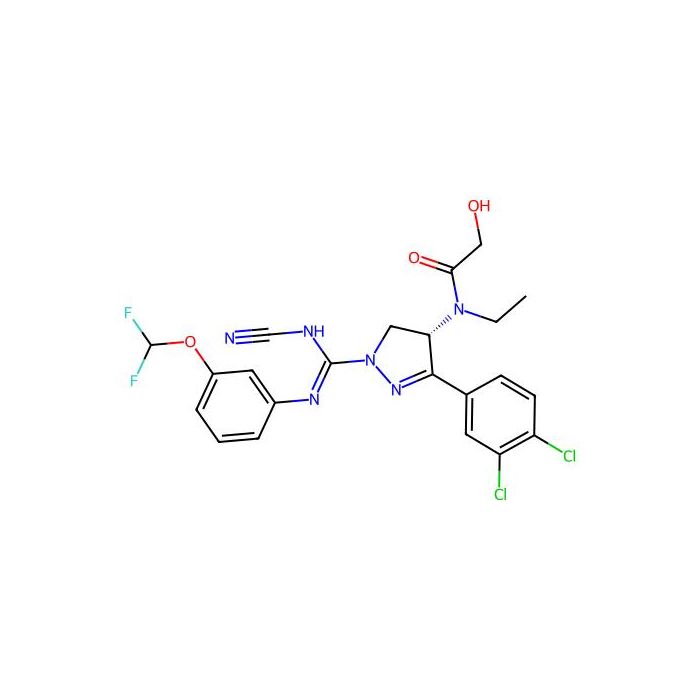
Structure and Identity
BAY-598 is supplied as a Moligand small-molecule screening compound.
SKU: B1498889
Product Name: BAY-598
CAS: 1906919-67-2
PubChem CID: 117072551 (literature identifier)
Molecular Formula: Not specified for this item; refer to CoA/Spec Sheet.
Molecular Weight: Not specified for this item; refer to CoA/Spec Sheet.
InChIKey: Not specified for this item; refer to CoA/Spec Sheet.
SMILES: Not specified for this item; refer to CoA/Spec Sheet.
Structural notes (general/literature context):
BAY-598 is widely referenced in the literature as a small-molecule tool compound originally disclosed by Bayer as a selective inhibitor used in chemical biology studies. Specific ring systems and functional groups are reported in the literature, but are not confirmed for this catalog item; consult the CoA/SDS for definitive identifiers for the lot supplied.
2D structure description:
Not specified for this item; refer to CoA/Spec Sheet for structural diagram and stereochemical information (if any).
Synthetic Utility
BAY-598 is offered as a finished small-molecule research ligand and is not intended as a general-purpose synthetic building block. Accordingly, it has limited applicability to routine organic synthesis workflows.
Where it may still be relevant (general):
Reference standard: May serve as a reference material for analytical method development (LC-MS, HPLC) in screening labs.
SAR benchmarking: Useful as a comparator in medicinal chemistry campaigns exploring related chemotypes, aiding structure–activity relationship interpretation.
Derivatization (advanced users): If functional handles exist (consult structure in CoA/literature), analog generation or probe development may be possible; however, such transformations are outside the scope of this catalog item and require user-validated chemistry.
If preparative transformations are desired, verify functional group compatibility and stability and start from appropriate intermediates rather than the finished ligand.
Target Specificity
Only product-data-derived target information may be listed here. For this item, no target specificity data are provided in the catalog entry.
Target/Enzyme/Pathway: Not specified for this item; refer to CoA/Spec Sheet.
Species reactivity/selectivity panel: Not specified for this item; refer to CoA/Spec Sheet.
Assay context/biomarker readouts: Not specified for this item; refer to CoA/Spec Sheet.
Note: Literature commonly discusses BAY-598 in the context of epigenetic enzyme studies; however, those details are not asserted here for this specific lot. Please consult primary publications or contact us for any available reference information.
Perguntas frequentes
What is Moligand??
Moligand? is one of Aladdin Scientific's premium product lines, formulated for high-purity applications across multiple workflows. Compared to standard grades in the same workflow, Moligand? products typically offer tighter specifications, more rigorous QC, and stronger lot-to-lot consistency.
How should this product be stored?
Store at ?80 °C. Ultra-low temperature storage is required to maintain the specified shelf life.
How is this product shipped?
This product ships frozen with dry ice and cold packs. Unpack on arrival and transfer it to the storage condition stated above; handle dry ice with insulated gloves in a ventilated area.
What are the CAS number, molecular formula and molecular weight?
The CAS Number is 1906919-67-2, the molecular formula is C22H20Cl2F2N6O3, and the molecular weight is 525.34 g/mol.
What documentation is provided?
Available product documentation, including Certificates of Analysis (COA), Safety Data Sheets (SDS), and specification sheets, is shown in the product document area. Document availability and access follow the current site policy.
Precisa de ajuda para escolher o grau?
O nosso guia de seleção de graus abrange pureza, estado do estabilizador e adequação à aplicação para todas as variantes do nosso catálogo.
Usamos cookies para garantir o funcionamento adequado do site e, quando permitido, para melhorar a sua experiência. Você pode gerenciar suas preferências a qualquer momento nas Configurações. Saiba mais em nossa Política de Cookies.
Deseja que lhe enviemos uma mensagem quando tivermos descontos disponíveis?
Lembrar-me mais tarde
Obrigado! Por favor, verifique a sua caixa de entrada de e-mail para confirmar.
Products are supplied to verified businesses, institutions, and qualified professionals for research and development use only. Not for use in humans, animals, diagnosis, or therapy.