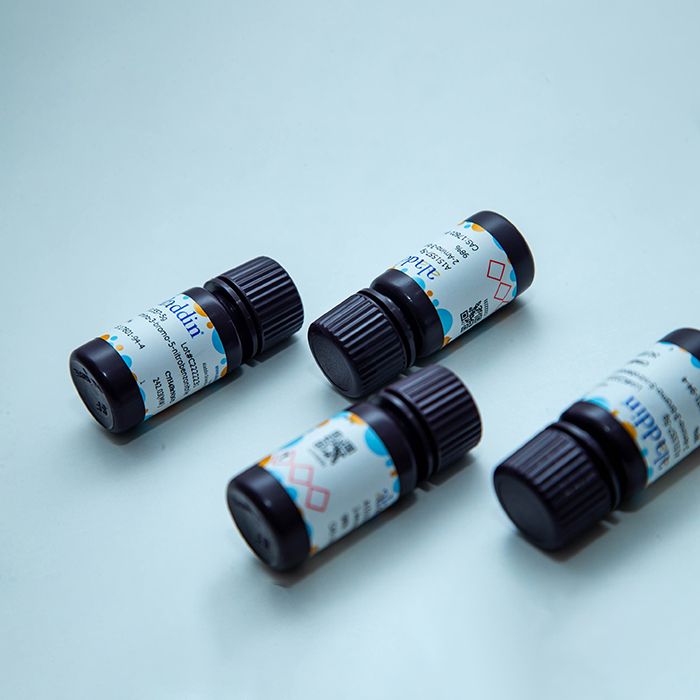
Determine the necessary mass, volume, or concentration for preparing a solution.
Dilution Calculator
Determine the dilution needed to prepare a stock solution.
Reconstitution Calculator
Revisões
Avaliações dos Clientes
Application Protocols
No item-specific validated protocols, tested applications, or recommended dilutions are provided in the Product Data for this derivative.
General workflow outlines (not item-specific; adapt to your chemistry)
Preparing stock: Dissolve the quencher derivative in anhydrous DMSO or DMF to 5–20 mM under low light. Store aliquots in amber vials.
Conjugation setup: Select buffer compatible with the reactive handle (amine- vs thiol- vs click-chemistry). Maintain low organic content in the reaction mixture and control pH as recommended in the Reaction Conditions tab.
Workup and purification: Remove excess quencher by gel filtration (bioconjugates), spin desalting, or preparative RP-HPLC. Verify removal of unconjugated quencher to minimize background quenching.
QC: Confirm degree of labeling by MS or spectrophotometry (using extinction coefficients for both donor and quencher when available). Evaluate quenching efficiency against donor-only controls.
Storage of conjugates: Protect from light; store per biomolecule stability (e.g., at 4°C for short term or −20/−80°C for long term), adding stabilizers as appropriate for the biomolecule (e.g., glycerol, salts).
Biological Roles
This product is a synthetic dark quencher reagent intended for laboratory research use only.
General/literature context (not item-specific)
BHQ-3–type quenchers do not have natural biological roles; they are engineered chromophores designed to nonradiatively dissipate energy transferred from excited donor fluorophores via FRET or through static/contact quenching.
In biochemical assays, they are used to report on molecular recognition or enzymatic activity through signal suppression that is relieved upon target interaction (e.g., cleavage of a linker or hybridization state change). Such uses are methodological and do not imply endogenous function.
When coupled to biomolecules (oligonucleotides, peptides, proteins), the quencher acts as a reporter moiety. Its performance depends on the microenvironment, interchromophore distance, and orientation.
Note: No clinical, diagnostic, or therapeutic claims are made for this item. All uses should be confined to controlled laboratory experiments.
Buffer Applications
Not a buffering reagent. BHQ-3 derivatives do not function as pH buffers.
Practical guidance (general; not item-specific)
For conjugation with amine-reactive handles (e.g., NHS ester), use non-amine buffers such as phosphate, bicarbonate/carbonate (pH 8–9), or HEPES; avoid Tris or other primary amines which compete with the reaction.
For thiol-selective handles (e.g., maleimide), use mildly acidic to neutral buffers (pH ~6.5–7.0) without competing thiols; degas to limit thiol oxidation.
Maintain low organic co-solvent percentages (typically ≤5% v/v DMSO/DMF) to keep biomolecules stable while ensuring quencher solubility.
All specific buffer compositions, pH ranges, and recipes for this catalog item are not specified; consult the CoA/Spec Sheet and adapt to your conjugation chemistry.
Green Alternatives
Since BHQ-3 derivatives are specialized quenching reagents rather than bulk solvents, “green alternatives” primarily relate to solvent/media choices and platform selection, not to the chromophore itself.
Greener solvent considerations (general; not item-specific)
Prefer water-rich media with minimal DMSO/DMF content where feasible; titrate in by small volumes of concentrated stocks.
When organic carrier is required, consider acetonitrile or ethanol (if compatible with the reactive handle and biomolecule) as less toxic alternatives to DMF.
Use anhydrous conditions to reduce waste from hydrolysis byproducts of activated esters.
DMF: Strong solvency; reproductive toxin classification in many jurisdictions—seek alternatives if possible.
Acetonitrile: Good solvency; higher volatility; less chronic toxicity than DMF; flammable—manage vapors.
Process improvements
Micro-scale conjugations with analytical monitoring (HPLC/LC–MS) reduce material use and solvent waste.
Solid-phase conjugation on oligos/peptides can limit excess quencher and simplify purifications.
Adopt closed, amberized reaction vessels to minimize photodegradation, reducing need for repeat syntheses and additional solvent consumption.
Pharmaceutical Uses
This product is offered for research use only and is not intended for human or veterinary use.
General formulation context (not item-specific)
BHQ-3–type quenchers are specialty analytical reagents used in assay development, probe manufacturing, and in-process quality controls. They are not typical pharmaceutical excipients.
In regulated environments, quencher-labeled probes may be components of analytical methods used during pharmaceutical development (e.g., qPCR methods), but the quencher itself is not a drug substance or dosage-form excipient.
No pharmacopeial monograph or excipient designation is provided for this item. For any use in regulated workflows, qualify the material per internal procedures and consult applicable guidance.
Physical Properties
Item-specific specifications
Molecular weight: Not specified for this item; refer to CoA/Spec Sheet.
Molecular formula: Not specified for this item; refer to CoA/Spec Sheet.
Melting/boiling point, density, refractive index, UV–vis maxima, logP, pKa: Not specified for this item; refer to CoA/Spec Sheet.
General/literature characteristics for BHQ-3–type dark quenchers (not item-specific)
Physical state: Often isolated as dark solid powders; intensely colored due to broad absorption; non-emissive (dark quencher) by design.
Solubility: Many BHQ-3 derivatives show good solubility in polar aprotic organic solvents (e.g., DMSO, DMF) and limited solubility in water unless bearing ionic/PEG substituents. Solubility can vary widely with the reactive handle and counterions (if salt forms).
Optical profile (literature, typical): Broad absorption spanning red to near-IR; commonly used to quench fluorophores such as Cy5, Alexa 647/660, ROX/Texas Red class via FRET or contact quenching. Exact λmax and ε depend on the specific derivative and must be verified on the CoA or by recording a spectrum under assay-relevant conditions.
Stability: Generally stable at ambient conditions when kept dry and protected from light; some reactive derivatives (e.g., NHS esters) are moisture-sensitive and hydrolyze over time, especially in basic or aqueous media.
Note: For experimental design (e.g., FRET pairs, spectral overlap integrals), measure the spectrum of the exact lot in the intended solvent/buffer to ensure accurate J(λ) calculations.
Quality and Grades
Item-specific details
Grade/Purity: Not specified for this item; refer to CoA/Spec Sheet.
Appearance: Not specified for this item; refer to CoA/Spec Sheet.
General guidance for BHQ-3–type quenchers (not item-specific)
Research-grade quencher reagents are typically qualified by NMR/HRMS and HPLC purity; for conjugation-grade materials, low levels of hydrolyzed byproducts and minimal inorganic residues are important to ensure consistent labeling efficiencies and low background signal.
If supplied as an activated ester (e.g., NHS), quality metrics may include assay of active ester content and residual free acid. For maleimide- or isothiocyanate-bearing derivatives, tests for functionality integrity are relevant.
UV–vis profile: Some suppliers include a reference spectrum and an extinction coefficient in a specified solvent; use these values as a starting point only and verify in your own matrix.
Stabilizers: Certain activated esters are formulated without stabilizers to avoid interference in bioconjugations; others may be packaged with desiccants and under inert gas. If any stabilizers are present in a specific item, they will be declared on the CoA/Spec Sheet.
Documentation and lot control
Request CoA and, where available, analytical pack (HPLC/LC–MS traces) for each lot.
For regulated workflows, ensure the material meets your internal QA specifications (e.g., low endotoxin/bioburden if required by your application).
Reaction and Applications
Item-specific application note
Manufacturer note: For research use only.
General applications for BHQ-3–type quenchers (not item-specific)
Fluorescence quenching: Serve as non-emissive acceptors in FRET- and contact-quenching assays, particularly matched with red/NIR fluorophores (e.g., Cy5-class, Alexa 647/660, Texas Red/ROX family, literature). Used in qPCR probes (e.g., hydrolysis/TaqMan-type), molecular beacons, hybridization probes, protease and nuclease reporters.
Probe construction: Depending on the derivative’s reactive handle (e.g., NHS ester for lysine primary amines; maleimide for cysteine thiols; isothiocyanate for amines; azide/alkyne for click), BHQ-3 can be site-selectively attached to oligonucleotides, peptides, proteins, or small molecules.
Signal optimization: The broad absorption and lack of native emission minimize bleed-through and improve signal-to-noise in multiplexed assays when paired properly with donor dyes and filter sets.
Surface and polymer labeling: Incorporation into microspheres, hydrogels, or surfaces for quenched sensors and lateral-flow test lines.
Practical tips
Choose donor–quencher distances and linkers to balance FRET efficiency and target binding. Calculate Förster distances using literature extinction coefficients and donor quantum yields, verifying spectral overlap in your solvent/buffer.
Protect from light throughout synthesis and purification of conjugates; assess residual free quencher by HPLC to avoid nonspecific quenching.
Validate quenching performance against a donor-only control and an absorptive control (inner-filter check) to distinguish true FRET from static quenching.
Reaction Conditions
No item-specific conditions are provided in the Product Data. The following are general, literature-based guidelines for common BHQ-3 conjugation chemistries (not item-specific; adjust to your derivative and substrate):
NHS ester to amines: Dissolve quencher in anhydrous DMSO or DMF (5–20 mM). Add to substrate in bicarbonate or phosphate buffer, pH 8.3–8.8, keeping final organic ≤10% v/v. Typical temperature 20–25°C, 0.5–2 h. Molar ratios 3–10 eq quencher per amine site, depending on substrate accessibility. Quench unreacted ester with ethanolamine. Hydrolysis competes; work swiftly.
Maleimide to thiols: Buffer at pH 6.5–7.0 (e.g., phosphate), degassed. Add DMSO stock to achieve ≤5% v/v organic. 20–25°C, 30–90 min. Avoid excess thiols; desalt/reduce disulfides immediately prior to coupling.
Isothiocyanate to amines: pH 8.5–9.0 carbonate buffer. 20–25°C, 2–12 h. Form stable thioureas; minimize water for faster rates.
CuAAC (azide/alkyne): Aqueous t-BuOH/H2O or ACN/H2O; CuSO4 + sodium ascorbate or CuBr/ligand (e.g., TBTA). 20–25°C, 0.5–4 h. Protect from light; remove copper post-reaction if labeling biomolecules.
Analytical control
Track reactions by HPLC (UV–vis at donor and quencher wavelengths) and/or LC–MS. Confirm dye-to-substrate ratios by MS or absorbance if extinction coefficients are known for your exact derivative/solvent.
Safety and Handling
Item-specific hazard data
GHS signal word: Not specified for this item; refer to SDS.
H-statements: Not specified for this item; refer to SDS.
GHS classification/pictograms: Not specified for this item; refer to SDS.
General laboratory safety guidance for dye/quencher reagents (not item-specific)
PPE: Wear lab coat, safety glasses, and appropriate chemically resistant gloves. Avoid skin/eye contact; many chromophores are strong stains and may be irritants.
Light sensitivity: Protect from light during handling and storage to prevent photodegradation; use amber vials and minimize exposure.
Moisture sensitivity (if bearing reactive handles): NHS esters, isothiocyanates, and other electrophiles can hydrolyze; handle quickly under dry conditions. Open only when ready to use; reseal under dry inert gas where practical.
Dust and aerosols: Avoid creating dust; weigh in a fume hood. Some dye powders can be respiratory irritants.
Incompatibilities: Strong oxidizers/reductants may degrade conjugated chromophores. Bases/acids can accelerate hydrolysis or structural changes depending on functionality. Avoid nucleophiles for acyl-activating groups unless intended for conjugation.
First-aid overview: In case of contact, rinse affected area with water for at least 15 minutes; remove contaminated clothing. If inhaled, move to fresh air. If ingested or upon any exposure causing concern, seek medical attention. Always consult the SDS for authoritative guidance.
Disposal: Collect waste solutions and contaminated disposables as halogen-free organic dye waste (per institutional policy); do not discharge to drains.
Solvent Selection
Applicability: BHQ-3 derivatives are hydrophobic quenchers commonly handled in polar aprotic organic solvents; specific miscibility depends on the substituents/reactive handle of the derivative.
General/literature guidance (not item-specific)
Primary dissolution solvents: DMSO and DMF often provide rapid dissolution at millimolar concentrations suitable for stock solutions used in oligo/probe labeling or assay preparation.
Co-solvent use: For aqueous applications, introduce via small volumes of DMSO/DMF stock into buffered media while monitoring final organic percentage (typically ≤5% v/v to maintain biomolecule integrity). If precipitation occurs, consider acetonitrile as a carrier co-solvent.
Polarity and dielectric: Polar aprotic solvents (DMSO ε ~47; DMF ε ~37, literature) favor solvation of conjugated chromophores and maintain reactivity of activated esters.
Water and protic solvents: May induce hydrolysis of activated handles (e.g., NHS) or aggregation of hydrophobic dyes. Use immediately after dilution into aqueous buffers.
Alternative media: For click-compatible derivatives (azide/alkyne), t-BuOH/H2O mixtures or acetonitrile/H2O can be effective, provided the quencher remains in solution.
Practical tips
Filter or centrifuge stock solutions if particulates persist; avoid using basic amine solvents (e.g., pyridine) unless required by the chemistry, as they may prematurely react with activated esters.
Record exact solvent composition in notebooks for reproducibility of FRET/quenching performance.
Storage and Reconstitution
Item-specific storage
Storage conditions: Room temperature (per Product Data).
Shipped: Normal.
Additional general guidance for BHQ-3–type reagents (not item-specific)
Light protection: Store in amber vials or wrap containers in foil to prevent photodegradation.
Moisture control: Keep tightly capped with desiccant; reactive derivatives (e.g., NHS esters) benefit from a dry atmosphere (optional inert gas backfill) to limit hydrolysis.
Reconstitution: Prepare concentrated stock solutions in anhydrous DMSO or DMF (e.g., 5–20 mM). Vortex and, if necessary, gently warm (≤30°C) briefly to aid dissolution, avoiding prolonged heating or light exposure.
Aliquoting: Divide stock into single-use amber microvials to minimize freeze–thaw and headspace moisture. Record preparation date and solvent.
Working solutions: Dilute into compatible buffers immediately before use; limit exposure to water/buffer for hydrolysis-prone handles.
Stability
Exact shelf life, impurity limits, and photostability are not specified for this item; refer to CoA/Spec Sheet and SDS. Verify integrity by HPLC/LC–MS or UV–vis prior to critical experiments, especially after extended storage.
Structure and Identity
Item-specific identifiers (from Product Data)
SKU: B664218
Product name: BHQ-3 derivative
CAS: 374592-00-4
Storage conditions: Room temperature
Shipped in: Normal
Not specified for this item; refer to CoA/Spec Sheet
Molecular formula: Not specified for this item; refer to CoA/Spec Sheet.
Molecular weight: Not specified for this item; refer to CoA/Spec Sheet.
SMILES: Not specified for this item; refer to CoA/Spec Sheet.
InChIKey: Not specified for this item; refer to CoA/Spec Sheet.
Appearance: Not specified for this item; refer to CoA/Spec Sheet.
Grade/Purity: Not specified for this item; refer to CoA/Spec Sheet.
General/literature context (BHQ-3 class; not item-specific)
BHQ-3 (Black Hole Quencher-3) refers to a family of nonfluorescent ("dark") quenchers designed to accept energy from red/near-IR fluorophores (typically ~620–730 nm absorption window, literature) via FRET and/or contact quenching.
Structural features commonly observed in BHQ-3 derivatives include extended conjugation and multiple aromatic/azo-like chromophoric units tailored for broad-band absorption without emission. Functionalized variants may bear reactive handles for conjugation (e.g., NHS ester for amines, maleimide for thiols, azide/alkyne for click), but the specific functionality of this catalog item is not provided in the Product Data.
2D structural motif (literature, generic): polyaromatic/quinoid core with auxochromes to tune absorption; substituents provide solubility or reactive linkage. Exact ring systems and stereochemistry depend on the specific derivative and are not specified here.
Synthetic Utility
Item-specific chemistry details (functional groups, reactivity) are not provided in the Product Data for this derivative.
General/literature utility of BHQ-3 derivatives (not item-specific)
Reactive handles: Common variants include NHS esters (acylation of primary amines on peptides/proteins/oligos), isothiocyanates (formation of thioureas with amines), maleimides (Michael addition to thiols), carboxylic acids (coupling via carbodiimides/HATU), and azide/alkyne partners for CuAAC or SPAAC.
Synthesis/derivatization: The quencher core can be appended to linkers (PEG, alkyl, aromatic) to tune solubility, spacing, and sterics. Spacer selection impacts FRET efficiency and biomolecule function.
Retrosynthetic value: Treat the BHQ-3 chromophore as a modular label. Functional group interconversions typically occur on the linker termini to avoid perturbing the chromophore.
Purification: Conjugated aromatics can be challenging in silica chromatography (tailing). Reverse-phase HPLC is frequently employed for both small-molecule intermediates and bioconjugates; protect from light throughout.
Notes
Verify stability of the reactive group under coupling conditions (avoid excess base with NHS esters; avoid amines with activated carbonates unless intended). Monitor reactions by LC–MS or analytical HPLC to track consumption and byproduct formation.
Target Specificity
Not an antibody or affinity reagent. No target, antigen, clone, isotype, or species reactivity applies to this item.
Use-case context (general; not item-specific)
When incorporated into probes, BHQ-3–type quenchers provide signal control but do not confer biological target specificity by themselves. Specificity derives from the attached ligand (e.g., oligonucleotide sequence, peptide motif, small-molecule binder).
We use cookies to ensure the website functions properly and, where permitted, to improve your experience. You can manage your preferences at any time in Settings. Learn more in our Cookie Policy.
Shall we send you a message when we have discounts available?
Remind me later
Thank you! Please check your email inbox to confirm.
Products are supplied to verified businesses, institutions, and qualified professionals for research and development use only. Not for use in humans, animals, diagnosis, or therapy.