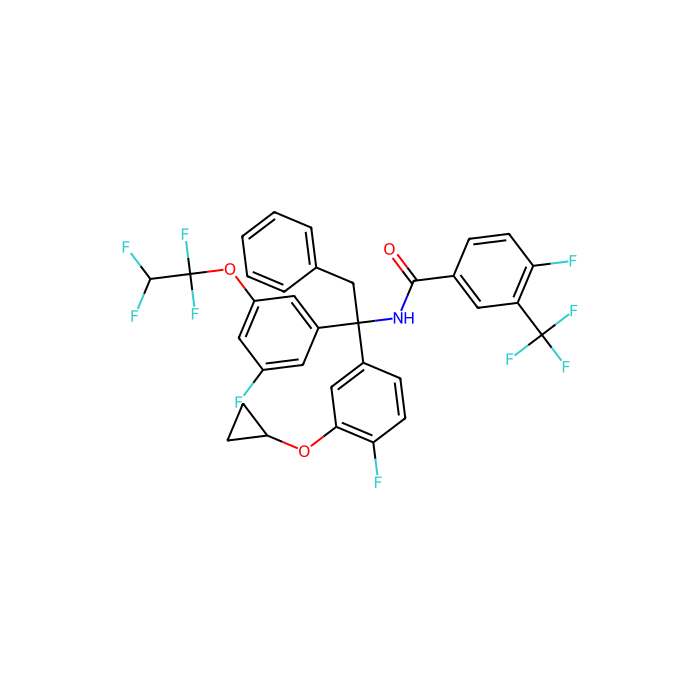
Potent cholesteryl ester transfer protein (CETP) inhibitor (IC50= 4 nM in an enzyme-based scintillation proximity assay). Inhibits cholesteryl ester transfer and increases HDL-C levelsin vivo. Orally bioavailable.
Condições de armazenamento de armazenamento
Store at -20°C
Enviado em
Ice chest + Ice pads
Este produto requer transporte de cadeia fria. Serviços terrestres e outros serviços econômicos não estão disponíveis.
This compound belongs to the class of organic compounds known as n-benzylbenzamides. These are compounds containing a benzamide moiety that is N-linked to a benzyl group.
External Descriptors
Not available
1. Djoumbou Feunang Y, Eisner R, Knox C, Chepelev L, Hastings J, Owen G, Fahy E, Steinbeck C, Subramanian S, Bolton E, Greiner R, and Wishart DS. ClassyFire: Automated Chemical Classification With A Comprehensive, Computable Taxonomy. Journal of Cheminformatics, 2016, 8:61.
Solvent:DMSO, Max Conc. mg/mL: 67.15, Max Conc. mM: 100; Solvent:ethanol, Max Conc. mg/mL: 67.15, Max Conc. mM: 100
Peso molecular
671.500 g/mol
XLogP3
9.500
Hydrogen Bond Donor Count
1
Hydrogen Bond Acceptor Count
13
Rotatable Bond Count
11
Exact Mass
671.152 Da
Monoisotopic Mass
671.152 Da
Topological Polar Surface Area
47.600 Ų
Heavy Atom Count
47
Formal Charge
0
Complexity
1040.000
Isotope Atom Count
0
Defined Atom Stereocenter Count
1
Undefined Atom Stereocenter Count
0
Defined Bond Stereocenter Count
0
Undefined Bond Stereocenter Count
0
The total count of all stereochemical bonds
0
Covalently-Bonded Unit Count
1
Calculadoras de soluções
Molarity Calculator
Determine the necessary mass, volume, or concentration for preparing a solution.
Dilution Calculator
Determine the dilution needed to prepare a stock solution.
Reconstitution Calculator
Revisões
Avaliações dos Clientes
Application Protocols
No manufacturer application protocols are provided for this SKU. The following are general, non-item-specific guidelines for using small-molecule research compounds in vitro.
Stock solution: Prepare in anhydrous DMSO after confirming solubility and stability. Typical screening stocks: 10 mM. Filter only if fully soluble and stable.
Serial dilution: Perform geometric dilutions (e.g., 1:3 or 1:10) in DMSO or assay buffer containing the same DMSO fraction to generate a concentration–response curve (8–12 points recommended).
Assay vehicle: Keep final DMSO ≤0.1–0.5% v/v for sensitive cell types; validate tolerability for your system.
Controls: Include vehicle control, positive control (if a known modulator exists for the same pathway), and negative/orthogonal controls. Randomize plate layouts to mitigate edge effects.
Incubation: Optimize time (e.g., 15 min to several hours) based on expected mechanism and cellular uptake; monitor potential precipitation or adsorption.
Data quality: Track Z′ factor, include intra- and inter-plate replicates, and confirm hits by re-testing fresh stocks.
Note: These are generic best practices. For any protocol claiming target engagement or selectivity, corroborate with independent methods and compound identity verification.
Biological Roles
Item-specific biological targets, pathways, or mechanisms for BMS 795311 are not provided in the Product Data. The following guidance is general to small-molecule research tools and is not a claim about this specific compound.
Small molecules may act as ligands, inhibitors, or activators of enzymes, transporters, ion channels, or receptors, enabling perturbation of cellular pathways in vitro.
Typical study endpoints include concentration–response behavior (IC50/EC50), selectivity profiles across related targets, and off-target assessments to understand phenotypic outcomes.
In systems biology contexts, tool compounds help dissect signal transduction, metabolism, or trafficking by providing reversible, titratable perturbations compared with genetic knockouts/knockdowns.
ADME-related characterizations (solubility, permeability, stability) inform suitability for cellular assays and guide dosing vehicles to avoid assay artifacts.
Important notes:
This product is supplied strictly for research use only; no medical, diagnostic, or therapeutic use is implied.
If you require a validated target/mechanism for your study design, request or consult peer-reviewed literature tied to the exact CAS 939390-99-5 or CID 23582473, and verify alignment with the material’s CoA.
Buffer Applications
This product is a research small molecule and is not a buffering reagent.
Buffer use: Not typically applicable. It does not constitute a defined acid/base conjugate pair for pH control in aqueous systems (no pKa data provided for this item).
For experiments requiring aqueous dosing, prepare vehicle controls by adding the same volume of solvent (e.g., DMSO or ethanol) to the buffer as used for the compound solution.
If precipitation is observed upon dilution into buffer, consider:
Increasing dilution factor of the DMSO stock.
Using a cosolvent (≤0.5% v/v DMSO or ethanol) and gentle warming/sonication.
Adding a non-ionic surfactant (e.g., 0.01–0.05% Tween 80) if biologically acceptable.
For true buffer selection (Good’s buffers, phosphate, HEPES, etc.), refer to dedicated buffering agents with known pKa and ionic strength parameters.
Green Alternatives
Because specific solvent/processing needs for BMS 795311 are not provided, consider general greener practices for handling small-molecule research compounds.
Greener solvent considerations (general):
Prefer water-based buffers with minimal co-solvent where feasible. Validate solubility and activity in ≤0.1–0.5% v/v DMSO or ethanol.
If neat organic solvent is required for preparative work, consider 2-MeTHF or ethyl acetate over chlorinated solvents (when compatible with stability/solubility).
For cleaning, use isopropanol or ethanol before resorting to acetone or chlorinated solvents.
Balanced comparison (general, not item-specific):
DMSO vs DMF: DMSO typically preferred for lower toxicity and better biodegradability; DMF offers strong solvency but is more hazardous.
Methanol vs Ethanol: Ethanol is generally safer and preferred from a green-chemistry standpoint; ensure solubility is adequate.
Aqueous micellar media: Emerging option (e.g., TPGS-750-M) for some transformations; relevance depends on whether you are conducting synthesis (not typical for this SKU).
Operational tips:
Prepare concentrated stocks to minimize solvent volumes introduced to assays.
Use amber vials and low-headspace storage to reduce photolysis/oxidation risk and material waste.
Document and justify solvent choices in your method to facilitate greener substitutions during scale-up or tech transfer.
Pharmaceutical Uses
No pharmacopeial status or excipient role is provided in the Product Data. This product is sold strictly for research use only.
General context (not item-specific):
Compounds identified by internal codes (e.g., “BMS ######”) are often discovery-stage tool molecules or leads used in non-clinical research. They are not manufactured under GMP and are not suitable as drug substances or excipients.
In pharmaceutical R&D, such materials may serve as reference standards for analytical method development (LC–MS retention time, fragmentation patterns) or as positive/negative controls in screening campaigns.
If your application requires GMP, ICH-compliant impurity profiling, or pharmacopeial monograph alignment, this research-grade material is not appropriate; contact Aladdin Scientific for available grades or custom synthesis under suitable quality systems.
Regulatory note:
Not approved for use in humans or animals for therapeutic or diagnostic purposes. No claims are made regarding safety, efficacy, or clinical utility.
Physical Properties
The Product Data do not provide physical constants or spectral data for BMS 795311. Values below are placeholders indicating lack of item-specific data; consult the product CoA/Spec Sheet or primary literature for definitive numbers.
Appearance: Not specified for this item; refer to CoA/Spec Sheet.
Molecular weight: Not specified for this item; refer to CoA/Spec Sheet.
Melting point / Boiling point: Not specified for this item; refer to CoA/Spec Sheet.
Density: Not specified for this item; refer to CoA/Spec Sheet.
Refractive index: Not applicable/unknown for solids; Not specified for this item; refer to CoA/Spec Sheet.
LogP / cLogP: Not specified for this item; refer to CoA/Spec Sheet.
pKa(s): Not specified for this item; refer to CoA/Spec Sheet.
Solubility profile: Not specified for this item; refer to CoA/Spec Sheet.
UV-Vis λmax / IR / NMR: Not specified for this item; refer to CoA/Spec Sheet.
General guidance (literature/practice, not item-specific):
Many discovery-stage small molecules are supplied as off-white to white solids with limited aqueous solubility and good solubility in DMSO. Verify experimentally.
If UV detection is planned (HPLC/UPLC), determine actual λmax from a recorded spectrum for this lot; do not assume generic chromophore behavior in the absence of a structure.
Quality and Grades
Grade/Purity (as sold): Not specified for this item; refer to CoA/Spec Sheet.
Interpretation and guidance (general, not item-specific):
If the material is intended for screening/assay use, typical expectations are ≥95% purity by HPLC/UPLC with supporting chromatogram and identity confirmation (1H NMR/LC–MS). Verify the actual specification on the CoA for this SKU/lot.
For analytical/reference use, customers may require ≥98% purity, defined residual solvents, and tight limits for unknown impurities. Request full analytical package if needed (chromatographic method, UV cutoff, residual solvents, water content).
If a stabilizer is present or special storage is required, it will be noted on the label/CoA. No stabilizer information is provided for this item in the Product Data.
Batch-to-batch reproducibility is critical for bioassays. Retain lot-specific documentation and consider re-qualifying potency/solubility when changing lots.
Documentation provided on request:
CoA with assay method(s), chromatograms, and identity spectra.
SDS for safety classification and handling.
Technical note with any available solubility/preparation guidance (if provided by the manufacturer).
Reaction and Applications
This product is sold as a finished research compound rather than a synthetic reagent; no manufacturer reaction applications are provided for this SKU.
General laboratory applications for discovery compounds (not item-specific):
Biochemical assays: Evaluate modulation of enzyme/receptor/transport activity in purified or membrane preparations. Establish concentration–response curves to estimate IC50/EC50.
Cell-based assays: Test phenotypic responses, pathway reporter activation/inhibition, or target engagement (e.g., CETSA, NanoBRET) with strict vehicle controls.
ADME profiling: Solubility, microsomal stability, plasma protein binding, and permeability (PAMPA/Caco-2) to characterize compound-like behavior.
Analytical reference: Use as a comparator standard in LC–MS methods for method development, retention time assignment, or metabolite ID (where authentic reference is needed).
Practical considerations:
Verify identity/purity by LC–MS and 1H NMR upon receipt when application-critical.
Establish stock concentration (commonly 10–50 mM in DMSO) only after confirming solubility and stability; store aliquots at −20°C to minimize freeze–thaw.
Conduct stability checks (bench/37°C/light) to define assay handling windows; protect from light if chromophores are suspected (unknown for this item).
Reaction Conditions
Not applicable to this SKU as sold. BMS 795311 is provided as a research compound, not a reagent for conducting named reactions. No manufacturer-specified reaction conditions are supplied.
General laboratory handling conditions for small-molecule stocks (not item-specific):
Stock preparation: Dissolve in anhydrous DMSO to a validated concentration (commonly 10–50 mM once solubility is confirmed). Vortex and, if necessary, gently warm or sonicate briefly.
Working solutions: Dilute into assay buffer or media immediately before use, maintaining consistent vehicle content across all samples.
Stability checks: Assess short-term stability at room temperature and 37°C; store on ice during prolonged bench work if instability is suspected.
Photostability: If the compound absorbs in the near-UV/visible region (unknown here), protect with amber vials/foil.
If you intend to use this substance as a reagent in synthesis, obtain the full structure and reactivity profile first; then consult literature for substrate scope, catalysts, and temperature ranges relevant to the identified functional groups.
Safety and Handling
Safety information is not specified in the Product Data for this item; always consult the official SDS for authoritative guidance.
GHS Classification / Pictograms / H-Statements / Signal Word: Not specified for this item; refer to SDS.
General PPE: Laboratory coat, safety glasses or splash goggles, and appropriate chemical-resistant gloves. Use in a fume hood to avoid inhalation of dust or vapors.
Handling notes (general):
Avoid generating dust/aerosols. Prevent contact with skin, eyes, and clothing.
Do not ingest, inhale, or inject. For research use only.
Keep containers tightly closed; open and weigh promptly to minimize moisture uptake or contamination.
Incompatibilities (general): Unknown for this item. Until data are available, segregate from strong oxidizers/reducers, strong acids/bases, and reactive acylating/alkylating agents.
First aid (overview; defer to SDS):
Inhalation: Move to fresh air; seek medical attention if symptoms persist.
Skin: Wash with soap and water; remove contaminated clothing.
Eyes: Rinse cautiously with water for several minutes; remove contacts if easy; seek medical advice if irritation continues.
Ingestion: Rinse mouth; do not induce vomiting unless directed by medical personnel.
Spill response: Avoid dust, collect with inert absorbent, place in a chemical waste container. Decontaminate area per institutional protocol.
Solvent Selection
Item-specific solubility data are not provided. The following guidance reflects common practice for small-molecule research compounds and should be verified experimentally.
Primary stock solvent (typical): Anhydrous DMSO due to broad solvating power for neutral and moderately polar organics.
Secondary solvents (if compatible): Ethanol, methanol, or DMF; for working solutions, aqueous buffers with co-solvent (e.g., 0.1–1% DMSO or ethanol) and surfactant (e.g., 0.01–0.05% Tween 80) may assist dispersion. Confirm stability.
Aqueous compatibility: Unknown for this specific item. Many screening compounds require cosolvent or pH adjustment. Avoid precipitation in cell-based assays.
Polarity class (general): Unknown for this item; assume non- to moderately polar unless structural data indicate otherwise.
Comparison (general, not item-specific):
DMSO: Highest solvency; potential biological effects above ~0.5% v/v in cells—keep vehicle constant across controls.
Ethanol: Volatile; tolerability varies by cell type; lower solvency than DMSO.
DMF: Strong solvency but higher toxicity; prefer DMSO where possible.
Practical tips:
Determine a solubility limit by incremental dilution and visual inspection; confirm with nephelometry or HPLC.
Filter sterilize only if the compound is stable and sufficiently soluble; otherwise prepare sterile stocks via sterile technique in a biosafety cabinet.
Storage and Reconstitution
Item-specific storage and shipping information from Product Data:
Storage Conditions: Store at −20°C (Product Data)
Shipped In: Ice chest + Ice pads (Product Data)
Additional guidance (general best practice; not item-specific):
Container: Keep tightly closed in original vial. If hygroscopic or air/light sensitive (unknown here), minimize headspace, consider inert gas backfill, and use amber glass.
Aliquoting: Upon first opening, prepare single-use aliquots of stock solution (e.g., in DMSO) to avoid repeated freeze–thaw cycles. Label with concentration, solvent, and date.
Reconstitution:
Solvent: Anhydrous DMSO is commonly used for hydrophobic research compounds. Verify solubility experimentally before setting working concentrations.
Technique: Warm gently to room temperature, vortex, and, if needed, brief sonication. Avoid prolonged heating.
Short-term handling: Keep solutions on ice or at 2–8°C during the assay day if stability is uncertain; discard if precipitation or discoloration occurs.
Long-term stability: Unknown for this item; establish an internal stability-indicating HPLC method to monitor degradation over storage.
Always consult the product CoA and SDS for lot-specific specifications and safety before use. For research use only.
Structure and Identity
Brief overview: BMS 795311 is a cataloged research chemical. The supplied Product Data do not include a chemical structure or defining identifiers beyond registry IDs.
Product Name (catalog): BMS 795311 (SKU: B288665)
CAS: 939390-99-5 (Product Data)
PubChem CID: 23582473 (Product Data)
InChIKey: 355428 (Product Data; truncated/incomplete as provided)
SMILES: Not specified for this item; refer to CoA/Spec Sheet.
Molecular formula: Not specified for this item; refer to CoA/Spec Sheet.
Molecular weight: Not specified for this item; refer to CoA/Spec Sheet.
Structural features (general notes):
No structural diagram, functional groups, or stereochemical details are provided in the Product Data. Consequently, specific ring systems, heteroatoms, HBA/HBD counts, or stereocenters cannot be described for this listing.
If your work requires unambiguous structural verification (e.g., for analytical reference standards or mechanistic studies), please request the latest CoA/SDS and structure file (SDF/MOL/SMILES) from Aladdin Scientific technical support.
2D structure in words:
Not available from the supplied data. Once structural information is provided, we can summarize functional motifs (e.g., aromatic cores, heterocycles, amide/urea linkages) and potential sites for ionization or metabolism.
Synthetic Utility
This SKU is offered as a finished research compound rather than a synthetic building block. Without structural information, specific transformations cannot be recommended.
General considerations (not item-specific):
If analog synthesis or SAR expansion is planned, obtain the structure and key functional groups from the supplier or literature (via CAS 939390-99-5 / CID 23582473) to identify handles amenable to diversification (e.g., aryl halides for cross-coupling, amines/acids for amide coupling, heterocycles for late-stage functionalization).
For analytical support in synthesis, develop LC–MS methods (single- or multi-λ UV detection) and a stability-indicating HPLC to monitor degradation during scale-up or purification.
If chiral centers are present (unknown here), plan for enantioselective synthesis or chiral resolution and include chiral HPLC or polarimetry in the control strategy.
Purification (general):
Normal- or reverse-phase flash/ prep-HPLC choices depend on polarity and chromophores; gradient RP-HPLC is often most reliable for complex discovery compounds.
For salt formation, screen counterions (HCl, HBr, fumarate, maleate, mesylate) only after confirming solid-state stability and desired polymorph behavior.
Target Specificity
Item-specific biological target(s), binding constants, and selectivity data are not provided in the Product Data.
Target/Pathway: Not specified for this item; refer to CoA/Spec Sheet and primary literature associated with CAS 939390-99-5 or CID 23582473.
Selectivity panel data: Not specified for this item; refer to CoA/Spec Sheet.
Potency metrics (IC50/EC50/Ki/Kd): Not specified for this item; refer to CoA/Spec Sheet.
Guidance (general, not item-specific):
Establish mechanism-of-action via orthogonal assays (biochemical vs cellular), and confirm on-target engagement (e.g., CETSA, DARTS, NanoBRET) where applicable.
Profile selectivity across close homologs and common off-targets to contextualize phenotypes and guide dosing.
Include vehicle controls and, if available, structurally distinct tool compounds to triangulate biological conclusions.
Usamos cookies para garantir o funcionamento adequado do site e, quando permitido, para melhorar a sua experiência. Você pode gerenciar suas preferências a qualquer momento nas Configurações. Saiba mais em nossa Política de Cookies.
Deseja que lhe enviemos uma mensagem quando tivermos descontos disponíveis?
Lembrar-me mais tarde
Obrigado! Por favor, verifique a sua caixa de entrada de e-mail para confirmar.
Products are supplied to verified businesses, institutions, and qualified professionals for research and development use only. Not for use in humans, animals, diagnosis, or therapy.