Determine the necessary mass, volume, or concentration for preparing a solution.
Dilution Calculator
Determine the dilution needed to prepare a stock solution.
Reconstitution Calculator
Revisões
Avaliações dos Clientes
Application Protocols
Item-specific tested applications, recommended dilutions, or protocols: Not specified for this item; refer to CoA/Spec Sheet.
General handling guidance for small-molecule stocks (not product specifications)
Prepare a concentrated stock (e.g., 10–50 mM) in dry DMSO or ethanol. Vortex and, if needed, gently warm (<40°C) to aid dissolution.
For biological assays, dilute the stock into pre-warmed assay buffer or media with vigorous mixing; keep final cosolvent low (≤0.1–0.5% v/v). Include vehicle controls matched to the maximum solvent content.
For LC–MS quantitation, prepare calibration curves spanning expected concentrations in your matrix, using stable isotope-labeled internal standards when available. Validate recovery and matrix effects.
To reduce adsorption to plastics, use low-bind tubes/plates or precondition surfaces with minimal serum-containing media.
Biological Roles
General biochemical context (literature; not product-specific, no clinical claims)
Boldenone cypionate is a pro-ester of boldenone, an anabolic-androgenic steroid that acts as an agonist of the androgen receptor (AR). The cypionate ester modulates lipophilicity and hydrolysis rate, influencing release of the active 17β-alcohol in biological systems.
The Δ1,4-diene and 3-keto functional groups are key pharmacophores for AR binding among androstane derivatives.
In vitro, boldenone (released from the ester) can regulate AR-dependent transcriptional programs; the cypionate itself is generally considered inactive until hydrolyzed. Esterases (carboxylesterases) mediate hydrolysis in biological matrices.
Research uses (non-clinical)
Tool compound for dissecting AR signaling, co-regulator recruitment, and structure–activity relationships across steroidal ligands.
Substrate in metabolism and stability studies (microsomes, S9, plasma) to characterize ester cleavage kinetics and potential oxidative transformations on the steroid nucleus (e.g., 5β/6β-hydroxylation) under controlled test-tube conditions.
Cautions
Handle as a bioactive hormone analog; design experiments to minimize unintended exposure, adsorption losses, and nonspecific binding.
Buffer Applications
This product is not a buffering reagent. It does not form classical buffer systems or serve as a pH control component.
Practical note: When introducing lipophilic steroids into aqueous buffers for in vitro assays, use cosolvents (DMSO or ethanol) and, if necessary, solubilizers (e.g., cyclodextrins, serum albumin, or nonionic surfactants) to maintain dispersion. Validate that the vehicle does not perturb your biological readout (general guidance).
Green Alternatives
Context
Boldenone cypionate is an active hydrophobic analyte, not a commodity solvent. “Greenness” considerations focus on solvent choices for dissolution, purification, and analysis.
Replace chlorinated solvents (e.g., CH2Cl2, CHCl3) with ethyl acetate or 2-methyltetrahydrofuran (2-MeTHF) where feasible for workup/purification.
For stock solutions, ethanol can substitute for DMSO when compatible with the assay and required concentrations are modest.
In normal-phase chromatography, heptane can replace hexane to reduce environmental impact; in reverse-phase, prioritize water–acetonitrile over water–methanol when energy use and toxicity profiles favor ACN in your facility’s LCA.
Example comparison (general)
DCM vs EtOAc: EtOAc offers lower toxicity and better biodegradability; may require slightly larger volumes for comparable solubility.
DMSO vs ethanol: DMSO enables higher stock concentrations; ethanol is greener but may limit achievable solubility and can affect certain bioassays.
Operational practices
Minimize solvent volumes via micro-scale workflows and closed transfers; recover and recycle ACN/EtOAc where permitted.
Pharmaceutical Uses
Item-specific pharmacopeial status or excipient role: Not specified for this item; refer to CoA/Spec Sheet.
Formulation context (general, no therapeutic claims)
Steroidal esters such as boldenone cypionate are often studied in oil-based depot formulations due to high lipophilicity; common non-aqueous vehicles in research settings include sterile-filtered vegetable oils or benzyl alcohol/benzyl benzoate mixtures (literature). These details are provided for formulation science discussions only and are not directions for human or veterinary use.
Analytical method development may focus on quantifying the ester and released boldenone in formulation matrices using stability-indicating LC methods.
Manufacturing considerations (general)
Control residual solvents and peroxides in excipients to prevent oxidative degradation of the Δ1,4-diene motif.
Light and oxygen protection during compounding and storage can improve stability; consider amber containers and inert headspace.
Physical Properties
Item-specific values
Appearance: Not specified for this item; refer to CoA/Spec Sheet.
Any numeric specifications (mp/bp, density, UV cutoff, residual solvents, water, metals): Not specified for this item; refer to CoA/Spec Sheet.
Literature/general reference values and behavior (for context; not product specifications)
Physical state: typically a lipophilic steroidal ester; often obtained as a crystalline solid or viscous oil depending on polymorph and residual solvent (literature).
Solubility: practically insoluble in water; soluble in organic solvents such as ethanol, methanol, acetone, acetonitrile, chloroform, ethyl acetate; highly soluble in DMSO and DMF (literature).
Partitioning: expected high logP due to steroid core plus cypionate ester; favors distribution into nonpolar phases (literature).
Spectroscopy: exhibits UV absorbance in the 240–270 nm region due to the Δ1,4-diene chromophore (literature).
Thermal behavior: ester linkages may undergo transesterification or slow hydrolysis at elevated temperature or in the presence of moisture and base/acid (literature).
Practical notes (general)
Prepare concentrated stocks in dry DMSO or ethanol to facilitate accurate dosing into aqueous systems using cosolvent or carrier proteins/surfactants.
Avoid prolonged exposure to strong light and heat to minimize potential degradation of conjugated diene systems (literature).
Quality and Grades
Item-specific grade/purity: Not specified for this item; refer to CoA/Spec Sheet.
How to interpret grades for small-molecule reference materials (general)
Research-grade small molecules are typically assessed by HPLC/UPLC purity, NMR identity, and mass spectrometry. Where relevant, residual solvents and water content (KF) are reported on the CoA.
For chromophore-containing steroids (Δ1,4-diene), low UV baseline impurities are desirable if the compound will be quantified by HPLC-UV.
If a stabilizer is used or if the product is supplied as a solution, this will be explicitly stated on the label/CoA. None is specified for this item.
Practical quality guidance
Request the current CoA for this lot to confirm purity, identification methods (1H/13C NMR, HRMS), and any residual solvent/moisture limits.
For quantitative studies, independently verify purity by orthogonal methods (qNMR vs HPLC) and correct for salt/solvate content if present.
If trace peroxide or acid levels are a concern for your application, evaluate by appropriate assays; no item-specific limits are provided here.
Reaction and Applications
Manufacturer applications: Not specified beyond “For research use only.”
Research/application context (literature/general)
Widely used as an androgen receptor (AR) ligand and reference analyte in receptor-binding studies, reporter assays, and comparative metabolism profiling (in vitro, non-clinical).
Serves as a standard for analytical method development in matrices (e.g., LC–MS/MS quantification in complex lipid media or formulation oils).
Useful for studying ester hydrolysis kinetics: conversion of boldenone cypionate to boldenone by base- or enzyme-catalyzed cleavage (e.g., porcine liver esterase) under controlled conditions.
Practical tips
Prepare dry stock solutions to avoid unintended hydrolysis. Avoid prolonged exposure to alkaline buffers or high temperatures.
For AR assays, pre-dissolve in DMSO/ethanol and perform serial dilutions to minimize adsorption to plastics; include vehicle controls and serum-free conditions when appropriate (general assay practice).
For stability-indicating analytics, monitor parent ester and released boldenone using dual transitions (LC–MS/MS) or distinct retention/UV profiles (HPLC-UV).
Reaction Conditions
Item-specific reaction data: Not specified for this item; refer to CoA/Spec Sheet.
General literature guidance for relevant transformations (not product specifications)
Esterification to form cypionate: boldenone (1.0 equiv), cyclopentylpropionyl chloride (1.2–1.5 equiv), pyridine or triethylamine (2–3 equiv), catalytic DMAP in dry DCM or THF; 0–25°C, 2–12 h; typical isolated yields reported in the steroid literature range from 70–90% after purification.
Base-catalyzed hydrolysis: 0.05–0.5 M K2CO3 or NaOH in MeOH/H2O (9:1), 20–40°C, 1–6 h, monitoring by HPLC; quenched with acid to recover boldenone.
Enzymatic hydrolysis: porcine liver esterase or CALB in phosphate buffer (pH ~7–8) with co-solvent (≤5% v/v acetonitrile or DMSO), 25–37°C; time course 1–24 h.
Analytical LC–MS/MS: reverse-phase C18, gradient 30–95% acetonitrile in water (0.1% formic acid), detection using transitions characteristic for steroid ester and aglycone; UV detection 240–260 nm for the diene chromophore.
Practical controls
Maintain anhydrous conditions during esterification to minimize hydrolysis of the acid chloride; use inert atmosphere.
Avoid strong acid/base and elevated temperature during storage and handling of the ester to limit undesired cleavage.
Safety and Handling
GHS classification and hazard statements for this specific item: Not specified for this item; refer to SDS.
Signal word and pictograms: Not specified for this item; refer to SDS.
General laboratory safety guidance (not a substitute for the SDS)
Potential hazards (literature/general): Steroidal androgens can present reproductive and developmental toxicity risks; avoid inhalation, ingestion, skin contact. Treat as a harmful organic compound.
PPE: Use appropriate lab coat, nitrile gloves, and safety glasses. Handle in a certified fume hood to prevent aerosol or dust exposure.
Engineering controls: Work in a containment hood; weigh in a draft-free enclosure or use pre-dissolved solutions to minimize particulate exposure.
Incompatibilities: Avoid strong acids/bases (hydrolysis of ester), strong oxidizers (possible oxidation at unsaturated centers), and prolonged UV exposure.
First aid (overview): If inhaled—move to fresh air; if on skin—wash with soap and water; if in eyes—rinse cautiously with water; if ingested—rinse mouth. Seek medical attention in all cases. Follow SDS instructions.
Waste: Collect organic solutions and contaminated disposables as hazardous chemical waste in accordance with institutional and regulatory requirements.
Shipping and storage conditions (item-specific)
Shipped in: Ice chest + ice pads.
Storage: Store at -20°C. Keep container tightly closed in a dry, well-ventilated place. Protect from moisture and light.
Solvent Selection
Polarity and miscibility (literature/general)
Boldenone cypionate is highly lipophilic and essentially insoluble in water. It dissolves readily in nonpolar to moderately polar organic solvents (e.g., dichloromethane, chloroform, ethyl acetate) and in polar aprotic solvents (DMSO, DMF). It is soluble in lower alcohols (ethanol, methanol) but may require gentle warming.
For aqueous biological assays, prepare concentrated DMSO or ethanol stocks and dilute into buffer with vigorous mixing; maintain final organic solvent ≤0.1–0.5% v/v to limit solvent effects (general guidance).
Practical selection by use case
Analytical HPLC/LC–MS: acetonitrile/water or methanol/water with 0.1% formic acid or ammonium formate; good UV response near 240–260 nm from the diene (literature). Avoid high pH mobile phases that may promote ester hydrolysis.
Purification: Normal-phase silica with hexane/ethyl acetate or dichloromethane/methanol gradients; reverse-phase C18 with acetonitrile–water (literature).
Versus boldenone base: the cypionate ester is more lipophilic and less soluble in protic solvents; DMSO is often preferred for highest concentration stocks.
Versus longer esters (e.g., undecylenate): cypionate is somewhat less hydrophobic, offering easier handling in common organic solvents.
Storage and Reconstitution
Item-specific storage and shipping
Storage Conditions: Store at -20°C.
Shipped In: Ice chest + Ice pads.
Container and protection (general best practices)
Store in tightly sealed, chemically compatible vials (glass recommended) with desiccant. Protect from light (amber vials) to preserve the conjugated diene.
Allow the container to equilibrate to room temperature before opening to prevent condensation.
Reconstitution guidance (general; not product specifications)
Solvents: DMSO, ethanol, or ethyl acetate are common choices. Begin with a small volume and incrementally add solvent until fully dissolved. Sonication or gentle warming (<40°C) can assist dissolution.
Avoid aqueous reconstitution; instead, prepare an organic stock and dilute into aqueous systems immediately before use.
Aliquot stock solutions to minimize freeze–thaw cycles. Store aliquots at -20°C (DMSO/ethanol stocks are commonly stable for weeks to months when protected from light and moisture; verify by HPLC before critical experiments).
Stability monitoring
Periodically check for hydrolysis to boldenone or oxidative changes by HPLC or LC–MS. Discard solutions showing significant degradation.
Structure and Identity
Item-specific identifiers
CAS: 106505-90-2
SKU: B665142
Molecular formula: Not specified for this item; refer to CoA/Spec Sheet.
Molecular weight: Not specified for this item; refer to CoA/Spec Sheet.
InChIKey: Not specified for this item; refer to CoA/Spec Sheet.
SMILES: Not specified for this item; refer to CoA/Spec Sheet.
Structural description (literature)
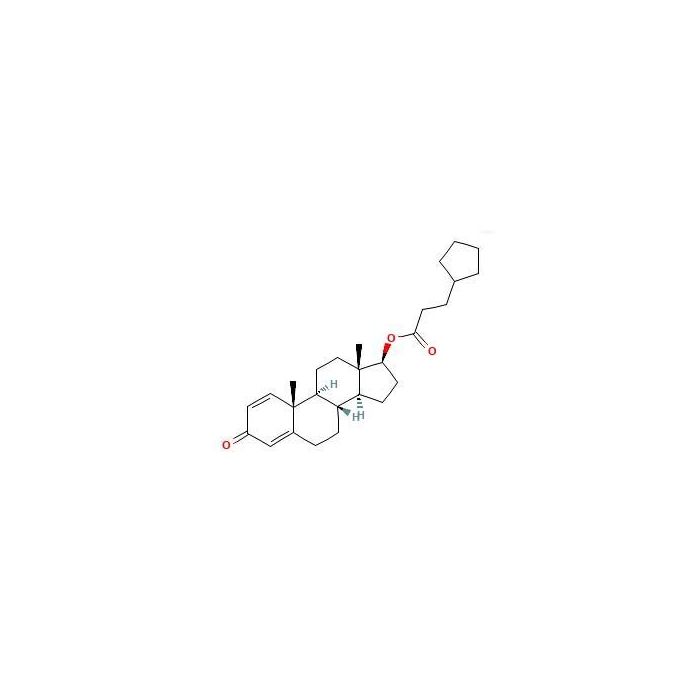
Boldenone cypionate is the 17β-cyclopentylpropionate (cypionate) ester of boldenone (Δ1-testosterone). The steroid nucleus is an androst-1,4-dien-17β-ol-3-one framework.
Key functional groups: a 3-keto group (C3), conjugated Δ1,4-diene in ring A, a secondary 17β-esterified alcohol (cypionate), multiple angular methyl groups at C10 and C13.
Stereochemistry: four fused rings (A/B/C/D) with characteristic trans A/B, B/C, and C/D ring junctions of androstane steroids; defined chiral centers at C8, C9, C10, C13, C14, and C17 (17β configuration for the esterified hydroxyl).
The cypionate residue is a cyclopentylpropionate chain forming a bulky, lipophilic ester that modulates solubility and hydrolysis rate.
Structural features relevant to handling (general)
Highly hydrophobic due to the steroid core and the cypionate ester; minimal aqueous solubility, favoring dissolution in nonpolar or moderately polar aprotic media.
The ester linkage is hydrolytically labile under strong acidic or basic conditions, releasing boldenone (the corresponding 17β-alcohol).
Synthetic Utility
Role in synthesis
Boldenone cypionate is primarily a target molecule rather than a general-purpose reagent. Its synthetic interest lies in steroid functionalization and esterification chemistry at C17β.
Transformations (literature/general)
Hydrolysis: Under basic (e.g., K2CO3/MeOH-H2O) or enzymatic conditions, the cypionate ester can be cleaved to yield boldenone (17β-ol).
Transesterification: The 17β-ester can be exchanged under acid chloride/anhydride conditions or via catalytic transesterification to generate alternative ester derivatives for SAR studies.
Oxidation/reduction at ring A: The conjugated Δ1,4-diene can participate in selective hydrogenation or epoxidation; care is required to maintain stereochemical integrity (specialized steroid chemistry).
Retrosynthetic note
Typical routes start from boldenone (or from dehydrogenation of testosterone) followed by esterification with cyclopentylpropionic acid (cypionic acid) using DCC/DMAP, EDCI, or acid chloride methodologies (literature).
Target Specificity
This section primarily applies to biological antibodies or targeted bioreagents. It is not directly applicable to a small-molecule steroid ester.
General research note: Boldenone (released from the ester) is an androgen receptor agonist in vitro (literature), but no item-specific binding constants or selectivity profiles are provided for this product.
We use cookies to ensure the website functions properly and, where permitted, to improve your experience. You can manage your preferences at any time in Settings. Learn more in our Cookie Policy.
Shall we send you a message when we have discounts available?
Remind me later
Thank you! Please check your email inbox to confirm.
Products are supplied to verified businesses, institutions, and qualified professionals for research and development use only. Not for use in humans, animals, diagnosis, or therapy.

 E2408111