
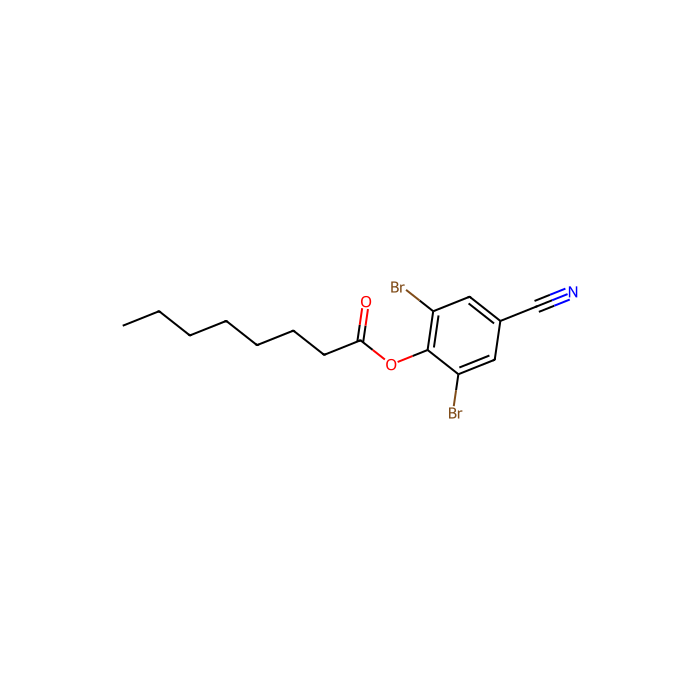
 C2609432
Determine the necessary mass, volume, or concentration for preparing a solution.
| Activity Type | Relation | Activity value | Units | Action Type | Journal | PubMed Id | doi | Assay Aladdin ID |
|---|
Taxonomy Tree
| Kingdom | Organic compounds |
|---|---|
| Superclass | Benzenoids |
| Classe | Phenol esters |
| Subclass | Not available |
| Intermediate Tree Nodes | Not available |
| Direct Parent | Phenol esters |
| Alternative Parents | Phenoxy compounds Benzonitriles Fatty acid esters Bromobenzenes Aryl bromides Carboxylic acid esters Nitriles Monocarboxylic acids and derivatives Organopnictogen compounds Organobromides Organic oxides Hydrocarbon derivatives Carbonyl compounds |
| Molecular Framework | Aromatic homomonocyclic compounds |
| Substituents | Phenol ester - Phenoxy compound - Benzonitrile - Bromobenzene - Fatty acid ester - Halobenzene - Aryl bromide - Aryl halide - Monocyclic benzene moiety - Fatty acyl - Carboxylic acid ester - Carboxylic acid derivative - Monocarboxylic acid or derivatives - Carbonitrile - Nitrile - Organobromide - Organonitrogen compound - Organooxygen compound - Carbonyl group - Hydrocarbon derivative - Organic oxide - Organic nitrogen compound - Organic oxygen compound - Organopnictogen compound - Organohalogen compound - Aromatic homomonocyclic compound |
| Descrição | This compound belongs to the class of organic compounds known as phenol esters. These are aromatic compounds containing a benzene ring substituted by a hydroxyl group and an ester group. |
| External Descriptors | Not available |
| Activity Type | Relation | Activity value | Units | Action Type | Journal | PubMed Id | doi | Assay Aladdin ID |
|---|
| Activity Type | Relation | Activity value | Units | Action Type | Journal | PubMed Id | doi | Assay Aladdin ID |
|---|
| Sensibilidade | Moisture sensitive |
|---|---|
| Ponto de fusão (°C) | 45-46°C |
| Peso molecular | 403.11 |
| XLogP3 | 5.800 |
| Hydrogen Bond Donor Count | 0 |
| Hydrogen Bond Acceptor Count | 3 |
| Rotatable Bond Count | 8 |
| Exact Mass | 402.961 Da |
| Monoisotopic Mass | 400.963 Da |
| Topological Polar Surface Area | 50.100 Ų |
| Heavy Atom Count | 20 |
| Formal Charge | 0 |
| Complexity | 341.000 |
| Isotope Atom Count | 0 |
| Defined Atom Stereocenter Count | 0 |
| Undefined Atom Stereocenter Count | 0 |
| Defined Bond Stereocenter Count | 0 |
| Undefined Bond Stereocenter Count | 0 |
| The total count of all stereochemical bonds | 0 |
| Covalently-Bonded Unit Count | 1 |
H302:Harmful if swallowed
H317:May cause an allergic skin reaction
H331:Toxic if inhaled
H361d:Suspected of damaging the unborn child
H400:Very toxic to aquatic life
H410:Very toxic to aquatic life with long lasting effects
P261:Avoid breathing dust/fume/gas/mist/vapors/spray.
P264:Wash hands [and …] thoroughly after handling.
P270:Do not eat, drink or smoke when using this product.
P271:Use only outdoors or in a well-ventilated area.
P272:Contaminated work clothing should not be allowed out of the workplace.
P273:Avoid release to the environment.
P280:Wear protective gloves/protective clothing/eye protection/face protection.
P321:Specific treatment (see ... on this label).
P330:Rinse mouth.
P391:Collect spillage.
P302+P352:IF ON SKIN: wash with plenty of water.
P304+P340:IF INHALED: Remove person to fresh air and keep comfortable for breathing.
P333+P313:IF SKIN irritation or rash occurs: Get medical advice/attention.
P362+P364:Take off contaminated clothing and wash it before reuse.
P405:Store locked up.
P403+P233:Store in a well-ventilated place. Keep container tightly closed.
P501:Dispose of contents/container to an approved waste disposal plant.
P203:Obtain, read and follow all safety instructions before use.
P301+P317:IF SWALLOWED: Get medical help.
P318:if exposed or concerned, get medical advice.
P316:Get emergency medical help immediately.
Example procedures for using bromoxynil-octanoate as an analytical standard (general guidance; adapt to your SOP):
Preparation of primary stock
Working standards (LC–MS/MS)
Sample extraction (produce/soil; QuEChERS-style)
QC and stability
These are illustrative; follow your lab’s validated methods.
This product is supplied strictly for research use; no clinical or field use is implied.
Literature biological context (not product specification or usage claim)
These points are provided solely to inform laboratory investigations (e.g., metabolism studies) and method development.
Not typically used as a buffering agent. As a hydrophobic aryl ester analytical standard, it is incompatible with aqueous buffer stock solutions due to hydrolysis risk. For aqueous-phase analyses, prepare organic stocks (e.g., acetonitrile) and dilute immediately before use into mobile phase or extraction mixtures.
As an analytical standard, the compound itself has fixed identity; “greener” considerations focus on solvent and workflow.
Comparison (general, literature-based):
Trade-offs: Ensure alternative solvents do not increase hydrolysis, reduce recovery, or impair detector response. Validate any process changes with matrix-matched calibration curves.
No direct pharmaceutical formulation role is typical for bromoxynil-octanoate. It is an agrochemical analytical standard used for research and method validation.
General notes for context (non-applicable to this item’s use):
Item-specific specs
Computed/literature values (for reference; not item specifications)
Note: Use these literature pointers only to guide method development; do not treat as product specifications.
Item-specific grade
What "Analytical standard" generally implies (general guidance)
Implications for use
Note: Do not infer pharmaceutical or clinical suitability from the analytical standard designation; this product is for research use only.
Primary use (product-specific category): Analytical standard
Analytical applications (literature practices; expand on intended use)
Reactivity notes (general chemistry)
Always validate recovery, matrix effects, and stability for your specific method.
For analytical and degradation studies (literature guidance; not product specifications):
Always perform recovery, linearity, and stability checks (bench-top, autosampler, freeze–thaw) for your matrix.
Item-specific safety fields
General safety guidance (literature/inferred for aryl ester herbicide standards; defer to SDS)
Always consult the product SDS for authoritative safety and regulatory information.
Bromoxynil-octanoate is a hydrophobic aryl ester; solvent choice strongly affects stability and solubility.
Select solvent based on analytical platform (GC vs LC), extraction protocol, and required stability window.
Item-specific instructions
Reconstitution and handling (general guidance for analytical standards)
For any lot-specific stability limits, appearance, and purity data: Not specified for this item; refer to CoA/Spec Sheet.
Item-specific identifiers (from Product Data)
Computed/literature structural information (for reference; not item specifications)
This compound is not typically employed as a general synthetic building block; it is supplied as an analytical standard. Nevertheless, understanding its chemical reactivity can aid in stability and degradation studies.
Takeaway: Treat primarily as an analyte; leverage its predictable ester chemistry when designing stability-indicating methods.
Not applicable. This product is a small-molecule analytical standard (not an antibody, enzyme, or affinity reagent). No antigen/epitope specificity, clone, isotype, or species reactivity data apply.
O nosso guia de seleção de graus abrange pureza, estado do estabilizador e adequação à aplicação para todas as variantes do nosso catálogo.
Ver o guia de graus Analytical standard →