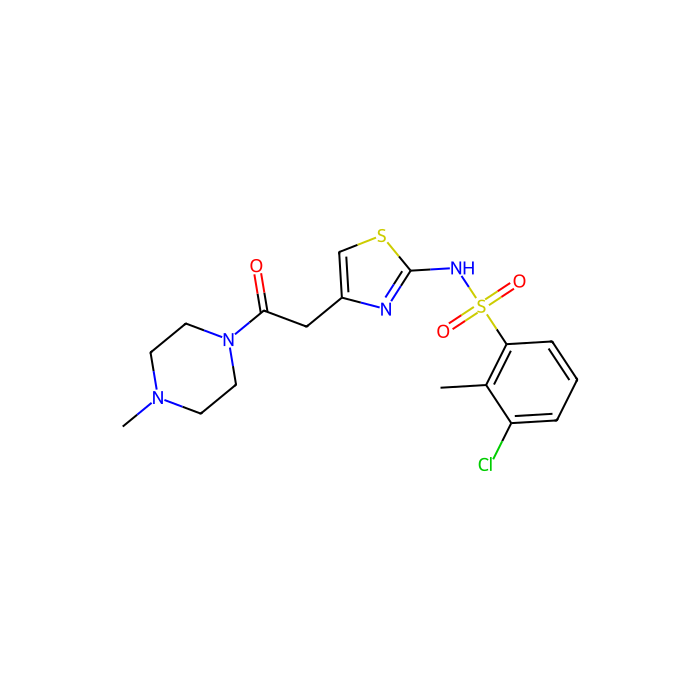
This compound belongs to the class of organic compounds known as benzenesulfonamides. These are organic compounds containing a sulfonamide group that is S-linked to a benzene ring.
External Descriptors
Not available
1. Djoumbou Feunang Y, Eisner R, Knox C, Chepelev L, Hastings J, Owen G, Fahy E, Steinbeck C, Subramanian S, Bolton E, Greiner R, and Wishart DS. ClassyFire: Automated Chemical Classification With A Comprehensive, Computable Taxonomy. Journal of Cheminformatics, 2016, 8:61.
Determine the necessary mass, volume, or concentration for preparing a solution.
Dilution Calculator
Determine the dilution needed to prepare a stock solution.
Reconstitution Calculator
Revisões
Avaliações dos Clientes
Application Protocols
No tested application protocols are provided in the Product Data for this item.
Item-specific recommended dilutions/assays: Not specified for this item; refer to CoA/Spec Sheet.
General research guidance (non-binding, for planning)
Prepare a sterile-filtered DMSO stock (e.g., 10–50 mM), aliquot, and store at −20 °C. Thaw an aliquot immediately before use and avoid repeated freeze–thaw.
For biochemical enzyme assays, perform serial dilutions in assay buffer to generate a concentration–response curve with appropriate vehicle controls.
For cell-based assays, verify cell line tolerance to vehicle (DMSO) and confirm compound solubility post-dilution (visual inspection, or analytical check).
Note: The above are generic practices and do not constitute item-specific validated protocols.
Biological Roles
Literature context (not item-specific; for research planning only)
BVT 2733 is widely cited as a small-molecule biochemical probe investigated for selective inhibition of 11β-hydroxysteroid dehydrogenase type 1 (11β-HSD1), a microsomal enzyme that converts inert cortisone to active cortisol using NADPH. Selective inhibition is commonly used to interrogate intracellular glucocorticoid regeneration and downstream metabolic signaling in liver, adipose, and other tissues.
Reported properties in the literature include:
High selectivity for 11β-HSD1 over 11β-HSD2 in human and rodent systems (exact IC50/Selectivity values vary by report and assay conditions). Researchers should consult primary publications and verify activity in their own hands.
Utility as a reference compound in enzymatic assays, pharmacology panels, and target-validation studies (in vitro and in cellulo). No medical or clinical claims are implied.
Experimental considerations
Stock preparation: Typically dissolved in DMSO to 10–50 mM; light and moisture sensitivity should be assessed empirically.
Assay notes: Enzyme assays often monitor cortisone→cortisol (or deuterated analogs) conversion via LC–MS/MS or radiometric readouts; include proper vehicle controls and, where relevant, counter-screens against 11β-HSD2.
Off-target profiling: For chemical probe use, it is advisable to profile against common ADME/tox panels and nucleophilic enzymes to assess selectivity.
Important: The above describes general literature use cases. This catalog item is provided strictly for research use only.
Buffer Applications
This product is not a buffering agent and does not constitute a buffer system. However, it is frequently dosed into aqueous buffers for biochemical assays.
Practical guidance (general; not item-specific specifications)
Prepare concentrated DMSO stock solutions and dilute into assay buffers such as PBS, HEPES, or Tris with a final DMSO content typically 0.05–0.5% v/v as tolerated by the biological system.
To mitigate precipitation, add the organic stock under vigorous mixing or after pre-diluting 1:10 in buffer.
For enzyme assays with 11β-HSD1 (literature context), buffers commonly include NADPH regeneration systems and a small amount of nonionic detergent (e.g., 0.01% Tween-20) to improve solubility and reduce nonspecific binding.
Note: No item-specific buffer compatibility data are provided; verify empirically for your assay.
Green Alternatives
Green solvent/reagent substitution frameworks (e.g., CHEM21, ACS GCI) are generally applied to process reagents or solvents rather than to discrete screening compounds like BVT 2733. As a target-specific probe, it has no direct “green alternative” without altering the experimental objective.
Practical sustainability considerations
Minimize solvent volumes by preparing concentrated stocks (e.g., 10–50 mM in DMSO) and aliquoting to reduce waste and freeze–thaw cycles.
Use microscale assays and 96–1536 well plate formats to limit chemical consumption.
Prefer lower-toxicity vehicles for dilutions (e.g., aqueous buffers with minimal DMSO) when biologically compatible.
Implement appropriate waste segregation for halogenated vs non-halogenated organic waste per institutional policy.
If synthetic route development to BVT 2733 is within scope (outside this catalog use)
Consider greener reaction media (2-MeTHF, CPME) and catalytic methods where compatible with the specific route (literature-dependent). These are general process suggestions and not specific to the supplied material.
Pharmaceutical Uses
No pharmacopeial or formulation grade information is provided for this item, and it is supplied strictly for research use only.
Regulatory/grade status: Not specified for this item; refer to CoA/Spec Sheet. Not intended for human or veterinary use, and not manufactured under GMP for clinical application.
Typical research-context uses (non-clinical)
Reference compound or tool molecule in preclinical enzymology and target-validation studies.
Method development control in LC–MS bioanalytical assays (e.g., to establish retention/ionization conditions), when appropriate and safe.
Do not use in drug product manufacturing or clinical investigations.
Physical Properties
Item-specific physicochemical specifications are not provided in the Product Data and should be confirmed on the CoA/Spec Sheet for the shipped lot.
Appearance: Not specified for this item; refer to CoA/Spec Sheet.
Melting point: Not specified for this item; refer to CoA/Spec Sheet. (Any literature values should not be used as product specifications.)
Boiling point: Not applicable/relevant for a high–boiling, non-volatile solid; exact value not specified for this item.
Density: Not specified for this item; refer to CoA/Spec Sheet.
Solubility (practical/literature guidance — not a specification)
Frequently prepared as concentrated DMSO stock solutions (e.g., 10–50 mM) for biochemical or cell-based assays; dilute into aqueous buffers with ≤0.1–1% final DMSO to maintain solubility while limiting vehicle effects.
Limited aqueous solubility is common for hydrophobic medicinal-chemistry scaffolds; gentle sonication or warming (≤37 °C) may assist dissolution.
LogP/logD, pKa, refractive index: Not specified for this item; refer to CoA/Spec Sheet.
Notes
All numerical physical property values, if required for your method validation, must be taken from the CoA/Spec Sheet for this specific lot. Literature/computed descriptors can aid method development but do not supersede product specifications.
Quality and Grades
Item-specific grade/purity is not listed in the Product Data for this SKU and must be confirmed on the CoA/Spec Sheet.
Grade/purity: Not specified for this item; refer to CoA/Spec Sheet.
Stabilizers/solute form: Not specified for this item; refer to CoA/Spec Sheet.
How to interpret typical quality annotations (general guidance)
Research grade: Suitable for discovery research, screening, and general lab use; may not include pharmaceutical GMP documentation.
Purity by HPLC/LC–MS: Values (if provided on CoA) indicate chromatographic purity under specified methods; they are method-dependent and do not guarantee absence of trace isomers or counter-ions.
Water/peroxide/metal limits, residual solvents, UV cutoff: Not specified for this item; check the CoA/SDS where applicable.
Solid form and salt form: Verify whether the material is free base, salt, solvate, or polymorph; this influences MW, solubility, and dosing calculations.
Recommendations
For quantitative biology/biochemistry, verify purity, counter-ion content, and identity (e.g., 1H NMR, HRMS) as needed for your application.
Record lot number and retain a copy of the CoA to ensure traceability in publications and screening databases.
Reaction and Applications
This catalog item is supplied as a finished small-molecule research compound for screening and biochemical experimentation, not as a synthetic reagent. Accordingly, it is not typically employed as a solvent, catalyst, or stoichiometric reactant in preparative organic synthesis.
Not typically applicable
Named reactions, reagent roles (e.g., reductant/oxidant, base/acid catalyst), or cross-coupling applications are not relevant to this product’s intended use.
Applicable uses (research context)
Preparation of DMSO stock solutions for in vitro enzyme assays or cell studies (research use only).
Reference/positive-control compound in target-based screening where literature supports its use as a chemical probe (see Biological Roles for literature context).
Reaction Conditions
Not applicable. BVT 2733 is supplied as a research compound rather than a reagent for conducting chemical reactions. There are no item-specific reaction condition recommendations.
If using in biological assays (general guidance)
Stock solvent: DMSO; typical stock 10–50 mM.
Working concentrations: Defined by assay design; include serial dilutions and appropriate vehicle controls.
Temperature: Prepare and store stocks at −20 °C; equilibrate to room temperature before opening to avoid condensation.
For any synthetic chemistry involving this scaffold (user-driven), consult the primary literature for route-specific conditions.
Safety and Handling
Safety details specific to this catalog item are not provided in the Product Data. Always consult the SDS for authoritative information.
GHS classification (item-specific): Not specified for this item; refer to SDS.
Signal word, pictograms, H-statements: Not specified for this item; refer to SDS.
General laboratory precautions (good practice for small-molecule research compounds)
Engineering controls: Work in a chemical fume hood to minimize inhalation exposure and to control dust/aerosols.
PPE: Lab coat, safety glasses or goggles, and suitable chemical-resistant gloves (e.g., nitrile). Avoid skin and eye contact; prevent ingestion and inhalation of dust or aerosols.
Handling: Avoid open handling of powders where possible; minimize static and use antistatic measures for microgram-to-milligram dosing. Use clean, dry tools; cap containers promptly to limit moisture/air exposure.
Incompatibilities: Avoid strong oxidizers and strong acids/bases unless compatibility is known. Do not mix with unknown materials.
First aid (overview; follow SDS/Institutional SOPs):
Inhalation: Move to fresh air; seek medical attention if symptoms occur.
Skin: Wash with soap and water; remove contaminated clothing.
Eyes: Rinse cautiously with water for several minutes; remove contact lenses if present and easy to do.
Ingestion: Rinse mouth; seek medical advice.
Spill/cleanup: Avoid raising dust; collect mechanically or with damp disposable wipes; dispose according to regulations.
Fire safety: Use CO2, dry chemical, or foam. Combustion may produce toxic fumes; firefighters should wear SCBA.
Note: For research use only; not for human or veterinary use.
Solvent Selection
This product is a drug-like small molecule typically handled as concentrated organic stock solutions for screening and biochemical assays.
Primary solvent (practical guidance — not a specification)
DMSO: Most common for initial dissolution due to high solvating power for lipophilic heteroaromatics; stable at −20 °C in aliquots. Filter if necessary (0.2 µm PTFE) to remove particulates.
Secondary options
DMF or NMP: Useful when DMSO solubility is limited, with similar handling cautions.
Ethanol or isopropanol: Can be used for less hydrophobic scaffolds; ensure compatibility with biological systems if used as vehicle.
Aqueous handling
Prepare a concentrated DMSO stock (e.g., 10–50 mM), then dilute into buffer/media to a final DMSO content typically 0.05–0.5% v/v (as tolerated by the system). Add stock last under vigorous mixing to minimize precipitation.
Miscibility/polarity (general)
Expected to be poorly water-soluble and highly soluble in polar aprotic solvents (DMSO/DMF). Validate empirically for your lot and assay conditions.
Troubleshooting
Precipitation after dilution: Lower final concentration, increase surfactant (e.g., 0.01–0.05% nonionic), or pre-warm buffer to 37 °C. Verify actual concentration via UV or LC–MS when feasible.
Note: No item-specific solubility or solvent specification is provided; confirm with small-scale tests before scaling experiments.
Storage and Reconstitution
Item-specific storage conditions are provided in the Product Data; reconstitution guidance below is general best practice for small-molecule research compounds.
Storage (from Product Data)
Store at −20 °C.
Shipped in an ice chest with ice pads to maintain cold chain.
Stability notes (general; verify empirically)
Protect from moisture and light where possible. Allow vials to warm to room temperature in a desiccator before opening to prevent condensation.
Once in solution (e.g., DMSO), stability can be enhanced by aliquoting under inert gas, minimizing headspace, and avoiding repeated freeze–thaw cycles.
Reconstitution (general guidance — not a specification)
Solvent: DMSO is commonly used to prepare concentrated stocks (e.g., 10–50 mM). If aqueous use is required, dilute the DMSO stock into buffer immediately before use.
Technique: Add a measured volume of solvent, vortex, and if necessary sonicate briefly. Filter through 0.2 µm PTFE to remove particulates for sensitive assays.
Working solutions: Prepare fresh on the day of use. Discard if precipitation, discoloration, or particulate formation is observed.
Documentation
Record the exact mass, final concentration, solvent lot, preparation date, and storage location. Retain CoA/SDS with the vial for traceability.
Note: For research use only.
Structure and Identity
Professional small‑molecule research compound supplied under the name BVT 2733 (CAS 376640-41-4).
Item-specific identifiers (from Product Data)
SKU: B412243
Product Name: BVT 2733
CAS: 376640-41-4
PubChem CID: 6918651 (literature identifier; provided in Product Data)
InChIKey: Not specified for this item; refer to CoA/Spec Sheet. (Note: value provided in Product Data appears incomplete.)
SMILES: Not specified for this item; refer to CoA/Spec Sheet.
Molecular formula: Not specified for this item; refer to CoA/Spec Sheet.
Molecular weight: Not specified for this item; refer to CoA/Spec Sheet.
Structural features (general/literature context — not item-specific)
BVT 2733 is widely referenced in the literature as a drug-like, heteroatom-containing small molecule used as a selective biochemical probe in enzymology studies. Specific ring systems, stereocenters, and substituent patterns vary by reported structure in different databases; consult the item’s CoA/SDS for definitive structural representation for this lot.
2D structure description (general guidance)
As a typical medicinal-chemistry scaffold, BVT 2733 is commonly depicted as an aromatic/heteroaromatic core bearing polar heteroatoms and lipophilic substituents that confer target affinity and cell permeability (literature). Exact atom connectivity and stereochemistry must be verified from the CoA/Spec Sheet for this catalog item.
Synthetic Utility
This product is provided as a finished small-molecule probe and is not typically employed as a synthetic reagent, protecting group, catalyst, or building block.
Not typically applicable
Does not serve a defined functional role (e.g., nucleophile/electrophile precursor, ligand for catalysis) in standard synthetic methodologies.
If derivatization is desired (general, user-driven chemistry)
Researchers occasionally derivatize probe molecules to prepare biotinylated or fluorescent analogs for target engagement studies; such work requires knowledge of the exact structure and SAR to avoid loss of activity. Any modification should be guided by primary literature and verified experimentally.
Because item-specific structural details are not provided here, no further synthetic recommendations are made.
Target Specificity
No target, antigen, clone, or isotype information is provided in the Product Data for this item. This section is generally applicable to biological macromolecules (e.g., antibodies), not small-molecule compounds.
Item-specific target data: Not specified for this item; refer to CoA/Spec Sheet.
For literature background on potential biological targets studied with BVT 2733, see the Biological Roles section (research context only).
Usamos cookies para garantir o funcionamento adequado do site e, quando permitido, para melhorar a sua experiência. Você pode gerenciar suas preferências a qualquer momento nas Configurações. Saiba mais em nossa Política de Cookies.
Deseja que lhe enviemos uma mensagem quando tivermos descontos disponíveis?
Lembrar-me mais tarde
Obrigado! Por favor, verifique a sua caixa de entrada de e-mail para confirmar.
Products are supplied to verified businesses, institutions, and qualified professionals for research and development use only. Not for use in humans, animals, diagnosis, or therapy.

 H2223060