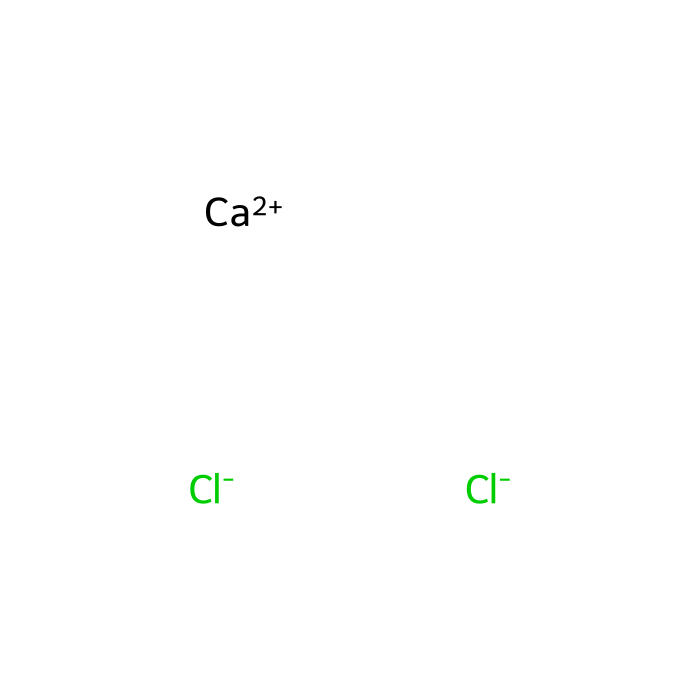
Calcium chloride - 10mM in Water , CAS No.10043-52-4

CAS: 10043-52-4 Cat. No.: C420267 Fórmula: CaCl2 Peso molecular: 110.98 Número CE: 233-140-8 PubChem CID: 5284359
Disponível para encomenda
GRAU & PUREZA 10mM in Water
Synonyms
Calcium(II) chloride
Storage
Store at -80°C
Shipped In
Dry ice packs + Cold packs
★
Tamanho
Alemanha (EU)
USA*
Preço
Qtd
1ml
C420267-1ml
—
4 Em stock

50,24€

58,92€
Gravar 8,68 € (14.73%)
Enter a quantity for the sizes you want to add.

Visão geral

A reagent used in preparation of competent E.coli

Especificações

Sinónimos
Calcium(II) chloride
Especificações e pureza
10mM in Water
Mecanismos bioquímicos e fisiológicos
Anhydrous Calcium Chloride is highly hygroscopic and is often used as a desiccant. Calcium plays important roles in many biological processes, including signal transduction, muscle contraction, maintenance of cell membranes and cell wall stability. Calcium chloride is a soluble compound that can serve as a source of calcium ions in a solution. Can be useful for displacing ions from solution; for example, phosphate may be displaced from solution by calcium.
Condições de armazenamento de armazenamento
Store at -80°C
Enviado em
Dry ice packs + Cold packs
Este produto requer transporte de cadeia fria. Serviços terrestres e outros serviços econômicos não estão disponíveis.
Nomes e identificadores
Pubchem Sid
SMILES
[Cl-].[Cl-].[Ca+2]
IUPAC Name
calcium;dichloride
InChIKey
UXVMQQNJUSDDNG-UHFFFAOYSA-L
InChI
1S/Ca.2ClH/h;2*1H/q+2;;/p-2
SMILES isoméricas
[Cl-].[Cl-].[Ca+2]
WGK Alemanha
1
PubChem CID
5284359
Peso molecular
110.98

Dados avançados

Taxonomic Classification

Taxonomy Tree

KingdomInorganic compounds
SuperclassMixed metal/non-metal compounds
ClasseAlkaline earth metal salts
SubclassAlkaline earth metal chlorides
Intermediate Tree Nodes Not available
Direct ParentAlkaline earth metal chlorides
Alternative Parents Inorganic chloride salts  Inorganic calcium salts  
Molecular FrameworkNot available
Substituents Alkaline earth metal chloride - Inorganic calcium salt - Inorganic chloride salt - Inorganic salt
DescriçãoThis compound belongs to the class of inorganic compounds known as alkaline earth metal chlorides. These are inorganic compounds in which the largest halogen atom is Chlorine, and the heaviest metal atom is a lanthanide.
External Descriptors inorganic chloride - calcium salt
Estrutura 3D
Modelo de Estrutura Química Interativa


Alvos associados (não humanos)
Colletotrichum musae (107 Activities)
Activity TypeRelationActivity valueUnitsAction TypeJournalPubMed IddoiAssay Aladdin ID
Fusarium verticillioides (912 Activities)
Activity TypeRelationActivity valueUnitsAction TypeJournalPubMed IddoiAssay Aladdin ID
Lasiodiplodia theobromae (193 Activities)
Activity TypeRelationActivity valueUnitsAction TypeJournalPubMed IddoiAssay Aladdin ID
Mecanismos de ação
Certificados(CoA,COO,BSE/TSE e Mapa de Análise)
C of A & Other Certificates(BSE/TSE, COO):
Analytical Chart:
Propriedades químicas e físicas
SensibilidadeMoisture sensitive.
Ponto de ebulição (°C)1600°C
Ponto de fusão (°C)782°C
Peso molecular110.98
XLogP3
Hydrogen Bond Donor Count0
Hydrogen Bond Acceptor Count2
Rotatable Bond Count0
Exact Mass109.9 Da
Monoisotopic Mass109.9 Da
Topological Polar Surface Area0.000 Ų
Heavy Atom Count3
Formal Charge0
Complexity0.000
Isotope Atom Count0
Defined Atom Stereocenter Count0
Undefined Atom Stereocenter Count0
Defined Bond Stereocenter Count0
Undefined Bond Stereocenter Count0
The total count of all stereochemical bonds0
Covalently-Bonded Unit Count3
Segurança e perigos (GHS)
Pictograma(s)
Sinal
Warning
Declarações de perigo

H319:Causes serious eye irritation

Declarações de precaução

P264:Wash hands [and …] thoroughly after handling.

P280:Wear protective gloves/protective clothing/eye protection/face protection.

P312:Call a POISON CENTER or doctor/... if you feel unwell.

P305+P351+P338:IF IN EYES: Rinse cautiously with water for several minutes. Remove contact lenses if present and easy to do - continue rinsing.

P403+P233:Store in a well-ventilated place. Keep container tightly closed.

WGK Alemanha
1
FAQs e artigos
Competent E. coli Cell Preparation Using the Calcium Chloride Method
Common Protein Gel Staining Methods
Differences Between Transformation and Transfection
Five Key Structural Features of Plasmids
Mag-Fluo-4 AM Magnesium/Calcium Ion Fluorescent Probe: Properties, Experimental Use, and Aladdin Metal Ion Fluorescent Probe Selection Guide
A Practical Guide to Fragrance Compositions: Turning a Black-Box Formula into an Engineerable System—Compatibility, Stability, Controlled Release, Traceability, and Selection
Practical Guide to Sodium Carboxymethyl Cellulose (CMC-Na): Thickening/Stabilizing Mechanisms, Key Controls for Solution Preparation, and Selection Navigation (including Table 1 and Tables A–C)
Selection of Common Research Salts: A Task Map for Alkali Metal Salts & Alkaline Earth Metal Salts (with Product Tables 1–6)
Proteinase K: Frequently Asked Questions
Deoxyribonuclease (DNase): DNA Hydrolytic Cleavage Properties, Methodological Value, and Multi-Context Applications
Chymosin: A Review of Molecular Features, Coagulation Kinetics, and Activity Evaluation
Micrococcal Nuclease (MNase): A Technical Review of Enzymatic Properties, Reaction Control, and Research and Biomanufacturing Applications
Hemicellulases: A Review of Substrate Specificity, Catalytic Systems, and Research and Industrial Applications
Phytase: Enzymological Properties, Mechanism of Action, and Applications in Feed and Food
Chitinases: Substrate-Specific Degradation Mechanisms, Enzymatic Properties, and Application Directions
Whey Protein: Composition Profile, Manufacturing Routes, and Key Product-Type Essentials
Coelenterazine (CTZ) Differences and an Application Overview
Alginate : An Overview of Extraction and Purification Processes, Quality Identification, and Multidomain Applications
Clostridial Proteases: Classification, Molecular Mechanisms, and Research Applications
Furin: A Review of Its Structural Features, Substrate Recognition, and Research Applications
The Key Starting Point for Phosphatidylserine Research: Changes in Membrane Localization, Functional Shifts, and Interpretation of Findings
Functional Framework of Starch Metabolism-Related Enzymes in Food Science Research and Mechanistic Analysis of Quality Regulation
Research Framework for Multi-Enzyme Digestion Strategies and Optimization of Proteomic Coverage
Selection Logic, Operating Parameters, and Application Boundaries of Common Cell Culture Coating Solutions
Key Judgments in Medical Hydrogel R&D: From Polymer Source and Crosslinking Strategy to Sterilization Planning, Scale-Up Feasibility, and Quality Control
From Natural Cellulose to Nanocrystals: Structural Characteristics, Application Directions, and Industrialization Challenges of CNC
Capable of Swelling, Adsorption, and Cation Exchange: What Makes Montmorillonite Clay Different?
Oxalate Metabolism and Degradation Detection Methods: Enzymatic Assays, Chromatography, and Enzymatic Degradation System Analysis
From Structure to Rheology: How Carbomer Forms Gel Structures and Enables Thickening, Suspension, and Auxiliary Emulsion Stabilization
Structure, Properties, and Mechanisms of Powdered Fragrances and Fragrance Delivery Materials: Stability, Release Mechanisms, and Selection Logic
Mechanisms and Troubleshooting of Foam Reduction in Personal and Household Care Formulations: Film Rupture, Weak Interfacial Films, Insufficient Surfactant Supply, and Phase-State Disturbance
Experimental Applications of Carboxymethyl Cellulose (CMC) Solution in Enzyme Assays, Suspension Systems, and Functional Materials
Moisturizing Mechanisms of Tremella fuciformis Polysaccharides: From Polysaccharide Structure and Hydration Rheology to Dynamic Film Formation on the Skin Surface
Mechanistic Basis of Acetyl Hexapeptide-8 in the Management of Expression Lines: SNARE Complex Interference, Constraints on Percutaneous Delivery, and Combination Strategies
Citations of This Product
Calculadoras de soluções
Revisões

Avaliações dos Clientes

Deseja que lhe enviemos uma mensagem quando tivermos descontos disponíveis?

Lembrar-me mais tarde

Obrigado! Por favor, verifique a sua caixa de entrada de e-mail para confirmar.

Ops! As notificações estão desativadas.