Determine the necessary mass, volume, or concentration for preparing a solution.
| Activity Type | Activity Value -log(M) | Mechanism of Action | Activity Reference | Publications (PubMed IDs) |
|---|

Moligand™, 10mM in DMSO Moligand™ for sensitive chromatographic and analytical workflows requiring minimal baseline interference.
Store at -80°C Ships Dry ice packs + Cold packs Check lot-specific COA for exact specifications.
SDS, COA, datasheet, and spec sheet available for download. Lot-specific COA accessible via lot number lookup.
Cited in 21 peer-reviewed publications across chromatography, organic synthesis, and cross-coupling reactions.
Information
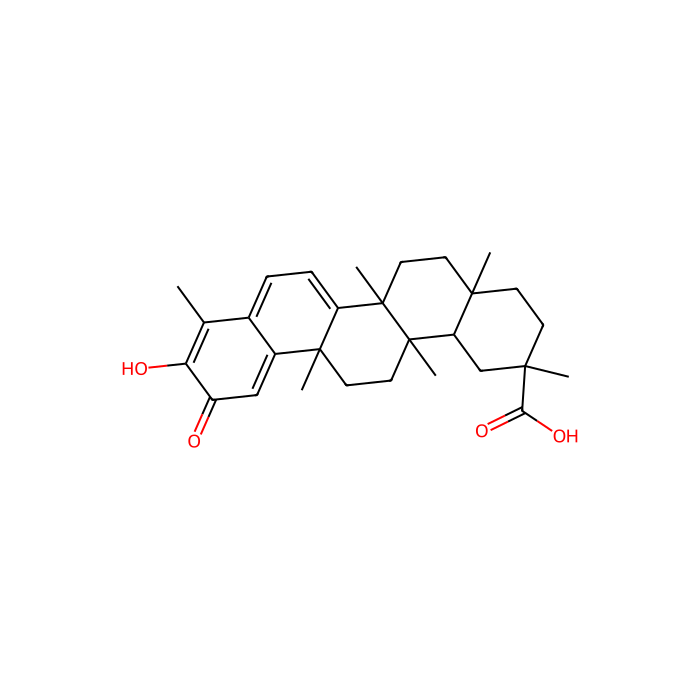
Celastrol (NSC 70931, Tripterine) is a potentproteasomeinhibitor for the chymotrypsin-like activity of a purified 20S proteasome withIC50of 2.5 μM. Celastrol inducesapoptosisandautophagyvia the ROS/JNK signaling pathway. Celastrol inhibits dopaminergic ne
In vitro
Celastrol at 5 μM inhibits the chymotrypsin-like, PGPH-like, and trypsin-like activities of the purified 20S proteasome by 80%, 5%, and <1%, respectively, whereas at 10 μM, it inhibits these three proteasomal activities by ∼90%, 15%, and <1%, respectively. Celastrol significantly inhibits the proteasomal chymotrypsin activity in PC-3 cells in a concentration-dependent manner. Celastrol at 2.5 μM to 5 μM induces caspase-3 activity by 4.7-fold to 5.5-fold in PC-3 cells. Celastrol (5 μM) treated cells, the levels of the proteasome target proteins, IκB-α and Bax, are increased after 1 hour and further increased to its peak for 4 hours to 12 hours. Celastrol (2.5 μM) treatment induces proteasome inhibition by 40%, as shown by the decreased levels of chymotrypsin-like activity and increased accumulation of ubiquitinated proteins in LNCaP cells. Celastrol (2.5 μM) induces apoptosis in the Celastrol-treated LNCaP cells, as shown by increased levels of caspase-3 activity (up to 3.5-fold), PARP cleavage, and apoptotic morphology. Celastrol (300 nM) is found to suppress LPS-induced production of TNF-alpha and IL-1beta by human monocytes and macrophages. Celastrol (100 nM) also decreases LPS-induced expression of class II MHC molecules by microglia. Celastrol strongly inhibits LPS and IFN-y-induced NO production with IC50 of 200 nM in macrophage lineage cells. Celastrol strongly inhibits TNF-α and IFN-γ-induced NO production with IC50 of 200 nM in endothelial cells. Celastrol (2.5 μM) potentiates the apoptosis induced by TNF and chemotherapeutic agents and inhibits invasion, both regulated by NF-kappaB activation, in KBM-5 cells. Celastrol (2.5 μM) suppresses the expression of TNF induced the expression of gene products involved in antiapoptosis (IAP1, IAP2, Bcl-2, Bcl-XL, c-FLIP, and survivin), proliferation (cyclin D1 and COX-2), invasion (MMP-9), and angiogenesis (VEGF) in KBM-5 cells. Celastrol (5 μM) is found to inhibit the TNF-induced activation of IkappaBalpha kinase, IkappaBalpha phosphorylation, IkappaBalpha degradation, p65 nuclear translocation and phosphorylation, and NF-kappaB-mediated reporter gene expression. Celastrol inhibits proliferating of RPMI 8226, KATOIII, UM-SCC1, U251MG and MDA-MB-231 cells with IC50 of 0.52 μM, 0.54 μM, 0.76 μM, 0.69 μM and 0.67 μM, respectively. Celastrol (1 μM) inhibits growth of RPMI 8226 with a decrease in the levels of cyclin D1 and cyclin E, but concomitant increase in the levels of p21 and p27. Celastrol induces apoptosis in RPMI-8226 cells indicated by the activation of caspase-8, bid cleavage, caspase-9 activation, caspase-3 activation, PARP cleavage and through the down regulation of anti-apoptototic proteins. Celastrol (1 μM) suppresses Akt pathway and activates JNK kinase in RPMI-8226 cells.
In vivo
Celastrol (3 mg/kg) results in significant inhibition (up to 70%) of tumor growth in male nude mice bearing PC-3 tumors, associated with increased p27 levels and Bax level. Celastrol (3 mg/kg) results more apoptotic tumor cells with the appearance of various PARP cleavage fragments in tumor of male nude mice bearing PC-3 tumors. Celastrol (3 mg/kg) causes 35% of tumor inhibition, associated with decreased proteasome activity and decreased expression of AR protein in nude mice bearing C4-2B tumors. Celastrol (3 mg/kg) is found to suppress strongly joint swelling and other manifestations of adjuvant arthritis in mice. Celastrol (0.2 mg/kg) significantly improves the performance in memory, learning and psychomotor activity tests in rats.
Cell Data
cell lines:
Concentrations:~5 μM
Incubation Time:2 hours
Powder Purity:≥98%
| SMILES isoméricas | CC1=C(C(=O)C=C2C1=CC=C3[C@]2(CC[C@@]4([C@@]3(CC[C@@]5([C@H]4C[C@](CC5)(C)C(=O)O)C)C)C)C)O |
|---|---|
| WGK Alemanha | 2 |
| CAS alternativo | 34157-83-0 |
| Número NSC | 70931 |
| Número UN | 2811 |
| Termos de entrada MeSH | 3-hydroxy-24-nor-2-oxo-1(10),3,5,7-friedelatetraen-29-oic acid;celastrol;tripterin;tripterine |
| Peso molecular | 450.61 |
| Reaxy-Rn | 5780870 |
| Reaxys-RN_link_address | https://www.reaxys.com/reaxys/secured/hopinto.do?context=S&query=IDE.XRN=5780870&ln= |
Comprehensive hazard, handling, storage, and regulatory compliance document.
Download SDS →Lot-specific quality data. Enter your lot number to retrieve the exact COA.
Look up COA →Full quality attributes and acceptance criteria for this grade.
View spec sheet →| Activity Type | Activity Value -log(M) | Mechanism of Action | Activity Reference | Publications (PubMed IDs) |
|---|
| Activity Type | Activity Value -log(M) | Mechanism of Action | Activity Reference | Publications (PubMed IDs) |
|---|
| Solubilidade | Solubility (25°C) In vitro Water: 28 mg/mL (199.18 mM); DMSO: Insoluble; Ethanol: Insoluble; |
|---|---|
| Rotação específica [α] | -122.7° (C=0.1,CHCl3) |
| Ponto de fusão (°C) | 203°C(lit.) |
Our grade selection guide covers purity, stabilizer status, and application suitability for all variants in our catalog.
View Moligand™ grade guide →