
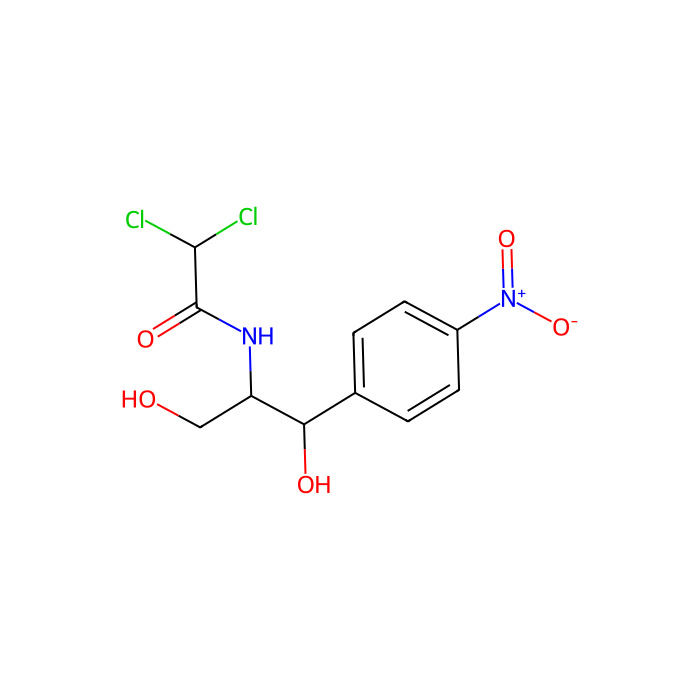
Determine the necessary mass, volume, or concentration for preparing a solution.
| Activity Type | Activity Value -log(M) | Mechanism of Action | Activity Reference | Publications (PubMed IDs) |
|---|
Moligand™, 10mM in DMSO Moligand™ para fluxos de trabalho cromatográficos e analíticos sensíveis que exigem interferência mínima da linha de base.
Store at -80°C Envio Dry ice packs + Cold packs. Consulte o COA específico do lote para obter as especificações exatas.
SDS, COA, ficha técnica e folha de especificações disponíveis para download. COA específico do lote acessível por meio de pesquisa por número de lote.
Citado em 331 publicações revisadas por pares nas áreas de cromatografia, síntese orgânica e reações de acoplamento cruzado.
Information
Chloramphenicol Chloramphenicol (Chloromycetin) is a bacteriostatic by inhibiting protein synthesis.
In vitro
Chloramphenicol results in a constitutive increase in the level of cspA transcript and constitutive production of CS7.4. Chloramphenicol down-regulates the mitochondrial DNA-encoded Cox I protein, but not nuclear-encoded proteins. Chloramphenicol increases cellular levels of the p21(waf1/cip1) protein and p21(waf1/cip1) mRNA through a p53-independent pathway. Chloramphenicol, at concentrations greater than 0.1 g/L (0.3 mM), inhibits the denitrifying enzyme activity (DEA) of slurries of humisol and sandy loam soils by disrupting the activity of existing nitrate reductase enzymes. Chloramphenicol, at concentrations from 5 mM to 2 mM initiates apoptosis in dividing cells from a monkey kidney-derived cell line and in haematopoietic progenitor cells from human neonatal cord blood. Chloramphenicol suppresses growth of progenitor cells.
In vivo
Chloramphenicol results in increased t1/2(beta) (by 209%), and decreased ClB (by 45%), and prolonged recovery indices (by 768 to 946%) in greyhounds. Chloramphenicol suppresses increases in the body weight and liver weight of experimental animals and at the same time induced a remarkable increase in lipid peroxidation in the liver during the formation of megamitochondria. Chloramphenicol-induced formation of megamitochondria is not simply ascribed to the suppression of the dividing process of mitochondria due to lowered protein synthesis in mitochondria but is intimately related to oxidative stress.
Cell Data
cell lines:MCF-7 cells
Concentrations:
Incubation Time:
Powder Purity:≥99%
Documento abrangente sobre perigos, manuseamento, armazenamento e conformidade regulamentar.
<<<<<<< HEAD Baixar SDS → ======= Baixar SDS → >>>>>>> release248-p3Dados de qualidade específicos do lote. Introduza o número de lote para obter o COA exato.
Consultar COA →Resumo de referência rápida das especificações e aplicações do produto.
Ver ficha técnica →Atributos de qualidade completos e critérios de aceitação para este grau.
Ver folha de especificações →| Activity Type | Activity Value -log(M) | Mechanism of Action | Activity Reference | Publications (PubMed IDs) |
|---|
| Activity Type | Activity Value -log(M) | Mechanism of Action | Activity Reference | Publications (PubMed IDs) |
|---|
| Solubilidade | Solubility (25°C) In vitro DMSO: 5 mg/mL warmed with 50ºC Water: bath (6.68 mM); Water: Insoluble; Ethanol: Insoluble; |
|---|---|
| Rotação específica [α] | 20 ° (C=5, EtOH) |
| Ponto de inflamação (°F) | 57.2°F closed cup |
| Ponto de inflamação (°C) | 14.0°C closed cup |
| Ponto de fusão (°C) | 149-153°C |
O nosso guia de seleção de graus abrange pureza, estado do estabilizador e adequação à aplicação para todas as variantes do nosso catálogo.
Ver o guia de graus Moligand™ →