GRADE & PURITYfor GC derivatization?GC-derivatization grade — reagents to make analytes GC-amenable (volatile/stable). Use before GC to derivatize polar or thermally labile compounds.≥99%(GC)
This compound belongs to the class of organic compounds known as trialkylchlorosilanes. These are organoheterosilanes, bearing a silicon atom linked to three alkyl groups and one chlorine atom.
External Descriptors
silyl chloride
1. Djoumbou Feunang Y, Eisner R, Knox C, Chepelev L, Hastings J, Owen G, Fahy E, Steinbeck C, Subramanian S, Bolton E, Greiner R, and Wishart DS. ClassyFire: Automated Chemical Classification With A Comprehensive, Computable Taxonomy. Journal of Cheminformatics, 2016, 8:61.
Determine the necessary mass, volume, or concentration for preparing a solution.
Dilution Calculator
Determine the dilution needed to prepare a stock solution.
Reconstitution Calculator
Revisões
Avaliações dos Clientes
Application Protocols
Not applicable as validated assay protocols.
No WB/IHC/IF/FC or similar bioassay protocols are provided for this chemical reagent. For practical usage, see Reaction Conditions and Reaction & Applications for representative chemistry workflows, and consult method-specific literature for GC derivatization procedures relevant to your analytes.
Biological Roles
Applicability
Chlorotrimethylsilane is a synthetic organosilicon reagent with no known endogenous biological role. It is not a metabolite, cofactor, or signaling molecule.
Analytical/biochemical context (general)
In bioanalytical chemistry, TMCS is widely used to derivatize polar biomolecules (e.g., organic acids, small carbohydrates, amino acids after suitable protection) to their trimethylsilyl derivatives to enable GC or GC-MS analysis. This improves volatility and reduces adsorption on active sites.
TMCS often functions as an activator (with HMDS) to convert carboxylic acids to TMS esters; for amines, more specialized silylating agents (e.g., BSTFA with 1% TMCS) are common.
Cautionary notes
Any contact with aqueous biological matrices leads to rapid hydrolysis and HCl release; derivatizations should be performed in anhydrous organic media after appropriate sample drying/extraction.
No clinical or therapeutic claims are made or implied for this product; Research Use Only (as per Product Data).
Buffer Applications
Not typically applicable.
TMCS is not used to prepare aqueous buffers due to rapid hydrolysis and acid generation. For experimental planning, focus on the Reaction & Applications and Solvent Selection sections for non-aqueous workflows.
If a buffer-compatible derivatization is required, dry the analyte (e.g., lyophilization or azeotropic drying) before adding anhydrous organic solvent and TMCS-based systems.
Green Alternatives
Context
TMCS is effective but moisture-reactive and corrosive (HCl release). Where feasible, consider less hazardous silylation systems or alternative analytical strategies.
Comparative options (general literature guidance)
HMDS with catalytic acid (e.g., ammonium sulfate) for GC derivatization: generates fewer corrosive byproducts than TMCS-catalyzed systems, but may require higher temperatures/longer times.
BSTFA/MSTFA (N-trimethylsilyl amides): Highly efficient silylating reagents producing volatile byproducts; can reduce need for strong acid scavengers. More expensive and still moisture sensitive.
Derivatization-free GC methods: Employ on-column derivatization or use GC columns and conditions tailored for polar analytes; may trade sensitivity/peak shape.
LC-MS alternatives: Avoid derivatization entirely by switching to LC-MS for polar/thermolabile analytes; greener in terms of reagent hazards but may increase solvent consumption.
Trade-offs (illustrative)
Reactivity vs hazard: TMCS is fast and broad-scope but releases HCl; alternatives can be milder yet slower.
Cost vs waste: TMCS is economical; some alternatives are pricier but generate more benign wastes.
Substrate scope: TMCS/HMDS often excels for carboxylic acids and polyfunctional substrates; amide-based silylating reagents may outperform for sterically hindered alcohols.
Sustainability practices with TMCS
Use microliter-scale additions via gas-tight syringes; keep headspace minimal.
Neutralize acidic off-gas through scrubbers; segregate halogenated waste.
Optimize derivatization to minimize excess reagent.
Pharmaceutical Uses
Formulation/excipient status
TMCS is not an excipient and is unsuitable for direct inclusion in dosage forms.
Process/research roles (general, non-clinical)
Employed as a silylating reagent in process development to transiently protect alcohols/phenols (TMS ethers) or to activate functional groups for subsequent transformations.
Utilized in analytical QC labs to derivatize polar impurities or intermediates for GC-based limit tests.
Can participate in halide exchange chemistry (e.g., in situ TMSI formation) relevant to intermediate synthesis.
Regulatory note
Any pharmacopeial status, residual limits, or impurity thresholds for this specific item are Not specified for this item; refer to CoA/Spec Sheet and governing guidelines (e.g., ICH Q3A/Q3C) for process residual evaluations.
Good manufacturing practice considerations
Ensure validated removal of TMCS and derived siloxanes; monitor residuals by GC with appropriate derivatization controls.
Implement closed, inert handling systems with off-gas scrubbing to manage HCl emissions.
Physical Properties
Item-specific (from Product Data)
Appearance: Not specified for this item; refer to CoA/Spec Sheet.
Literature/typical values (for reference; not product specifications)
State: Colorless, fuming liquid (literature)
Boiling point: ~57–58 °C at 1 atm (literature)
Melting point: ~−40 °C (literature)
Density: ~0.855–0.860 g/mL at 20–25 °C (literature)
Refractive index: nD20 ≈ 1.385–1.387 (literature)
Vapor pressure: High at ambient temperatures; readily volatilizes (literature)
Solubility: Reacts with water; miscible with many anhydrous organic solvents (e.g., ethers, hydrocarbons, chlorinated solvents) (literature)
LogP (estimated): Positive; dominated by three methyl groups (literature/computed)
Hydrolytic sensitivity: Rapid; generates HCl and silanols that can condense to siloxanes (literature)
Notes for practitioners
Handle and measure under rigorously anhydrous conditions—physical constants can drift in the presence of moisture due to rapid hydrolysis.
For precision values applicable to a given lot (e.g., density used for molar calculations), consult the lot-specific CoA.
Quality and Grades
Item-specific (from Product Data)
Grade/Purity designation: for GC derivatization
What “for GC derivatization” typically implies (general guidance)
Optimized for forming trimethylsilyl (TMS) derivatives of polar analytes prior to gas chromatography, where reagent purity and low background are important for baseline stability and reproducibility.
Emphasis is commonly placed on low levels of hydrolyzable impurities (water, alcohols), acidic/halide contaminants, and volatile residues that can contribute to ghost peaks. However, exact impurity limits for this item are Not specified for this item; refer to CoA/Spec Sheet.
Stabilizer/antioxidant
Any stabilizers used and their levels are Not specified for this item; refer to CoA/Spec Sheet.
Recommended quality checks for critical applications (general)
Run a reagent blank under the intended GC method to assess background.
Titrate or Karl Fischer test for water content prior to derivatization workflows when sensitivity is critical.
Verify derivatization performance using a standard panel (e.g., alcohol/acid/amine mix) to ensure conversion under your method conditions.
Reaction and Applications
Item-specific note
Catalog designation “for GC derivatization” highlights its use to generate TMS derivatives that improve volatility/thermal stability for gas chromatography.
GC Derivatization: Catalyst/activator with HMDS (hexamethyldisilazane) to silylate acids, alcohols, phenols, and amines; TMCS promotes formation of TMS esters/amides/ethers, enhancing GC detectability.
Silyl Ether Formation: Converts alcohols/phenols to TMS ethers in the presence of base (e.g., Et3N, imidazole, pyridine). TMS ethers serve as transient protecting groups; readily cleaved by mild acid or fluoride.
Silyl Enol Ether Generation: With strong bases (e.g., LDA) or Lewis acids, TMCS traps enolates to give TMS enol ethers, enabling Mukaiyama aldol and related reactions.
Halide Exchange/Iodination: TMCS + NaI (or catalytic I−) forms TMSI in situ, converting alcohols/epoxides to iodides and effecting deprotections.
Chlorination of Alcohols/Acids: TMCS with catalytic DMF or in combination with oxalyl chloride systems can facilitate conversion to chlorides or acid chlorides (substrate-dependent).
Activation/Promoters: Enhances amide bond-forming chemistry in presence of base and nucleophilic catalysts (e.g., TMCS/NaI/NEt3 systems) and promotes acylation of weak nucleophiles by in situ silylation.
Practical tips
Rigorously dry glassware/solvents; trace moisture quenches TMCS and generates HCl.
Add TMCS last and slowly; provide adequate base or HCl scavenger when appropriate.
Verify completeness of derivatization by monitoring disappearance of polar peaks (TLC, GC-MS) and/or emergence of characteristic TMS fragments (m/z 73) in GC-MS.
Reaction Conditions
General conditions (literature; adjust to substrate)
Temperature: Typically 0–25 °C for silylations; −78 to 0 °C when trapping enolates to form TMS enol ethers.
Bases/catalysts: Et3N, pyridine, imidazole, DMAP for alcohol/phenol silylation. LDA or LiHMDS to generate enolates before quenching with TMCS. Iodide salts (NaI, TBAI) for in situ TMSI formation.
Times: Minutes to 2 h for simple silylations; 0.5–3 h for GC derivatization with HMDS/TMCS depending on matrix and temperature.
Illustrative procedures
Alcohol to TMS ether: ROH (1.0 eq), Et3N (1.2–2.0 eq), TMCS (1.1–1.5 eq) in dry DCM, 0–25 °C, 0.5–2 h; work up with aqueous bicarbonate then rapid separation to limit hydrolysis.
Enolate trapping: Form enolate with LDA in THF at −78 °C, then add TMCS (1.2–1.5 eq); warm to 0 °C; isolate TMS enol ether.
GC derivatization (acids): Analyte + HMDS (excess) + catalytic TMCS (1–10% v/v) in dry toluene, 60–120 °C as needed; vent carefully to manage HCl.
Monitoring & endpoints
TLC/GC to confirm disappearance of starting polar substrate; GC-MS detection of m/z 73 and expected retention shift.
Safety overlay
Add TMCS last; provide venting through acid gas trap. Quench residues cautiously with anhydrous alcohol before aqueous workup.
GHS/Signal word/H-statements/Pictograms: Not specified for this item; refer to SDS.
General safety information (literature; always defer to SDS)
Hazards: Moisture-sensitive silyl chloride; hydrolysis releases HCl gas and corrosive fumes. Causes severe skin/eye irritation or burns; harmful if inhaled. Reacts exothermically with water, alcohols, and bases.
PPE: Use chemical-resistant gloves (e.g., butyl or Viton for chlorosilanes), splash goggles or face shield, lab coat; handle in a certified fume hood.
Handling: Maintain under inert gas (argon or nitrogen). Use oven-dried glassware and anhydrous techniques. Avoid contact with moisture, acids, bases, and oxidizers. Add slowly to dry solvents/reaction mixtures.
First aid (overview): Inhalation—move to fresh air; seek medical attention. Skin/Eye—immediate decontamination with copious water for at least 15 minutes; remove contaminated clothing; seek medical attention. Ingestion—not expected route; do not induce vomiting; seek medical attention.
Spill/Quench: Small spills—absorb with dry, inert material; quench cautiously with anhydrous alcohol then aqueous base only after complete silyl chloride consumption. Prevent water entry until controlled quench.
Storage notes: Keep tightly closed under dry inert gas with desiccant. Use a septum/seal to minimize air ingress after opening.
Solvent Selection
Applicability
Chlorotrimethylsilane is primarily a reactive silylating agent rather than a bulk solvent. Solvent selection concerns focus on choosing an appropriate anhydrous medium for reactions or derivatizations.
General solvent compatibility (literature)
Preferred dry solvents: Dichloromethane, toluene, hexanes/heptane, acetonitrile, ethyl acetate (anhydrous), and ethers such as THF or diethyl ether (well-dried). Avoid protic solvents.
Incompatibilities: Water/alcohols (rapid hydrolysis); strong bases (can induce side reactions); amines (rapid HCl scavenging may form salts and reduce effective silylating power).
Polarity: Nonpolar-to-moderately polar aprotic media are typically used. Ensure low basicity to avoid premature quench.
Selection tips (general)
For GC derivatization with HMDS/TMCS systems, nonpolar solvents (e.g., toluene) minimize co-elution and stabilize analyte TMS derivatives.
For generation of silyl enol ethers or in situ TMSI (from NaI + TMCS), acetonitrile or dichloromethane provides good solubility and control.
For moisture exclusion, use molecular sieves (3Å or 4Å) and perform syringe/Schlenk transfers under inert gas.
Packaging: Store in airtight, moisture-tight containers (e.g., septum-capped bottles) under dry inert gas. Minimize headspace; consider Sure/Seal-type closures for repeated withdrawals.
After opening: Maintain argon blanket; use dry needles/syringes. If possible, transfer to a dry, inert-atmosphere glovebox bottle for routine use.
Stability: Sensitive to moisture; gradual formation of silanols/siloxanes and HCl upon trace water ingress. Avoid long-term storage with wet desiccants.
Reconstitution: Not applicable—ready-to-use liquid reagent. Do not dilute with protic or wet solvents. Prepare any working solutions freshly in anhydrous, aprotic solvents immediately before use.
Shelf life/Specifications: Not specified for this item; refer to CoA/Spec Sheet.
Waste and decontamination
Quench small residues with anhydrous isopropanol or methanol under inert conditions, then neutralize and follow local regulations for halogenated/silicon-containing waste. Vent through an acid gas scrubber where applicable.
Structure and Identity
Item-specific (from Product Data)
Product name: Chlorotrimethylsilane (TMCS)
SKU: C131616
CAS: 75-77-4
PubChem CID: 6397
InChIKey (as provided): 142672
SMILES: Not specified for this item; refer to CoA/Spec Sheet.
Grade: for GC derivatization
Literature/Computed identity (for reference only; not product specifications)
Common synonyms: Trimethylsilyl chloride, TMSCl, TMCS
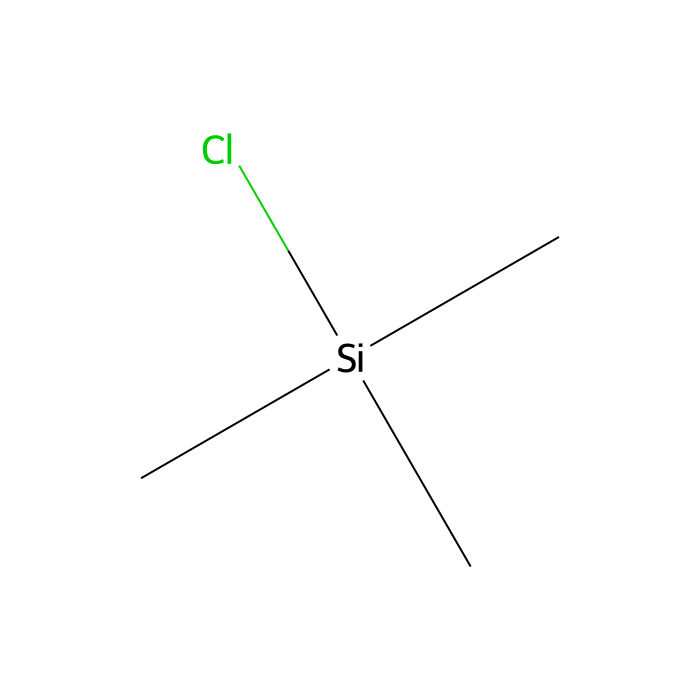
Structural features: A tetra-coordinate silicon bearing three methyl groups and one chloride (silyl chloride). No rings, no stereocenters. The Si–Cl bond is highly polarized and moisture-sensitive, enabling silylation of nucleophilic heteroatoms (O, N, S).
2D structure description (general)
Central Si atom bonded to three equivalent –CH3 substituents arranged trigonal pyramidal around Si, and one Si–Cl bond. The molecule is compact, non-aromatic, and hydrophobic aside from the reactive Si–Cl moiety.
Synthetic Utility
Functional group chemistry (literature)
Electrophilic silyl chloride that transfers a trimethylsilyl group to nucleophiles (O, N, S, and C via enolates), forming TMS derivatives and liberating chloride or HCl.
Converts enolates to TMS enol ethers—key intermediates for Mukaiyama aldol, Michael additions, and electrophilic substitutions.
Forms TMS ethers from alcohols/phenols; serves as transient protecting groups that are rapidly installed and selectively removed.
In situ generation of TMSI with iodide salts enables alcohol/epoxide iodination and selective deprotections.
Retrosynthetic value
Strategic use of labile TMS protection allows chemoselective sequences where rapid deprotection is advantageous (e.g., orthogonal to TBDMS/TIPS protections).
TMCS can activate carboxylic acids (via TMS esters) for subsequent conversion to acid chlorides or anhydrides.
Practical considerations
Choose base and solvent to steer selectivity: imidazole or pyridine for alcohol silylation; hindered bases for minimizing acylation side reactions.
Control temperature (0–25 °C) to moderate exotherm during additions. Use stoichiometric or slight excess TMCS to ensure completion, particularly in derivatization workflows.
Analyze by GC-MS for the characteristic m/z 73 fragment (Si(CH3)3+) to confirm TMS incorporation.
Target Specificity
Not applicable.
This product is a small-molecule chemical reagent, not a biological targeting agent. No antigen, epitope, clone, isotype, or species reactivity information applies.
We use cookies to ensure the website functions properly and, where permitted, to improve your experience. You can manage your preferences at any time in Settings. Learn more in our Cookie Policy.
Shall we send you a message when we have discounts available?
Remind me later
Thank you! Please check your email inbox to confirm.
Products are supplied to verified businesses, institutions, and qualified professionals for research and development use only. Not for use in humans, animals, diagnosis, or therapy.
 F2513038