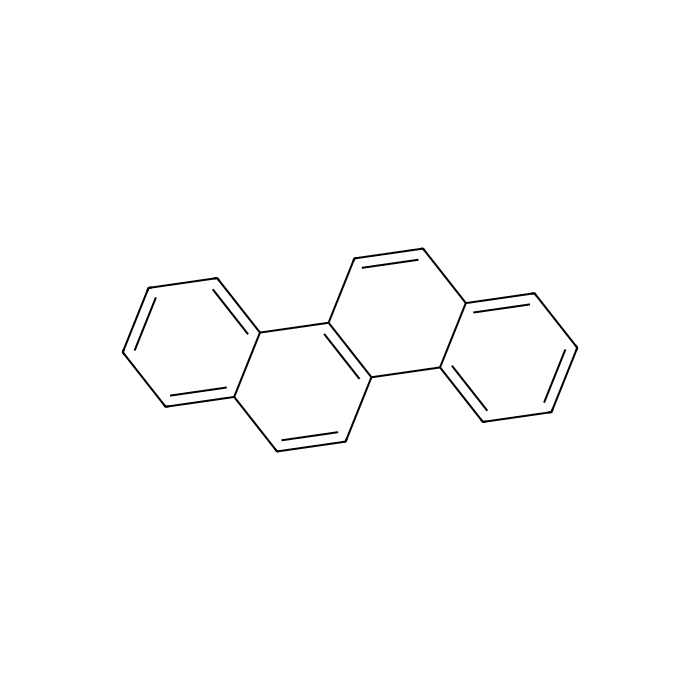
This compound belongs to the class of organic compounds known as chrysenes. These are compounds containing the polyaromatic chrysene moiety, which consists of a benzene ring fused to a phenanthrene ring system to form Benzo[a]phenanthrene.
External Descriptors
an aromatic compound
1. Djoumbou Feunang Y, Eisner R, Knox C, Chepelev L, Hastings J, Owen G, Fahy E, Steinbeck C, Subramanian S, Bolton E, Greiner R, and Wishart DS. ClassyFire: Automated Chemical Classification With A Comprehensive, Computable Taxonomy. Journal of Cheminformatics, 2016, 8:61.
Determine the necessary mass, volume, or concentration for preparing a solution.
Dilution Calculator
Determine the dilution needed to prepare a stock solution.
Reconstitution Calculator
Revisões
Avaliações dos Clientes
Application Protocols
No item-specific validated application protocols are provided for this SKU. General literature practices include:
Preparation of analytical standards: Weigh under low ambient light; dissolve in spectroscopic-grade toluene or acetonitrile; prepare serial dilutions gravimetrically; store in amber vials at 2–8 °C for working solutions.
Fluorescence measurements: Use low micromolar to nanomolar concentrations; record excitation/emission spectra while minimizing inner-filter effects; calibrate instrument with a standard fluorophore.
SPE recovery tests: Spike known amounts into pre-extracted matrices; perform method blanks and matrix spikes; analyze by GC/MS or HPLC/FLD.
Any tested applications, recommended dilutions, or positive controls specific to this item: Not specified for this item; refer to CoA/Spec Sheet.
Biological Roles
No biological activity is assigned for this product listing; content below summarizes general literature on chrysene as an environmental PAH. Use is strictly for research, not clinical or diagnostic applications.
Occurrence (literature): Found in combustion-derived mixtures (e.g., fossil fuel combustion, biomass burning, tobacco smoke) and in complex matrices such as soot and tar.
Biotransformation (literature): Metabolized by cytochrome P450 monooxygenases to epoxides and dihydrodiols; subsequent formation of diol-epoxides can lead to DNA adducts in model systems. Specific rates and pathways depend on species, tissue, and co-exposures.
Bioaccumulation (literature): High logKow suggests partitioning into lipids and sediments; limited aqueous mobility but potential for trophic transfer.
Receptor interactions (literature): Some PAHs, including chrysene derivatives, can activate the aryl hydrocarbon receptor (AhR) in cellular models, though potency varies with substitution pattern and metabolites.
Analytical biomarkers (literature): Hydroxylated chrysene metabolites may serve as exposure biomarkers in environmental health studies.
Item-specific biological testing data: Not specified for this item; refer to CoA/Spec Sheet.
Buffer Applications
Not typically applicable. Chrysene is a non-ionic, highly hydrophobic PAH and is not used to prepare aqueous buffer systems. For experimental work requiring aqueous environments, chrysene is generally handled via organic co-solvents, micelles/surfactants, or encapsulation (e.g., cyclodextrins) in specialized research protocols.
Green Alternatives
Chrysene is a persistent, hydrophobic PAH with potential hazardous classifications. Greener practice focuses on solvent choice, scale minimization, and substitution where feasible.
Greener solvent choices (literature-based)
Prefer toluene or ethyl acetate (if solubility allows) over chlorinated solvents; use cyclopentyl methyl ether (CPME) or 2-MeTHF where dissolution is adequate.
For HPLC, acetonitrile or ethanol-rich mobile phases can reduce halogenated waste if method sensitivity remains acceptable.
Process considerations
Miniaturize analytical standards and use gravimetric dilutions to reduce waste.
Employ closed systems (amber vials, low-evaporation septa) to limit emissions.
Implement SPE sorbents with higher recovery to avoid repeat extractions.
Comparison (general)
| Aspect | Conventional option | Greener alternative | Trade-offs |
|---|---|---|---|
| Dissolution | DCM, chloroform | Toluene, 2-MeTHF, CPME | May require warming/sonication; slightly longer drying times |
| Film casting | Chlorobenzene | Toluene/xylene blends | Solubility may be lower; adjust concentration/temperature |
| HPLC diluent | DCM/hexane | Acetonitrile/ethanol | Detector response/solubility must be verified |
Substitution (application-dependent)
For fluorescence standards, consider less hazardous PAHs (e.g., anthracene or pyrene) if spectral requirements permit.
Item-specific environmental certifications or green grade: Not specified for this item; refer to CoA/Spec Sheet.
Pharmaceutical Uses
Not applicable as a pharmaceutical ingredient or excipient. Chrysene is a PAH used as an analytical standard and research reagent. It is not formulated as a drug product. Any pharmacopeial status, excipient monographs, or GMP specifications for this item: Not specified for this item; refer to CoA/Spec Sheet.
Physical Properties
Only literature/computed values are provided below as general reference; they are not item specifications for this SKU.
Phase/appearance: Literature – pale yellow to off-white crystalline solid; exhibits blue fluorescence under UV.
Melting point: Literature ~254–256 °C (sublimes at elevated temperatures).
Boiling point: Literature ~448 °C (decomposes/partial sublimation before boiling at 1 atm).
Density: Literature ~1.25 g/cm³ (20–25 °C, solid).
Vapor pressure: Literature – very low at ambient temperature (on the order of 10⁻⁷ to 10⁻⁸ mmHg at 25 °C).
Aqueous solubility: Literature – extremely low (micro- to nanogram per liter at 25 °C); practically insoluble.
Organic solvent solubility: Literature – soluble in aromatic and chlorinated solvents (e.g., toluene, xylene, chlorobenzene, DCM), moderately soluble in THF and hot ethanol; insoluble in alkanes at room temp.
logKow (octanol/water partition): Literature ~6.1–6.4 (highly hydrophobic).
pKa: Not applicable (non-ionizable hydrocarbon).
Refractive index: Not applicable to solids; powdered solid has no single nD.
Item-specific specifications (e.g., MP range, purity, water content, elemental/metals profile, UV cutoff): Not specified for this item; refer to CoA/Spec Sheet.
Quality and Grades
Item-specific grade/purity: Not specified for this item; refer to CoA/Spec Sheet.
Appearance (item-specific): Not specified for this item; refer to CoA/Spec Sheet.
Context for chrysene materials (general):
PAH reference standards: When used for environmental analysis (e.g., GC/MS, HPLC/FLD), high-purity material with tightly controlled isomeric and alkylated PAH impurities is preferred. Verification by GC and/or HPLC purity and documented identity (NMR/HRMS) is common.
Fluorescence/UV studies: Low background fluorescence impurities and accurate extinction coefficients are desirable; some suppliers provide spectrophotometric qualification.
Metals/ionic residues: Typically minimal in hydrocarbon PAHs; however, trace metal contamination can affect photocatalysis or electronic measurements. If relevant, consult CoA for ppm-level metals.
Stabilizers: Usually none added to neat PAHs; if present (rare), ensure compatibility with your analytical method.
What “grade” implies (general guidance):
Analytical reference grade: Intended for calibration/quantitation; batch-specific analyte purity and uncertainty provided.
Reagent grade: Suitable for synthetic/transformation use; fewer analytical documents.
For this SKU, any explicit purity (%), assay method, residual solvent, water, metals, or stabilizer information: Not specified for this item; refer to CoA/Spec Sheet.
Reaction and Applications
Chrysene serves both as a reference analyte for PAH analysis and as a polyaromatic scaffold for functional materials chemistry.
Calibration standard for GC/MS and HPLC/FLD in PAH suites (EPA priority pollutants often include chrysene).
Recovery studies in solid-phase extraction (SPE) and QuEChERS workflows from soils, sediments, and air particulates.
Photophysics/materials (literature)
Strong fluorescence and high photostability make it a probe for solvent polarity, microenvironmental studies, and as a component in organic semiconductors/emitters.
π–π stacking propensity supports thin-film studies and crystal engineering.
Synthetic transformations on the chrysene core (literature)
Notes: Sensitive to substitution pattern; avoid overoxidation.
Oxidation to quinones
Reagents: RuO4 (from RuO2/NaIO4) or DDQ under controlled conditions.
Solvent: Acetonitrile or DCM; 0–25 °C.
Expected yields vary widely with substitution and conditions; consult primary literature for specific substrates.
Item-specific recommended conditions: Not specified for this item; refer to CoA/Spec Sheet.
Safety and Handling
Always consult the product SDS for authoritative guidance. The following summarizes typical hazards of chrysene as reported in literature/regulatory databases and general PAH handling practices.
GHS/Classification (literature, not item-specific): Often classified as hazardous to the aquatic environment (chronic), and as a suspected carcinogen (due to PAH class and metabolic activation to diol epoxides). Exact classification varies by jurisdiction/manufacturer. Item-specific GHS for this SKU: Not specified; refer to SDS.
Exposure routes: Inhalation of dust, skin contact with contaminated solutions, ingestion. Avoid generating dust/aerosols.
PPE: Chemical-resistant gloves (nitrile or equivalent), lab coat, safety glasses or splash goggles; handle in a fume hood, especially when weighing/dissolving.
Incompatibilities: Strong oxidizers (risk of exotherm/oxidation), strong electrophiles under Friedel–Crafts conditions; avoid open flames and hot surfaces (combustible organic solid).
Special risks: Persistent, bioaccumulative hydrophobic compound; potential phototoxicity under UV due to PAH fluorescence/photosensitization.
First aid (general):
Inhalation: Move to fresh air; seek medical attention if symptoms persist.
Skin contact: Wash with soap/water; remove contaminated clothing.
Eye contact: Rinse with water for several minutes; seek medical advice.
Ingestion: Rinse mouth; do not induce vomiting; seek medical attention.
Environmental: Prevent release to drains/soil; collect contaminated materials as hazardous waste.
Signal word, H-statements, pictograms for this item: Not specified for this item; refer to SDS.
Solvent Selection
Chrysene is highly hydrophobic and requires aromatic or chlorinated organic solvents for efficient dissolution.
Polarity and solubility profile (literature)
Water: Practically insoluble.
Good solvents: Toluene, xylene, chlorobenzene, dichloromethane, chloroform.
Moderate solvents: THF, hot ethanol or isopropanol; solubility improves with heat.
Poor solvents: Alkanes at room temperature; DMF/DMSO can dissolve at elevated temperatures but may not be preferred for photophysics due to background.
Practical selection guidance
Analytical (HPLC/FLD or GC): Dissolve in acetone, acetonitrile, or toluene depending on method compatibility; for GC, prepare standards in nonpolar solvents (iso-octane, toluene) to match injector/column conditions.
Photophysical studies: Use spectroscopic-grade toluene or cyclohexane (if soluble) to minimize background fluorescence; protect from stray light.
Materials processing/film casting: Chlorobenzene or o-dichlorobenzene enable higher loading and slower evaporation for uniform films.
Small comparison (literature-based)
Toluene: Good solubility, relatively benign vs chlorinated; strong UV cutoffs may interfere < 260 nm.
DCM: Fast evaporation, good solubility; chlorinated, higher EH&S burden.
Chlorobenzene: Higher boiling, excellent solubility; more persistent odor and slower drying.
Item-specific solvent recommendations: Not specified for this item; refer to CoA/Spec Sheet.
Storage and Reconstitution
Storage (item-specific): Room temperature (Product Data). Protect from light and store dry, tightly closed. For long-term stock solutions, refrigeration (2–8 °C) in amber glass is common practice (literature guidance).
Shipping: Normal (Product Data).
Stabilizers: Not specified for this item; refer to CoA/Spec Sheet.
Reconstitution/dissolution (general guidance):
Neat solid: Warm gently (30–50 °C) and sonicate with a suitable solvent (toluene, chlorobenzene, DCM) to accelerate dissolution. Avoid prolonged high heat.
Stock solutions: Prepare at known mass fraction (e.g., 1–10 mg/mL) using gravimetric addition. Filter through PTFE (0.2 µm) if particulate is present.
Light protection: Use amber vials/foil wrap; minimize UV exposure during weighing and transfers.
Freeze–thaw: Not applicable to neat solid; avoid repeated freeze–thaw of solutions—prepare aliquots instead.
Any item-specific reconstitution instructions, solution stability, or shelf-life: Not specified for this item; refer to CoA/Spec Sheet.
Research use: For research use only (Product Data).
Structure and Identity
Chrysene is a polycyclic aromatic hydrocarbon (PAH) composed of four fused benzene rings in an angular arrangement, yielding a rigid, planar, conjugated π-system.
Item-specific identifiers (from Product Data)
SKU: C107020
Product name: Chrysene
CAS: 218-01-9
PubChem CID: 9171
Storage: Room temperature (Product Data)
Shipped in: Normal (Product Data)
SMILES: Not specified for this item; refer to CoA/Spec Sheet.
InChIKey: Not specified for this item; refer to CoA/Spec Sheet.
Molecular formula: Not specified for this item; refer to CoA/Spec Sheet.
Molecular weight: Not specified for this item; refer to CoA/Spec Sheet.
Literature structural identifiers (for reference; not item specifications)
Framework: Four-ring PAH; angular (as opposed to linear) fusion pattern.
Functional groups: Fully aromatic; no heteroatoms; no substituents (parent hydrocarbon).
Conjugation: Extensive delocalization; strong UV absorption and fluorescence.
Symmetry and planarity: Highly planar, facilitating π–π stacking in the solid state.
2D description: Two central rings share an edge; outer rings fused on adjacent sides, producing a kinked polyaromatic surface.
Synthetic Utility
Chrysene is a versatile aromatic scaffold for building extended π-systems and for probing PAH reactivity patterns.
Functionalization strategies (literature)
Halogenation: Regioselective bromination/iodination provides handles for cross-coupling (Suzuki–Miyaura, Stille, Sonogashira). Control of temperature and equivalents is crucial to avoid over-substitution.
Directed metalation: With strong bases (e.g., s-BuLi/tmeda), site-selective lithiation can be achieved, enabling formylation, borylation, or silylation after electrophile quench.
Friedel–Crafts acylation/alkylation: Under Lewis acid catalysis to install carbonyl or alkyl groups; substrate deactivation and sterics govern position selectivity.
Oxidation/reduction: Access to chrysenequinones and dihydrodiols for mechanistic and materials studies.
Retrosynthetic value (literature)
Serves as a parent core for donor–acceptor materials, OLED emitters, and organic semiconductors through strategic substitution.
Halogenated chrysenes act as cross-coupling linchpins for constructing larger nanographenes and contorted aromatics (via Scholl oxidative cyclodehydrogenation).
Practical considerations
Limited solubility can constrain reaction rates; use higher-boiling aromatic solvents (chlorobenzene, o-DCB) and elevated temperatures.
Purification often via recrystallization from aromatic solvents; silica chromatography may require nonpolar eluents and protection from strong UV.
Target Specificity
Not applicable. This product is a small-molecule PAH, not a biological macromolecule or antibody. No target antigen, clone, or species reactivity applies.
Usamos cookies para garantir o funcionamento adequado do site e, quando permitido, para melhorar a sua experiência. Você pode gerenciar suas preferências a qualquer momento nas Configurações. Saiba mais em nossa Política de Cookies.
Deseja que lhe enviemos uma mensagem quando tivermos descontos disponíveis?
Lembrar-me mais tarde
Obrigado! Por favor, verifique a sua caixa de entrada de e-mail para confirmar.
Products are supplied to verified businesses, institutions, and qualified professionals for research and development use only. Not for use in humans, animals, diagnosis, or therapy.

 G2220442