GRADE & PURITYMoligand™?Moligand™ — Aladdin's line of ligands and bioactive small molecules. Use for receptor, pathway, and binding studies needing defined small-molecule tools.10 mM in DMSO
Moligand™, 10 mM in DMSO Moligand™ for sensitive chromatographic and analytical workflows requiring minimal baseline interference.
🌡
Storage & shipping
Store at -80°C Ships Dry ice packs + Cold packs Check lot-specific COA for exact specifications.
📋
Quality documents
SDS, COA, datasheet, and spec sheet available for download. Lot-specific COA accessible via lot number lookup.
📚
Literature proof
Cited in 0 peer-reviewed publications across chromatography, organic synthesis, and cross-coupling reactions.
Visão geral
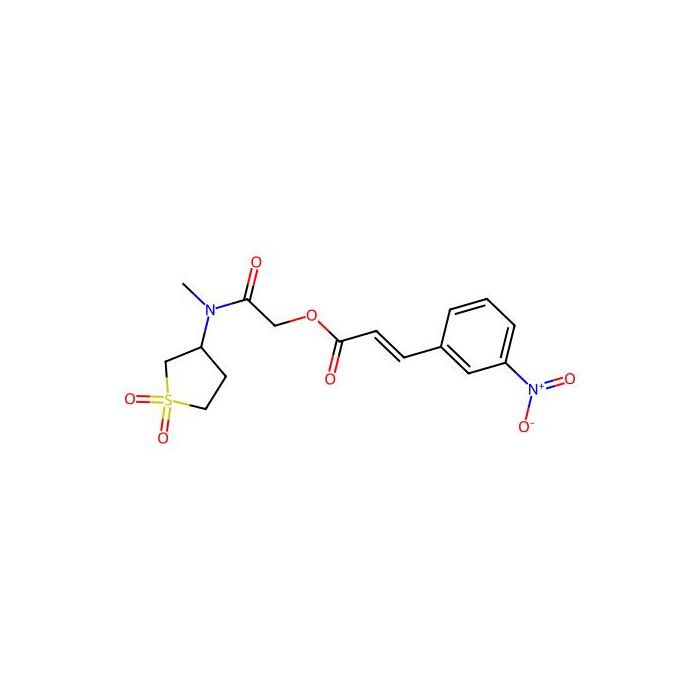
CID 5951923 is a potent inhibitor of Krüppel-like factor 5 (KLF5) , with an IC 50 of 603 nM. CID 5951923 can inhibit proliferation of cancer cells in vitro.
Specifications
Especificações e pureza
Moligand™, 10 mM in DMSO
Condições de armazenamento de armazenamento
Store at -80°C
Enviado em
Dry ice packs + Cold packs
Este produto requer transporte de cadeia fria. Serviços terrestres e outros serviços econômicos não estão disponíveis.
Determine the necessary mass, volume, or concentration for preparing a solution.
Dilution Calculator
Determine the dilution needed to prepare a stock solution.
Reconstitution Calculator
Revisões
Avaliações dos Clientes
Application Protocols
No vendor-validated application protocols are provided for this item.
Item-specific facts
Tested applications, concentrations, or positive controls: Not specified for this item; refer to CoA/Spec Sheet.
General protocols for screening compounds (guidance)
Stock preparation: Dissolve in anhydrous DMSO to a convenient concentration (e.g., 10 or 20 mM, as assay permits). Filter if needed (PTFE, 0.22 µm) and aliquot.
Plate handling: Use low-binding plates and caps/seals to minimize adsorption and evaporation. Standardize vehicle % across all wells.
Concentration–response: 10-point half-log serial dilutions are common; include replicates and intra-plate controls.
Aggregation controls: Include low % non-ionic detergent and test for precipitation visually or by light scattering.
Orthogonal confirmation: Follow primary hits with secondary assays (biochemical vs. cell-based) and biophysical validation.
Documentation
Record batch/lot, preparation date, and freeze–thaw history. Retain chromatograms/spectra for QC traceability.
Biological Roles
Item-specific biological function or target engagement for CID 5951923 is not provided in this listing.
Item-specific facts
Intended use: Research screening compound (Moligand™). No biological role, mechanism, or target annotations are specified; consult primary literature or PubChem annotations for CID 5951923 if available.
General guidance for characterization
In silico profiling: Use cheminformatics to predict liabilities (e.g., PAINS, structural alerts), pKa/logD windows, and potential off-target pharmacology.
In vitro assays: Begin with broad target-family panels or the intended biochemical assay; collect IC50/EC50 curves and Hill slopes; verify activity across orthogonal assay formats to exclude artifacts.
ADME triage (discovery-stage, non-GLP): Microsomal stability, permeability (PAMPA/MDCK), solubility across pH 2–8, and plasma protein binding to contextualize potency vs. exposure.
Assay interference risks (general)
Aggregation: Test with low concentrations of non-ionic detergent (e.g., 0.01–0.05% Triton X-100/Tween-20) and dynamic light scattering where possible.
Redox/chelation/fluorescence: Run counter-screens to detect redox cycling, metal chelation, and optical interference.
Disclaimer
No medical, diagnostic, or therapeutic claims are made. Use strictly for laboratory research. Any biological roles for this specific CID must be verified from authoritative databases or the CoA/Spec Sheet.
Buffer Applications
This product is a small-molecule screening compound, not a buffering agent. Specific buffer systems or pKa values enabling buffering capacity are not provided.
Applicability
Not typically used to establish buffer pH. Instead, dissolve in an appropriate assay buffer (e.g., HEPES, PBS, Tris) compatible with the biological system and the compound’s solubility.
Practical notes (general)
Prepare concentrated DMSO stock and dilute into the chosen buffer while maintaining a constant final organic percentage across controls.
If precipitation occurs, introduce a small co-solvent fraction (EtOH or PEG-400) or raise temperature slightly during mixing; then equilibrate to assay temperature.
Item-specific data
Buffer-related constants (pKa, buffer range) for CID 5951923: Not specified for this item; refer to CoA/Spec Sheet or determine experimentally.
Green Alternatives
Given the compound is used primarily for screening stocks rather than as a process solvent or reagent, “green alternatives” pertain mainly to solvent selection for handling and assays.
Greener solvent choices for stock/dilution (general; literature)
Prefer EtOH, i-PrOH, or water-miscible PEG-400 blends where the compound’s solubility allows, reducing reliance on high-boiling dipolar aprotics.
Keep DMSO volumes minimal in assays; DMSO is widely used but consider EtOH or aqueous co-solvent systems when equally effective.
Comparative considerations (general)
DMSO: Excellent solvency; high boiling point; manageable hazard profile; common in HTS.
EtOH/i-PrOH: Renewable feedstocks; lower toxicity; volatilize readily but may affect membrane permeability in cells.
PEG-400: Low volatility and good solvency for hydrophobes; may increase solution viscosity and affect readouts at high %.
Small comparison (literature, typical use)
Solvent vs. Pros vs. Trade-offs:
DMSO: Broad solubility; very common in HTS; Trade-off: assay interference at higher %; hygroscopic.
EtOH: Greener, volatile; Trade-off: cytotoxicity above ~1–2% v/v, volatility in open wells.
PEG-400: Aids solubility; low volatility; Trade-off: viscosity, potential assay background.
Item-specific note
No compound-specific green chemistry metrics (e.g., E-factor, synthesis route) are available for CID 5951923 in this listing.
Pharmaceutical Uses
No pharmacopeial status or excipient role is provided for this item.
Item-specific facts
Intended for research use only (screening/discovery). Not for human or veterinary use; no clinical formulation claims are made.
General context (non-clinical R&D)
Compounds like this may be used in early discovery workflows to explore structure–activity relationships and to generate preclinical hypotheses in vitro. If further development is pursued, separate GMP-grade material, full impurity profiling, and comprehensive CMC/GLP safety evaluations would be required.
Documentation
Any reference to pharmacopoeial monographs, excipient listings, or clinical manufacturing standards is Not specified for this item. Users should not employ this SKU in any clinical or diagnostic setting.
Physical Properties
Item-specific physical constants are not provided in this listing.
Item-specific facts (from Product Data)
Appearance: Not specified for this item; refer to CoA/Spec Sheet.
Molecular weight: Not specified for this item; refer to CoA/Spec Sheet.
Typical properties to verify (literature/assay planning guidance; not item specifications)
Melting point (solid) or boiling point (liquid): Not specified for this item; check CoA or PubChem.
Density: Not specified for this item.
LogP / cLogP and pKa: Critical for solubility and permeability modeling; retrieve from PubChem or calculate (e.g., with ACD/Labs, ChemAxon). Not specified for this item.
Aqueous and co-solvent solubility: Not specified for this item; determine empirically. For screening use, initial stock preparation is commonly in anhydrous DMSO (literature practice).
UV–Vis characteristics: Not specified for this item; if required for quantitative assays, record a solvent-specific spectrum to establish extinction coefficients.
Hygroscopicity/photolability: Not specified for this item; handle under low moisture and subdued light until behavior is known.
Practical recommendations (general)
Start with a small-scale solubility screen (DMSO, DMF, MeOH, water with co-solvents) before plate preparation.
If crystalline, confirm identity and assess polymorphism by NMR, MS, and DSC as needed.
For assay readouts overlapping with compound absorbance/fluorescence, record blank spectra to avoid interference.
Quality and Grades
Item-specific facts (from Product Data)
Grade/Purity: Moligand™ (screening library grade)
What Moligand™ implies (general explanation)
Moligand™ indicates suitability for discovery research such as target-based or phenotypic screening, fragment hits follow-up, and SAR exploration. While high chemical purity and identity confirmation are expected in screening-grade materials, explicit assay-suitable attributes (e.g., residual solvent content, salt form, water content, or metal traces) are not stated here and should be verified on the CoA/Spec Sheet for this SKU.
Documentation and verification
Identity confirmation: Typically by 1H NMR and MS; some libraries include LC purity with UV traces. For this item, specific test methods and pass criteria are Not specified for this item; refer to CoA/Spec Sheet.
Salt form/solvate: Not specified for this item; check CoA to avoid molecular weight miscalculations for stock solutions.
Purity reporting: Not specified for this item; users should confirm LC area% purity prior to HTS/assays to mitigate false positives from impurities.
Practical advice for screening use
Record in-house QC (LC–MS, 1H NMR) upon receipt, especially if preparing master plates for long-term campaigns.
If UV transparency is critical (e.g., HPLC/UPLC method development), determine the compound’s UV cutoff empirically; it is Not specified for this item.
Cross-reference PubChem CID 5951923 for orthogonal identifiers; reconcile with the product’s CoA.
Reaction and Applications
This product is listed as a Moligand™ small-molecule screening compound rather than a synthetic reagent.
Applicability to synthesis
The compound’s exact functional groups and reactivity are Not specified for this item; therefore, it is not recommended to use this SKU as a stoichiometric reagent or catalyst without first confirming structure and purity via CoA/Spec Sheet and independent analysis.
Discovery and screening applications (general)
Target-based screening: Evaluate as a potential ligand or modulator in enzymatic, receptor, or protein–protein interaction assays. Establish concentration–response curves and evaluate aggregation artifacts (use detergent controls if needed).
Phenotypic assays: Probe cellular phenotypes; monitor cytotoxicity and off-target liabilities using orthogonal readouts.
Biophysical binding: Test by DSF/TSA, MST, SPR, or NMR (WaterLOGSY, STD-NMR). Confirm stoichiometry and binding specificity with orthogonal methods.
Practical tips
Implement PAINS and aggregator filters computationally; follow with orthogonal biophysical confirmation.
Include vehicle controls and counter-screens to deconvolute assay interference (e.g., redox cycling, fluorescence quenching).
If hit-like behavior is observed, procure fresh material or resynthesize to confirm activity and rule out degradation artifacts.
Not item specifications
No reaction conditions or named reaction usage are provided for CID 5951923 in this listing.
Reaction Conditions
No reaction conditions are provided for this item, as it is intended for screening rather than synthetic use.
Item-specific status
Named reactions, catalysts, or solvent/temperature windows: Not specified for this item.
General laboratory considerations (if chemical modification is attempted)
Begin with analytical-scale trials (≤5 mg) in inert atmosphere when functional group sensitivity is unknown.
Choose mild, chemoselective conditions first (e.g., amide couplings with modern coupling agents, Suzuki couplings under Pd with aqueous-compatible ligands) only after verifying that the structure supports such transformations.
Monitor by LC–MS/UPLC for conversion, impurity formation, and stability; adjust temperature/time cautiously.
Disclaimer
The above are general literature practices and not specifications for CID 5951923.
Safety and Handling
Safety details for this specific item are not provided in the listing and must be obtained from the SDS.
Item-specific hazard statements
Signal word: Not specified for this item; refer to SDS.
H-statements: Not specified for this item; refer to SDS.
GHS classification/pictograms: Not specified for this item; refer to SDS.
General laboratory precautions (best practice for small molecules)
PPE: Wear lab coat, safety glasses, and appropriate chemically resistant gloves (e.g., nitrile). Use a certified chemical fume hood for weighing and solution preparation.
Avoid inhalation, ingestion, and skin/eye contact. Prevent aerosol/dust formation during handling.
Incompatibilities: Unknown; keep away from strong oxidizers and strong acids/bases until compatibility is established. Avoid heat and light until stability is confirmed.
First-aid overview (general)
Inhalation: Move to fresh air; seek medical attention if symptoms persist.
Skin contact: Wash with soap and water; remove contaminated clothing.
Eye contact: Rinse cautiously with water for several minutes; obtain medical advice if irritation persists.
Ingestion: Rinse mouth; seek medical attention; do not induce vomiting unless directed by medical personnel.
Spills and disposal
Contain with inert absorbent, collect in labeled waste. Dispose of in accordance with institutional and local regulations. Defer to SDS for precise instructions.
Transport/storage risks
Shipped on dry ice/cold packs; minimize freeze–thaw cycles. Maintain at -80°C as specified.
Solvent Selection
Because the exact structure is not provided here, solvent choices should follow a tiered screening strategy commonly used for small molecules.
Primary stock solvent (general practice)
DMSO (literature): Widely used for 10–100 mM stocks due to broad solvency and assay compatibility at ≤1–2% v/v in wells.
MeOH, EtOH, i-PrOH: Protic, volatile options; often acceptable up to ~1% v/v in biochemical assays.
Aqueous buffers with co-solvent (0.1–1% Tween-80 or 5–20% PEG-400) can aid solubilization for bioassays.
Polarity and dielectric context (solvent properties; literature values)
DMSO ε ~47; DMF ε ~37; MeOH ε ~33; EtOH ε ~25; i-PrOH ε ~20; water ε ~80 (at 20–25°C). These guide miscibility and ionization-dependent solubility strategies.
Practical guidance
Begin with anhydrous DMSO stock, then dilute into assay buffer to the minimal final organic fraction compatible with the biology.
If precipitation occurs upon dilution, pre-mix DMSO stock with an equal volume of co-solvent (e.g., EtOH or PEG-400), then add to buffer under vortexing.
For cell-based assays, maintain consistent vehicle controls and verify that final solvent composition does not perturb readouts.
Not item specifications
Specific solubility, partitioning, or pKa values for CID 5951923 are Not specified for this item; consult CoA/Spec Sheet or measure experimentally.
Storage and Reconstitution
Item-specific facts (from Product Data)
Storage Conditions: Store at -80°C
Shipped In: Dry ice packs + Cold packs
Appearance: Not specified for this item; refer to CoA/Spec Sheet.
Reconstitution (general guidance for small molecules; not item specifications)
Allow the sealed container to equilibrate to room temperature before opening to prevent moisture condensation.
Prepare a concentrated stock in anhydrous DMSO (commonly 10–100 mM as assay allows). If solubility is limited, consider EtOH, DMF, or PEG-400 blends, then dilute into buffer.
Filter sterilize if required for cell-based assays (0.22 µm PTFE for organic stocks; PES for aqueous dilutions if compatible).
Aliquoting and stability (general)
Dispense single-use aliquots to avoid repeated freeze–thaw. Store aliquots at -80°C in tightly sealed, chemically compatible vials.
Protect from light and moisture until compound stability is known. Track freeze–thaw cycles; discard aliquots showing precipitation, color change, or assay drift.
Shelf-life and specifications
Formal retest/expiry dating, hydration/solvation state, and stability data are Not specified for this item; refer to CoA/Spec Sheet and confirm by periodic LC–MS/UPLC.
Safety note
Defer to the SDS for handling hazards during reconstitution and disposal.
Structure and Identity
Overview: This listing is for a single small-molecule entry from Aladdin’s Moligand™ screening collection, referenced by its PubChem CID.
Item-specific facts (from Product Data)
SKU: C1500376
Product Name: CID 5951923
CAS: 749872-43-3
PubChem CID: 5951923
Grade: Moligand™ (screening library grade)
Storage: Store at -80°C
Shipped on: Dry ice packs + Cold packs
Research Use: For research use only
Structure identifiers
Molecular formula: Not specified for this item; refer to CoA/Spec Sheet.
Molecular weight: Not specified for this item; refer to CoA/Spec Sheet.
SMILES: Not specified for this item; refer to CoA/Spec Sheet.
InChIKey: Not specified for this item; refer to CoA/Spec Sheet.
Structural features (general note)
The precise functional groups, heteroatoms, and ring systems are not disclosed in this listing. For target/assay planning (e.g., H-bonding capacity, pKa domains, or aromatic content), consult the compound’s CoA/Spec Sheet or PubChem entry for CID 5951923.
2D structure description (general)
Not available in this listing. The 2D depiction (skeletal formula) should be reviewed from authoritative databases (PubChem) or the item’s Spec Sheet to confirm atom connectivity, substitution pattern, and potential stereogenic centers before use in SAR or docking workflows.
Synthetic Utility
This SKU is presented as a screening library compound rather than a building block. Without structural disclosure, its use as a synthetic intermediate cannot be advised.
Item-specific note
Functional groups, leaving groups, and stereochemical elements: Not specified for this item; refer to CoA/Spec Sheet and structure databases (PubChem CID 5951923) if synthetic repurposing is intended.
General guidance (if repurposing is considered)
Confirm identity and purity (1H/13C NMR, HRMS, LC purity) and determine whether the substance is a free base/acid, salt, solvate, or hydrate.
Assess stability under common transformations (oxidation/reduction, coupling conditions) on milligram scale to identify labile motifs.
If chiral, evaluate enantiopurity (chiral HPLC) before and after transformations.
Recommendation
For routine synthesis, procure the corresponding building blocks with known specifications rather than using a screening compound whose exact reactivity and stability are unknown.
Target Specificity
Target, mechanism, or selectivity annotations for CID 5951923 are not included in this listing.
Item-specific facts
Target class, binding site, Ki/Kd/IC50, and selectivity panels: Not specified for this item; consult PubChem bioassay entries or the CoA/Spec Sheet if available.
General recommendations
Validate any claimed activity using at least two orthogonal assay formats.
Incorporate selectivity profiling early (e.g., counterscreens across related target families) to identify off-target liabilities.
Important note
No medical or diagnostic use is implied. All evaluations must remain within research laboratory settings.
Need help choosing the grade?
Our grade selection guide covers purity, stabilizer status, and application suitability for all variants in our catalog.
We use cookies to ensure the website functions properly and, where permitted, to improve your experience. You can manage your preferences at any time in Settings. Learn more in our Cookie Policy.
Shall we send you a message when we have discounts available?
Remind me later
Thank you! Please check your email inbox to confirm.
Products are supplied to verified businesses, institutions, and qualified professionals for research and development use only. Not for use in humans, animals, diagnosis, or therapy.