Acetate salt - Organic transition metal salt - Monocarboxylic acid or derivatives - Carboxylic acid - Organic oxygen compound - Organic oxide - Hydrocarbon derivative - Organic copper salt - Organic salt - Organooxygen compound - Carbonyl group - Aliphatic acyclic compound
Descrição
This compound belongs to the class of organic compounds known as acetate salts. These are organic compounds containing acetic acid as its acid component.
External Descriptors
Not available
1. Djoumbou Feunang Y, Eisner R, Knox C, Chepelev L, Hastings J, Owen G, Fahy E, Steinbeck C, Subramanian S, Bolton E, Greiner R, and Wishart DS. ClassyFire: Automated Chemical Classification With A Comprehensive, Computable Taxonomy. Journal of Cheminformatics, 2016, 8:61.
Determine the necessary mass, volume, or concentration for preparing a solution.
Dilution Calculator
Determine the dilution needed to prepare a stock solution.
Reconstitution Calculator
Revisões
Avaliações dos Clientes
Application Protocols
No vendor-validated bioassay protocols (e.g., WB, IHC, IF, FC) are associated with this inorganic reagent. For synthetic and catalytic applications, see the “Reaction Conditions” and “Reaction & Applications” sections for literature-style guidance, and consult primary literature to tailor conditions to your substrates.
Biological Roles
This product is intended for research use only. The following provides biochemical context for copper species in general (literature; not specific to any medical use):
Essential trace element
Copper cycles between Cu(I)/Cu(II) oxidation states, serving as a cofactor in enzymes such as cytochrome c oxidase, superoxide dismutase (Cu/Zn-SOD), lysyl oxidase, and tyrosinase.
Coordination chemistry in biology
Strong affinity for histidine, cysteine, and methionine residues; acetate ligands exchange readily in aqueous media, so copper(II) acetate primarily serves as a convenient, water/alcohol-soluble Cu(II) source in biochemical experiments.
Redox activity
Cu(II)/Cu(I) redox couples participate in electron transfer but can also catalyze Fenton-like reactions in the presence of peroxides, generating reactive oxygen species; exercise caution in biomolecule-containing systems.
Laboratory relevance
Used to prepare defined copper–protein adducts, to probe metal-binding sites, or as a standard for colorimetric assays (e.g., biuret/BCA rely on Cu chemistry, though specialized copper reagents are typically used).
No clinical, diagnostic, or therapeutic claims are made for this product.
Buffer Applications
Copper(II) acetate monohydrate is not typically used as a buffering agent. While acetate buffers are common (acetic acid/acetate), the presence of Cu(II) introduces strong metal–ligand interactions that can interfere with biological assays and alter pH equilibria.
Practical notes (literature)
If a metal-containing acetate medium is required (e.g., to maintain copper activity), prepare a conventional acetate buffer (AcOH/NaOAc) at the desired pH and add Cu(II) acetate last, monitoring for precipitation with competing anions (phosphate, carbonate, sulfide).
Avoid buffers with strong chelators (Tris, EDTA, citrate) if free Cu(II) is needed; these will sequester copper and change speciation.
For general pH control without metal ions, use standard acetate, phosphate, or Good’s buffers instead.
Green Alternatives
Positioning Cu(OAc)2·H2O within greener synthesis strategies (literature perspective):
Advantages
Enables O2/air as terminal oxidant in many transformations (Chan–Lam, alcohol oxidations), avoiding stoichiometric chromium or permanganate oxidants.
Operates in comparatively benign solvents (AcOH, MeOH, MeCN) and often at room temperature.
Considerations
Copper is a heavy metal; minimize catalyst loading and ensure proper waste handling/metal recovery.
Coordinating aprotic solvents (DMF/DMSO) complicate waste; prefer MeCN, alcohols, or aqueous systems when feasible.
Alternate reagents/conditions (compare and choose per application)
| Use case | Typical with Cu(OAc)2·H2O | Greener alternative(s) | Trade-offs |
|---|---|---|---|
| Alcohol oxidation | Cu/TEMPO in MeCN under O2 | Aqueous NaOCl/TEMPO at pH ~9–10; or electrochemical oxidation | Bleach generates chloride waste; electrochemistry requires setup but avoids metals |
| C–N/C–O coupling (Chan–Lam) | Cu(OAc)2, base, air | Photoredox with organic dyes; electrochemical Chan–Lam | New equipment/optimization; scope may differ |
| C–H acetoxylation (Pd/Cu) | Pd(OAc)2 + Cu(OAc)2 in AcOH | Hypervalent iodine oxidants in greener solvents; electrooxidative Pd catalysis | Cost/atom economy vs electricity; substrate compatibility |
Practical green tips
Use catalytic Cu with O2 rather than stoichiometric Cu(II) where possible.
Recycle copper via scavengers or electrodeposition from aqueous waste.
Employ solvent selection guides (e.g., prefer MeCN, EtOAc, alcohols over DMF/DMSO/NMP when viable).
Pharmaceutical Uses
No medical or therapeutic uses are claimed. The following relates to formulation/manufacturing contexts (literature; not specific to this SKU):
Role in process chemistry
Cu(OAc)2·H2O is employed as a catalyst or oxidant in API intermediate synthesis (e.g., Chan–Lam couplings for aryl ether/aryl amide formation; aerobic oxidations).
Excipient status
Copper(II) acetate is not a common excipient and is generally avoided in finished formulations due to toxicity and reactivity of Cu(II) ions.
Manufacturing considerations
Residual copper must be controlled per ICH Q3D (elemental impurities). Robust metal removal (scavengers, aqueous washes with chelators) and validated analytical methods (ICP-MS) are standard.
Choice of solvent and ligands impacts purgeability of copper; acetate ligands are relatively labile, aiding removal during aqueous workup.
Any use in pharmaceutical manufacturing should be governed by cGMP and relevant pharmacopeial/ICH guidelines.
Physical Properties
Item-specific (Product Data)
Appearance: Not specified for this item; refer to CoA/Spec Sheet.
Molecular Weight: Not specified for this item; refer to CoA/Spec Sheet.
Literature/General properties (typical values for copper(II) acetate monohydrate; not item specifications)
Thermal behavior: loses lattice water on heating (~100 °C), further decomposition at elevated temperature; anhydrous species stable to ~240 °C before decomposition (literature)
Solubility: moderately soluble in water; soluble in methanol and ethanol; sparingly soluble in acetone; essentially insoluble in nonpolar solvents (literature, qualitative)
pKa: not applicable (salt of a weak acid/metal complex)
Partitioning: inorganic coordination compound; logP not meaningful in the classical sense
UV–Vis: d–d band typical of Cu(II) centers (broad absorption in visible), exact maxima vary with solvent/ligand field (literature)
Notes
Reported values vary with hydration state, sample history, and measurement method. For definitive specifications applicable to this item, consult the CoA/Spec Sheet.
Quality and Grades
Item-specific (Product Data)
Grade/Purity: Not specified for this item; refer to CoA/Spec Sheet.
Guidance on grades for copper(II) acetate (general; not specific to this SKU)
ACS/Reagent grade: meets defined impurity limits suitable for analytical and general lab use.
Catalyst grade: optimized for homogeneous/heterogeneous catalysis; may specify residual halides, alkali/alkaline-earth metals, and water content.
Electronic or high-purity grade: trace-metal specifications at low ppm/ppb for materials science applications.
What grade implies in practice
Lower UV background and low organic impurities are important if Cu(OAc)2 is used in photochemical or spectroscopic studies.
Trace chloride/halide can affect catalytic cycles (e.g., Chan–Lam, aerobic oxidations). When critical, verify halide and alkali metal content on the CoA.
Hydration state matters: monohydrate vs anhydrous can change stoichiometry and solubility; account for this when calculating reagent equivalents.
For this specific item (C105398), consult the CoA/Spec Sheet for exact purity, trace metal profile, and hydration verification.
Reaction and Applications
Common roles of Cu(OAc)2·H2O in synthesis and catalysis (literature; expand/adjust per your protocol):
Oxidative cross-coupling (Chan–Lam–Evans)
Couples aryl/alkenyl/alkyl boronic acids with N–H or O–H nucleophiles to form C–N and C–O bonds under mild, aerobic conditions. Cu(OAc)2 acts as both catalyst and oxidant (reoxidation by air/O2 often sufficient).
Aerobic alcohol oxidations (Cu/nitroxyl systems)
With TEMPO/ABNO and bipyridine or diamine ligands, Cu(OAc)2 catalyzes selective oxidation of primary/secondary alcohols to aldehydes/ketones using O2 as the terminal oxidant.
C–H functionalization and acetoxylation
As sacrificial oxidant or co-catalyst with Pd(OAc)2 in directed C–H activation to install OAc groups; Cu(II) promotes Pd(0) → Pd(II) turnover.
Alkyne homocoupling (Glaser-type)
Facilitates oxidative coupling of terminal alkynes (often via in situ Cu(I) acetylides) with O2 or Cu(II) as oxidant; bases such as amines or carbonates used.
Halide/heteroatom exchange and ligand delivery
Source of acetate ligand in transmetalation or ligand exchange to prepare copper(II) carboxylates or to modulate catalyst acidity/basicity.
Inorganic/materials synthesis
Precursor to copper-containing coordination polymers and MOFs (e.g., acetate-bridged paddlewheel nodes); can seed copper oxide films/particles upon thermal treatment.
Practical tips (literature)
Hydration state: account for monohydrate mass in mmol calculations.
Air and moisture: many reactions are air-tolerant; however, bases and coordinating amines affect Cu speciation—optimize stoichiometry.
Workup: chelating agents (aqueous NH3, EDTA) help remove residual copper from organic phases; filter through silica with small NH3/MeOH if needed.
Reaction Conditions
Representative, literature-reported conditions using Cu(OAc)2·H2O (guidance only; optimize per substrate):
Chan–Lam C–N/C–O coupling
Typical: aryl boronic acid (1.0–1.5 equiv), nucleophile (1.0 equiv), Cu(OAc)2 (5–20 mol% or stoichiometric for difficult substrates), base (pyridine, Et3N, K2CO3), solvent (MeCN, DCM, dioxane, or toluene), air/O2, 20–60 °C, 4–24 h; isolated yields commonly 60–90%.
Aerobic alcohol oxidation (Cu/TEMPO)
Example: alcohol (1.0 equiv), TEMPO (5–10 mol%), Cu(OAc)2 (1–10 mol%), ligand (bpy or diamine, 5–10 mol%), base (NMI or DBU), MeCN or MeCN/AcOH, O2 balloon or air, 25–40 °C, 1–8 h; aldehydes/ketones in high selectivity.
Pd-catalyzed C–H acetoxylation
Example: arene with directing group, Pd(OAc)2 (5–10 mol%), Cu(OAc)2 (1–3 equiv) as sacrificial oxidant, Ac2O/AcOH solvent, 80–120 °C, 6–24 h; monoacetoxylated products prevalent.
Glaser-type alkyne homocoupling
Terminal alkyne (2.0 equiv), Cu(OAc)2 (10–100 mol% depending on system), base (amine or carbonate), solvent (pyridine, MeOH, or toluene/MeOH), air/O2, rt–60 °C, 2–16 h; diynes in moderate to excellent yields.
Operational notes
Hydration correction: multiply weighed mass by (1 mol / 199.65 g) for mmol; adjust if switching to anhydrous Cu(OAc)2.
Oxygen control: many protocols succeed open to air; O2 balloon increases rates/selectivity in oxidations.
Workup: quench with aqueous NH3 or EDTA to extract copper; filter through silica with 1–5% MeOH/NH3 in DCM if needed.
Safety and Handling
Item-specific (Product Data)
GHS Classification: Not specified for this item; refer to SDS.
Signal Word: Not specified for this item; refer to SDS.
H-Statements: Not specified for this item; refer to SDS.
Pictograms: Not specified for this item; refer to SDS.
Literature/General safety information for copper(II) acetate salts (for guidance; defer to SDS for this item)
Likely hazards: harmful if swallowed; causes skin/eye irritation; may cause respiratory irritation; very toxic to aquatic life with long lasting effects (typical for copper(II) salts).
PPE: lab coat, safety glasses or face shield, and appropriate chemical-resistant gloves (e.g., nitrile). Use in a fume hood to control dust and vapors.
First aid overview: if inhaled—move to fresh air; if on skin—wash with soap/water; if in eyes—rinse cautiously for several minutes; if ingested—rinse mouth, seek medical attention. Always follow your institutional protocols.
Incompatibilities: strong bases (precipitation of Cu(OH)2), strong reducing agents (may reduce Cu2+ to Cu+ or Cu0), sulfide sources (formation of CuS), and strong acids (liberation of acetic acid and potential corrosion). Avoid contact with aluminum or reactive metals in moist conditions.
Environmental precautions: prevent release to waterways; collect spills with inert absorbent and dispose per regulations.
Special risks: dust can stain and cause irritation; copper salts can catalyze oxidative processes—store away from finely divided organics.
Always consult the SDS for authoritative, product-specific safety guidance.
Solvent Selection
Copper(II) acetate monohydrate is an ionic coordination solid. Solvent choice is driven by the intended application (catalysis vs. precursor synthesis) and by ligand exchange considerations.
Alcohols (MeOH, EtOH): generally good solubility; commonly used to prepare homogeneous catalyst solutions.
Polar aprotics (MeCN, DMF, DMSO): typically good solubility and stable complexation; widely used for oxidative couplings and aerobic oxidations.
Weakly polar/ nonpolar (Et2O, hexanes, toluene): poor solubility; use only as co-solvents or with phase-transfer strategies.
Practical selection by use case
Chan–Lam couplings: MeCN, DCM, dioxane, toluene, or mixtures; bases such as pyridine, Et3N, or carbonate often included.
Aerobic oxidation with nitroxyl radicals (e.g., TEMPO): MeCN, MeOH, AcOH, or AcOH/MeCN mixtures; O2 or air as terminal oxidant.
MOF/coordination polymer synthesis: alcohols, water/alcohol mixtures, or acetic acid to favor acetate-bridged motifs.
Comparison notes (literature)
Acetonitrile vs methanol: MeCN often yields faster Chan–Lam couplings; MeOH can promote ligand exchange and transesterification side processes.
DMSO/DMF: enhance solubility but complicate workup and may coordinate strongly to Cu(II), altering reactivity.
Always ensure solvent dryness/degassing as required by the specific transformation; acetate can buffer mildly acidic media when acetic acid is present.
Storage and Reconstitution
Item-specific (Product Data)
Storage Conditions: Not specified for this item; refer to CoA/Spec Sheet.
Shipped in: Normal
General guidance (literature; for planning only—follow the product label/CoA)
Storage: store in a tightly closed container at ambient temperature, in a dry place. Avoid contact with strong bases/reductants and sulfide sources. Normal laboratory lighting is acceptable; avoid prolonged exposure to moisture.
Stability: monohydrate is stable under normal conditions; may lose water upon prolonged heating (>100 °C).
Reconstitution/solution preparation (literature)
Aqueous solutions: dissolve in deionized water with gentle stirring; adjust pH if needed to maintain solubility (avoid high pH that precipitates Cu(OH)2).
Organic solutions: dissolve in MeOH, EtOH, MeCN, DMF, or DMSO as required by the application.
Filtration: if particulates remain, filter through 0.2–0.45 µm PTFE or PES.
Storage of solutions: prepare fresh when possible. If storage is necessary, keep at 2–8 °C in glass, protected from light/air; check for precipitation or color change before use.
Always refer to the product label and SDS/CoA for item-specific storage instructions and compatibility.
Structure and Identity
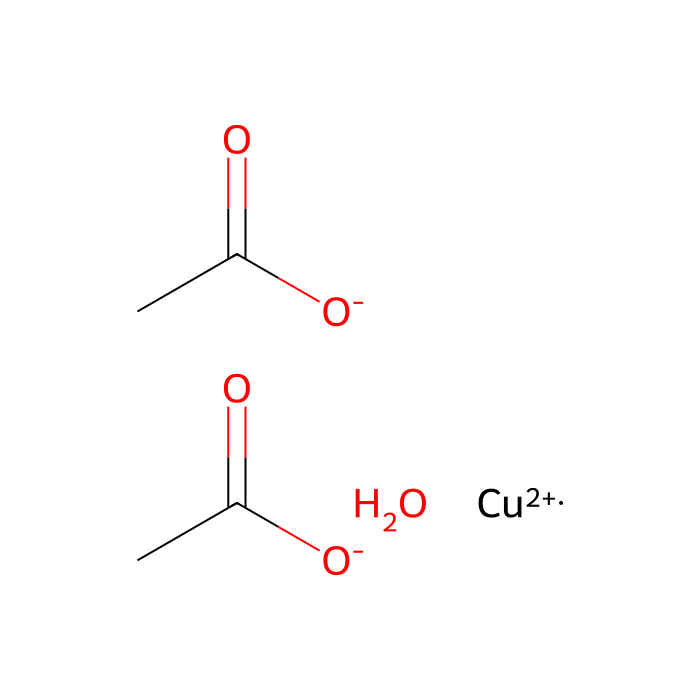
Brief overview: Copper(II) acetate monohydrate is a coordination compound of Cu2+ with two acetate ligands and one axial water ligand; it commonly forms the classic “paddlewheel” Cu2(OAc)4·2H2O dimer in the solid state, with square-pyramidal Cu(II) centers bridged by acetates.
Item-specific (Product Data)
SKU: C105398
Product name: Copper(II) acetate monohydrate
CAS: 6046-93-1
PubChem CID: 165397
InChIKey: 249560 (as provided)
SMILES: Not specified for this item; refer to CoA/Spec Sheet.
Literature/General identifiers (for reference only; not product specifications)
Geometry: each Cu(II) typically square-pyramidal—four equatorial O atoms from two μ2-acetate ligands; one axial water O donor.
Aggregation: often dimeric “paddlewheel” core Cu2(μ-O2CMe)4 with two axial H2O (one on each Cu) in the monohydrate.
2D description: two acetate groups bridge a pair of Cu(II) centers; an additional water coordinates axially to each copper in the hydrate.
Synthetic Utility
Functional and strategic roles of Cu(OAc)2·H2O in synthesis (literature):
Oxidant/co-oxidant
Reoxidizes Pd(0) → Pd(II) in C–H activation/acetoxylation; facilitates radical generation in certain oxidative couplings.
Catalyst precursor
Forms catalytically active Cu(II)/Cu(I) species in situ for Chan–Lam C–N/C–O bond formation; acetate ligands provide mild basicity and facilitate transmetalation from boron reagents.
Ligand source and pH modulator
Acetate can act as an internal base or bridging ligand, stabilizing dinuclear copper species implicated in catalytic cycles.
Building block for materials
Serves as a robust, inexpensive source of Cu(II) for assembling acetate-bridged paddlewheel nodes in coordination polymers and MOFs; thermal treatment yields CuO/Cu2O materials.
Retrosynthetic value
As a readily available Cu(II) salt, it supports modular assembly of C–N/C–O bonds from boronic acids and heteroatom nucleophiles, often under ambient conditions and open to air.
Key advantages
Inexpensive, bench-tolerant, and compatible with molecular oxygen as the terminal oxidant; monohydrate improves handling and solubility in protic/polar media.
Target Specificity
Not applicable. This product is a small-molecule inorganic reagent (copper salt), not a biological targeting reagent such as an antibody or ligand with defined epitope specificity. No target specificity data are provided for this item.
Perguntas frequentes
How is this product shipped?
This product ships under standard ambient conditions. No temperature-controlled packaging is required.
Usamos cookies para garantir o funcionamento adequado do site e, quando permitido, para melhorar a sua experiência. Você pode gerenciar suas preferências a qualquer momento nas Configurações. Saiba mais em nossa Política de Cookies.
Deseja que lhe enviemos uma mensagem quando tivermos descontos disponíveis?
Lembrar-me mais tarde
Obrigado! Por favor, verifique a sua caixa de entrada de e-mail para confirmar.
Products are supplied to verified businesses, institutions, and qualified professionals for research and development use only. Not for use in humans, animals, diagnosis, or therapy.

 A2305488