This compound belongs to the class of organic compounds known as acetals. These are compounds having the structure R2C(OR')2 ( R' not Hydrogen) and thus diethers of geminal diols. Originally, the term was confined to derivatives of aldehydes (one R = H), but it now applies equally to derivatives of ketones (neither R = H ). Mixed acetals have different R' groups.
External Descriptors
Not available
1. Djoumbou Feunang Y, Eisner R, Knox C, Chepelev L, Hastings J, Owen G, Fahy E, Steinbeck C, Subramanian S, Bolton E, Greiner R, and Wishart DS. ClassyFire: Automated Chemical Classification With A Comprehensive, Computable Taxonomy. Journal of Cheminformatics, 2016, 8:61.
Determine the necessary mass, volume, or concentration for preparing a solution.
Dilution Calculator
Determine the dilution needed to prepare a stock solution.
Reconstitution Calculator
Revisões
Avaliações dos Clientes
Application Protocols
Not applicable. No immunoassay or bioassay protocols (WB, IHC, IF, FC) are associated with this small-molecule reagent. For practical use, see Reaction Conditions for general hydrolysis/transacetalization procedures.
Biological Roles
This product is a synthetic organic acetal used as a protecting group and intermediate. It is not a biological buffer or metabolite, and no endogenous roles are expected.
General context (informational)
Acetals of long-chain aldehydes are not common natural metabolites; in biological environments, acid-catalyzed hydrolysis would liberate the corresponding aldehyde and ethanol.
Any interactions with enzymes or receptors would relate to the released aldehyde (decanal), which can occur under acidic conditions; such considerations are outside the scope of laboratory reagent use.
Note: For research use only. No clinical or diagnostic applications are implied.
Buffer Applications
Not typically applicable. Decanal diethyl acetal is a hydrophobic organic building block/protecting group reagent, not a buffering species. For aqueous work, see the sections on Reaction & Applications (acidic hydrolysis conditions) and Solvent Selection for biphasic setups.
Green Alternatives
Rationale: Using an acetal protects the aldehyde function, enabling step economy and minimizing waste from side reactions/over-oxidation versus handling free decanal. Green considerations focus on solvent/catalyst choices and energy input.
Greener choices for common steps (literature-based guidance)
Hydrolysis (deprotection):
Greener: Aqueous citric acid or Amberlyst-15 (solid acid) in ethanol–water at ambient temperature, enabling easy catalyst recovery and lower mineral acid use.
Conventional: Dilute HCl/H2SO4 in THF or acetone, often at reflux.
Transacetalization:
Greener: Solid acids (zeolites, Nafion-H) under solvent-free or ethanol media; drive by removing ethanol/water under reduced pressure.
Conventional: p-TsOH in toluene with Dean–Stark.
Solvent selection (comparative)
Favor biorenewable/benign solvents (2-MeTHF, Cyrene, ethanol) when compatible with rate/selectivity; avoid chlorinated solvents.
Energy and waste minimization
Run at room temperature where possible; employ azeotropic or membrane dehydration to minimize drying agents.
Recycle ethanol generated during hydrolysis where feasible.
Trade-offs
Solid acid catalysis can slow reactions for long-chain acetals; may require higher loadings or temperature.
Ethanol-rich media can shift equilibria; careful removal of volatiles is needed to drive conversions.
Pharmaceutical Uses
This material is not a pharmacopeial buffer or common excipient and is primarily used as a synthetic intermediate/protecting group reagent in R&D synthesis.
Formulation/excipient role: Not typical; hydrophobic acetals are rarely used directly in dosage forms.
Regulatory status: Not specified for this item; refer to CoA/Regulatory documentation if required for your application.
Note: For research use only; not for human or veterinary use.
Physical Properties
Item-specific specifications
Appearance: Not specified for this item; refer to CoA/Spec Sheet.
Grade/Purity: Not specified for this item; refer to CoA/Spec Sheet.
Literature/general expectations for 1,1-diethoxyalkanes of similar chain length (informational; not item specifications)
Physical state: Typically colorless to pale yellow liquid (long-chain acetals)
Hydrophobicity: High; expected to be immiscible with water and miscible with nonpolar/aprotic organic solvents (hexanes, toluene, ether-like solvents)
Volatility: Lower than short-chain acetals; moderate vapor pressure at ambient temperature
Density at 20–25 C: Expected slightly below or around 0.85–0.90 g/mL (literature trend for C14H30O2 acetals; verify on CoA for this item)
Refractive index (nD 20): Typically in the 1.41–1.43 range for long-chain diethyl acetals (literature range; check CoA)
Partitioning: LogP expected >3 (hydrocarbon-dominant skeleton; literature expectation)
Notes: Do not treat the above as product specifications. For exact BP/MP, density, refractive index, and UV cutoffs applicable to this SKU, consult the Aladdin CoA/Spec Sheet.
Quality and Grades
Item-specific quality
Grade/Purity: Not specified for this item; refer to CoA/Spec Sheet.
Stabilizers: Not specified for this item; refer to CoA/Spec Sheet.
General guidance on grades for neutral organic building blocks/solvents
Analytical/Reagent grade: Emphasis on low nonvolatile residues and defined assay—suited for synthesis and analytical sample prep.
HPLC/GC grade: Controlled UV absorbance/volatiles for chromatographic applications; not typically required for acetal protection chemistry unless used as a solvent.
Water/peroxide/metal specifications: Not specified for this item; refer to CoA/Spec Sheet.
What matters for acetals like decanal diethyl acetal
Moisture content: Lower is better to minimize background hydrolysis in storage and reaction setup.
Acid number/acidic impurities: Trace acids catalyze acetal cleavage—specification or neutralization status can be critical for long-term stability.
Odor profile: While not a specification, aldehyde back-formation alters odor; stability controls mitigate this.
Recommended quality checks (user-side, if critical)
1H/13C NMR: Diagnostic acetal CH (~4.5–5.5 ppm, literature) and ethoxy CH2 (~3.3–3.7 ppm) confirm integrity; absence of aldehydic CHO signal (~9–10 ppm) supports low hydrolysis.
GC or GC–MS: Monocomponent profile; monitor decanal as a potential impurity during storage.
Reaction and Applications
Decanal diethyl acetal functions primarily as a protected form of decanal, enabling aldehyde-masked synthetic sequences and controlled unmasking.
Protecting group strategy (general literature)
Stability profile: Stable to bases, many nucleophiles, and mild oxidants; cleaves under Brønsted/Lewis acidic conditions in the presence of water (acetal hydrolysis) to give decanal + ethanol.
Use case: Protect aldehyde during reactions incompatible with carbonyls (e.g., Grignard formation elsewhere in the molecule, strong base-mediated couplings, or enolate chemistry at remote positions).
Typical operations
Hydrolysis (deprotection): Aqueous HCl or H2SO4 (0.1–1 M) in THF, MeCN, or acetone with controlled water content; 0–60 C; times from 0.5–6 h depending on acidity and temperature (literature guidance).
Transacetalization: Acid-catalyzed exchange with diols (to cyclic acetals, e.g., 1,3-propanediol) or with other alcohols; Dean–Stark or azeotropic water removal increases conversion.
Oxidation–reduction sequences: Perform reductions/oxidations on the alkyl chain while the aldehyde is masked, then reveal the aldehyde at the end.
Application domains (non-clinical)
Fragrance/flavor intermediates: Controlled release of decanal (citrus/waxy note) in multi-step synthesis of odorants.
Materials/surfactant synthesis: Use as a masked electrophile for subsequent elaboration of C10-based amphiphiles.
Practical tips
Monitor for trace acid in reagents/solvents; neutralize silica or use basic alumina during workup/chromatography to limit on-column hydrolysis.
If intentional hydrolysis is slow, add small water aliquots or switch to a more polar cosolvent; for selectivity, buffer the aqueous phase to moderate acidity.
Confirm completion by disappearance of acetal methine (1H NMR ~4.5–5.5 ppm, literature) and appearance of aldehydic proton (~9–10 ppm).
Reaction Conditions
The following are literature-style general conditions for acetals of aliphatic aldehydes; adjust to your substrate and scale. These are not specifications for this SKU.
Acidic hydrolysis (to decanal)
Typical: 0.1–1.0 M HCl (aq) with THF, acetone, or MeCN as cosolvent (1:1–3:1, v/v). 20–50 C, 0.5–4 h. Quench by neutralization, extract with hexane/toluene, dry, and distill or chromatograph.
Heterogeneous acid: Amberlyst-15 (5–20 wt%) in EtOH/H2O (9:1) at RT–40 C, 2–8 h; filter resin, concentrate, extract.
Lewis acid: Catalytic BF3·Et2O (2–10 mol%) with trace water in CH2Cl2 at 0–25 C; rapid cleavage; carefully control water to avoid overreaction.
Transacetalization
With diols (to cyclic acetal): 1,3-propanediol (3–5 equiv), p-TsOH (1–5 mol%), toluene, Dean–Stark, reflux 2–6 h.
With other alcohols: Alcohol solvent (MeOH, i-PrOH), catalytic acid (1–5 mol%), RT–reflux until equilibrium; remove volatiles to drive conversion.
Workup and purification
Avoid acidic silica; neutralize or use basic alumina to minimize on-column hydrolysis.
Monitor by GC or NMR for disappearance of acetal signals and appearance of aldehyde signals.
Expected outcomes (illustrative)
Hydrolysis yields are commonly >80% for simple aliphatic acetals under optimized conditions; rates/yields depend on acidity, temperature, and water activity (literature trends).
Safety and Handling
GHS and hazard statements
Signal Word: Not specified for this item; refer to SDS.
H-Statements/GHS Classification/Pictograms: Not specified for this item; refer to SDS.
General safety profile for long-chain diethyl acetals (informational; defer to SDS)
Flammability: Organic liquids with ethoxy groups are commonly combustible; keep away from ignition sources.
Irritation: Vapors or liquid may cause eye/skin irritation on contact; avoid inhalation of mists/vapors.
Hydrolysis: Under acidic aqueous conditions, acetals cleave to the parent aldehyde (decanal) and ethanol; both can be irritants—control pH and moisture exposure.
Handling recommendations
Use under inert gas as indicated (argon-charged) to minimize moisture/acid exposure.
Employ dry glassware; avoid strong acids and protic media unless intentional deprotection is desired.
PPE: Safety glasses or goggles, lab coat, suitable chemical-resistant gloves (e.g., nitrile), and work in a fume hood.
Incompatibilities and stability
Avoid: Strong acids (catalyze hydrolysis/transacetalization), strong oxidizers, and prolonged contact with aqueous acidic media.
Stable to: Bases and many nucleophiles; generally stable under neutral, anhydrous conditions.
First-aid overview (general; consult SDS)
Inhalation: Move to fresh air; seek medical attention if symptoms persist.
Skin/Eye contact: Rinse with water for several minutes; remove contaminated clothing; obtain medical advice if irritation continues.
Ingestion: Rinse mouth; do not induce vomiting; seek medical attention.
Always consult the Aladdin SDS for authoritative hazard classification, response measures, and regulatory information for this specific SKU.
Solvent Selection
This material is a hydrophobic neutral organic liquid and is most often used as a substrate/building block rather than a bulk solvent. However, solvent choice affects its handling and reactivity.
Polarity/miscibility (general)
Polarity class: Nonpolar to weakly polar (dominated by C10 hydrocarbon chain; two ether oxygens confer minimal polarity).
Miscibility: Expected to be miscible with hydrocarbons (hexane, heptane), aromatics (toluene), and common ethers (MTBE, Et2O, THF). Poorly soluble in water.
Solvent choices by use case
Acidic hydrolysis (deprotection to decanal): Use biphasic systems (water + THF/acetone/MeCN) or homogeneous protic solvents (EtOH) with catalytic mineral acid or p-TsOH; control water activity.
Transacetalization or acetal exchange: Choose the product alcohol as solvent (e.g., ethanol) with catalytic acid; remove water/EtOH as needed to drive equilibrium.
Base-stable transformations on the alkyl chain (e.g., radical halogenation, oxidations at remote positions): Nonpolar solvents (C6–C7, toluene) or inert ethers are suitable.
Comparison guidance (general)
Versus the free aldehyde (decanal): The acetal is less polar, less reactive, and less prone to polymerization/oxidation; it tolerates basic/nucleophilic conditions far better.
Versus shorter-chain acetals: Lower volatility and improved handling; solubility in very polar media decreases with chain length.
Note: Select solvents compatible with any planned acid/base catalysis and with moisture control requirements.
Shipped in: Not specified for this item; refer to CoA/Spec Sheet.
Practical storage guidance (general for acetals)
Keep tightly sealed under inert gas (argon or nitrogen) to minimize moisture ingress and acid-catalyzed hydrolysis.
Store away from acids, oxidizers, and light/heat sources. Use amber glass if long-term storage is anticipated.
Use dry septa and syringes for aliquoting; briefly purge headspace with inert gas after each use.
Stability considerations
In neutral, dry conditions, acetals are typically stable for extended periods. Trace acids/moisture accelerate cleavage to decanal + ethanol.
Periodically check by GC/NMR if stored for long durations, especially after repeated openings.
Reconstitution
Not applicable; product is a neat liquid. If solidifies at low temperature, warm gently to ambient and mix thoroughly before use.
Structure and Identity
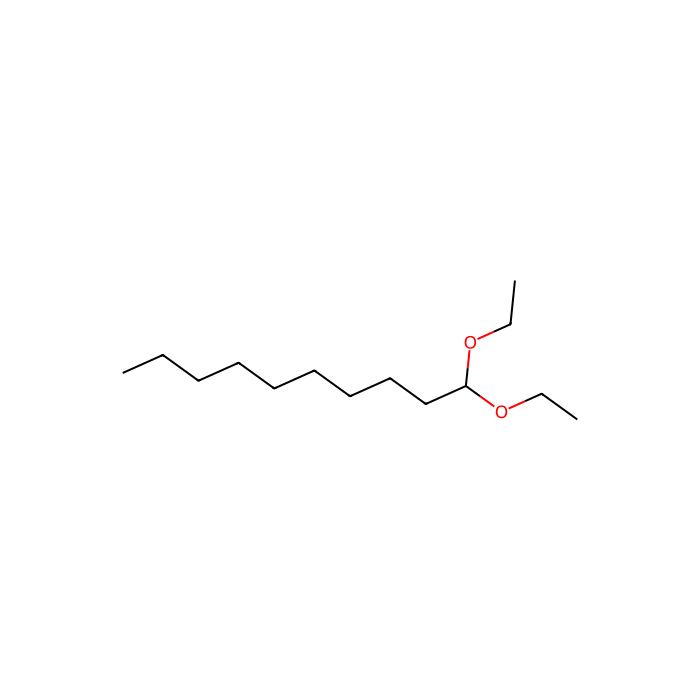
Decanal diethyl acetal is the diethyl acetal derived from the linear C10 aldehyde (decanal), i.e., a masked aldehyde in which the formyl carbon bears two ethoxy substituents and a nonyl chain.
Item-specific identifiers (from Product Data)
SKU: D404333
CAS: 34764-02-8
InChIKey: 98908 (as provided; appears truncated—consult CoA/SDS for full key)
CID: 101363
SMILES: Not specified for this item; refer to CoA/Spec Sheet.
2D structure (verbal): A central sp3 carbon (the former carbonyl carbon) bonded to (i) a straight C9 alkyl chain (–(CH2)9–CH3), (ii) an –O–CH2–CH3 group, (iii) a second –O–CH2–CH3 group, and (iv) a hydrogen.
Structural features and implications (general)
The acetal carbon is stereogenic only if R groups differ; here the two alkoxy groups are identical, so the center is prochiral and typically observed as achiral in bulk.
The acetal is stable to base/nucleophiles but hydrolyzes under acidic aqueous conditions back to decanal + ethanol.
Synthetic Utility
Functional group behavior (general literature)
The acetal carbon (former carbonyl carbon) is masked as 1,1-diethoxy, rendering the aldehydic center inert to nucleophilic additions and many base-mediated processes.
Robust to: Organometallic reagents directed elsewhere in the molecule, strong bases (e.g., LDA) when no acid is present, and many catalytic hydrogenations on remote functionalities.
Cleavable by: Brønsted acids (HCl, H2SO4), Lewis acids (BF3·Et2O), and heterogeneous acids (Amberlyst-15, Nafion-H) in the presence of water or alcohols.
Transformations enabled
Orthogonal protection: Combine with other protecting groups (e.g., silyl ethers) to sequence multi-step routes along a C10 scaffold.
Late-stage unmasking: Reveal decanal for subsequent aldol condensations, reductive aminations, or Wittig/olefination steps.
Exchange to cyclic acetals: Increase acid stability/selectivity via diol-derived acetals for specific process needs.
Retrosynthetic value
Serves as a stable surrogate for decanal, allowing planning of base-intensive routes that would otherwise consume the aldehyde.
In convergent routes, the acetal fragment can be joined, then deprotected to unveil the reactive carbonyl at the optimal stage.
Target Specificity
Not applicable. This product is a small-molecule organic reagent (acetal protecting group) and does not possess antigen/epitope specificity, clone, isotype, or species reactivity attributes.
Usamos cookies para garantir o funcionamento adequado do site e, quando permitido, para melhorar a sua experiência. Você pode gerenciar suas preferências a qualquer momento nas Configurações. Saiba mais em nossa Política de Cookies.
Deseja que lhe enviemos uma mensagem quando tivermos descontos disponíveis?
Lembrar-me mais tarde
Obrigado! Por favor, verifique a sua caixa de entrada de e-mail para confirmar.
Products are supplied to verified businesses, institutions, and qualified professionals for research and development use only. Not for use in humans, animals, diagnosis, or therapy.

 B23091317