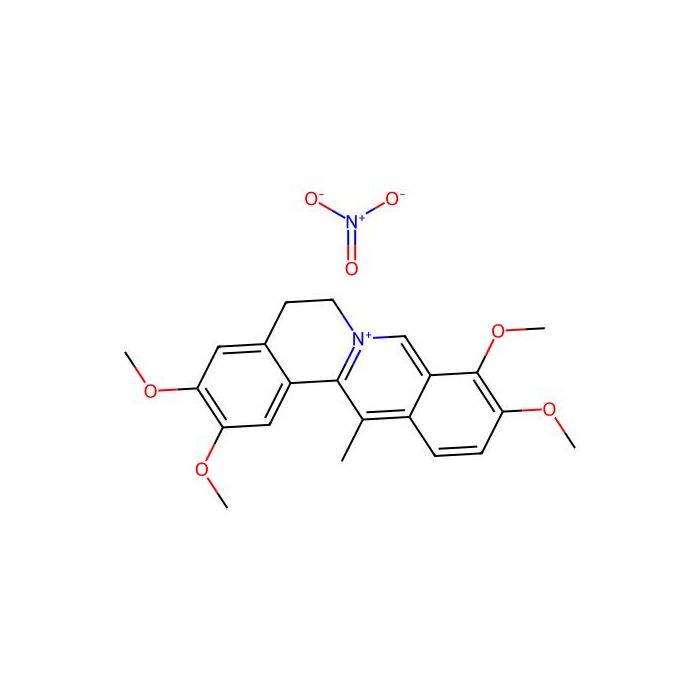
Dehydrocorydaline nitrate (13-Methylpalmatine nitrate) is an alkaloid. Dehydrocorydaline regulates protein expression of Bax , Bcl-2 ; activates caspase-7 , caspase-8 , and inactivates PARP Dehydrocorydaline nitrate elevates p38 MAPK activation. Anti-inflammatory and anti-cancer activities. Dehydrocorydaline nitrate shows strong anti-malarial effects ( IC 50 =38 nM), and low cytotoxicity (cell viability > 90%) using P. falciparum 3D7 strain
Form:Solid
IC50& Target:IC50: 38 nM ( P. falciparum 3D7 strain)
Especificações
Especificações e pureza
≥99%
Mecanismos bioquímicos e fisiológicos
Dehydrocorydaline nitrate (13-Methylpalmatine nitrate) is an alkaloid. Dehydrocorydaline regulates protein expression of Bax , Bcl-2 ; activates caspase-7 , caspase-8 , and inactivates PARP. Dehydrocorydaline nitrate elevates p38 MAPK activation. Ant
Condições de armazenamento de armazenamento
Store at 2-8°C,Protected from light,Desiccated
Enviado em
Wet ice
Este produto requer transporte de cadeia fria. Serviços terrestres e outros serviços econômicos não estão disponíveis.
Tipo de ação
INHIBITOR
Pureza
≥99%
Nomes e identificadores
Peso molecular
428.44
Dados avançados
Certificados(CoA,COO,BSE/TSE e Mapa de Análise)
C of A & Other Certificates(BSE/TSE, COO):
Analytical Chart:
Propriedades químicas e físicas
Solubilidade
DMSO : 50 mg/mL (116.70 mM; Need ultrasonic)
Calculadoras de soluções
Molarity Calculator
Determine the necessary mass, volume, or concentration for preparing a solution.
Dilution Calculator
Determine the dilution needed to prepare a stock solution.
Reconstitution Calculator
Revisões
Avaliações dos Clientes
Application Protocols
No manufacturer-validated protocols are provided for this item. The following general procedures are suitable starting points for handling quaternary alkaloid salts in research workflows:
Stock solution preparation (analytical):
Dissolve in DMSO (high-concentration master stock) or in water/methanol (lower concentration working stock). Protect from light. Filter through 0.2 µm PVDF before LC–MS.
For aqueous stocks, adjust to pH ~5 with acetate or formate buffer to enhance stability.
LC–MS method development:
Column: C18 or phenyl-hexyl.
Mobile phases: A = water + 0.1% formic acid; B = acetonitrile + 0.1% formic acid.
Gradient: 5–60% B over 10–20 min as a starting point; detect at UV 280 nm and a visible channel suitable for protoberberines.
Spectroscopy (UV–Vis):
Record spectra in methanol or water; scan 200–600 nm. Dilute to avoid inner-filter effects due to strong visible absorption.
Biological assay handling:
Prepare fresh dilutions immediately before use; verify absence of precipitation upon dilution into assay buffer. Keep DMSO below assay tolerance.
Adjust concentrations/volumes to your application. Refer to CoA/SDS for any item-specific constraints.
Biological Roles
Biological context (literature/general):
Dehydrocorydaline is a plant-derived protoberberine-type isoquinolinium alkaloid found in species of Corydalis and related genera. In plants, such alkaloids often serve as chemical defense metabolites against herbivores and pathogens and contribute to pigmentation/UV protection due to their chromophoric nature.
At the molecular level, quaternary isoquinolinium alkaloids are known to interact with nucleic acids, proteins, and membranes via their planar, cationic structures, enabling intercalation-like binding in some systems and electrostatic interactions with polyanionic biomolecules (extent and specificity vary by substitution pattern and conditions).
In biochemical assays, such compounds are frequently used as tool molecules to probe transporter interactions, efflux mechanisms, and binding to alkaloid-recognizing proteins. Their strong absorbance in the visible region can facilitate spectroscopic tracking in enzymatic or binding studies.
Important notes:
No medical, therapeutic, or clinical claims are made for this product. It is supplied strictly for research use only.
Item-specific potency, selectivity, and bioactivity metrics are not provided for this product; consult primary literature for assay design and expected response ranges.
For cell-based experiments, confirm solubility and non-interference of vehicle (e.g., DMSO) and perform appropriate controls to account for intrinsic color/fluorescence of protoberberines.
Buffer Applications
This product is not a buffering agent. However, buffer choice is relevant for preparing aqueous solutions/samples of quaternary alkaloid salts.
Practical guidance (general):
pH: Use mildly acidic buffers (pH 4–6) such as acetate or citrate to support solubility and stability; the molecule is permanently cationic, but slightly acidic media can suppress degradation.
Ionic strength: Moderate ionic strength (10–50 mM) aids reproducibility in binding/biophysical assays without excessive salt that could cause salting-out with co-solvents.
Additives: 0.01–0.1% acid modifier (formic or acetic acid) is often used in LC–MS sample diluents to improve peak shape and signal stability.
Filtration: Colored, polyaromatic alkaloids may adsorb to some plastics; use low-binding polypropylene or glass vials and filter through PVDF or PTFE (check compatibility) to remove particulates before analysis.
Recipes and exact concentrations are application-dependent and not specified for this item. Validate your buffer composition empirically for your assay and refer to the CoA/SDS for compatibility boundaries.
Green Alternatives
This item is a target molecule rather than a process solvent; green considerations focus on solvent choices for its handling and analytical workflows.
Preferred greener media (general guidance):
Water (slightly acidified, pH 4–6): Maximizes solubility and minimizes organic solvent use.
Bio-based alcohols (ethanol) over methanol or acetonitrile when compatible with the analytical method.
Avoid chlorinated solvents (e.g., DCM) which offer little solubility benefit for quaternary salts and have higher environmental burdens.
Comparison (general, literature-informed):
Water/EtOH: Low toxicity, renewable (EtOH), suitable for prep and spectroscopy; may require acid modifier for stability/solubility.
MeOH/MeCN: Excellent chromatographic performance, but MeCN has higher EHS concerns and supply volatility; MeOH is toxic and should be minimized when possible.
DMSO: High solvating power; use sparingly and dispose responsibly; consider propylene carbonate as a greener alternative in some contexts.
Process tips to lower footprint:
Prepare concentrated stocks to reduce solvent volumes.
Use UPLC with shorter columns to cut organic solvent consumption.
Recycle HPLC solvents via in-house distillation when allowed.
Note: No item-specific solvent or impurity specifications are provided; tailor green choices to your method’s performance requirements.
Pharmaceutical Uses
No pharmacopeial grade or excipient role is specified for this item; it is provided for research use only.
Research/manufacturing context (general):
Reference standard: Can serve as a system suitability or identification standard in natural-product sourcing, botanical extract characterization, and process R&D for plant-derived alkaloids (where permitted).
Counterion/form selection studies: The nitrate salt can be compared to other counterions to evaluate physicochemical properties (hygroscopicity, crystallinity, dissolution) relevant to preformulation research.
Analytical development: Useful for establishing LC–UV/Vis or LC–MS methods because protoberberines have strong visible absorbance, allowing dual UV channels for specificity.
Notes:
No therapeutic claims are made and none should be inferred.
No pharmacopeial monograph or compliance details are provided for this item; consult CoA/Spec Sheet if available or qualify internally according to your quality system.
Physical Properties
Item-specific physical data
Appearance: Not specified for this item; refer to CoA/Spec Sheet.
Grade/Purity: Not specified for this item; refer to CoA/Spec Sheet.
Safety-relevant properties
Hygroscopicity/photolability: Storage guidance indicates to keep desiccated and protected from light, suggesting possible moisture sensitivity and light-induced degradation for the chromophoric protoberberine system (practical note; item-specific stability limits not specified).
Literature/general properties (qualitative)
Ionic character: Quaternary ammonium nitrate; typically highly polar and water/methanol soluble; often freely soluble in DMSO.
UV–Vis: Protoberberine alkaloids display strong π–π* absorption in the visible region (yellow to orange solutions) due to extended conjugation (wavelengths vary by substitution; consult literature for exact λmax).
Acido–basic behavior: Permanently cationic (no acid–base interconversion to a neutral free base under normal conditions).
Solid-state: Quaternary ammonium nitrates commonly form crystalline, often hygroscopic solids; melting points can be decomposition-prone (report exact MP from CoA where available).
Numerical values such as melting point, density, refractive index, partition coefficients, or solubilities are not specified for this item; refer to CoA/Spec Sheet. Any numerical data needed for method development should be sourced from peer-reviewed literature or measured under your lab’s conditions.
Quality and Grades
Item-specific grade/purity
Grade/Purity: Not specified for this item; refer to CoA/Spec Sheet.
How to interpret grades for alkaloid reference materials (general guidance)
Research grade: Suitable for discovery biology, method development, and synthetic reference; may not include pharmacopeial certification.
Analytical/reference grade: Emphasizes identity and purity verification (e.g., HPLC, HRMS, NMR), residual solvent and water content control, and light/moisture stability profiling.
Counterion specification: For quaternary ammonium alkaloids, the named counterion (nitrate here) should be confirmed by elemental analysis or ion chromatography; counterion content can impact chromatographic behavior and solubility.
Stabilizer/impurity considerations
Stabilizers: None specified for this item; refer to CoA/Spec Sheet. Products sensitive to light/moisture are typically packaged under inert or desiccated conditions.
Impurities: Typical related substances for protoberberines include O-demethylated congeners and alternative counterion forms; review the CoA for specific impurity profiles and analytical methods (e.g., HPLC-UV with visible detection).
Always match your application’s requirements (e.g., LC–MS reference, bioassay) to the provided CoA metrics: identity confirmation (NMR/HRMS), purity by HPLC/UPLC, water/LOD, residual solvents, and counterion verification.
Reaction and Applications
Research/analytical applications (typical for this compound class)
Reference standard: Used as a small-molecule reference for method development in natural products, metabolomics, and alkaloid profiling (e.g., retention time, MS/MS libraries) — item-specific validation parameters not specified.
Counterion studies: Nitrate form allows evaluation of counterion effects on solubility, crystallinity, and chromatographic behavior vs. chloride or bromide salts.
Chemical manipulation (general synthetic context)
Counterion exchange (salt metathesis): Nitrate can be exchanged for other anions (Cl−, PF6−, BF4−) using ion-exchange resins or metathesis in polar solvents to tune solubility and crystallinity.
O-Demethylation/remethylation (on related protoberberines): Literature describes selective demethylation of methoxy groups (e.g., with BBr3 or AlCl3/thiols) followed by etherification for SAR studies; exercise caution due to cationic core sensitivity.
Redox/photochemical behavior: The extended conjugation supports rich photophysics; light sensitivity suggests handling under low-light during photophysical experiments.
Practical tips
Minimize light and moisture exposure during reactions and workups.
For LC–MS quantitation, prepare fresh standards and store aliquots refrigerated, protected from light.
Use glassware free of basic residues; strong bases can promote side reactions or degradation of quaternary salts.
No specific manufacturer application notes are provided for this item; adapt these general practices to your experimental goals.
Reaction Conditions
General conditions relevant to typical manipulations of quaternary protoberberine salts (literature-informed):
Counterion exchange (salt metathesis):
Solvent: Water, methanol, or ethanol.
Reagents: Ion-exchange resin (Cl− form) or addition of a slight excess of the target anion’s salt (e.g., NaCl) followed by precipitation or dialysis.
Temperature/time: Ambient temperature; 0.5–4 h contact with resin, monitor by ion chromatography or silver nitrate test (for halides).
O-Demethylation (on related scaffolds; handle with caution):
Reagent: BBr3 in dry DCM is classical for anisoles; for cationic protoberberines, milder demethylation protocols (e.g., AlCl3/thiols) at 0–25°C are reported to mitigate core degradation.
Workup: Quench carefully at low temperature; maintain low light exposure and minimize basic conditions.
Preparative HPLC purification:
Mobile phase: Water/acetonitrile with 0.05–0.1% formic or TFA (compatibility with downstream assays should be considered).
Detection: 280 nm and a visible wavelength (e.g., 420–450 nm) often provide strong signals for protoberberines.
These are general starting points from literature and practice. Item-specific optimal conditions, reaction scales, and expected yields are not provided for this product and should be determined empirically.
Safety and Handling
GHS/SDS status for this item
Signal word, hazard statements, pictograms, and classification: Not specified for this item; refer to the product SDS for authoritative information.
General laboratory precautions (good practice)
PPE: Wear lab coat, safety glasses, and appropriate chemical-resistant gloves. Use in a fume hood to avoid inhalation of dusts/aerosols.
Avoid generating dust; handle solids with micro-spatulas and antistatic measures.
Hygiene: Wash hands thoroughly after handling; avoid contact with skin and eyes.
Stability/incompatibilities (general guidance)
Protect from light and moisture as indicated by storage instructions; store in tightly sealed, light-resistant containers with desiccant.
Incompatibilities: Strong oxidizers and strong bases/acids may promote degradation or counterion exchange; avoid contact with nitrosating agents. While the nitrate counterion is generally stable in this context, avoid mixing with strong reducing agents or combustible materials in bulk.
First-aid overview (consult SDS for details)
Inhalation: Move to fresh air; seek medical advice if symptoms persist.
Skin/eye contact: Rinse with water for several minutes; remove contaminated clothing; obtain medical attention if irritation persists.
Ingestion: Rinse mouth; do not induce vomiting; seek medical attention.
For spill/leak: Avoid dust formation, collect with inert absorbent or HEPA-equipped vacuum, and dispose of as chemical waste per institutional and local regulations.
Solvent Selection
Polarity and miscibility (general behavior for quaternary protoberberines)
Primary solvents: Water (acidified), methanol, ethanol, and DMSO typically dissolve quaternary isoquinolinium salts well. Solubility in aprotic, nonpolar media is poor.
Practical tip: Prepare a concentrated DMSO stock (e.g., for screening) and dilute into aqueous buffers with gentle vortexing; include 0.1–1% co-solvent if needed to prevent precipitation.
Dielectric environment and method development
Reversed-phase LC: Mobile phases of water/acetonitrile or water/methanol with 0.05–0.1% formic acid enhance peak shape and ionization stability for MS detection.
Ion-pairing is generally unnecessary due to permanent cationic charge; avoid strongly basic eluents that may promote degradation.
When to choose alternatives
If protein compatibility is required, use aqueous buffers (pH 5–6) with minimal organic content. For spectroscopic work, methanol or water provides clean UV–Vis backgrounds in the visible region.
Comparison (general)
Water (acidified): Highest polarity; maximizes solubility and stability; best for bioassays.
Methanol/ethanol: Good solubility; convenient for spectroscopy and preparative handling.
DMSO: Highest solvating power; ideal for high-concentration stocks; ensure final DMSO in assays is kept low to avoid interference.
Note: Exact solubility values for this item are not specified; determine empirically under your conditions or consult literature.
Storage and Reconstitution
Item-specific storage/shipping
Storage conditions: Store at 2–8°C, protected from light, desiccated.
Shipped on: Wet ice.
Research use: For research use only.
General reconstitution guidance (not item-specific specifications)
Allow the vial to equilibrate to room temperature in the dark before opening to minimize moisture condensation.
Open under low light and dry conditions. If available, handle in a desiccator or glove box with dry air/nitrogen.
Suggested solvents: Water (slightly acidified), methanol, ethanol, or DMSO. Start with small volumes, vortex, and sonicate briefly if needed. Record exact concentrations gravimetrically.
For long-term use, prepare single-use aliquots, protect from light (amber vials/foil), and store refrigerated per above conditions. Avoid repeated freeze–thaw of solutions; prefer refrigerated storage of working solutions for short periods and frozen aliquots (light-protected) for longer-term, if stability allows.
Inspect solutions for discoloration/precipitation prior to use; discard if degradation is suspected.
Exact solution stability, maximum concentration, and shelf-life are not specified for this item; consult the CoA/Spec Sheet and determine stability under your conditions.
Structure and Identity
Item-specific identifiers
SKU: D650015
Product name: Dehydrocorydaline nitrate
CAS: 13005-09-9
Molecular formula: Not specified for this item; refer to CoA/Spec Sheet.
Molecular weight: Not specified for this item; refer to CoA/Spec Sheet.
InChIKey: Not specified for this item; refer to CoA/Spec Sheet.
SMILES: Not specified for this item; refer to CoA/Spec Sheet.
Permanently cationic nitrogen (quaternary ammonium), usually accompanied by multiple methoxy substituents on the aromatic rings.
The nitrate is an inorganic counterion; alternative counterions (e.g., chloride) are common for this class via ion-exchange.
2D structure in words (literature): A fused polycyclic aromatic framework bearing an N-methyl (or N-substituted) isoquinolinium center; several anisole (–OCH3) substituents on the A/D rings; the positive charge is delocalized over the protoberberine system with nitrate balancing charge externally.
Note: Exact stereochemical descriptors and definitive connectivity strings (SMILES/InChI) are not provided with this item; consult the CoA/Spec Sheet or authoritative databases for definitive identifiers.
Synthetic Utility
While dehydrocorydaline nitrate is typically used as a reference alkaloid rather than a building block, chemists may leverage the following features in synthesis and materials studies (general literature-informed guidance):
Quaternary ammonium center: Permanently charged, enabling ion-exchange to tune solubility and crystallinity. Useful in studying ion-pairing and phase-transfer behaviors.
Aromatic methoxy groups: Sites for selective O-demethylation, enabling preparation of phenolic derivatives for further derivatization (e.g., etherification, acylation) to probe structure–property relationships.
Polycyclic, π-rich scaffold: Potential for supramolecular interactions and intercalation studies; can act as a chromophore/reporting unit in conjugates prepared through peripheral modifications (without altering the cationic core).
Salt metathesis: Exchange nitrate for chloride, bromide, tetrafluoroborate, or hexafluorophosphate to adjust crystallization behavior for single-crystal X-ray or to modify solubility in electrochemical media.
Constraints:
The cationic core is sensitive to strong bases and nucleophiles that can induce decomposition; conditions should be mild and non-basic.
The quaternary nature precludes formation of a neutral free base; strategies should focus on peripheral functionalization or counterion manipulation.
Item-specific reactivity data and yields are not provided; consult primary literature and validate conditions at small scale.
Target Specificity
Not applicable. This product is a small-molecule alkaloid, not a biological targeting reagent (e.g., antibody, enzyme, or ligand with validated target specificity provided by the manufacturer).
No antigen/epitope, species reactivity, clone, or isotype information applies.
For biochemical or cellular studies, any target engagement must be established independently by the researcher using appropriate controls and orthogonal assays.
Usamos cookies para garantir o funcionamento adequado do site e, quando permitido, para melhorar a sua experiência. Você pode gerenciar suas preferências a qualquer momento nas Configurações. Saiba mais em nossa Política de Cookies.
Deseja que lhe enviemos uma mensagem quando tivermos descontos disponíveis?
Lembrar-me mais tarde
Obrigado! Por favor, verifique a sua caixa de entrada de e-mail para confirmar.
Products are supplied to verified businesses, institutions, and qualified professionals for research and development use only. Not for use in humans, animals, diagnosis, or therapy.