Determine the necessary mass, volume, or concentration for preparing a solution.
Dilution Calculator
Determine the dilution needed to prepare a stock solution.
Reconstitution Calculator
Revisões
Avaliações dos Clientes
Application Protocols
Not applicable as validated bioassay/diagnostic protocols.
The product is supplied for research use only and does not come with tested biological application protocols.
General preparation tips (research context)
Stock solution preparation: dissolve in DMSO (e.g., 10–50 mg/mL) or ethanol with gentle warming and sonication. Filter through PTFE (0.45 μm) if particulate remains (avoid hydrophilic membranes which may adsorb analyte).
Analytical standard solutions: prepare in isooctane or chloroform for GC; in MeOH/IPA/CHCl3 mixtures for LC with ELSD/CAD. For GC–MS, consider TMS-derivatization (BSTFA + 1% TMCS, 60–80 °C, 30–60 min).
Adsorption mitigation: use silanized glass vials; pre-rinse syringes and lines with sample solvent to minimize losses.
Biological Roles
General biochemistry context (literature; no clinical claims)
Biosynthetic origin: delta-Amyrin is an isomer in the amyrin family of pentacyclic triterpenoids produced via cyclization of 2,3-oxidosqualene by specific amyrin synthases (oxidosqualene cyclases) in plants.
Physiological role in plants: structural component of cuticular waxes and resins; contributes to barrier functions against desiccation and pathogens. Often co-occurs with α- and β-amyrin in exudates (e.g., Protium, Bursera, and other resin-producing taxa).
Metabolic fate: in planta, further oxidized to triterpenic acids (e.g., ursolic/oleanolic-type acids depending on scaffold) by cytochrome P450 monooxygenases, and can be glycosylated by UDP-glycosyltransferases.
Biophysical properties: extreme hydrophobicity promotes incorporation into lipid phases and microdomains; the tertiary alcohol at C-3 can participate in weak H-bonding within membranes or resin matrices.
Analytical markers: amyrin isomer ratios (α/β/δ) are used to chemotaxonomically profile species and tissues. Quantification by GC–MS typically follows silylation to increase volatility and stability.
Use in research (non-therapeutic)
Serves as a standard in metabolomics of cuticular waxes and resins.
A convenient model scaffold to study structure–property relationships in pentacyclic triterpenoids, including packing, crystallinity, and mixed-film behavior with long-chain alkanes and fatty alcohols.
Buffer Applications
Not typically applicable.
delta-Amyrin is an extremely hydrophobic neutral solid and is essentially insoluble in aqueous buffers. It does not function as a buffering agent.
For working solutions in biological assays, prepare concentrated stocks in DMSO or ethanol and dilute into buffer with vigorous mixing and appropriate co-solvent limits to avoid precipitation. Consider use of solubilizers (cyclodextrins, surfactants) if aqueous delivery is required.
Green Alternatives
Context
delta-Amyrin is a solid triterpenoid, not a solvent or reagent typically replaced for hazard reasons. Greener considerations focus on the choice of solvents and derivatization reagents used to process, purify, or analyze it.
Prefer ethyl acetate, ethanol, isopropanol, or 2-MeTHF over chloroform/DCM where solubility and selectivity allow.
For normal-phase separations, hexane can be partially replaced with cyclopentyl methyl ether (CPME) or heptane to lower toxicity; pair with EtOAc/i-PrOH modifiers.
Derivatization for GC–MS
BSTFA/MSTFA are standard; consider silylation under minimal solvent and catalytic TMCS to reduce reagent excess. Explore alternative detection (ELSD/CAD) to avoid derivatization where sensitivity permits.
Workup and concentration
Employ rotary evaporation with solvent recovery; minimize chlorinated solvent use. Use microscale derivatizations to cut waste.
Trade-offs and notes
Chlorinated solvents often provide superior solubility and handling for waxy triterpenes; greener substitutes may require slightly elevated temperature, longer dissolution times, or different chromatographic selectivity.
2-MeTHF and CPME are peroxide-forming ethers; implement periodic peroxide checks and inhibitors as per institutional policy.
For bioassay stocks, ethanol or PEG400:EtOH:saline co-solvent systems can reduce reliance on DMSO, but assess compatibility with the assay system.
Pharmaceutical Uses
Formulation/contextual information (no therapeutic claims)
Role: delta-Amyrin is a lipophilic triterpenoid sometimes employed as a reference standard in the quality control of botanical extracts and as a model compound in formulation studies of highly hydrophobic actives.
Excipient status: not recognized as a common pharmaceutical excipient.
Formulation research considerations: due to very high logP and low aqueous solubility, systems such as lipid-based formulations (self-emulsifying drug delivery systems), cyclodextrin inclusion complexes, or nanosuspensions are explored in research settings to solubilize analogous triterpenoids. These approaches are study-specific and not item specifications.
Analytical control: quantification in complex matrices often uses RP-HPLC with ELSD/CAD or GC–MS after derivatization; lack of strong UV absorbance limits UV detection sensitivity.
Regulatory: no pharmacopeial monograph is generally available for delta-amyrin; any use is strictly for research and development.
Note
This product is designated For research use only (per Product Data) and is not intended for human or veterinary applications.
Physical Properties
Item-specific specifications
Appearance: Not specified for this item; refer to CoA/Spec Sheet.
Storage and shipping (from Product Data)
Storage: Store at −20 °C.
Shipped: Ice chest + ice pads.
Literature/General properties (for context; not item specifications)
Phase at RT: solid (crystalline or resinous, typical for amyrins).
Solubility: practically insoluble in water; soluble in nonpolar and moderately polar organic solvents (e.g., hexane, toluene, ethyl acetate, chloroform, dichloromethane) and in strong organics such as THF; soluble in DMSO and ethanol upon warming/sonication.
Lipophilicity: very high; logP commonly reported >7 for amyrin isomers (literature).
UV: lacks strong chromophores; weak end-absorbance in the deep UV; detection often by ELSD/CAD or derivatization in HPLC (literature guidance).
Melting behavior: amyrin isomers exhibit melting in the ~150–190 °C range depending on isomer and purity; polymorphism/microcrystalline behavior may broaden the range (literature, non-specific to this item).
Practical notes
Dissolution is rate-limited by crystallinity; gentle warming (30–50 °C) and vortex/sonication facilitates preparation of concentrated stock solutions in DMSO (e.g., 10–50 mg/mL) or in chloroform/ethanol mixtures. Avoid aqueous systems unless using co-solvents or surfactants.
Drying: material is non-hygroscopic but may retain residual organic solvents; vacuum drying at ambient temperature is generally adequate (literature best practice).
Quality and Grades
Item-specific quality details
Grade/purity: Not specified for this item; refer to CoA/Spec Sheet.
How to interpret grades for triterpenoid standards (general guidance)
Research grade: suitable for exploratory synthesis and qualitative/quantitative analytical work (e.g., TLC/HPLC standards). Trace residual plant-derived isomeric triterpenes may be present unless otherwise specified.
High-purity/analytical grade (when specified): tightened limits on isomeric content (α/β/δ-amyrin ratios), ash, and residual solvents; improved suitability for quantitative reference standard work.
Identity: 1H/13C NMR in CDCl3 or C5D5N to resolve the crowded aliphatic region; HRMS (ESI/APCI) for [M+H]+ at m/z ~427 (literature for amyrins; not a spec). IR confirms tertiary O–H and aliphatic C–H.
Purity profiling: GC–MS after trimethylsilylation (TMS) can separate isomers; alternatively, RP-HPLC with ELSD/CAD. Report any α/β/δ isomer content if critical to application.
Residual solvents/metals, water, and peroxides: Not specified for this item; refer to CoA/Spec Sheet.
Stabilizers/additives
None typically required for saturated triterpenes; any stabilizers or antioxidants would be declared on the CoA if used. Not specified for this item; refer to CoA/Spec Sheet.
Reaction and Applications
Applications (general; expand-on use cases)
Reference standard: widely used as a phytochemical marker in plant resin/wax profiling (GC–MS after TMS derivatization; HPLC–ELSD/CAD).
Semisynthesis: starting point for functionalized triterpenoids via C-3 derivatization (esterification, carbonate/urethanes, etherification) and olefin manipulations (epoxidation, hydroboration/oxidation, hydrogenation).
Materials research: hydrophobic scaffold for self-assembled monolayers/blends in bio-inspired coatings due to its wax-like nature (literature precedent).
Reactivity highlights (literature)
Tertiary alcohol at C-3: acylation with acyl chlorides/anhydrides (pyridine, DMAP) to give esters; silylation (TBDMS/TBS-Cl, imidazole) for protection; conversion to carbonate/carbamate under phosgene equivalents (triphosgene).
Olefin: epoxidation (mCPBA) with possible stereochemical control; hydroboration–oxidation yields tertiary alcohol migration products carefully controlled by conditions; dihydroxylation is typically low-yield due to sterics; catalytic hydrogenation (Pd/C, H2 1–3 atm) saturates the double bond.
Oxidation: Dess–Martin, PDC/Jones can convert the C-3 alcohol to ketone (watch overoxidation). TEMPO-type systems are often inefficient on tertiary alcohols.
Analytical/processing tips
Sample prep for GC–MS: BSTFA or MSTFA with catalyst (TMCS) to form TMS-ether improves volatility and peak shape; 60–80 °C, 30–60 min.
For HPLC: normal-phase (hexane/IPA 95:5→90:10) resolves triterpenoid isomers; reversed-phase (C18) often needs high organic (MeOH or MeCN) and non-UV detectors.
Due to high lipophilicity, adsorption to plasticware is significant; use silanized glass and add carrier solvent to minimize losses.
Reaction Conditions
General literature guidance (not item specifications; adjust per your system)
Esterification (C-3 OH):
Reagents: acyl chloride (1.2–1.5 eq), DMAP (0.1 eq), pyridine or DIPEA, dry DCM or toluene.
Conditions: 0 °C to rt, 2–16 h; inert atmosphere recommended. Typical isolated yields 70–95% depending on sterics.
Silylation (protection):
Reagents: TBS-Cl (1.5 eq), imidazole (3 eq), DMF or DCM.
Conditions: 0 °C to rt, 1–4 h; mixtures of epoxide diastereomers possible due to facial selectivity.
Hydrogenation (olefin saturation):
Catalyst: Pd/C (5–10 wt%), solvent: EtOAc, EtOH, or AcOEt/hexane.
Conditions: H2 1–3 atm, rt to 40 °C, 2–12 h; high conversions with minimal over-reduction.
Oxidation to ketone:
Reagents: Dess–Martin periodinane (1.5 eq) in DCM.
Conditions: rt, 1–3 h; typical yields 70–90%. Tertiary alcohol oxidation can require stronger systems (PDC/Jones) with careful quench.
Workup and purification
Quench per reagent best practices (e.g., Na2S2O3 for peracids). Silica gel chromatography with hexane/EtOAc (95:5→85:15) often separates starting material and products. Visualization by anisaldehyde or vanillin stain.
Analytical
1H NMR in CDCl3: crowded aliphatic region (δ 0.7–2.0), olefinic proton(s) near δ 5.1–5.3 if present; broad O–H may appear 0.5–1.5 ppm depending on H-bonding.
GC–MS after TMS-derivatization improves volatility for quality control.
Safety and Handling
Item-specific hazard information
Signal word: Not specified for this item; refer to SDS.
H-statements: Not specified for this item; refer to SDS.
GHS classification and pictograms: Not specified for this item; refer to SDS.
General safety guidance for pentacyclic triterpenoids (literature/consensus best practice)
Expected hazards: low volatility, dust may cause mechanical irritation to eyes/respiratory tract. Combustible organic solid; fine dust may form combustible dust–air mixtures.
PPE: lab coat, safety glasses or goggles, and appropriate gloves (e.g., nitrile). Avoid generating dust and inhalation of particulates. Use in a fume hood when handling powders or preparing organic solutions.
Handling: avoid open flames and ignition sources. Use antistatic measures when weighing fine powders. When dissolving in strong organic solvents (chloroform, dichloromethane), follow those solvents’ SDS precautions.
First aid (overview):
Inhalation: move to fresh air; seek medical attention if symptoms persist.
Skin contact: wash with soap and water; remove contaminated clothing.
Eye contact: rinse cautiously with water for several minutes; remove contact lenses if present and easy to do.
Ingestion: rinse mouth; do not induce vomiting; seek medical attention.
Incompatibilities: strong oxidizers (may oxidize the allylic/tertiary alcohol); strong acids can promote dehydration/isomerization; strong bases may induce elimination/retro-aldol at high temperature.
Waste: dispose as organic solid waste according to institutional and local regulations.
Always consult the product-specific SDS for authoritative hazard and response information.
Solvent Selection
Polarity and miscibility (general behavior)
Polarity class: strongly hydrophobic neutral polycyclic alcohol; essentially nonpolar aside from a single tertiary O–H.
Water: practically insoluble; aqueous work requires co-solvents (DMSO, ethanol, isopropanol) or surfactants.
Organic solvents: readily soluble in nonpolar to mid-polar organics—hexane, heptane, toluene, chloroform, dichloromethane, ethyl acetate, THF. Good solubility in DMSO and warm ethanol/IPA.
Use scenarios
Stock solutions for bioassays/analytical work: DMSO (10–50 mg/mL) or ethanol with gentle warming; dilute into media with vigorous mixing and final organic content typically ≤0.5–1% v/v to avoid precipitation.
Preparative chromatography: normal phase (hexane/EtOAc) or reversed phase (MeOH/H2O with MeCN modifiers and ELSD/CAD detection). For NP, small additions of i-PrOH can aid elution without oversolvating silica.
Comparison and selection tips
For maximum solubility: chloroform, DCM, or DMSO.
For greener workflows: replace chlorinated solvents with ethyl acetate, 2-MeTHF, or cyclopentyl methyl ether (CPME) when feasible; modest heating may be required.
Avoid highly protic/aqueous environments without co-solvent systems; precipitation and adsorption losses to plastics can occur—use glassware and pre-wet surfaces with solvent.
Practical notes
Gentle warming (30–50 °C) and sonication speeds dissolution. Prepare single-use aliquots in amber vials to minimize adsorption and oxidation during storage.
Storage and Reconstitution
Item-specific storage and shipping
Storage conditions: Store at −20 °C (per Product Data). Keep container tightly closed in a dry, inert atmosphere. Protect from light and heat.
Solvents: DMSO, chloroform, dichloromethane, ethyl acetate, THF, or warm ethanol/isopropanol. Start with 10–20 mg/mL stocks.
Technique: allow vial to equilibrate to room temperature before opening to avoid condensation. Add pre-warmed solvent (30–40 °C), vortex, and sonicate if needed. For bioassays, dilute stock into media slowly with vigorous mixing; maintain final organic solvent content typically ≤0.5–1% v/v.
Aliquoting and stability
Prepare single-use aliquots in amber glass vials to limit freeze–thaw and adsorption losses. Under dry, oxygen-limited conditions at −20 °C, solid triterpenoids are generally stable for many months (literature); verify integrity by TLC/HPLC before critical use.
Shelf life and specifications
Appearance, water content, residual solvents, and assay/purity: Not specified for this item; refer to CoA/Spec Sheet.
Research use note
For research use only (per Product Data). Not for human or veterinary use.
Structure and Identity
Item-specific (from Product Data)
SKU: D1007885
Product name: delta-Amyrin
CAS: 508-04-3
InChIKey: 165609 (as provided)
SMILES: Not specified for this item; refer to CoA/Spec Sheet.
Molecular formula: Not specified for this item; refer to CoA/Spec Sheet.
Molecular weight: Not specified for this item; refer to CoA/Spec Sheet.
Literature/General identity (for context; not item specifications)
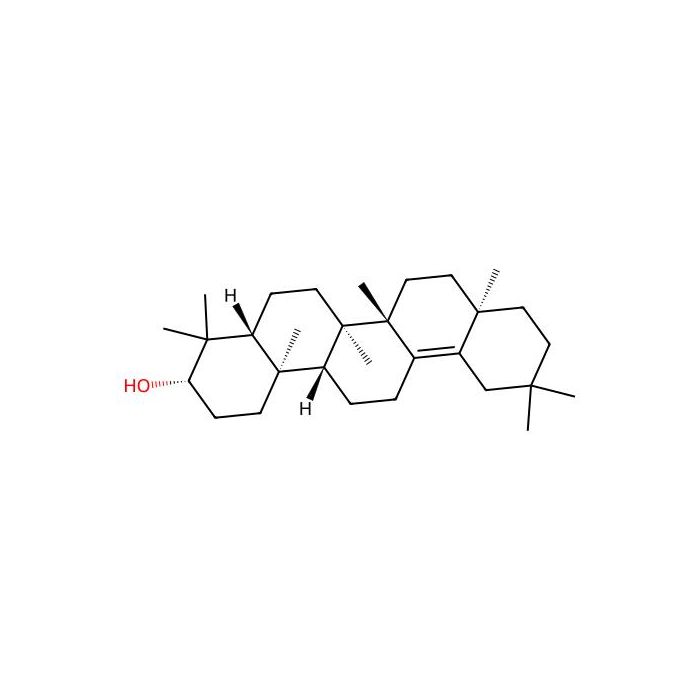
Compound class: pentacyclic triterpenoid (amyrin isomer) bearing a single tertiary alcohol at C-3 and one olefin in the ring system.
Typical empirical formula (literature for amyrins): C30H50O; typical formula weight ~426.7 g/mol.
Structural features: five fused carbocyclic rings (oleanane/ursane-type skeleton, depending on isomer), one tertiary hydroxyl group at C-3, and one internal trisubstituted C=C bond within the rings. The framework is highly hydrophobic and sterically congested.
2D structure description (general)
A compact, chair–chair fused polycyclic core (A–E rings) with multiple quaternary centers, methyl substituents at angular positions, a tertiary C-3 hydroxyl projecting axial/equatorial depending on isomer, and a single internal double bond. No heteroatoms besides the hydroxyl oxygen; no aromaticity; no stereogenic heteroatoms. High degree of saturation yields a dense, lipophilic scaffold.
Synthetic Utility
Functional groups and handles
Tertiary alcohol at C-3: amenable to protection (TBS/TBDMS), esterification (Ac2O, acyl chlorides with DMAP), carbonate/carbamate formation, and dehydration under acidic conditions to give more unsaturated derivatives.
Internal double bond: epoxidation (mCPBA), hydroboration–oxidation, oxyfunctionalizations, or hydrogenation (Pd/C) to tune saturation and sterics.
Allylic and tertiary C–H positions: candidates for selective C–H oxidation under modern catalytic systems (e.g., SeO2 allylic oxidation; P450-inspired methods) to access triterpenic acids/ketones.
Strategic value (literature)
Scaffolding: a dense, conformationally constrained, lipophilic framework useful for constructing libraries of semisynthetic triterpenoids by late-stage diversification at C-3 and the olefin.
Stereochemical richness: multiple stereocenters enable exploration of 3D topology in SAR studies for membrane interaction or materials applications.
Typical transformations
Oxidation of C-3 OH to ketone (Dess–Martin, PDC), followed by Wittig/haloform-type manipulations at adjacent centers when accessible.
Ester libraries via acyl chloride/anhydride coupling under mild base; carbonate linkers enable attachment to PEG or fluorophores for biophysical probes.
Selective epoxidation of the double bond and subsequent ring opening provides diol/halohydrin derivatives with altered polarity.
Practical notes
Steric congestion requires strong activators (DMAP) or longer reaction times; elevated temperatures risk isomerization. Monitor by TLC (stain with anisaldehyde/sulfuric acid) or LC–MS of derivatized samples.
Target Specificity
Not applicable.
This product is a small-molecule triterpenoid, not an antibody or biological targeting reagent. No antigen/epitope, clone, isotype, or species reactivity information applies.
We use cookies to ensure the website functions properly and, where permitted, to improve your experience. You can manage your preferences at any time in Settings. Learn more in our Cookie Policy.
Shall we send you a message when we have discounts available?
Remind me later
Thank you! Please check your email inbox to confirm.
Products are supplied to verified businesses, institutions, and qualified professionals for research and development use only. Not for use in humans, animals, diagnosis, or therapy.