This compound belongs to the class of organic compounds known as fatty acid esters. These are carboxylic ester derivatives of a fatty acid.
External Descriptors
Not available
1. Djoumbou Feunang Y, Eisner R, Knox C, Chepelev L, Hastings J, Owen G, Fahy E, Steinbeck C, Subramanian S, Bolton E, Greiner R, and Wishart DS. ClassyFire: Automated Chemical Classification With A Comprehensive, Computable Taxonomy. Journal of Cheminformatics, 2016, 8:61.
Determine the necessary mass, volume, or concentration for preparing a solution.
Dilution Calculator
Determine the dilution needed to prepare a stock solution.
Reconstitution Calculator
Revisões
Avaliações dos Clientes
Application Protocols
No tested bioassay or analytical application protocols are specified for this item. Typical uses are in synthetic chemistry and materials processing.
For polymerizations (general, literature guidance):
Charge diethyl azelate, chosen diol/diamine, and catalyst to a dry reactor under N2. Heat to 130–180 °C to begin transesterification; remove ethanol. Increase to 180–220 °C under high vacuum to drive polycondensation. Monitor viscosity/acid value.
For Dieckmann condensation (general):
Dry glassware and ethanol. Generate sodium ethoxide or use commercial solution; add diethyl azelate dropwise at 0–5 °C, then warm to reflux. Quench cautiously and perform standard aqueous workup. Purify by distillation or chromatography of downstream products.
These are general literature procedures provided for context; adapt to your system. For item-specific instructions, consult internal SOPs and the CoA/Spec Sheet.
Biological Roles
This product is supplied for research use only and is not intended for biological administration.
General biochemical context (literature/general):
Diethyl azelate is the diethyl ester of azelaic acid (nonanedioic acid). While azelaic acid occurs in nature (e.g., via fatty acid oxidation pathways), the fully esterified diethyl derivative does not have a known endogenous biological role.
In biological systems, esters can undergo enzymatic hydrolysis by esterases to liberate the parent diacid and ethanol; hydrolysis rates depend on chain length and steric/electronic factors. Long-chain diesters like diethyl azelate are relatively resistant without enzyme catalysis.
The hydrophobic, non-ionic structure favors partitioning into lipid phases; logP >3 (literature/estimated), implying low aqueous solubility and potential accumulation in hydrophobic matrices during in vitro exposure studies.
Research implications:
May serve as a model hydrophobic ester substrate in esterase assays or as a hydrophobic phase component in in vitro delivery studies. Any such use should be strictly non-clinical and controlled.
No medical or clinical claims are made or implied for this material.
Buffer Applications
Diethyl azelate is a hydrophobic, high-boiling ester and is not used to prepare aqueous buffers. It lacks acid/base functionality in water and is essentially insoluble.
Practical note: For biochemical buffers, select appropriate buffering agents (e.g., phosphate, Tris, HEPES). If diethyl azelate is present in an experimental system, it will form a separate organic phase or require an organic cosolvent/emulsifier.
See also: Solvent Selection and Reaction & Applications for contexts in which this material is relevant.
Green Alternatives
Considering solvent and plasticizer roles, greener choices should balance renewability, toxicity, and process performance.
Renewable sourcing (context):
Azelaic acid can be produced from bio-based feedstocks (e.g., oxidative cleavage of oleic acid). Diethyl azelate prepared from bio-azelaic acid and bio-ethanol improves sustainability metrics (literature/general). Verify sourcing if this is critical for your project.
Alternative materials (general comparison):
| Option | Greenness highlights | Trade-offs vs diethyl azelate |
|---|---|---|
| Triethyl citrate | Non-phthalate, low toxicity, partially bio-based | Lower hydrophobicity; different plasticization profile; lower thermal stability |
| Dibutyl sebacate | Good low-temp plasticizer, often low-tox | Slightly higher volatility than azelate homologs; different compatibility |
| 2-MeTHF (solvent) | Biomass-derived, recyclable | Not a plasticizer; low bp makes high-temp processes harder |
| Dimethyl carbonate | Low toxicity, reactive solvent | Highly reactive; unsuitable as plasticizer; fast evaporation |
Process intensification (general):
Use reactive distillation for transesterifications to minimize solvent needs.
Employ heterogenous acid catalysts (e.g., solid sulfonic resins) for easier separation and reuse.
Waste/energy considerations:
The high bp of diethyl azelate can reduce evaporative losses and VOC emissions during processing, but increases energy for removal; plan for vacuum-assisted recovery and recycling.
Pharmaceutical Uses
No pharmacopeial or excipient status is specified for this item; it is provided for research use only.
Item-specific: Grade/purity and excipient compliance are not specified for this SKU; refer to the CoA/Spec Sheet if regulatory suitability is being considered in pre-formulation research.
General formulation context (literature/general):
Long-chain diesters are sometimes evaluated as plasticizers in film coatings, transdermal matrices, or as components of oily vehicles in non-clinical formulation screening due to favorable viscosity and low volatility.
Compatibility: Typically compatible with hydrophobic polymers (e.g., Eudragit-types, cellulose derivatives). May affect permeability and mechanical properties.
Extraction and leachables: The hydrophobic nature may interact with container plastics; conduct extractables/leachables studies when relevant.
Caution: This product is not intended for human or veterinary use. Do not use in GMP manufacturing without appropriate qualification, specifications, and regulatory review.
Physical Properties
Only storage and shipping are specified for this item; all other numerical properties below are literature values and not product specifications.
Item-specific (from Product Data):
Appearance: Not specified for this item; refer to CoA/Spec Sheet.
Storage Conditions: Room temperature
Shipped In: Normal
Literature/typical values (for reference; not specifications):
Physical state: Colorless, oily liquid with low volatility (literature, typical for dialkyl azelates)
Vapor pressure: Very low at ambient temperature (literature)
Note: For lot-specific physical data (e.g., exact refractive index, color limits, acidity), consult the CoA/Spec Sheet. Do not use literature data as acceptance criteria for this SKU.
Quality and Grades
Item-specific grade/purity: Not specified for this item; refer to CoA/Spec Sheet.
Interpreting grades (general guidance):
If supplied as “technical” or “industrial” grade, typical focus is on color (APHA), acidity (as mg KOH/g), and ester content for materials applications (plasticizers, lubricants). Trace moisture and alcohol content can influence polymerizations and transesterifications.
“Analytical” or “reagent” grade materials may also control on GC purity (area%), acid value, and peroxides (though peroxides are generally less relevant for esters than ethers).
For polymer synthesis, low acid value and low water content are important to drive equilibria; these are often specified on polyester-grade esters.
Stabilizers/inhibitors:
No stabilizer is listed for this SKU. If a stabilizer is required for your process (e.g., to suppress acid-catalyzed side reactions), verify by CoA/Spec Sheet.
Practical guidance:
Request a recent CoA for: GC purity, color (APHA), acid value (mg KOH/g), water (Karl Fischer), residual ethanol, and any metal contaminants if catalytic processes are planned.
For chromatographic or spectroscopic applications, consider pre-filtering through alumina/silica to remove trace acids, and vacuum stripping to minimize residual volatiles.
Reaction and Applications
With two terminal ethyl ester groups, diethyl azelate is a versatile intermediate for polymer, materials, and synthetic transformations.
Materials and processing (general/literature):
Plasticizer: Enhances flexibility and lowers Tg in polymer matrices (e.g., polyurethanes, cellulose esters, acrylics) during formulation screening.
Lubricant base-stock component: Long-chain diesters impart good low-temperature fluidity and oxidative stability.
Synthetic transformations (general/literature):
Transesterification: Exchange with diols/long-chain alcohols under acid or base catalysis (e.g., p-TsOH, Ti(OiPr)4, NaOMe) to tailor ester side chains or generate mixed esters.
Polycondensation: Reacts with diols (e.g., ethylene glycol, 1,4-butanediol) to form aliphatic poly(azelate)s; water/ethanol removal and vacuum drive equilibrium.
Dieckmann condensation: Intramolecular Claisen of diethyl azelate using sodium ethoxide yields 2-carbethoxycyclohexanone, a classic route to cyclohexanone derivatives.
Reductions: LAH or catalytic hydrogenation (via ester hydrogenolysis catalysts) affords 1,9-nonanediol; DIBAL-H can provide aldehyde intermediates under controlled conditions.
Amidation: Conversion with diamines (e.g., hexamethylenediamine) yields aliphatic diamides for materials and ligand scaffolds.
Practical notes:
Drying: Trace water promotes hydrolysis/acid formation; dry over molecular sieves (3 Å/4 Å) or by azeotropic distillation.
Acidity control: Neutralize residual acids (wash with NaHCO3 or pass through basic alumina) prior to base-catalyzed reactions.
Removal: High bp demands high-vacuum stripping or solvent exchange for workups.
Reaction Conditions
General, literature-based conditions for common transformations of diethyl azelate (reference guidance; adjust to your system). These are not specifications for this SKU.
Dieckmann condensation to 2-carbethoxycyclohexanone (literature):
Base: NaOEt (1.1–1.5 equiv) in absolute ethanol.
Conditions: 0–25 °C addition, then warm to reflux (EtOH) 1–4 h; quench with dilute acid. Typical isolated yields: 60–80% after hydrolysis/decarboxylation sequence.
Transesterification with diols (polyester formation, literature):
Catalyst: Titanium isopropoxide (50–200 ppm Ti) or p-TsOH (0.05–0.5 wt%).
Conditions: 130–180 °C under N2 to remove ethanol; then 180–220 °C under high vacuum (≤5 mbar) to build molecular weight. Time: 4–16 h total, depending on target Mn.
Amidation with diamines (literature):
Catalyst: Optional (Ti, Zr, or organocatalysts); otherwise thermal.
Conditions: 120–200 °C with removal of ethanol; apply vacuum/N2 sweep. Use inhibitors/antioxidants if color is critical.
Reduction to 1,9-nonanediol (literature):
Reagent: LiAlH4 (2.5–3.0 equiv/ester), THF, 0 °C to reflux; careful quench. Alternatively, catalytic hydrogenolysis (Ru/C, high H2 pressure) for greener routes.
Workup/processing tips:
Rigorous drying (molecular sieves, vacuum) minimizes side hydrolysis.
Monitor by GC or 1H NMR (triplet of –CH3 at ~1.2 ppm for EtO, quartet at ~4.1 ppm) to follow conversion.
Given high bp, product isolation often favors precipitation/polymer isolation or solvent exchange over distillation.
Safety and Handling
Safety classification for this specific item is not provided in the Product Data; consult the SDS for authoritative guidance.
Item-specific hazard data (from Product Data):
Signal Word: Not specified for this item; refer to SDS.
H-Statements: Not specified for this item; refer to SDS.
GHS Classification: Not specified for this item; refer to SDS.
Pictograms: Not specified for this item; refer to SDS.
General safety considerations for dialkyl azelate esters (literature/general):
Expected hazards: Low acute toxicity; may cause mild skin/eye irritation. Ingestion/aspiration should be avoided. Combustible liquid.
Peroxide formation: Not typically prone (esters are less susceptible than ethers), but good practice is to minimize air/heat exposure over long storage.
Incompatibilities: Strong oxidizers; strong bases or acids can catalyze hydrolysis/transesterification—avoid contact if purity must be maintained.
Thermal decomposition: At elevated temperatures may emit acrid fumes, CO/CO2.
PPE and handling:
Wear safety glasses, lab coat, and suitable chemical-resistant gloves (e.g., nitrile). Use in a fume hood to avoid inhalation of mists/vapors when heating.
Spill response: Absorb with inert material (vermiculite), collect for disposal. Clean residues with an appropriate solvent and detergent.
First aid (overview): Rinse eyes/skin with water for several minutes; remove contaminated clothing. If inhaled, move to fresh air. If ingested, rinse mouth—do not induce vomiting; seek medical attention. Always follow SDS.
Fire safety:
Extinguishing media: CO2, dry chemical, foam. Cool containers with water spray.
Solvent Selection
Diethyl azelate is not a routine analytical solvent but can serve as a high-boiling, low-volatility medium or plasticizer in materials processing.
Solvent polarity and behavior (literature/general):
Polarity: Moderately polar ester functionality with a largely hydrophobic backbone; behaves as a low-polarity, aprotic solvent/plasticizer.
Dielectric constant: Typical dialkyl azelates lie in the ~4–6 range at 20 °C (literature for related dialkyl esters); supports dissolution of nonpolar to moderately polar organics and many polymers.
Miscibility: Immiscible with water; miscible with hydrocarbons, ethers, ketones, chlorinated solvents, and higher alcohols.
Boiling range: ~280–290 °C (literature), enabling elevated-temperature operations without significant loss.
When to choose it:
As a processing aid/plasticizer to lower Tg and viscosity of polymer melts (e.g., PVC alternatives, polyamides, and cellulose esters in research settings).
As a solvent or cosolvent for high-temperature esterification/transesterification where removal of lighter alcohols is desired.
Alternatives and comparisons (general):
Dibutyl/diethyl sebacate: Similar function, slightly higher bp (sebacate) and lower viscosity tuning.
Citrate esters (e.g., triethyl citrate): Greener, more polar, lower bp; better for some coatings but less hydrophobic.
2-MeTHF/CPME: Better for synthetic steps requiring medium polarity and easy removal; not plasticizers.
Note: For analytical separations, this ester is usually too high-boiling to be practical; select lower-bp solvents instead.
Keep container tightly closed under dry, inert atmosphere if possible to minimize moisture ingress and acid-catalyzed hydrolysis over long storage.
Store away from strong oxidizers, strong acids/bases, and sources of heat/ignition.
If long-term color stability is critical, protect from prolonged light and elevated temperatures.
Reconstitution:
Not applicable. This product is supplied as a liquid (appearance for this item is not specified; refer to CoA). If viscosity increases at low temperature, warm gently to ambient and mix thoroughly before use.
Before use:
If your application is base-catalyzed, consider pre-washing with dilute sodium bicarbonate or passing through basic alumina to remove trace acidity, followed by drying over molecular sieves (3–4 Å).
Verify key quality attributes (e.g., GC purity, acid value, water by KF) from the CoA/Spec Sheet for critical applications.
Structure and Identity
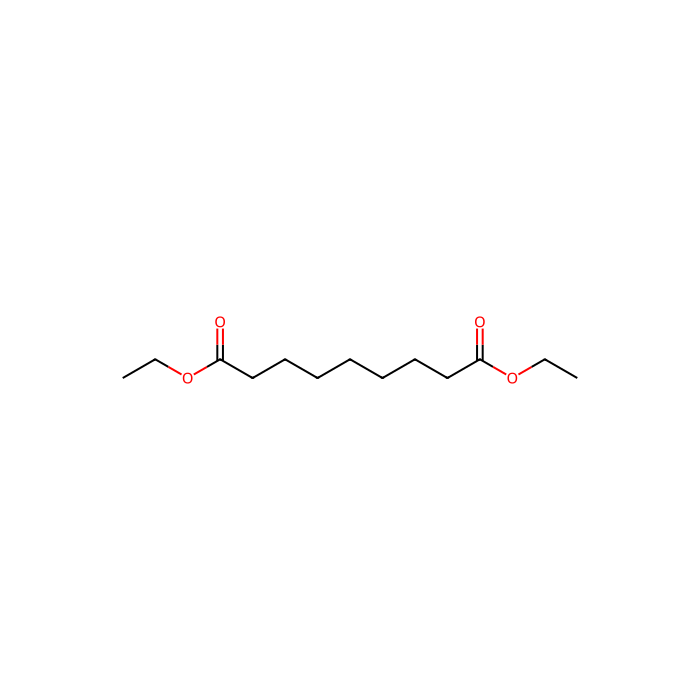
A dialkyl diester derived from azelaic acid, diethyl azelate is a linear aliphatic C9 diacid fully esterified with ethanol at both termini.
Item-specific identifiers (Product Data):
SKU: D304183
Product Name: Diethyl azelate
CAS: 624-17-9
PubChem CID: 12204
InChIKey: 51017 (as provided)
SMILES: Not specified for this item; refer to CoA/Spec Sheet.
Literature/typical identifiers (for reference only; not item-specific specs):
Preferred IUPAC name (literature): Diethyl nonanedioate
Molecular formula (literature): C13H24O4
Molecular weight (literature): 244.33 g/mol
SMILES (literature): CCOC(=O)CCCCCCCC(=O)OCC
Structural features (general chemistry):
Functional groups: Two terminal ethyl esters (–CO2Et) connected by a flexible n-alkylene chain (–(CH2)7–) of azelaic acid.
No rings, no heteroatoms other than the four ester oxygens; no stereocenters.
2D description: EtO–C(=O)–(CH2)7–C(=O)–OEt; a symmetric molecule with ester carbonyls at both ends and a hydrophobic interior.
Polarity: Moderately polar at the termini (carbonyl/alkoxy), overall hydrophobic due to long methylene spacer.
Synthetic Utility
Diethyl azelate (diethyl nonanedioate) is a valuable difunctional ester synthon bridging small-molecule and materials chemistry.
Retrosynthetic value (general):
Serves as a masked nonanedioic acid equivalent; dual ester handles enable iterative functionalization, selective mono-saponification, or convergent coupling.
Key transformations (literature/general):
Dieckmann condensation: Base-promoted intramolecular Claisen producing 2-carbethoxycyclohexanone; useful for cyclohexanone scaffolds and subsequent ring elaborations.
Polycondensation: Step-growth polymerization with diols to poly(azelate)s; tunable crystallinity and flexibility via comonomer selection.
Reductive routes: LAH reduction to 1,9-nonanediol (a monomer/intermediate). Partial reduction (DIBAL-H) affords aldehydes for further elaboration.
Cross-metathesis/functionalization via transformations on derivatives of the methylene chain (after selective transformations of one ester group).
Amidation: Formation of diamides or imide precursors; downstream cyclizations possible under dehydrative conditions.
Selectivity/tactics:
Differentiation of the two ester termini can be achieved via temporary protection (e.g., mixed esters) or by kinetic control in mono-hydrolysis.
For base-sensitive sequences, pre-neutralize trace acids (acid value) and dry thoroughly to avoid adventitious hydrolysis.
Workup/handling:
High-boiling nature favors in-situ consumption or solvent exchange rather than distillative removal.
Target Specificity
Not applicable. This product is a small-molecule diester and not an antibody, enzyme, or affinity reagent. No target-binding specificity, clone information, epitope mapping, or species reactivity is provided in the Product Data.
Perguntas frequentes
What is the purity of this product?
This product is supplied at ≥97% purity (chemical assay). Lot-specific values are stated on the Certificate of Analysis.
How should this product be stored?
Store at room temperature.
How is this product shipped?
This product ships under standard ambient conditions. No temperature-controlled packaging is required.
What are the CAS number, molecular formula and molecular weight?
The CAS Number is 624-17-9, the molecular formula is C13H24O4, and the molecular weight is 244.33 g/mol. InChIKey CQMYCPZZIPXILQ-UHFFFAOYSA-N.
What documentation is provided?
Available product documentation, including Certificates of Analysis (COA), Safety Data Sheets (SDS), and specification sheets, is shown in the product document area. Document availability and access follow the current site policy.
Usamos cookies para garantir o funcionamento adequado do site e, quando permitido, para melhorar a sua experiência. Você pode gerenciar suas preferências a qualquer momento nas Configurações. Saiba mais em nossa Política de Cookies.
Deseja que lhe enviemos uma mensagem quando tivermos descontos disponíveis?
Lembrar-me mais tarde
Obrigado! Por favor, verifique a sua caixa de entrada de e-mail para confirmar.
Products are supplied to verified businesses, institutions, and qualified professionals for research and development use only. Not for use in humans, animals, diagnosis, or therapy.

 D2307479