≥97%, mixture of cis and trans for sensitive chromatographic and analytical workflows requiring minimal baseline interference.
🌡
Storage & shipping
Room temperature Ships Normal Check lot-specific COA for exact specifications.
📋
Quality documents
SDS, COA, datasheet, and spec sheet available for download. Lot-specific COA accessible via lot number lookup.
📚
Literature proof
Cited in 0 peer-reviewed publications across chromatography, organic synthesis, and cross-coupling reactions.
Visão geral
application:
Dihydro-α-terpineol is used as a bronchodilator for treatment of asthma, bronchitis, and other respiratory diseases. It is also a useful deodorant, food additive, and analgesic agent.
This compound belongs to the class of organic compounds known as menthane monoterpenoids. These are monoterpenoids with a structure based on the o-, m-, or p-menthane backbone. P-menthane consists of the cyclohexane ring with a methyl group and a (2-methyl)-propyl group at the 1 and 4 ring position, respectively. The o- and m- menthanes are much rarer, and presumably arise by alkyl migration of p-menthanes.
External Descriptors
Not available
1. Djoumbou Feunang Y, Eisner R, Knox C, Chepelev L, Hastings J, Owen G, Fahy E, Steinbeck C, Subramanian S, Bolton E, Greiner R, and Wishart DS. ClassyFire: Automated Chemical Classification With A Comprehensive, Computable Taxonomy. Journal of Cheminformatics, 2016, 8:61.
Determine the necessary mass, volume, or concentration for preparing a solution.
Dilution Calculator
Determine the dilution needed to prepare a stock solution.
Reconstitution Calculator
Revisões
Avaliações dos Clientes
Application Protocols
No application protocols (e.g., WB, IHC, IF, FC) are applicable to this small-molecule reagent. For synthetic or analytical uses, refer to the Reaction Conditions and Synthetic Utility sections for general laboratory guidance. Always validate procedures under your specific lab conditions.
Biological Roles
General background (literature)
Dihydroterpineol is a monoterpenoid alcohol within the p-menthane family, conceptually derived by hydrogenation of terpineol. Monoterpenoids are biosynthesized from geranyl pyrophosphate (GPP) via cyclization and subsequent functionalization.
While dihydroterpineol itself is less commonly cited as a native metabolite than terpineol, it represents a plausible biotransformation product (e.g., microbial hydrogenation/reduction) within terpene processing streams.
Physicochemical-biological considerations
Hydrophobicity (logP in the ~2.5–3.5 range, literature) suggests preferential partitioning into lipid phases and membranes, affecting aroma volatility and transport.
Alcohol functionality permits conjugation in biological systems (e.g., glucuronidation/sulfation in xenobiotic metabolism, literature generality for monoterpene alcohols).
Enzymatic transformations (general)
Oxidation by alcohol dehydrogenases to corresponding ketones, followed by further metabolism via phase II conjugation pathways.
Potential for microbial esterification or hydrolysis in biodegradation processes.
Research use context
Suitable as a model hydrophobic alcohol for studying membrane partitioning, volatilization, sorption, and biotransformation kinetics in environmental and biochemical systems (research use only).
Note: No item-specific biological testing data are provided for this SKU. Avoid extrapolating to clinical or therapeutic contexts; this product is for research use only.
Buffer Applications
This compound is a hydrophobic monoterpene alcohol and is not used as an aqueous buffering agent. It has no established buffering capacity in biochemical assays. If incorporated into aqueous systems (e.g., formulation studies), organic co-solvents or emulsifiers may be required for dissolution. For pH control, select conventional buffers (e.g., phosphate, Tris, HEPES) appropriate to your system.
Green Alternatives
As a substrate/reagent, dihydroterpineol itself is not typically replaced by a “green alternative.” However, greener processing choices can reduce environmental impact when using it in synthesis or formulation.
Greener solvent choices (general guidance)
Prefer 2-MeTHF, CPME, EtOAc, MeOH, or IPA over chlorinated solvents when compatible with the transformation.
For extractions, heptane or cyclopentyl methyl ether (CPME) can substitute for hexanes/diethyl ether with improved safety profiles.
Example comparisons (literature/general)
DCM → EtOAc or Me-THF: similar solvency for acylations/oxidations; reduced halogenated waste.
Hexanes → Heptane or cycloalkanes: comparable nonpolarity; lower toxicity classification in some jurisdictions.
THF → 2-MeTHF/CPME: reduced peroxide formation rate and improved process safety; note different azeotropes and water miscibility.
Process intensification
Use catalytic systems (e.g., TEMPO/bleach for alcohol oxidations) in place of stoichiometric chromium(VI) reagents.
Employ solid acids (Amberlyst-15) for dehydration/esterification to facilitate separation and reuse.
Consider flow chemistry for exothermic steps (oxidations, acylations) to improve heat and mass transfer.
Waste and emissions
Capture and treat VOCs via condensers and carbon filtration.
Segregate terpene-containing organic waste streams for solvent recovery where feasible.
These recommendations are general and should be validated for your specific reaction system.
Pharmaceutical Uses
No pharmacopeial grade, excipient designation, or formulation role is specified for this SKU; refer to the CoA/Spec Sheet if regulatory status is relevant to your application.
General, non-clinical context (literature/industry):
Monoterpene alcohols can function as fragrance components or flavor modifiers in non-therapeutic products and may be studied as permeation enhancers or solvent-like excipients in research settings. Such uses require rigorous compatibility, extractables/leachables, and sensory testing.
For any consideration in dosage-form development research, ensure compliance with applicable excipient standards (e.g., FCC, USP–NF) and verify impurity profiles, residual solvents, and allergen declarations. These statuses are not specified for this item.
This product is supplied strictly for research use only and is not intended for human or veterinary use, clinical applications, or as a finished excipient without further qualification.
Physical Properties
Item-specific values are not provided in the Product Data for this SKU. The following are general literature characteristics for dihydroterpineol-type monoterpene alcohols and should be used as guidance only (not item specifications):
Appearance: Typically colorless to pale yellow viscous liquid with characteristic terpene-like odor (literature). Not specified for this item; refer to CoA/Spec Sheet.
Boiling point: commonly reported in the ~205–220 °C range at 1 atm (literature, varies with isomer and purity).
Melting point: generally liquid at room temperature; reported MPs often below 0 °C (literature).
Density (20/25 °C): ~0.90–0.93 g/mL (literature, isomer- and temperature-dependent).
Refractive index (n20 D): ~1.46–1.48 (literature).
Vapor pressure: low at ambient temperature (literature qualitative).
Solubility: sparingly soluble in water; miscible with many organic solvents (ethanol, diethyl ether, hydrocarbons) (literature).
LogP (octanol/water): typically ~2.5–3.5 for monoterpene alcohols (literature estimate).
pKa: alcohol O–H of secondary aliphatic alcohols typically ~16–18 in water (literature, conceptual only).
Heat and mass-transfer notes (general): Elevated viscosity versus lower alcohols can slow mixing; mild heating (under inert atmosphere if required by your process) reduces viscosity. For quantitative, method-validated properties applicable to this SKU, consult the CoA/Spec Sheet.
Quality and Grades
Item-specific grade/purity: Not specified for this item; refer to CoA/Spec Sheet.
Interpreting common grades for monoterpene alcohols (general guidance)
Reagent grade: Suitable for most synthetic applications; impurities (e.g., residual hydrocarbons, isomeric alcohols) minimized but not necessarily quantified by GC.
High-purity/GC grade: Narrow impurity profile with GC assay; useful when odor profile or analytical response is critical.
Fragrance/aroma grade: Tailored for sensory applications with organoleptic criteria; may not meet reagent impurity limits—verify before critical synthetic use.
Water content control: Karl Fischer moisture values can influence select transformations (e.g., esterifications). For this SKU, moisture specification is not provided; verify on CoA if water-sensitive chemistry is planned.
Stabilizers/inhibitors: Not specified for this item; refer to CoA/Spec Sheet. Terpene alcohols generally do not require polymerization inhibitors; however, antioxidant traces may be present in some commercial streams—confirm if interference is a concern.
Practical QC suggestions (general)
Confirm identity and isomer ratio by GC–MS and 1H/13C NMR.
Check residual solvents (GC headspace) if used in formulation work.
Document refractive index and density at a defined temperature for lot-to-lot comparability.
Reaction and Applications
General roles in synthesis (literature)
Versatile secondary aliphatic alcohol on a p-menthane scaffold; useful as a building block for monoterpene-derived libraries.
Precursor to ketones via oxidation; esters via acylation; alkenes via acid-catalyzed dehydration; and ethers via Williamson-type approaches (through the corresponding halide/mesylate).
Oxidation: PCC/PDC, Swern, Dess–Martin periodinane, or catalytic TEMPO/oxone to the corresponding menthanone (secondary → ketone). Control temperature to limit over-oxidation or rearrangement.
Esterification: Fischer–Speier (mineral acid catalysis) or DCC/DMAP coupling for mild conditions; use azeotropic water removal to drive equilibrium.
Dehydration: Acid-catalyzed elimination (H2SO4, p-TsOH, Amberlyst-15) to produce p-menthene isomers; reaction temperature and acid strength steer regioselectivity.
Halide formation/activation: Convert to mesylate/tosylate (MsCl/TsCl, base) or halide (SOCl2, PBr3) for nucleophilic substitution or cyclization cascades.
Hydrogenolysis/Reductive modifications: Limited at the alcohol center; however, ring functionalizations may be pursued after activation.
Practical notes
Terpene substrates can isomerize under strong acid or heat; employ mild, selective conditions and monitor by GC.
Use anhydrous conditions when moisture-sensitive reagents are employed (e.g., DCC couplings, acid chlorides).
If odor carryover is problematic in multi-step synthesis, include vacuum stripping or short-path distillation steps.
Non-reaction laboratory uses
Hydrophobic model alcohol in partitioning studies and sensory chemistry investigations (research use only).
Reaction Conditions
General literature guidance for transforming secondary terpene alcohols like dihydroterpineol (not item specifications):
Oxidation to ketone
Swern oxidation: DMSO, oxalyl chloride, Et3N, −78 → 0 °C, 1–2 h; typical good yields (70–90%) with minimal rearrangement.
Dess–Martin: DMP in DCM, 0 °C → rt, 1–3 h; quench with NaHCO3/Na2S2O3.
TEMPO/bleach: TEMPO (2–5 mol%), NaOCl (1.1–1.5 eq active), NaHCO3 buffer, CH2Cl2/H2O biphasic, 0–25 °C.
Esterification (Fischer–Speier)
Alcohol:acid (1:1–1:2), catalytic H2SO4 or p-TsOH (1–5 mol%), Dean–Stark in toluene or refluxing neat acid/alcohol; 2–12 h.
Alternative: DCC (1.1 eq) and DMAP (5–10 mol%) in DCM or THF at 0–25 °C.
Dehydration to alkenes
Catalyst: p-TsOH (5–10 mol%) or Amberlyst-15; solvent toluene or heptane; 60–110 °C; 1–6 h. Control to minimize rearrangements; collect isomer mixture of p-menthenes.
Activation to sulfonates/halides
MsCl/TsCl (1.1–1.5 eq), Et3N or pyridine, 0 °C → rt, 1–3 h; subsequent SN reactions as required.
SOCl2 (1.2–1.5 eq) with catalytic DMF in DCM or toluene at 0–25 °C affords chloride; beware of elimination.
Workup and analysis
Extractive workups with NaHCO3/NaCl washes; dry over MgSO4/Na2SO4.
Monitor by GC–FID/MS; confirm structure by 1H/13C NMR and IR (O–H ~3300 cm−1; C–O ~1050–1150 cm−1).
Optimize equivalents, temperature, and time based on your substrate’s isomer/stereochemistry and desired selectivity.
Safety and Handling
Item-specific GHS details (signal word, hazard statements, pictograms, classification) are not provided; defer to the product SDS for authoritative guidance.
Item-specific conditions
Storage: Room temperature (per Product Data). Store tightly closed in a well-ventilated area away from ignition sources.
Shipping: Shipped under normal conditions (per Product Data).
General safety profile for monoterpene alcohols (literature/general guidance)
Expected hazards: May cause skin and eye irritation; may cause respiratory irritation if mist/vapor is generated; harmful to aquatic life with long lasting effects for some terpenoids.
Flammability: Combustible liquid; keep away from heat/sparks/open flames. Use explosion-proof equipment where applicable.
Incompatibilities: Strong oxidizers (e.g., peracids, chromates), strong acids or bases (may catalyze dehydration or resinification), and reactive acylating agents without proper controls.
Recommended PPE: Lab coat, safety glasses or splash goggles, and suitable chemical-resistant gloves (e.g., nitrile). Use in a chemical fume hood.
First aid (overview):
Inhalation: Move to fresh air; seek medical attention if symptoms persist.
Skin contact: Wash with soap and water; remove contaminated clothing.
Eye contact: Rinse cautiously with water for several minutes; remove contact lenses if present and easy to do; continue rinsing.
Ingestion: Rinse mouth; do not induce vomiting; seek medical advice.
Always consult the SDS for this SKU for official classification, exposure limits, spill response, and disposal procedures.
Solvent Selection
This product is a substrate/reagent, not a primary laboratory solvent. However, solvent choice affects its handling and reactivity.
Polarity and miscibility (literature/general)
Moderately hydrophobic, low water solubility; readily soluble in common organics (EtOH, i-PrOH, EtOAc, ethers, hydrocarbons, chlorinated solvents).
Useful co-solvent behavior: small percentages of alcohols (EtOH/i-PrOH) can aid dissolution in aqueous-organic systems.
Choosing media for transformations
Esterification/Acylation: Use aprotic solvents (DCM, toluene) or azeotropic alcohols with Dean–Stark for water removal.
Oxidations to ketones: DCM, EtOAc, or MeCN under Swern/PCC/PDC or TEMPO/bleach conditions; ensure controlled exotherm.
Dehydration to alkenes: Non-nucleophilic solvents (toluene, heptane) under acid catalysis minimize side reactions.
Small comparison (general)
Alcoholic media (EtOH, i-PrOH): enhance solubility; may participate in transesterification.
Ethers (MTBE, THF): good solvency; consider peroxide formation risk of the ether solvent, not of dihydroterpineol.
Hydrocarbons (hexanes, toluene): good for extractions and hydrophobic formulations; slower dissolution rates.
For analytical sample prep, hexanes/MTBE or DCM are commonly used for GC; MeOH/ACN for LC as needed. Validate solvent choice against your downstream application and regulatory constraints.
Storage and Reconstitution
Item-specific storage: Room temperature (per Product Data). Store tightly sealed, in original container, protected from light and ignition sources. Shipments: normal conditions (per Product Data).
Stabilizers: Not specified for this item; refer to CoA/Spec Sheet.
Reconstitution: Not applicable; product is typically supplied as a neat liquid. If a solution is required, prepare in a compatible organic solvent (e.g., ethanol, isopropanol, ethyl acetate, hexanes) immediately before use. For moisture-sensitive reactions, dry solvents and minimize atmospheric exposure.
Shelf life: Not specified for this item; refer to CoA/Spec Sheet. As a general practice, record opening date and monitor by GC/NMR for any signs of oxidation or acid-catalyzed isomerization over time.
Handling tips
Minimize headspace oxygen if long-term storage is anticipated (optional nitrogen blanket).
Wipe cap threads and use PTFE-lined closures to reduce odor permeation and contamination.
Avoid prolonged contact with reactive metals or strong acids/bases that can induce side reactions.
For definitive stability, impurity profile, and storage duration for SKU D347986, consult the lot-specific CoA and SDS. Research use only.
Structure and Identity
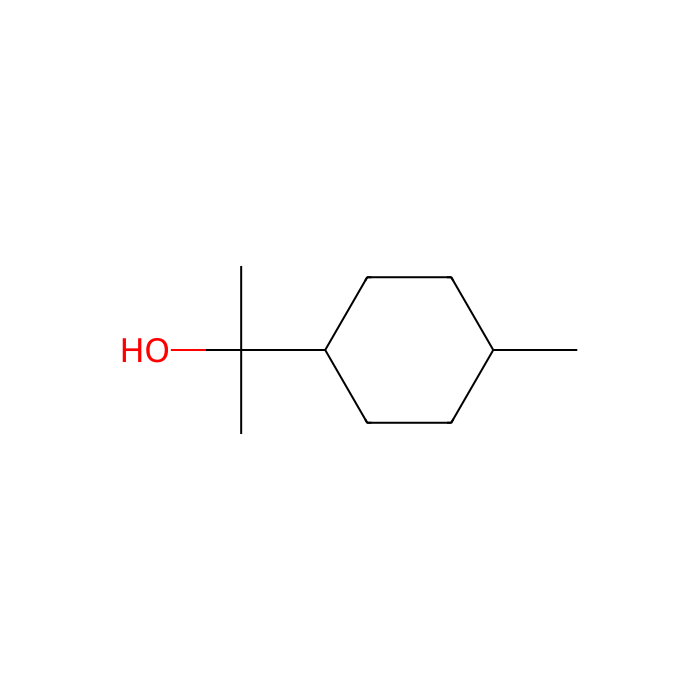
Brief overview: Dihydroterpineol is a saturated monoterpenoid alcohol formed by hydrogenation of terpineol; it is a C10 terpene framework bearing a single hydroxyl group.
Item-specific (from Product Data)
Product name: Dihydroterpineol
CAS: 498-81-7
PubChem CID: 10353
InChIKey: 364912 (as listed; full-length key not specified for this item)
SMILES: Not specified for this item; refer to CoA/Spec Sheet.
Literature/derived identifiers and features (for reference; not item specifications)
Molecular formula (literature): C10H20O (typical for dihydro derivatives of terpineol)
Molecular weight (literature): ~156.27 g/mol
Structural features: saturated p-menthane backbone (cyclohexane ring with isopropyl and methyl substituents), secondary alcohol functionality on the ring; multiple stereocenters possible leading to isomeric forms.
2D structure description: a cyclohexane ring substituted by an isopropyl and a methyl group (p-menthane motif); one ring carbon bears a hydroxyl substituent. Hydrogenation relative to terpineol removes the ring C=C bond, yielding a fully saturated ring.
Stereochemistry
Dihydroterpineol may be available as racemic or as individual stereoisomers (literature). If stereochemical specification is critical, confirm via CoA/Spec Sheet for this SKU.
Note: Exact constitutional isomer (position of OH and alkyl substituents) and stereochemistry for this catalog item are not specified; consult the CoA for definitive identifiers (e.g., full InChI, precise SMILES).
Synthetic Utility
Functional group leverage
Secondary alcohol amenable to oxidation (→ ketone), esterification (→ esters/carbonates), and activation as sulfonates/halides for substitution chemistry.
p-Menthane scaffold provides a bulky, hydrophobic backbone useful for tuning lipophilicity and steric environment in target molecules.
Retrosynthetic value
Entry point to p-menthane derivatives: menthanones, menthyl ethers/esters, and alkylated variants relevant to odorant libraries and terpene-inspired bioactive scaffolds (research).
Potential chiral pool utility if enantiopure material is obtained (not specified here); ring substitution pattern offers multiple stereocenters for asymmetric synthesis design.
Named/standard methodologies (literature)
Oxidations: Swern, Dess–Martin, TEMPO/bleach to menthanone analogs.
Dehydrations/isomerizations: Acid-catalyzed E1 pathways to p-menthenes; control regioselectivity via catalyst choice (e.g., Amberlyst-15 vs mineral acids).
Carbon–carbon formation: After activation, SN1/SN2 routes to introduce heteroatoms or carbon substituents; or employ ketone intermediates for aldol/Claisen variants.
Practical tips
Avoid over-acidic conditions that promote skeletal rearrangements common to terpene systems.
Monitor reactions by GC–FID/MS; terpene mixtures can contain close-boiling isomers—use calibrated retention indices.
Purify via vacuum distillation or silica gel chromatography with hydrocarbon/ether eluents to minimize odor contamination of equipment.
Target Specificity
Not applicable. This product is a small-molecule monoterpene alcohol and is not an antibody, enzyme, or affinity reagent. No target, epitope, or isotype information is relevant to this SKU.
Usamos cookies para garantir o funcionamento adequado do site e, quando permitido, para melhorar a sua experiência. Você pode gerenciar suas preferências a qualquer momento nas Configurações. Saiba mais em nossa Política de Cookies.
Deseja que lhe enviemos uma mensagem quando tivermos descontos disponíveis?
Lembrar-me mais tarde
Obrigado! Por favor, verifique a sua caixa de entrada de e-mail para confirmar.
Products are supplied to verified businesses, institutions, and qualified professionals for research and development use only. Not for use in humans, animals, diagnosis, or therapy.

 B2322646