This compound belongs to the class of organic compounds known as alpha amino acid esters. These are ester derivatives of alpha amino acids.
External Descriptors
Not available
1. Djoumbou Feunang Y, Eisner R, Knox C, Chepelev L, Hastings J, Owen G, Fahy E, Steinbeck C, Subramanian S, Bolton E, Greiner R, and Wishart DS. ClassyFire: Automated Chemical Classification With A Comprehensive, Computable Taxonomy. Journal of Cheminformatics, 2016, 8:61.
Determine the necessary mass, volume, or concentration for preparing a solution.
Dilution Calculator
Determine the dilution needed to prepare a stock solution.
Reconstitution Calculator
Revisões
Avaliações dos Clientes
Application Protocols
Not applicable. No antibody/assay protocols (WB, IHC, IF, FC) or biological application dilutions are relevant for this small-molecule reagent. For practical usage, see Reaction Conditions and Application notes in Reaction & Applications.
Biological Roles
This material is a synthetic organic intermediate and does not have a defined endogenous biological role.
General notes (literature)
Nitro-malonate esters are occasionally employed as chemical biology modifiers or pro‑building blocks, but dimethyl nitromalonate itself is not a known metabolite, cofactor, or signaling molecule.
The –NO2 group can be transformed into amines, carbonyls, or eliminated in synthetic sequences that ultimately generate biologically active frameworks; such roles pertain to downstream products rather than to this reagent per se.
Research use only
Per Product Data: For research use only. Not for human or veterinary use, in vitro diagnostic, or clinical applications.
Buffer Applications
Not typically applicable. Dimethyl nitromalonate is an organic synthesis reagent and is not used to formulate aqueous buffer systems. For relevant information, see Reaction & Applications, Synthetic Utility, and Reaction Conditions for its use in organic media.
Green Alternatives
Solvent substitutions (literature guidance)
Replace chlorinated/aromatic solvents with 2‑MeTHF or CPME for deprotonation/alkylation and Knoevenagel steps; these ethers offer lower peroxide tendencies than THF and improved safety profiles.
MeCN can substitute for DMF/DMSO to reduce EHS concerns and simplify workup; in some cases, propylene carbonate functions as a greener polar aprotic medium.
Reagent economy
Base choice: K2CO3/Cs2CO3 in phase-transfer or biphasic systems can supplant stronger bases (NaH) while maintaining conversions, reducing pyrophoric risk.
Catalysis: Organocatalytic amines (e.g., secondary amines, ammonium salts) avoid heavy metals for Knoevenagel condensations.
Example comparison (general)
Traditional vs greener settings:
Deprotonation/alkylation: THF/NaH → 2‑MeTHF/K2CO3 (longer reaction time possible; safer, less hazardous waste).
Knoevenagel in toluene with piperidine → ethanol/water with L-proline or ammonium acetate (tradeoff: solubility and rate may decrease).
Process considerations
Minimize excess electrophile; high conversions are achievable with controlled base addition and azeotropic water removal.
Choose workups that reduce halogenated waste (e.g., heptane/EtOAc partitions, carbonate washes) and facilitate solvent recycling.
Pharmaceutical Uses
Role: This compound is used as a synthetic building block in process and medicinal chemistry to access nitro-, amino-, and carbonyl‑substituted 1,3‑dicarbonyl derivatives that can be elaborated into API intermediates (literature context). It is not an excipient.
Regulatory status: No pharmacopeial monograph is indicated for this specific compound. Any use in GMP manufacturing requires independent qualification, impurity profiling, and process-specific specifications.
Formulation note: As a reactive intermediate, it is typically consumed in synthesis rather than formulated into finished dosage forms.
Physical Properties
Item-specific specs (this lot): Not specified for this item; refer to CoA/Spec Sheet.
Literature/computed values (non-spec, for general reference only)
Molecular weight: 177.11 g/mol (computed from formula C5H7NO6)
Elemental composition: C 33.9%, H 4.0%, N 7.9%, O 54.1% (computed)
Acidic methine: markedly acidified by –NO2 and two carbonyls; conjugate-base stabilization enables facile deprotonation with mild bases (general property).
Volatility/phase: Typically a low-volatility liquid or low-melting solid depending on sample and purity; consult CoA for exact MP/BP.
Solubility (qualitative, literature): miscible with many polar aprotic organics (e.g., THF, MeCN, DMF, DCM); limited solubility in water due to diester character.
Spectroscopic handles: strong IR C=O bands (~1730–1750 cm−1 for esters) and NO2 asymmetric/symmetric stretches (~1550 and ~1350 cm−1) (literature trends).
Note: Do not use literature values as specifications. For assay, water, residual solvents, refractive index, density, peroxide, metals, UV cutoff, etc., see the item’s CoA/Spec Sheet if available.
Quality and Grades
Item-specific grade/purity: Not specified for this item; refer to CoA/Spec Sheet.
Interpreting grades for this class of reagent (general guidance)
Synthetic/technical grade: Suitable for many preparative reactions; may contain higher levels of acidity, moisture, or residual solvents that can affect base‑sensitive applications.
AR/Analytical grade: Tighter control of organic/elemental impurities; preferable for quantitative or sensitive transformations.
High-purity (≥98–99% by GC/LC/NMR): Reduces background in multistep sequences and asymmetric catalysis; typically specified with water and residual solvent limits.
Stabilizers/additives: Not specified for this item; refer to CoA/Spec Sheet. Many users prefer unstabilized material to avoid amine or alcohol inhibitors that could interfere with base-catalyzed condensations.
Quality considerations for dimethyl nitromalonate
Water and base trace levels can shift acidity and promote premature hydrolysis or self‑condensation; dry solvent handling is recommended.
Residual acids can influence Knoevenagel/Henry-type rates; assay and acidity data on the CoA are helpful for reproducing conditions.
Chromatographic purity may not reflect trace nitrate/nitrite; if downstream reductions are planned, consider additional QC (e.g., IC for anions).
Reaction and Applications
Dimethyl nitromalonate is an α‑nitro 1,3‑dicarbonyl synthon combining a highly activated methine with a transformable –NO2 group.
C–C bond formation (literature)
Alkylation: Smooth deprotonation with mild to strong bases (K2CO3/Cs2CO3, DBU, NaH) followed by SN2 alkylation with primary halides/sulfonates to access α‑alkyl derivatives.
Knoevenagel condensations: Condenses with aldehydes/ketones under amine catalysis (e.g., piperidine, pyrrolidine, ammonium acetate) to give nitro‑substituted alkenes; water removal drives equilibrium.
Michael additions/annulations: Acts as a soft nucleophile toward enones/enoates; intramolecular variants enable cyclizations.
Functional group interconversions (literature)
Nef reaction: Hydrolysis/acidic workup of nitronate after oxidation affords the corresponding carbonyl (formyl/oxo derivatives) enabling access to malonyl carbonyl frameworks.
Reductive transformations: –NO2 reduction (e.g., catalytic hydrogenation, metal/acids, or hydride reagents under specific conditions) provides α‑amino malonates; subsequent cyclizations furnish lactams/pyrrolidines or serve as precursors to α‑amino acids.
Decarboxylation strategies: After selective hydrolysis, thermal or oxidative decarboxylation adjusts the carbon count while retaining derived functionality.
Asymmetric synthesis
Chiral phase-transfer or organocatalysts (e.g., cinchona-derived, squaramides) enable enantioselective alkylations/Michael additions of the nitromalonate scaffold.
Practical notes
Control base strength and temperature to minimize over-alkylation or transesterification.
Use anhydrous conditions; adventitious water promotes ester cleavage.
Monitor by TLC/LC–MS; strong UV at 210–230 nm and distinct nitro stretches in IR assist tracking.
Reaction Conditions
General, literature-based guidance; optimize per substrate and scale.
Deprotonation/alkylation
Base: K2CO3 or Cs2CO3 (1.2–2.0 equiv) in MeCN/DMF/2‑MeTHF; or NaH (1.1–1.5 equiv) in THF/2‑MeTHF.
Temperature: 0–25 °C for deprotonation; 25–60 °C for alkylation; slower at lower temperatures but improved selectivity.
Time: 1–16 h depending on electrophile; monitor by TLC/LC–MS.
Catalyst: piperidine, pyrrolidine, ammonium acetate, or L-proline (5–20 mol%).
Solvent: toluene (Dean–Stark), MeCN, or ethanol; water removal increases conversion.
Temperature: RT to reflux; typical times 2–24 h.
Nef conversion (nitro → carbonyl)
Generate nitronate (base: NaOMe/NaOMe–MeOH or Na2CO3 in MeOH), then oxidative/acidic workup (e.g., H2SO4, HNO3, or oxone under controlled conditions) to furnish carbonyl derivatives. Temperature control is critical to suppress decomposition.
Reductive amination pathway (–NO2 → –NH2)
Hydrogenation (Pd/C, H2 1–5 bar) in MeOH/EtOH or EtOAc at RT–40 °C; or metal/acid systems (Fe/AcOH) as alternatives. Follow with intramolecular cyclizations as desired.
Workup/purification
Quench bases at 0–5 °C; extract promptly to organic layer; dry over MgSO4/Na2SO4; purify by silica gel using non-basic eluents.
Safety and Handling
Item-specific GHS data: Not specified for this item; refer to the SDS for authoritative hazard classification, pictograms, and H-statements.
General hazards for nitro-activated diesters (literature/good practice)
May cause skin/eye irritation; harmful if swallowed or inhaled; nitro-organics can present systemic toxicity with sufficient exposure. Avoid aerosols and inhalation.
Combustible organic; keep away from ignition sources. Not an explosive nitrate ester, but observe standard precautions.
Engineering controls: Use in a fume hood. Ensure good ventilation during transfers and reactions.
PPE: Lab coat, safety glasses, and appropriate chemically resistant gloves (e.g., nitrile). Use splash protection when charging or quenching.
Hygroscopicity/volatility: Keep container tightly closed to minimize moisture ingress and loss of volatiles.
First aid (overview; defer to SDS)
Skin/eye contact: Rinse with water for ≥15 min; remove contaminated clothing; seek medical attention if irritation persists.
Inhalation: Move to fresh air; monitor breathing; seek medical attention if symptoms occur.
Ingestion: Rinse mouth; do not induce vomiting; obtain medical attention.
Always consult the current SDS before use and for spill/fire-fighting guidance.
Solvent Selection
Dimethyl nitromalonate is a polar, hydrogen-bond accepting substrate suited to polar aprotic media.
Polarity/miscibility (literature trends)
Readily soluble in polar aprotic solvents (DMF, DMSO, MeCN, THF, dioxane, acetone) and chlorinated solvents (DCM, CHCl3).
Limited solubility in alkanes; modest in lower alcohols (may promote transesterification under basic/acidic conditions).
Choosing solvents by transformation
Base-mediated deprotonation/alkylation: THF, 2-MeTHF, MTBE, or MeCN with K2CO3, Cs2CO3, NaH, or DBU; avoid protic solvents to limit side reactions.
Knoevenagel condensations with aldehydes: Toluene, MeCN, or ethanol under catalytic amine/base; azeotropic water removal in toluene can drive equilibrium.
Michael additions/annulations: DMF/MeCN frequently used to balance solubility and base strength; CPME or 2‑MeTHF are greener substitutes for THF/toluene.
Practical tips
Dry solvents (molecular sieves or distillation) improve reproducibility by suppressing hydrolysis and shifting enolate equilibria.
For chromatography, DCM/EtOAc or hexanes/EtOAc systems typically resolve nitro-malonate derivatives; avoid strong bases on silica.
Comparison note
Versus ethyl nitroacetate, dimethyl nitromalonate is less volatile and often more manageable; however, it can be less nucleophilic per mole due to increased stabilization of the conjugate base.
Storage and Reconstitution
Storage (item-specific): Room temperature (per Product Data). Ship under normal conditions.
General storage guidance (good practice)
Keep tightly sealed under dry, inert atmosphere if possible; moisture can promote ester hydrolysis and alter acidity profile.
Store away from strong bases, acids, and reducing agents. Protect from prolonged heat and direct sunlight.
If long-term storage is needed, consider refrigeration (2–8 °C) to further limit degradation; allow to equilibrate to RT before opening to prevent condensation.
Reconstitution/handling
Use directly as supplied. If solidified upon cold storage, warm to ambient and homogenize before use.
For solution preparation, employ anhydrous solvents (e.g., THF, MeCN, DCM). Filter through a PTFE syringe filter if particulates are present.
Stability notes
Avoid extended contact with aqueous media, especially under basic or acidic conditions, to minimize hydrolysis or transesterification.
For any specific stability-indicating parameters (assay, water, residual solvents), refer to the CoA/Spec Sheet for this lot.
Structure and Identity
A nitro-activated malonate diester commonly used as a C1 electrophile/acidic methine synthon in organic synthesis.
Item-specific (from Product Data)
Product name: Dimethyl nitromalonate
CAS: 5437-67-2
PubChem CID: 226085
InChIKey: 105123 (as provided)
Literature/computed identifiers and features (for reference; verify against databases/CoA)
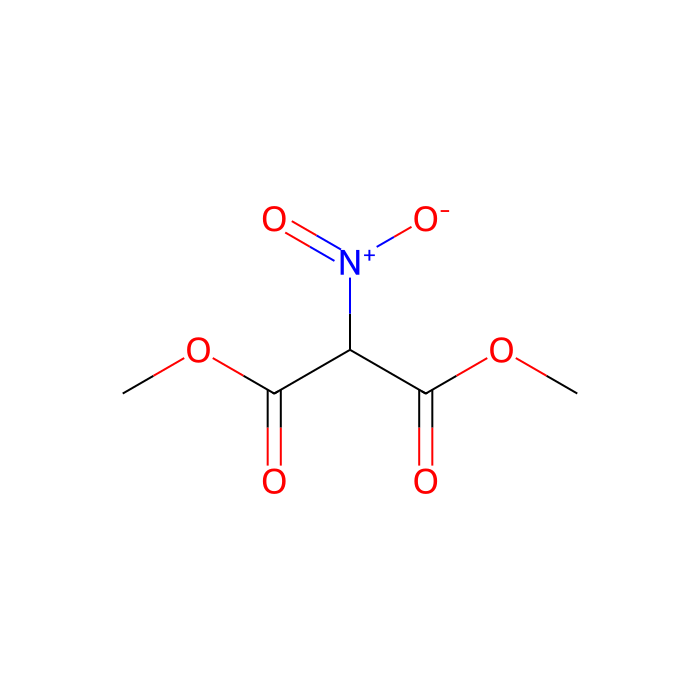
Molecular formula (computed from structure): C5H7NO6
Molecular weight (computed): 177.11 g/mol
Typical SMILES (literature): COC(=O)C(NO2)C(=O)OC
Core structural motif: a 1,3-dicarbonyl (malonate) diester with an α-nitro substituent on the central methine carbon.
Functional groups: two methyl esters (–CO2Me), one nitro group (–NO2) on the α-carbon.
2D description: A central sp3 carbon bearing –NO2 and flanked by two carbonyl carbons; each carbonyl is esterified with a methoxy group. No stereogenic centers (the α-carbon is prochiral but typically handled as achiral).
Synthetic Utility
Functional group portfolio
α‑Nitro group: versatile handle—reduction to amine, Nef conversion to carbonyl, or elimination/denitration under specific conditions.
Diester (malonate): enables decarboxylation, selective hydrolysis, transesterification, and serves as a masked acyl anion equivalent in C–C bond formation.
Retrosynthetic value (literature)
Serves as a linchpin for constructing β‑nitro carbonyls (via Knoevenagel/Michael), α‑amino esters (via reduction), and 1,3‑dicarbonyl frameworks with tunable substitution via sequential deprotonation–alkylation.
Orthogonal manipulation: The nitro and ester groups can be addressed independently, allowing route flexibility (e.g., alkylate → reduce –NO2 → cyclize; or Nef → decarboxylate → carbonyl rearrangements).
Control mono‑ vs dialkylation by stoichiometry and base choice; weak bases (K2CO3/Cs2CO3) often favor mono‑functionalization.
Protect against hydrolysis when aqueous workups are necessary; perform rapid, cold quench and promptly extract to organic phase.
Target Specificity
Not applicable. This product is a small-molecule reagent and does not possess biological target specificity, antigen/epitope information, or clone/isotype characteristics.
Usamos cookies para garantir o funcionamento adequado do site e, quando permitido, para melhorar a sua experiência. Você pode gerenciar suas preferências a qualquer momento nas Configurações. Saiba mais em nossa Política de Cookies.
Deseja que lhe enviemos uma mensagem quando tivermos descontos disponíveis?
Lembrar-me mais tarde
Obrigado! Por favor, verifique a sua caixa de entrada de e-mail para confirmar.
Products are supplied to verified businesses, institutions, and qualified professionals for research and development use only. Not for use in humans, animals, diagnosis, or therapy.

 E23151078