GRADE & PURITYMoligand™?Moligand™ — Aladdin's line of ligands and bioactive small molecules. Use for receptor, pathway, and binding studies needing defined small-molecule tools.10 mM in DMSO
Moligand™, 10 mM in DMSO Moligand™ for sensitive chromatographic and analytical workflows requiring minimal baseline interference.
🌡
Storage & shipping
Store at -80°C Ships Dry ice packs + Cold packs Check lot-specific COA for exact specifications.
📋
Quality documents
SDS, COA, datasheet, and spec sheet available for download. Lot-specific COA accessible via lot number lookup.
📚
Literature proof
Cited in 1 peer-reviewed publications across chromatography, organic synthesis, and cross-coupling reactions.
Visão geral
Dimethylmalonic acid is a short-chain dicarboxylic acid in human serum. Dimethylmalonic acid is also a volatile organic compound detected in alveolar breath.
Specifications
Especificações e pureza
Moligand™, 10 mM in DMSO
Condições de armazenamento de armazenamento
Store at -80°C
Enviado em
Dry ice packs + Cold packs
Este produto requer transporte de cadeia fria. Serviços terrestres e outros serviços econômicos não estão disponíveis.
Determine the necessary mass, volume, or concentration for preparing a solution.
Dilution Calculator
Determine the dilution needed to prepare a stock solution.
Reconstitution Calculator
Revisões
Avaliações dos Clientes
Application Protocols
This listing is for a small-molecule research chemical, not an antibody or kit. No vendor-tested biological assay protocols are provided for this item.
Tested applications, recommended dilutions, and positive controls: Not applicable.
General guidance for library use (literature/practice-based)
Stock solutions: Prepare concentrated stocks (e.g., 10–100 mM) in DMSO or water (adjusting pH to enhance solubility as needed). Filter through 0.22 µm if your workflow requires particulate-free solutions.
Plate handling: For high-throughput screening, dispense with calibrated acoustic or pin tools; limit DMSO to assay-tolerated levels (commonly 0.1–1% v/v).
Controls: Include vehicle and pH-matched controls; confirm activity with orthogonal readouts where possible.
Please refer to your laboratory’s SOPs and validate any protocol parameters locally.
Biological Roles
Item is provided strictly for research use. The following context is general, literature-based information about related chemotypes and does not constitute medical or clinical claims.
Chemical class: Dicarboxylic acid (gem-dimethyl-substituted malonic acid). Unlike malonic acid itself (a known metabolic inhibitor of succinate dehydrogenase), the gem-dimethyl substitution alters physicochemical properties and may change biological interactions.
Potential roles in biochemical studies (literature/general):
Acid–base and ion-pairing studies: The presence of two acidic groups enables investigation of di-anionic binding motifs with metal ions or basic protein residues.
Membrane permeability and ionization: As a diacid with relatively low logP in neutral form and high polarity when ionized, it can serve as a reference chemotype for correlating permeability with ionization state.
Enzyme substrate/inhibitor analog screening: As part of a small-molecule library, it may be profiled against enzyme panels to map noncovalent interactions driven by carboxylate coordination.
Transport and metabolism: No established endogenous metabolic pathway is attributed to 2,2-dimethylmalonic acid specifically; any metabolism would likely proceed via conjugation/activation of carboxyl groups (literature inference). Empirical ADME properties must be determined experimentally for the intended biological system.
Note: For all biological studies, ensure assay media compatibility (pH/ionic strength) and define the counterion if salts are used, as ion pairing can strongly affect observed activity.
Buffer Applications
Dimethylmalonic acid is a diacid but is not a standard buffering reagent in biochemistry. If a dicarboxylic acid buffer is required, researchers more commonly select malonic, succinic, adipic, or phthalic acid systems with well-characterized pKa values and buffering ranges.
Applicability to buffering: Possible in principle (two dissociation steps), but not typically used as a primary buffer due to limited tabulated constants and adoption.
Practical guidance (if used experimentally):
Determine the pKa values under your ionic strength and temperature by titration; establish the useful buffering window (approximately pKa ± 1 pH unit for each step).
Prepare solutions gravimetrically; adjust pH with standardized NaOH or KOH to the desired setpoint.
Verify compatibility with your assay components (metal ions, amines), as carboxylate ligation can perturb enzyme behavior.
Recommendation
Prefer established buffers with robust literature support for reproducibility and ease of peer review. Use dimethylmalonic acid as a buffer component only if your study explicitly requires this scaffold.
Green Alternatives
This product is a solid building block rather than a process solvent; “green alternatives” primarily concern solvent and reagent choices around its use.
Greener choices around common transformations (literature/general guidance)
Dissolution and stocks:
Prefer water or aqueous buffers (adjust pH to enhance solubility) over high-boiling aprotics where assay-compatible.
Ethanol can substitute for methanol in Fischer esterifications to reduce toxicity.
Activations/couplings:
Use carbodiimide chemistry in water or aqueous-organic mixtures (e.g., EDC·HCl with NHS in water/MeCN) to avoid acid chlorides and chlorinated reagents.
If an acid chloride is required, consider Ghosez’s reagent alternatives or catalytic DMF in thionyl chloride with appropriate scrubbing; assess lifecycle and waste.
Reaction media:
Shift from DMF/DMAc/NMP to acetone/2-MeTHF/ethyl acetate or water when feasible.
Illustrative comparison (qualitative)
Acid chloride route (SOCl2/oxalyl chloride): efficient activation but generates HCl/SO2/CO/CO2; requires scrubbing and chlorinated waste handling.
EDC/NHS coupling in water or EtOAc: milder, fewer halogenated byproducts; urea waste still generated but easier to manage.
Aqueous pH-control dissolution vs DMSO stocks: water is greener and easier to remove; DMSO offers superior solubilization and freeze–thaw stability—choose based on assay tolerance.
Operational tips
Target aqueous or bio-based solvents where solubility/performance allow.
Minimize protecting-group steps by leveraging the innate diacid functionality.
Evaluate solvent substitution with small-scale solubility and reactivity screens.
Pharmaceutical Uses
No clinical/therapeutic claims are made. The information below concerns formulation and manufacturing chemistry in a general, literature-based sense.
Excipient status: Dimethylmalonic acid is not a common pharmacopeial excipient.
Synthetic intermediate context:
Decarboxylation to pivalic acid derivatives can be leveraged in the preparation of pivalate esters and pivaloylated motifs, which occasionally serve as protecting groups or pro-moieties in process chemistry.
Activation to acid chlorides/anhydrides enables amide/ester couplings to generate gem-dimethyl-containing frameworks with favorable steric and stability profiles.
Salt and counterion considerations: As a diacid, it can form crystalline salts with basic APIs for solid-form screening; however, such use requires case-by-case evaluation (solubility, hygroscopicity, stability) and is not standard.
Impurity/scavenging: Carboxylic acids can sometimes be used to quench basic reagents or capture alkylating agents in process development; any such role must be validated.
Regulatory note
No pharmacopeial monograph is cited here. If use in a regulated context is contemplated, full qualification (identity, purity, residual solvents, elemental impurities) must be established according to ICH/compendial guidance.
Physical Properties
Item-specific specifications (this lot):
Appearance: Not specified for this item; refer to CoA/Spec Sheet.
Molecular formula: Not specified for this item; refer to CoA/Spec Sheet.
Molecular weight: Not specified for this item; refer to CoA/Spec Sheet.
Literature/general reference values (for planning only; not product specifications):
Molecular formula (literature): C5H8O4
Formula weight (literature): ~132.11 g/mol
Physical state: typically a crystalline solid (literature)
Melting point: often reported near 190–195 °C, may show partial decomposition on heating (literature; values vary with purity and method)
Boiling behavior: dicarboxylic acids of this type do not distill cleanly; thermal decarboxylation tends to occur upon strong heating (literature)
Solubility: expected to be soluble in polar protic solvents (water, methanol, ethanol) and in DMSO; lower solubility in nonpolar hydrocarbons (literature)
Acid-base: diacid with two carboxyl groups; exhibits two dissociation steps (pKa1 < pKa2), with reported values in the acidic-to-weakly-acidic ranges typical of substituted malonic acids (literature; consult primary sources for exact values)
LogP: anticipated low due to double acidity; increases with ionization state suppression in nonaqueous media (literature, qualitative)
Practical notes
Hygroscopicity for this specific item is not specified; handle under dry conditions as a precaution.
For quantitative properties controlling a process (e.g., precise solubility, pKa), verify with primary literature or measure under your exact conditions.
Quality and Grades
Item grade (as listed): Moligand™.
What Moligand™ generally implies (program-level context; not item-specific specifications)
Curated small-molecule/ligand library eligibility: Intended for screening, hit discovery, and medicinal chemistry triage. Emphasis on identity verification and research usability.
Lot-level documentation: Identity and basic quality attributes are typically traceable via CoA/Spec Sheet. Specific analytical metrics (e.g., purity percentage, residual solvents, water content, metal content, peroxide levels, UV cutoffs) are NOT provided here and should be taken from the CoA.
How to use this grade effectively
Screening stocks: Prepare concentrated DMSO or aqueous stocks appropriate for your assay format; filter if your workflow requires particle-free solutions.
Orthogonal confirmation: For actives/hits, confirm identity/purity by independent analytical methods in your lab (e.g., LC–MS, quantitative NMR) prior to SAR decisions.
Stabilizers/additives: Not specified for this item; refer to CoA/Spec Sheet. If stabilizers are present in any Moligand™ items, understand their potential assay interferences before use.
Summary of item-specific quality information
Purity/assay, residuals, and other specifications: Not specified for this item; refer to CoA/Spec Sheet.
Appearance: Not specified for this item; refer to CoA/Spec Sheet.
Note: Never assume generic solvent grades (ACS, HPLC, etc.) apply; Moligand™ denotes a research compound/library context rather than a solvent or chromatographic grade.
Reaction and Applications
As a gem-dimethylated malonic acid, dimethylmalonic acid is a versatile C1–C2 retron for constructing tert-alkyl carboxylic acids and activated acyl derivatives.
Key application families (literature/general)
Thermal decarboxylation to tert-alkyl acids: Heating 2,2-disubstituted malonic acids expels CO2 to give the corresponding tertiary carboxylic acid. Dimethylmalonic acid decarboxylates to trimethylacetic (pivalic) acid under appropriate thermal or acidic conditions.
Formation of activated derivatives: Conversion to the acid chloride (e.g., SOCl2, oxalyl chloride) or mixed anhydrides enables acylation (amide/ester formation) of nucleophiles, installing a pivaloyl-equivalent moiety after decarboxylation.
Esterification and protection chemistry: Fischer esterification delivers the diester or half-esters, enabling downstream alkylation/condensation strategies from the malonate platform.
Dehydrative cyclizations/anhydride formation: Geminal diacids can form cyclic anhydrides or mixed anhydrides under dehydrating conditions; useful for stepwise derivatization.
Salt formation and phase-transfer: The di-anionic salts (Na/K) can be leveraged for phase behavior or subsequent couplings in biphasic systems.
Practical tips
Control water activity: Dry conditions are preferred for acyl chloride formation and carbodiimide couplings (DCC/EDC + NHS).
Monitor for decarboxylation: Extended heating promotes CO2 loss; if the malonic scaffold is required intact, limit temperature/time and use milder reagents.
Purification: Carboxylic acids may tail on silica; add a small amount of acetic acid to eluents or convert to esters/salts for improved chromatography.
Applications in discovery
As a Moligand™ library member, it can serve as a polar, acidic chemotype for fragment or ligand screening, offering a compact, H-bonding-rich scaffold.
Reaction Conditions
The following are general literature-type conditions for common manipulations of 2,2-dimethylmalonic acid; optimize for your substrate, scale, and equipment.
Decarboxylation to trimethylacetic (pivalic) acid:
Conditions: Heat neat or in a high-boiling inert solvent (e.g., Dowtherm A, xylene) at elevated temperature (commonly 150–200 °C).
Catalysis: Mineral acids (H2SO4, H3PO4) can promote decarboxylation at somewhat lower temperatures; avoid excessive dehydration leading to side reactions.
Workup: Remove solvent, neutralize, and distill/extract the resulting monocarboxylic acid.
Formation of acid chloride:
Reagents: Thionyl chloride (SOCl2) or oxalyl chloride ((COCl)2), optionally with catalytic DMF.
Solvent/temperature: Reflux in DCM, toluene, or neat SOCl2 until gas evolution subsides; maintain anhydrous conditions.
Quench: Careful solvent removal under reduced pressure with appropriate gas scrubbing; use immediately or store under inert atmosphere at low temperature.
Fischer esterification (di- or mono-):
Conditions: Alcohol (MeOH/EtOH), catalytic H2SO4 or p-TsOH, reflux; water removal (Dean–Stark for higher alcohols) improves conversion and controls mono/di-ester ratio.
Carbodiimide-mediated coupling:
Reagents: EDC·HCl (aqueous-compatible) or DCC in DCM/DMF; additives like NHS to form active esters.
Temperature: 0–25 °C typically; monitor for O→N acyl transfer if amines are present.
Yield expectations vary widely with conditions and substrate; consult primary references and run small-scale trials.
Safety and Handling
Authoritative safety information must be taken from the product’s SDS. The following summarizes typical considerations for small dicarboxylic acids and this product’s logistics:
GHS, pictograms, signal word, and H-statements: Not specified for this item; refer to SDS.
General safety guidance (literature/general; not a substitute for the SDS)
Likely hazards: Organic acids commonly cause skin/eye irritation; dust may irritate respiratory tract. Strong heating may cause decomposition with CO2 evolution.
PPE: Use lab coat, safety glasses, and appropriate chemical-resistant gloves (e.g., nitrile). Avoid dust generation and inhalation; handle powders in a fume hood.
Incompatibilities: Avoid strong bases (exothermic neutralization), strong oxidizers, and reactive dehydrating agents (e.g., SOCl2, oxalyl chloride) unless used intentionally under controlled conditions.
First aid (overview): In case of skin/eye contact, rinse with water for several minutes; remove contaminated clothing. If inhaled, move to fresh air. If ingested, rinse mouth. Seek medical attention as indicated by SDS.
Fire behavior: Combustible organic solid; use water spray, CO2, dry chemical, or foam. Thermal decomposition can release irritating fumes.
Handling tips
Allow frozen containers to equilibrate in a desiccated environment before opening to minimize moisture condensation on a cold solid.
Reseal promptly; return to specified storage to maintain library integrity (Moligand™ collection).
Solvent Selection
Dimethylmalonic acid is a polar, diacidic organic solid. Solvent choice depends on application (analytical prep, biological assay stock, or synthetic transformation).
Polarity class: Polar protic/ionic character when neutralized; neutral form is hydrogen-bond donor/acceptor rich.
Miscibility/solubility (literature, qualitative):
Water: typically soluble, especially as salts; solubility of the neutral acid increases with temperature.
Polar organics: good solubility expected in DMSO; moderate in methanol/ethanol; lower in acetonitrile; poor in aprotic nonpolars (hexanes, toluene).
Assay stock preparation:
DMSO is often preferred for library stocks due to broad solubilizing power and freeze–thaw resilience.
For aqueous assays, prepare a DMSO concentrate and dilute into buffered media; or adjust pH above pKa1 to increase aqueous solubility (forming mono-/di-anions). Verify assay tolerance to DMSO and pH.
Analytical sample prep:
For LC–MS, 50–95% water with 0.1% formic acid or ammonium buffer is typically compatible; avoid high salt if ESI is used.
Synthetic use:
For esterifications and couplings, alcohol solvents (MeOH, EtOH) or polar aprotics (DMF, DCM with coupling reagents) are typical.
Quick comparison (literature, qualitative)
DMSO: highest solvency; compatible with −80 °C storage as concentrates.
Water/buffer: greenest option; maximize ionization to increase solubility.
MeOH/EtOH: useful for Fischer esterification and moderate solubility; easier removal than DMSO.
Always confirm solubility experimentally at your target concentration and temperature.
Storage and Reconstitution
Item-specific storage and shipping
Storage condition: Store at −80 °C (per Product Data). Keep container tightly closed.
Shipping: Dispatched on dry ice packs + cold packs (per Product Data) to maintain ultra-cold chain.
General guidance for handling and reconstitution (not item-specific specifications)
Equilibration: Before opening, allow the vial to reach room temperature in a desiccator to prevent moisture condensation on a cold solid.
Atmosphere: Handle quickly under dry ambient conditions; reseal promptly. For long-term archiving of partial vials, consider inert-atmosphere storage with desiccant.
Stock preparation:
DMSO stocks: Common for library compounds owing to broad solubility and freeze–thaw stability. Typical working concentrations 10–100 mM (verify solubility experimentally).
Aqueous stocks: If water is preferred, adjust pH with NaOH/KOH to partially or fully deprotonate for higher solubility; record final pH and counterion.
Aliquoting: Prepare single-use aliquots to minimize freeze–thaw cycles and moisture ingress.
Freeze–thaw: If repeated freeze–thaw is unavoidable, assess compound integrity periodically by LC–MS or NMR.
Specifications not provided here
Appearance, stabilizers, and exact solubility limits: Not specified for this item; refer to CoA/Spec Sheet. Always defer to the SDS for safety-related storage constraints.
Structure and Identity
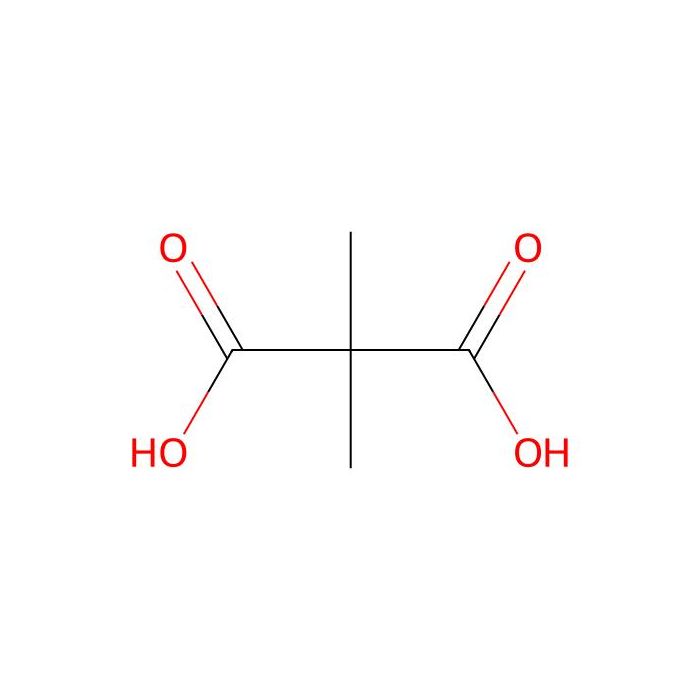
Dimethylmalonic acid is a geminally disubstituted malonic acid (the 2,2-dimethyl analog), making it a compact dicarboxylic acid building block with a quaternary (tert-alkyl) center.
Item-specific identifiers (from Product Data):
CAS: 595-46-0
PubChem CID: 11686
SKU: D1500248
Grade: Moligand™
Literature identity details (for reference; not item-specific specifications):
Structural features: two carboxylic acid groups (–CO2H) attached to a central quaternary carbon bearing two methyl substituents (gem-dimethyl). No stereocenters.
2D structure (verbal): central sp3 carbon substituted by two methyl groups and two carboxyl groups; the molecule is achiral and compact; both acids are equivalent by symmetry.
Common synonyms: 2,2-dimethyl-propane-1,3-dioic acid; dimethylpropanedioic acid (literature)
SMILES/InChIKey: Not specified for this item; refer to CoA/Spec Sheet.
Notes
All item-binding identifiers are as listed under Product Data. The additional molecular and structural descriptors are provided as general literature information for recognition and planning purposes and are not a substitute for the item’s Certificate of Analysis (CoA).
Synthetic Utility
Dimethylmalonic acid provides a compact, gem-dimethyl dicarboxylic motif useful in synthesis and derivatization campaigns.
Key reactive handles
Two carboxylic acids: amenable to esterification, amidation, anhydride formation, and conversion to acid chlorides.
Gem-dimethyl quaternary center: confers steric bulk and can direct selectivity; upon decarboxylation, delivers a tert-alkyl carboxyl functionality (pivaloyl equivalent).
Thermal decarboxylation → pivalic acid: Heating neat or in high-boiling solvents affords trimethylacetic acid; mineral acids can catalyze CO2 loss.
Acyl chloride formation → amide/ester synthesis: SOCl2 or (COCl)2 activation followed by coupling to nucleophiles yields pivaloyl-like products after decarboxylation or mixed anhydrides for selective monoacylation.
Fischer esterification → di-/mono-esters: Acid-catalyzed reaction with alcohols (MeOH, EtOH) under reflux generates esters that can be further manipulated.
Carbodiimide-mediated couplings: EDC/DCC with NHS or HOBt (where appropriate) form activated esters for peptide-like couplings, enabling gem-dimethyl acyl installation.
Anhydride formation: Dehydration of the diacid can produce symmetrical or mixed anhydrides that serve as transient activators.
Strategic use
As a Moligand™ component, it can also act as a polar fragment for SAR elaboration via late-stage coupling, taking advantage of orthogonal activation of each acid group when mono-selectivity is desired (protect one acid as an ester to control sequential reactivity).
Target Specificity
This product is a small-molecule chemical and not a biological affinity reagent. No antigen/epitope or isotype information applies.
Target specificity data: Not applicable.
Tested species reactivity/clone/isotype: Not applicable.
For biochemical screening, any observed target engagement must be determined empirically in the user’s assay systems.
We use cookies to ensure the website functions properly and, where permitted, to improve your experience. You can manage your preferences at any time in Settings. Learn more in our Cookie Policy.
Shall we send you a message when we have discounts available?
Remind me later
Thank you! Please check your email inbox to confirm.
Products are supplied to verified businesses, institutions, and qualified professionals for research and development use only. Not for use in humans, animals, diagnosis, or therapy.