10mM in DMSO for sensitive chromatographic and analytical workflows requiring minimal baseline interference.
🌡
Storage & shipping
Store at -80°C Ships Dry ice packs + Cold packs Check lot-specific COA for exact specifications.
📋
Quality documents
SDS, COA, datasheet, and spec sheet available for download. Lot-specific COA accessible via lot number lookup.
📚
Literature proof
Cited in 3 peer-reviewed publications across chromatography, organic synthesis, and cross-coupling reactions.
Visão geral
Information
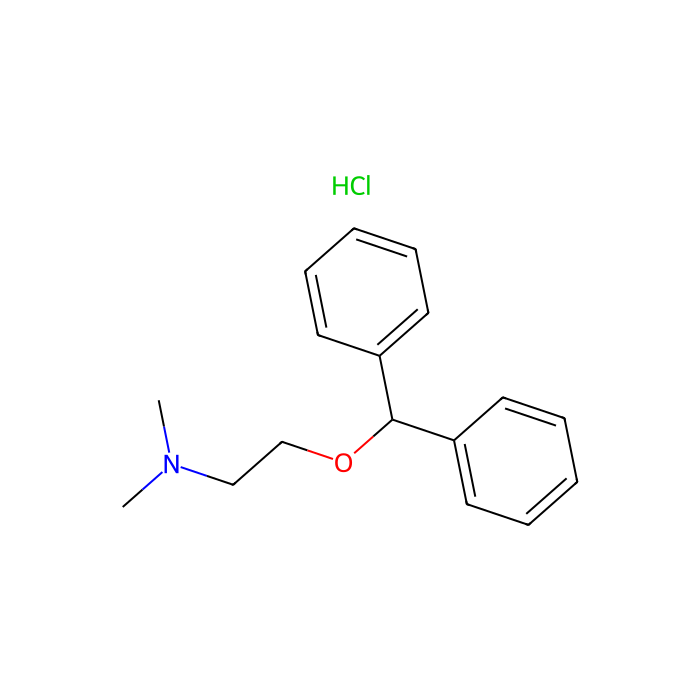
Diphenhydramine HCl is a first-generationhistamine H1 receptorantagonist, used in various allergic conditions such as rhinitis, urticaria and conjunctivitis. In vitro
Diphenhydramine blocks tetrodotoxin-sensitive (TTX-S) and tetrodotoxin-resistant (TTX-R) sodium currents with K(d) values of 48 mM and 86 mM, respectively, at a holding potential of -80 mV. Diphenhydramine shifts the conductance-voltage curve for TTX-S sodium currents in the depolarizing direction but has little effect on that for TTX-R sodium currents. Diphenhydramine causes a shift of the steady-state inactivation curve for both types of sodium currents in the hyperpolarizing direction. Diphenhydramine produces a profound use-dependent block when the cells are repeatedly stimulated with high-frequency depolarizing pulses. Diphenhydramine induces apoptosis in a dose- and time-dependent manner in both CCRF-CEM and Jurkat cell lines, whereas Cimetidine fails to induce significant effects at similar concentrations. Diphenhydramine-induced apoptosis is evaluated in terms of morphology, flow cytometry, and the release of cytochrome c to the cytosol. Diphenhydramine inhibits cell proliferation without inducing apoptosis in human peripheral blood mononuclear cells. Diphenhydramine (500 nM) significantly reduces the baseline firing of the periaqueductal gray neurons without a significant effect on the frequency of postsynaptic potentials. Diphenhydramine at high concentration inhibits periaqueductal gray neurons, but at low concentrations it has no effect on the baseline-firing rate and it blocks the response to neurotensin and tomedial preoptic nucleus stimulation.
Diphenhydramine HCl is a first-generation histamine H1 receptor antagonist, used in various allergic conditions such as rhinitis, urticaria and conjunctivitis.
Condições de armazenamento de armazenamento
Store at -80°C
Enviado em
Dry ice packs + Cold packs
Este produto requer transporte de cadeia fria. Serviços terrestres e outros serviços econômicos não estão disponíveis.
Determine the necessary mass, volume, or concentration for preparing a solution.
Dilution Calculator
Determine the dilution needed to prepare a stock solution.
Reconstitution Calculator
Revisões
Avaliações dos Clientes
Perguntas frequentes
How should this product be stored?
Store at ?80 °C. Ultra-low temperature storage is required to maintain the specified shelf life.
What are the CAS number, molecular formula and molecular weight?
The CAS Number is 147-24-0, the molecular formula is C17H22ClNO, and the molecular weight is 291.82 g/mol.
How is this product shipped?
This product ships frozen with dry ice and cold packs. Unpack on arrival and transfer it to the storage condition stated above; handle dry ice with insulated gloves in a ventilated area.
What documentation is provided?
Available product documentation, including Certificates of Analysis (COA), Safety Data Sheets (SDS), and specification sheets, is shown in the product document area. Document availability and access follow the current site policy.
Usamos cookies para garantir o funcionamento adequado do site e, quando permitido, para melhorar a sua experiência. Você pode gerenciar suas preferências a qualquer momento nas Configurações. Saiba mais em nossa Política de Cookies.
Deseja que lhe enviemos uma mensagem quando tivermos descontos disponíveis?
Lembrar-me mais tarde
Obrigado! Por favor, verifique a sua caixa de entrada de e-mail para confirmar.
Products are supplied to verified businesses, institutions, and qualified professionals for research and development use only. Not for use in humans, animals, diagnosis, or therapy.