Antagonizes the binding of p-aminoclonidine to a2-adrenergic receptors; blocks outward K+ current; blocks voltage-gated K+-channels in rat brain synaptosomes.
This compound belongs to the class of organic compounds known as thioureas. These are organic compounds containing the thiourea functional group, a derivative of urea with the general structure (R1(N)R2C(=S)(R3)R4, R1-R4=H, alkyl, aryl), obtained by replacing the carbonyl group of urea with a thiocarbonyl group.
External Descriptors
Not available
1. Djoumbou Feunang Y, Eisner R, Knox C, Chepelev L, Hastings J, Owen G, Fahy E, Steinbeck C, Subramanian S, Bolton E, Greiner R, and Wishart DS. ClassyFire: Automated Chemical Classification With A Comprehensive, Computable Taxonomy. Journal of Cheminformatics, 2016, 8:61.
Determine the necessary mass, volume, or concentration for preparing a solution.
Dilution Calculator
Determine the dilution needed to prepare a stock solution.
Reconstitution Calculator
Revisões
Avaliações dos Clientes
Application Protocols
No application protocols are specified for this item in the Product Data. For general laboratory use:
Preparing stock solutions (research guidance): Dissolve in DMSO, DMF, ethanol, or aqueous ethanol to the desired concentration (e.g., 10–100 mM); filter if required. Adjust solvent choice to downstream reaction or complexation needs.
Metal complexation (generic example): Combine metal salt (e.g., Cu(II), Ni(II)) with dithiobiuret in ethanol or aqueous ethanol (1:1–1:2 molar), stir at ambient temperature to gentle reflux until complex precipitates; isolate by filtration and wash with cold solvent. Optimize conditions per metal/ligand system.
These are non-validated, literature-style suggestions intended for experienced chemists. Always confirm suitability with small-scale trials and consult primary literature.
Biological Roles
Item-specific: None specified; this product is for research use only.
Literature/General context:
Dithiobiuret is not an endogenous metabolite and has no established physiological role. It serves primarily as a chemical probe/ligand in coordination and materials research.
Thioamide groups can modulate hydrogen-bonding and conformational preferences in biomimetic systems; dithiobiuret derivatives are occasionally used to study thioamide effects on peptide-like backbones or metal–protein model complexes.
Interaction with metals: Due to soft sulfur donors, dithiobiuret binds to soft/borderline metal centers, enabling model studies of metalloprotein active sites under controlled, non-physiological conditions.
Toxicology note (general; no clinical claims): Thioamide-containing small molecules can perturb thyroid function in certain organisms at sufficient exposures; treat dithiobiuret as potentially bioactive and limit exposure to laboratory settings.
Research use statement: This material is intended solely for laboratory research and development. It is not intended for human or veterinary use, diagnostic procedures, or as a food/drug additive.
Buffer Applications
Dithiobiuret is not a buffering agent and is not typically used to prepare pH-stable buffer systems. Its multiple N–H groups are involved in thioamide resonance and coordination, not in establishing defined acid–base buffer ranges. For buffer preparation, use established systems (e.g., phosphate, Tris, HEPES), and consult the sections on Solvent Selection and Reaction & Applications for guidance on dissolving or reacting dithiobiuret in buffered or aqueous media when necessary.
Green Alternatives
Context: Dithiobiuret is a sulfur-rich, multi-donor ligand/reagent. Greener choices depend on the target transformation (ligand design, S-transfer, or heterocycle formation).
Pros: Widely available, lower molecular complexity, often higher aqueous solubility; extensive data on safety and handling.
Cons: Monodentate vs dithiobiuret’s potential bidentate/bridging coordination; different selectivity in S-alkylations.
Thioacetamide
Pros: Common sulfur donor in aqueous media; simpler workups.
Cons: Different reactivity profile and safety considerations; limited multidentate coordination.
L-cysteine or glutathione (as S donors in water)
Pros: Bio-based, aqueous compatibility.
Cons: Narrow pH windows, competing functional groups, and reduced synthetic scope for electrophilic substitutions.
Solvent greening:
Prefer ethanol or water/ethanol mixtures for metal complexation and crystallization when feasible instead of DMF/DMSO.
For S-alkylations, consider MeCN or 2-MeTHF (when compatible) rather than DMF; however, solubility may limit performance.
Trade-offs:
Replacing dithiobiuret in coordination chemistry sacrifices chelation geometry and binding strength unique to bis-thioamides.
Greener solvents may reduce solubility, requiring higher temperatures or longer times.
In practice, a tiered approach—starting with ethanol/water and simpler S-donors—can reduce environmental impact, then escalate to dithiobiuret/stronger solvents only if performance demands it.
Pharmaceutical Uses
Item-specific: No pharmacopeial grade or excipient designation is provided for this item; Not specified for this item; refer to CoA/Spec Sheet.
General context (non-clinical, formulation/manufacturing perspective):
Dithiobiuret is not a common pharmaceutical excipient and has no monograph in major pharmacopeias to the best of general knowledge. Its strong coordination and reactive thioamide functionality make it more suitable for research in medicinal chemistry or coordination chemistry rather than as a formulation aid.
Potential roles in R&D workflows include:
Ligand precursor for synthesizing metal complexes evaluated in pre-formulation studies (e.g., solubility, stability) strictly within research settings.
Building block for generating heterocyclic scaffolds in discovery chemistry.
Regulatory note: Any use in GMP or clinical contexts would require rigorous impurity profiling, residual solvent control, and toxicological evaluation—outside the scope of this research-grade listing.
This product is supplied for research use only and is not intended for use as an active pharmaceutical ingredient or excipient.
Physical Properties
Item-specific specifications (Product Data):
Appearance: Not specified for this item; refer to CoA/Spec Sheet.
Molecular weight: Not specified for this item; refer to CoA/Spec Sheet.
Literature/General properties (for context; not item specifications):
Physical state: typically a crystalline solid for thiourea/biuret analogues.
Phase behavior: thioamide solids often melt/decompose upon heating rather than exhibit a clean distillation range; purification commonly via recrystallization.
Polarity/H-bonding: strong H-bond donor (3 × N–H) and moderate H-bond acceptor (C=S) sites; forms extended H-bond networks in the solid state.
Solubility (qualitative): sparingly to moderately soluble in water; greater solubility in polar protic (e.g., ethanol, methanol) and highly polar aprotic solvents (e.g., DMSO, DMF); limited solubility in nonpolar hydrocarbons.
Partitioning: expected low logP due to multiple N–H donors balanced by limited hydrophobic surface; actual value context-dependent.
Spectroscopy: thioamide C=S stretch typically observed in IR near 1180–1050 cm−1 (literature range); N–H stretches around 3300–3150 cm−1; UV shows n→π* transitions characteristic of C=S.
Acid/base behavior: thioamide N–H protons are markedly less basic than amines and show weak acidity in strongly basic media; S centers are soft nucleophiles and ligate soft metal centers.
Note: For exact BP/MP, density, refractive index, elemental analysis, water content, or UV cutoff specific to this Aladdin item, please refer to the item’s CoA/Spec Sheet. No numeric specifications are provided here.
Quality and Grades
Item-specific (Product Data):
Grade/Purity: Not specified for this item; refer to CoA/Spec Sheet.
Guidance on grades and what to expect:
Research-grade dithiobiuret is typically supplied as a crystalline solid with assay determined by HPLC, GC, or qNMR and identity confirmed by NMR/IR/MS. Absent an explicit grade, treat as research reagent suitable for synthetic and analytical laboratory use.
UV/Chromatography: If intended for photochemical or chromatographic work, low-UV-absorbing grades are sometimes preferred, but this is not specified for this item.
Residuals and limits: Water content, residual solvents, inorganics, and trace metals can influence catalysis and coordination chemistry outcomes. For this specific SKU, such quantitative limits are not specified; consult the CoA.
Stabilizers: Thioamides generally do not require stabilizers. No stabilizer is indicated for this item.
Recommendations:
Before metal-complexation or catalysis studies, consider drying the solid under vacuum at ambient temperature and screening for water content (e.g., KF titration) if moisture sensitivity is a concern.
For analytical work, request or review chromatographic purity, residual solvent profile, and identification spectra from the CoA to ensure suitability for your application.
Reaction and Applications
Coordination chemistry (literature/general):
The two thioamide sulfur atoms make dithiobiuret a versatile bidentate/bridging ligand for soft and borderline metal ions (e.g., Cu, Ni, Co, Zn, Cd, Hg). Complexes often exhibit distinctive optical and redox properties and are studied in catalysis and materials chemistry. Binding mode can be S,S′-chelation or mixed S,N depending on conditions and metal preference.
Synthetic transformations:
S-alkylation/S-acylation: Reaction of the thioamide sulfur(s) with alkyl halides, sulfonates, or acylating agents affords isothiourea-type derivatives and thioimidate analogues. Bases such as K2CO3, Cs2CO3, or DBU in DMF/DMSO/MeCN are common.
N-acylation/Protection: The three N–H sites can be differentially acylated or protected; chemoselectivity can be tuned by base, solvent, and temperature.
Heterocycle synthesis: Condensation/cyclization with 1,2-dicarbonyls, acid chlorides, or activated diesters can generate thiadiazoles, triazines, and related N,S-heterocycles (mechanisms often proceed via thioimidoyl intermediates).
Sulfur transfer: Acts as a sulfur donor under certain conditions, enabling thionation or incorporation of sulfur into target frameworks (often in the presence of activating agents).
Practical tips:
Control stoichiometry to avoid over-alkylation across the two S and three N sites.
Conduct air/moisture-sensitive steps under inert atmosphere when using reactive electrophiles or moisture-labile metal salts.
For complexation, slow diffusion or vapor diffusion crystallization (EtOH/Et2O or MeOH/Et2O) can yield X-ray quality crystals.
These applications are derived from literature precedent on bis-thioamide scaffolds and should be adapted to your system with small-scale pilots.
Reaction Conditions
The following are general literature-style guidelines (not item specifications). Optimize for your specific system.
Temperature/time: 20–60 °C, 2–24 h, depending on electrophile reactivity.
Notes: Monitor for over-alkylation (both S centers) and possible N-alkylation at elevated temperatures.
N-acylation/protection:
Reagents: Acyl chlorides/anhydrides with triethylamine or pyridine; carbamoyl chlorides for urea-type derivatives.
Solvent: Dichloromethane, THF, or DMF (dry).
Temperature: 0 °C to rt for selectivity; warm cautiously if needed.
Heterocycle formation (condensation with 1,2-dicarbonyls):
Solvent: Ethanol or acetic acid; sometimes aqueous ethanol.
Catalyst: Acids (AcOH, p-TsOH) or Lewis acids.
Temperature: Reflux 2–8 h.
Metal complexation:
Medium: EtOH/MeOH/H2O.
Stoichiometry: 1:1 to 1:2 (metal:ligand) typical; adjust pH to modulate S vs N binding.
Workup: Filtration/crystallization; slow evaporation for X-ray quality crystals.
Analytics and control:
IR (C=S ~1180–1050 cm−1), 1H/13C NMR (C=S ~180–200 ppm by 13C), MS to verify substitution pattern.
These ranges are typical for bis-thioamide chemistry; run small-scale trials to tune base strength, solvent polarity, and temperature.
Safety and Handling
Item-specific hazard information (Product Data):
Signal word: Not specified for this item; refer to SDS.
H-statements: Not specified for this item; refer to SDS.
GHS classification/pictograms: Not specified for this item; refer to SDS.
General safety profile (literature/analog-based; not a substitute for SDS):
Hazard overview: Thioamide-containing compounds may cause irritation to skin, eyes, and respiratory tract; ingestion or inhalation of dust can be harmful. Avoid generation of dust and aerosol. Use only in a chemical fume hood.
Potential chronic concerns: Some thiourea analogues have shown thyroid-related effects in animal studies; treat as potentially harmful—practice stringent exposure control (no clinical claims implied).
Incompatibilities: Strong oxidizers (risk of exotherm/oxidation), strong nitrosating agents, and strong bases (which may promote decomposition or deprotonation). Avoid reactive acyl/alkylating agents unless intended for synthesis.
Thermal decomposition: Heating can lead to decomposition with release of irritating sulfur- and nitrogen-containing gases (e.g., H2S, SOx, NOx) under severe conditions.
PPE: Lab coat, nitrile gloves, and splash goggles at minimum. Consider double-gloving for extended handling. Use a NIOSH-approved respirator if dust formation cannot be controlled (per institutional policy).
First aid (summary; follow SDS):
Inhalation: Move to fresh air; seek medical attention if symptoms persist.
Skin/eye contact: Rinse with water for at least 15 minutes; remove contaminated clothing; seek medical evaluation if irritation continues.
Ingestion: Rinse mouth; do not induce vomiting; obtain medical attention.
Always consult the product-specific SDS for authoritative hazard classifications and emergency measures.
Solvent Selection
Polarity and H-bonding considerations (literature/general):
Dithiobiuret is a highly polar, polyfunctional H-bond donor (3 × N–H) with two soft Lewis-basic sulfur atoms. It dissolves best in polar protic solvents (water, methanol, ethanol) and polar aprotic solvents (DMSO, DMF). Solubility in nonpolar solvents (hexanes, toluene) is typically poor.
Practical solvent choices by task:
Spectroscopy/NMR: DMSO-d6 or D2O with mild base/acid for exchange studies; MeOD-d4 for routine 1H/13C (beware H/D exchange of NHs).
S-alkylation/S-acylation reactions: Dry DMF, DMSO, MeCN, or alcohols; include a base such as K2CO3/Na2CO3 or a non-nucleophilic base depending on electrophile.
Metal complexation: Ethanol, methanol, water, or aqueous alcohols facilitate dissolution of both ligand and metal salts; adjust pH to modulate binding if necessary.
Crystallization: Alcohols (EtOH/iPrOH) or aqueous alcohols often afford good crystal growth due to strong H-bonding and moderate volatility.
Comparison snapshot (general):
DMSO: Highest solvating power; excellent for stock solutions; high boiling point can complicate workup.
DMF: Strong solvent for reactions; easy to quench/work up; moisture sensitive electrophiles require dry conditions.
Ethanol: Greener choice; good solubility; compatible with many complexation protocols; easier solvent removal.
Selecting solvent should balance solubility, reactivity (e.g., avoid competing nucleophilicity), and downstream isolation needs.
Storage and Reconstitution
Item-specific storage (from Product Data): Store at room temperature. Shipped at ambient conditions.
General storage guidance (literature/typical for thioamide solids):
Keep tightly closed in a dry, well-ventilated place. Protect from prolonged exposure to heat and strong light.
Minimize contact with strong oxidizers and bases. If long-term storage is planned, consider desiccation and secondary containment to prevent moisture uptake and cross-contamination.
Reconstitution and solution handling (research guidance):
Solubility: Readily dissolves in polar media such as DMSO, DMF, ethanol, and aqueous ethanol; limited solubility in nonpolar solvents.
Preparing stock solutions: Use dry, oxygen-free solvents if subsequent steps are moisture/air sensitive. Filter sterilize only if necessary for your application (0.2 μm PTFE/nylon compatible with the chosen solvent).
Solution stability: Thioamides can slowly degrade in strongly basic or strongly oxidizing solutions. Prepare fresh solutions as needed, or store aliquots at 2–8 °C protected from light for short periods. Avoid repeated freeze–thaw cycles by aliquoting.
Disposal: Collect waste and contaminated materials in halogen-free organic or aqueous organosulfur waste streams according to institutional and regulatory guidelines.
For any item-specific stability data (e.g., solution shelf life, water content, assay), consult the CoA/Spec Sheet and SDS.
Structure and Identity
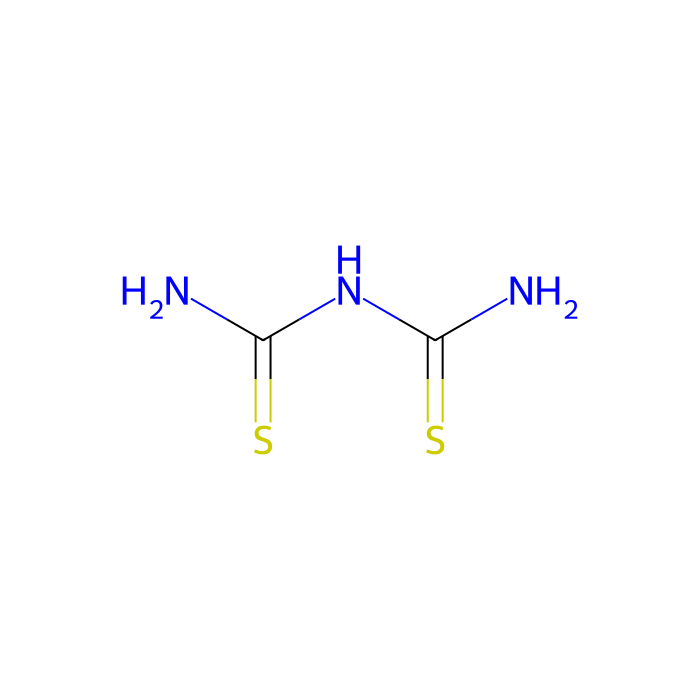
Brief overview: Dithiobiuret is the sulfur analogue of biuret, featuring two thioamide (C(=S)–NH) units linearly connected through a secondary amide nitrogen.
Item-specific (from Product Data):
SKU: D113564
CAS: 541-53-7
Storage: Room temperature
Shipped: Normal
Category: Small molecules and compound library (全部 / 可售 / 小分子和化合物库)
Molecular formula: Not specified for this item; refer to CoA/Spec Sheet.
Molecular weight: Not specified for this item; refer to CoA/Spec Sheet.
InChIKey: 161480 (as provided in Product Data)
SMILES: Not specified for this item; refer to CoA/Spec Sheet.
Literature/General identity (for scientific context; verify against CoA for this item):
Common structural description: H2N–C(=S)–NH–C(=S)–NH2 (a bis-thioamide/bis-thiourea motif).
Functional groups: two thioamide carbonyl equivalents (C=S), three N–H donors; two soft Lewis base sulfur atoms.
Electronic features: thioamide resonance (n→π* and π→π* transitions of C=S), potential thioamide–imidthiol tautomerism in certain media.
2D structural description in words:
Linear chain with terminal primary thioamide (–NH2 attached to C(=S)–), a central secondary amide nitrogen (–NH–), and a second terminal primary thioamide. Each C(=S) is sp2-like, and the N–C(=S)–N segments are typically planar due to conjugation.
Synthetic Utility
Functional group leverage:
Dual thioamide C(=S) groups enable diverse reactivity at both sulfur and nitrogen sites. The three N–H donors allow stepwise protection/acylation, while sulfur centers undergo S-alkylation/acylation and coordinate to metals.
Retrosynthetic value (literature/general):
Serves as a modular synthon to introduce bis-thioamide motifs into targets or to construct heterocycles (e.g., thiadiazoles, triazines) via condensation with di-electrophiles.
As a ligand platform, enables rapid access to S,S′-chelated metal complexes by simple salt metathesis in protic solvents.
Typical transformations:
Electrophilic substitution at S: Alkyl halides, acid chlorides/anhydrides (with base) to give thioimidate/isothiourea derivatives.
N-functionalization: Carbamoylation, sulfonylation, or selective mono-/diacylation leveraging differential acidity/reactivity of terminal vs central NH.
Cyclizations: Reaction with 1,2-dicarbonyls or activated diesters to form N,S-heterocycles; thermal or Lewis acid activation may be employed.
Metal-binding: Precipitation of metal–dithiobiuret complexes from alcoholic media; tunable stoichiometry (1:1, 1:2) by reagent ratios.
Practical notes:
Control chemoselectivity through solvent choice (polar aprotic for S-alkylation; protic for complexation) and base strength.
Analyze product mixtures by 13C NMR (C=S resonances), IR (C=S stretch), and HRMS to confirm site of substitution and degree of functionalization.
Target Specificity
Not applicable. This product is a small-molecule reagent/ligand, not a biological antibody or affinity reagent. No target antigen, epitope, clone, isotype, or species reactivity is defined for this item.
Perguntas frequentes
What is the purity of this product?
This product is supplied at ≥97% purity (chemical assay). Lot-specific values are stated on the Certificate of Analysis.
How should this product be stored?
Store at room temperature.
How is this product shipped?
This product ships under standard ambient conditions. No temperature-controlled packaging is required.
What are the CAS number, molecular formula and molecular weight?
The CAS Number is 541-53-7, the molecular formula is C2H5N3S2, and the molecular weight is 135.21 g/mol. InChIKey JIRRNZWTWJGJCT-UHFFFAOYSA-N.
What documentation is provided?
Available product documentation, including Certificates of Analysis (COA), Safety Data Sheets (SDS), and specification sheets, is shown in the product document area. Document availability and access follow the current site policy.
Usamos cookies para garantir o funcionamento adequado do site e, quando permitido, para melhorar a sua experiência. Você pode gerenciar suas preferências a qualquer momento nas Configurações. Saiba mais em nossa Política de Cookies.
Deseja que lhe enviemos uma mensagem quando tivermos descontos disponíveis?
Lembrar-me mais tarde
Obrigado! Por favor, verifique a sua caixa de entrada de e-mail para confirmar.
Products are supplied to verified businesses, institutions, and qualified professionals for research and development use only. Not for use in humans, animals, diagnosis, or therapy.

 G2602768