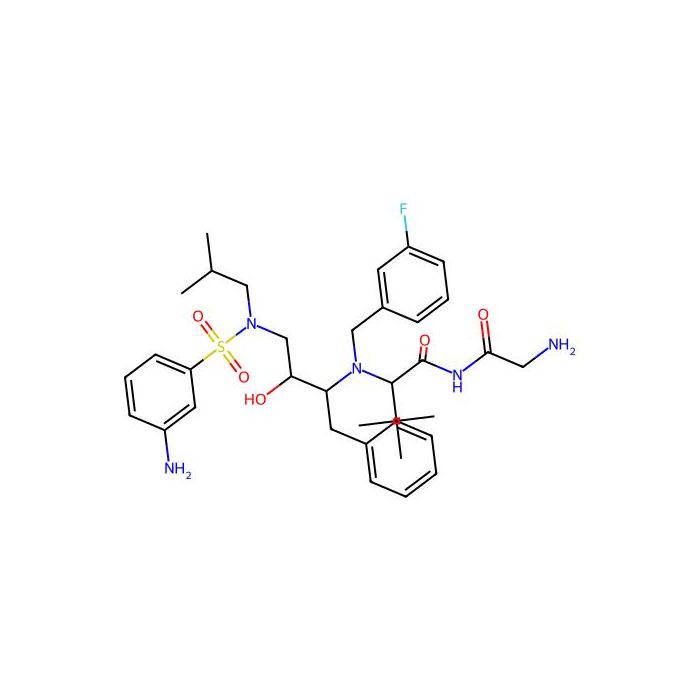
DPC-681 is a potent and selective inhibitor of HIV protease with IC90s for wild-type HIV-1 of 4 to 40 nM.IC50 value: 4 - 40 nM Target: HIV protease in vitro: DPC 681 is extremely potent inhibitor of wild-type HIV-1. When all of the HIV-1 strains tested are considered, the average concentrations required for 90% inhibition of replication were 7.3 ± 3.4 for DPC 681. DPC 681 shows no loss in potency toward recombinant mutant HIVs with the D30N mutation and a fivefold or smaller loss in potency toward mutant variants with three to five amino acid substitutions.in vivo: The total body clearance (CL) of DPC 681 in dogs was high (1.8 liter/h/kg) equaling hepatic blood flow for this species (1.8 liter/h/kg). After an oral dosing, the Cmax increased ninefold between the 10- and 30-mg/kg DPC 681 dose groups. Bioavailability also increased between the 10- and 30-mg/kg dose groups (18.3 and 78.1%, respectively). These data suggest that hepatic extraction (first-pass effect) can be saturated in the dog.
Form:Solid
IC50& Target:HIV-1
Especificações
Sinónimos
DPH 153893 | N-((3-Fluorophenyl)methyl)glycyl-N-((1S,2R)-3-(((3-aminophenyl)sulfonyl)(2-methylpropyl)amino)-2-hydroxy-1-(phenylmethyl)propyl)-3-methyl-L-valinamide | 2-Amino-N-(N-{4-[(3-aminobenzene-1-sulfonyl)(2-methylpropyl)amino]-3-hydroxy-1-phenylbutan-2-yl}-N-[(3-fluorophenyl)methyl]-3-methylvalyl)ethanimidic acid | (2R)-N-(2-aminoac Show more
Especificações e pureza
≥99%
Mecanismos bioquímicos e fisiológicos
DPC-681 is a potent and selective inhibitor of HIV protease with IC90s for wild-type HIV-1 of 4 to 40 nM.\nIC50 value: 4 - 40 nM \nTarget: HIV protease in vitro: DPC 681 is extremely potent inhibitor of wild-type HIV-1 . When all of the HIV-1 strains t
Condições de armazenamento de armazenamento
Store at -20°C
Enviado em
Ice chest + Ice pads
Este produto requer transporte de cadeia fria. Serviços terrestres e outros serviços econômicos não estão disponíveis.
This compound belongs to the class of organic compounds known as valine and derivatives. These are compounds containing valine or a derivative thereof resulting from reaction of valine at the amino group or the carboxy group, or from the replacement of any hydrogen of glycine by a heteroatom.
External Descriptors
Not available
1. Djoumbou Feunang Y, Eisner R, Knox C, Chepelev L, Hastings J, Owen G, Fahy E, Steinbeck C, Subramanian S, Bolton E, Greiner R, and Wishart DS. ClassyFire: Automated Chemical Classification With A Comprehensive, Computable Taxonomy. Journal of Cheminformatics, 2016, 8:61.
Determine the necessary mass, volume, or concentration for preparing a solution.
Dilution Calculator
Determine the dilution needed to prepare a stock solution.
Reconstitution Calculator
Revisões
Avaliações dos Clientes
Application Protocols
No item-specific tested applications are provided. The following outlines a general workflow commonly used for small-molecule library compounds. Adapt and validate for your system.
Stock preparation (general): Weigh accurately in a low-humidity environment. Prepare a concentrated stock solution in anhydrous DMSO (e.g., 10–50 mM depending on solubility). Vortex and sonicate briefly if needed. Record exact concentration by mass and final volume.
Aliquoting: Dispense single-use aliquots (e.g., 10–50 µL) into amber vials or plates to minimize freeze–thaw cycles and light exposure.
Working solutions: Dilute into assay buffer or media immediately before use, ensuring the final organic solvent content is compatible with the biology (commonly ≤0.1–0.5% v/v DMSO).
Controls: Include vehicle controls, and when available, a known active comparator on the same target/class.
Analytical QC: Verify identity/purity by LC–MS/HPLC upon receipt and periodically during long-term studies.
Note: These are generic research-use instructions; consult the CoA/SDS for any item-specific directions.
Biological Roles
Item-specific mechanistic or target information is not included in the product data. The code name “DPC-681” has appeared in the literature in the context of bioactive small molecules; users should consult primary sources for mechanistic details and avoid inferring activity without verification.
General guidance for small-molecule tool compounds:
Establish compound identity and purity (HPLC, LC–MS, NMR as required) prior to biological assays.
Determine vehicle tolerability (e.g., DMSO percentage) in the specific cell or enzyme system.
Conduct preliminary concentration–response studies to bracket active ranges while monitoring for off-target toxicity or aggregation (include nonionic detergent controls if applicable).
Assess stability in assay buffers and in the presence of reducing agents, metals, or serum components as needed.
Note: All uses are for research only. No medical, diagnostic, or therapeutic claims are made or implied. For any target-specific assertions (e.g., enzyme inhibition, receptor binding), cite the primary literature and confirm batch-to-batch consistency using the CoA.
Buffer Applications
Not typically applicable. DPC-681 is a discrete small molecule rather than a buffering agent. It does not constitute a buffer system on its own.
Practical notes (general):
When dosing into aqueous buffers, first prepare a concentrated stock in a miscible organic solvent (commonly DMSO), then dilute into the buffer with gentle mixing to minimize precipitation.
If the compound is ionizable (unknown here), buffer pH can influence apparent solubility and stability—evaluate across a reasonable pH range (e.g., pH 5–8) and include co-solvent as permitted by your assay.
Filter sterilization (0.22 µm) of working solutions may be used for cell-based studies if solubility allows; verify that no significant adsorption to membranes occurs.
Green Alternatives
Because DPC-681 is a discrete small molecule rather than a process solvent, green chemistry considerations primarily apply to solvent choices for dissolution, work-up, and analysis.
Prefer EtOH or i-PrOH over MeOH when feasible (lower toxicity), provided solubility and assay tolerance are acceptable.
Consider acetonitrile over DMF/NMP for LC–MS sample preparation due to lower persistence and easier removal, while minding worker exposure limits.
For extractions, ethyl acetate or 2-MeTHF may substitute for chlorinated solvents if partitioning and stability permit.
Trade-offs:
Highly hydrophobic compounds may still require DMSO or DMF for reliable stock solutions; ensure minimal volumes and closed systems to reduce exposure.
2-MeTHF and CPME offer improved safety relative to THF/diethyl ether but may not dissolve polar/ionic analytes effectively.
Recommendation:
Document solvent selection along with waste minimization steps (micro-scale stocks, shared aliquots) and assess greener alternatives during method optimization. Verify chemical stability of DPC-681 in any new solvent system before adoption.
Pharmaceutical Uses
No pharmacopeial status or excipient role is provided for this item. This product is supplied strictly for research use only.
Relevant laboratory/CMC contexts (general):
May serve as a reference or system suitability compound in analytical method development (e.g., LC–MS/MS) for small molecules with similar properties, provided identity/purity are verified.
Useful in pre-formulation research to study solubility enhancement strategies (cosolvents, cyclodextrins, lipid carriers) in a discovery setting. These activities remain non-clinical and exploratory.
If used as an internal or external standard, establish calibration purity via qNMR or validated HPLC purity and document salt form/water content, as applicable.
No claims are made regarding therapeutic indications, dosage, or clinical utility.
Physical Properties
Item-specific physical constants are not supplied in the product data.
Appearance: Not specified for this item; refer to CoA/Spec Sheet.
Melting point (literature/third-party): Not provided here. Consult curated databases or CoA.
Boiling point (literature): Not applicable/unknown for this solid-type research compound; consult CoA if needed.
Density (literature): Not provided.
Solubility: Not specified for this item; refer to CoA/Spec Sheet. As general practice for small-molecule libraries, initial dissolution is often attempted in anhydrous DMSO, DMF, or acetonitrile before dilution into assay buffers (general guidance, not item-specific).
LogP, pKa, refractive index: Not specified for this item; refer to CoA/Spec Sheet.
Notes for method development (general guidance):
When physicochemical data are unknown, perform a small-scale solubility screen (e.g., DMSO, MeOH, ACN, DMF, PBS with co-solvent) and document turbidity/precipitation.
For chromatographic method scouting, a C18 RP gradient with 0.1% formic acid in water/ACN is a pragmatic starting point for many drug-like compounds; adjust based on observed retention and UV response.
Quality and Grades
The product data do not specify grade or purity.
Grade/Purity: Not specified for this item; refer to CoA/Spec Sheet.
Guidance on interpreting grade (general):
For small-molecule screening compounds, suppliers typically provide assay purity by HPLC/UPLC (often ≥95%) with accompanying chromatograms and, where relevant, NMR/MS identity confirmation. Verify the actual acceptance criteria on the CoA.
If UV-sensitive or air/moisture-sensitive stabilizers are used, they will be stated explicitly on the label or CoA. None are specified here.
For analytical uses (reference standard, LC–MS method development), ensure that residual solvents, counter-ions/salts, and water content are documented when critical to your application. Request extended characterization (e.g., qNMR) if required by your SOP.
What is specific to this item:
Storage condition and shipping temperature are specified (see below). All other quality attributes must be confirmed from the batch CoA before regulated or quantitative use.
Reaction and Applications
This product is supplied as a small-molecule research compound (compound library context). It is generally used as a biochemical or screening tool compound rather than as a synthetic reagent.
Synthetic reagent use: Not typically applicable; no functional-group reactivity or protecting-group behavior is provided in the product data.
Analytical/screening use (general): Small-molecule code names like DPC-681 are often used as reference ligands or tool compounds in enzymology, binding assays, or cellular screening. If employing in biochemical assays, confirm identity and purity from CoA and optimize solvent vehicle, concentration, and exposure time.
Method development: For LC–MS quantitation of drug-like molecules, start with ESI+ and ESI− scans to locate dominant adducts; optimize cone/fragmentor voltage empirically. A short C18 gradient (5–95% ACN over 5–10 min with 0.1% FA) is a pragmatic starting point.
If you intend to use this substance as a building block or in chemical synthesis, obtain definitive structural information and stability/compatibility data before designing reactions.
Reaction Conditions
Not typically applicable. The product is not supplied for use as a reagent or catalyst in named organic reactions, and no reactivity profile is provided in the product data.
General laboratory handling of solutions (non-reactive context):
Prepare stock solutions in dry DMSO or another suitable solvent as determined experimentally.
Avoid prolonged exposure to strong acids/bases or oxidants until chemical stability is confirmed from structural data or forced-degradation studies.
If you plan to modify or derivatize this molecule, first obtain complete structural information and consult primary literature for reaction precedents specific to this scaffold.
Safety and Handling
Safety information is not specified in the product data and must be confirmed from the item’s SDS.
GHS classification, pictograms, H-statements, signal word: Not specified for this item; refer to SDS.
Primary risk management: Handle as a potentially hazardous small molecule. Avoid inhalation of dust/aerosols, skin contact, and ingestion. Use in a fume hood with appropriate PPE.
Recommended PPE: Lab coat, safety glasses or chemical splash goggles, and suitable chemical-resistant gloves (e.g., nitrile). Consider double-gloving for prolonged handling of solutions.
Storage incompatibilities (general): Keep away from strong oxidizers and strong acids/bases unless compatibility is known. Avoid prolonged exposure to moisture and light until stability is established.
Spill/accidental release (general): Absorb small liquid spills with inert material; collect solids with minimal dust generation. Dispose according to institutional and regulatory requirements.
First aid (overview): If on skin/eyes, rinse with water for at least 15 minutes and seek medical attention. If inhaled, move to fresh air; if ingested, seek medical attention. Always follow the SDS for authoritative instructions.
Waste: Accumulate in halogenated/non-halogenated solvent waste or solid hazardous waste streams per your EHS guidance.
Solvent Selection
Item-specific solubility data are not provided. The following are general, literature-informed practices for drug-like small molecules and should be verified experimentally for DPC-681.
Initial dissolution: Start with anhydrous DMSO due to its broad solvating power for hydrophobic and amphiphilic compounds. If insoluble or only partially soluble, test DMF, NMP, methanol, ethanol, or acetonitrile.
Assay dilution: After preparing a concentrated DMSO stock (e.g., 10–50 mM as a typical screening practice), dilute into aqueous buffers with gentle mixing while maintaining final DMSO ≤0.1–1% v/v as assay allows to mitigate precipitation.
Non-protic options: ACN or MTBE can aid in extractions and sample cleanup for LC–MS workflows if the compound partitions poorly.
pH adjustment: If ionizable groups are present (unknown here), modest pH shifts (pH 2–3 with formic acid or pH 9–10 with ammonium hydroxide) can improve solubility during LC–MS sample prep; confirm compound stability first.
Light and moisture: Until stability is known, avoid prolonged exposure to light/humidity during dissolution and storage.
Comparison (general):
DMSO vs DMF: DMSO is preferred for bioassays; DMF can wet stubborn solids but is less favored in biological systems. ACN is ideal for LC–MS injection solutions owing to volatility.
Storage and Reconstitution
Item-specific storage and shipping conditions are provided; reconstitution details are general guidance only.
Storage conditions (provided): Store at −20°C.
Shipped in (provided): Ice chest + Ice pads.
Container recommendations: Keep in a tightly sealed, inert container. Use amber vials to limit light exposure until photostability is established.
Atmosphere: If the compound is moisture- or air-sensitive (not specified), consider storing under inert gas (N2/Ar). Absent such information, minimize headspace and humidity exposure.
Reconstitution (general guidance): For initial use, prepare a concentrated stock solution in anhydrous DMSO. Filter through a low-protein-binding 0.22 µm PTFE filter only if fully dissolved and filtration is required for sterility; avoid filtering suspensions.
Aliquoting: Prepare single-use aliquots to avoid repeated freeze–thaw. Thaw at room temperature and vortex to ensure homogeneity before use.
Stability: Not specified for this item; refer to CoA/Spec Sheet. If stability data are absent, limit bench time, protect from light, and document any observed changes in appearance or chromatographic purity over time.
Research use note (provided): For research use only.
Structure and Identity
Brief overview: DPC-681 is listed as a small-molecule research compound. The product data here do not include a structural description; identifiers are provided for cross-referencing.
Product name: DPC-681 (catalog code name)
CAS: 284661-68-3 (provided)
PubChem CID: 3083536 (provided)
InChIKey: 25117 (provided; note that this does not follow the typical 27-character format; verify against CoA/SDS or public databases before citing)
SMILES: Not specified for this item; refer to CoA/Spec Sheet.
Molecular formula: Not specified for this item; refer to CoA/Spec Sheet.
Molecular weight: Not specified for this item; refer to CoA/Spec Sheet.
Structural features (general guidance):
Product data do not include functional groups, ring systems, or stereochemistry for this item. If your work requires a 2D/3D representation, consult the PubChem entry (CID 3083536) or the Certificate of Analysis for definitive structural information.
2D description in words (general note):
Not provided in the product data. Users should retrieve the authoritative structure from a curated database or the manufacturer’s specification prior to method development or analytical qualification.
Synthetic Utility
Not typically applicable as a general-purpose reagent. DPC-681 is sold as a finished small-molecule entity rather than a building block or catalyst.
If you intend to employ it in synthesis (uncommon):
Obtain the exact structure, functional groups, and stereochemistry from the CoA or trusted databases to assess compatibility with planned transformations.
Evaluate chemical stability toward acids/bases, oxidants/reductants, and heat prior to any derivatization.
Consider protecting-group strategies only after confirming the presence of reactive handles (e.g., alcohols, amines). Without structural data, such planning is speculative.
Typical and more appropriate uses involve analytical characterization, biological screening, and comparative studies rather than synthetic transformations.
Target Specificity
Target/epitope/clone details apply to biologics such as antibodies and are not applicable to this small-molecule product.
No target specificity data are provided in the product data. If you plan to use DPC-681 as a biochemical tool compound against a particular protein, consult the primary literature and verify activity in your assay system with proper positive and negative controls.
Usamos cookies para garantir o funcionamento adequado do site e, quando permitido, para melhorar a sua experiência. Você pode gerenciar suas preferências a qualquer momento nas Configurações. Saiba mais em nossa Política de Cookies.
Deseja que lhe enviemos uma mensagem quando tivermos descontos disponíveis?
Lembrar-me mais tarde
Obrigado! Por favor, verifique a sua caixa de entrada de e-mail para confirmar.
Products are supplied to verified businesses, institutions, and qualified professionals for research and development use only. Not for use in humans, animals, diagnosis, or therapy.