This compound belongs to the class of organic compounds known as chlorobenzenes. These are compounds containing one or more chlorine atoms attached to a benzene moiety.
External Descriptors
Not available
1. Djoumbou Feunang Y, Eisner R, Knox C, Chepelev L, Hastings J, Owen G, Fahy E, Steinbeck C, Subramanian S, Bolton E, Greiner R, and Wishart DS. ClassyFire: Automated Chemical Classification With A Comprehensive, Computable Taxonomy. Journal of Cheminformatics, 2016, 8:61.
Determine the necessary mass, volume, or concentration for preparing a solution.
Dilution Calculator
Determine the dilution needed to prepare a stock solution.
Reconstitution Calculator
Revisões
Avaliações dos Clientes
Application Protocols
Not applicable. No antibody/assay protocols, dilutions, or biological application validations are provided for this small-molecule reagent. For synthetic use, see Reaction Conditions and Synthetic Utility for general procedural guidance, and consult peer-reviewed literature when developing a specific route.
Biological Roles
Item-specific biological function: Not specified for this item; refer to CoA/Spec Sheet.
General context (literature):
Ethyl 2-(2-chlorophenyl)acetate is a synthetic small molecule. It is not known as an endogenous metabolite or cofactor in biological systems.
Parent scaffolds: Phenylacetic acid derivatives occur in nature and in metabolism; however, chloro-substituted analogs like this one are typically anthropogenic and used as intermediates in chemical synthesis.
Biotransformations: Aromatic esters can undergo hydrolysis by esterases in biological matrices, forming the corresponding acid and ethanol. The presence of an ortho-chloro substituent generally increases hydrophobicity and may slow enzymatic hydrolysis relative to unsubstituted analogs (qualitative observation in ester SAR literature).
Use limitations:
For research use only (per Product Data). Not for human or animal therapeutic, diagnostic, or clinical use.
If biological testing is intended (e.g., enzyme assays or ADME screening in discovery research), generate in-house purity, identity (NMR/HRMS), and stability data under assay conditions and evaluate non-specific binding in protein-rich media due to the lipophilic aryl ester motif.
Buffer Applications
This compound is not a buffering agent and is not typically used to prepare aqueous buffers.
Practical note: If used in biochemical assays, dissolve first in a suitable organic co-solvent (e.g., DMSO, EtOH) and then dilute into buffer, ensuring the final organic content is compatible with the system. Confirm absence of ester hydrolysis in the chosen buffer (avoid strong acidic or basic buffers if the ester must remain intact).
Green Alternatives
Because this item is a substrate rather than a solvent, greenness focuses on media and process choices, not replacing the compound itself.
Replace DCM with EtOAc or toluene where feasible for extractions and reactions.
Substitute THF with 2-MeTHF or CPME for enolate chemistry and Pd-catalyzed couplings; these offer higher boiling points, lower peroxide formation risk (vs THF), and improved sustainability metrics.
Use water-containing biphasic systems (e.g., dioxane/H2O or toluene/H2O) for Suzuki couplings to reduce solvent load and facilitate phase separation.
Comparison (general):
DCM vs EtOAc: EtOAc is less toxic, biodegradable, and often provides comparable solubility for aryl esters; workups are straightforward but note higher boiling point (77 °C vs 40 °C).
THF vs 2-MeTHF: 2-MeTHF from renewable sources, better partitioning for extractions, and reduced energy for solvent recovery; may require slight adjustment to reaction times/temperatures.
Process intensification:
Employ Pd-catalysts with bulky electron-rich ligands enabling aryl chloride coupling under milder conditions (lower temperature, shorter times), reducing energy input.
Consider flow chemistry for exotherm control during enolate alkylations and to minimize solvent volumes.
Recover and reuse greener solvents (EtOAc, 2-MeTHF) via distillation.
Pharmaceutical Uses
Item-specific pharmacopeial status and excipient role: Not specified for this item; refer to CoA/Spec Sheet.
General information (literature/industry practice; no therapeutic claims):
Role in discovery and process chemistry: Arylacetic esters like Ethyl 2-(2-chlorophenyl)acetate are commonly used as intermediates in the synthesis of active ingredient candidates and advanced intermediates. The ortho-chloro substituent provides a handle for late-stage diversification via cross-coupling, while the ester serves as a protected acid function for convergent assembly.
Formulation relevance: Not used as a pharmaceutical excipient to the best of general knowledge; if present in development samples, it would be as an impurity or intermediate requiring clearance.
Control strategies: Analytical methods (GC, HPLC with UV) are used to monitor residual levels when this compound is a process intermediate. Stress testing under ICH conditions can be informative to map hydrolysis and transesterification pathways during development work.
Physical Properties
Item-specific specifications (this lot):
Appearance: Not specified for this item; refer to CoA/Spec Sheet.
Grade/purity: Not specified for this item; refer to CoA/Spec Sheet.
Molecular formula: Not specified for this item; refer to CoA/Spec Sheet.
Molecular weight: Not specified for this item; refer to CoA/Spec Sheet.
Literature/general reference values (do not constitute item specifications):
Empirical formula (literature): C10H11ClO2
Formula weight (literature): ~198.65 g/mol
Physical state: typically a colorless to pale yellow liquid for closely related arylacetic esters (literature trend).
Density, refractive index, boiling point, melting point, UV cutoff: Not located in authoritative literature at time of writing; consult primary databases or CoA/SDS.
Solubility (qualitative, literature):
Expected miscible with common organic solvents (e.g., dichloromethane, ethyl acetate, toluene, THF).
Low aqueous solubility due to hydrophobic aryl and ester moieties.
Partition behavior (qualitative, literature):
LogP anticipated to be positive (lipophilic), typical of arylacetic esters bearing a chloro substituent; quantified value not provided here.
Notes:
For process development or analytical method design, determine exact BP/RI/density experimentally or from the item’s CoA. Avoid assuming peroxide formation risk typical of ethers; this compound is an ester and not prone to peroxidation under normal storage.
Quality and Grades
Item-specific grade/purity: Not specified for this item; refer to CoA/Spec Sheet.
Guidance on grades for this chemical class (general):
Research grade: Suitable for most synthetic transformations. Verify impurity profile (e.g., residual acids/alcohols) if using in sensitive catalysis.
Purification considerations: Arylacetic esters are typically amenable to vacuum distillation or flash chromatography. Ensure dryness if performing base-sensitive reactions (e.g., enolate chemistry).
Stabilizers/inhibitors: Not typically stabilized. If trace acids promote hydrolysis during storage, passing through a short plug of basic alumina before use may restore performance; verify by NMR/GC.
Analytics: For HPLC/GC method development, determine UV profile experimentally (π–π* transitions expected around 200–230 nm; aromatic tailing possible). Low UV cutoffs associated with HPLC-grade solvents do not apply to this neat reagent but are relevant when choosing mobile phases.
Recommendations:
Request CoA for actual assay, water content, and residual solvent data before scale-up.
If using in Pd-catalyzed cross-coupling, confirm low metal background to avoid catalyst poisoning; pre-treat with activated carbon if needed (general practice).
Reaction and Applications
Ethyl 2-(2-chlorophenyl)acetate is a versatile arylacetic ester combining a benzylic methylene and an aryl chloride, enabling orthogonal strategies:
Benzylic/enolate chemistry (literature):
Deprotonation alpha to the carbonyl (pKa ≈ 25 for simple esters) with LDA/LiHMDS affords enolates for C–C bond formation (alkylation, acylation) and for Claisen or Dieckmann-type condensations.
Phase-transfer alkylations using NaH or K2CO3 with tetrabutylammonium salts in polar aprotic solvents (DMSO, DMF, MeCN) can functionalize the methylene under milder conditions.
Transformations at the ester (literature):
Saponification to the acid, then coupling (amide formation via EDC/HOBt, HATU) while retaining the ortho-chloro handle.
Transesterification to modify protecting group/leaving group profile (acid- or base-catalyzed).
Reduction to the corresponding alcohol (DIBAL-H at low temperature for aldehyde stage; LiAlH4/NaBH4 variants depending on chemoselectivity requirements).
Aryl chloride cross-coupling (literature):
Suzuki–Miyaura: Pd(dppf)Cl2 or Pd/XPhos systems, K3PO4 or Cs2CO3, dioxane/H2O or toluene/H2O, 80–110 °C, to diversify the aryl substituent while preserving the ester.
Buchwald–Hartwig amination: Pd2(dba)3 with BrettPhos/XPhos, NaOtBu or Cs2CO3, 90–110 °C, enabling ortho-anilide motifs.
Negishi/Kumada: viable with appropriate catalysts/activators; consider halide activation strategies for aryl chlorides.
With caution due to the ester (which can react with organolithiums), halogen–lithium exchange at −78 °C followed by electrophile quench may be possible if the ester is masked or conditions are tuned.
Applications: synthesis of substituted phenylacetic motifs, medicinal chemistry scaffolds, fragrance intermediates, and polymer/additive building blocks (research use only).
Reaction Conditions
General literature conditions (illustrative; optimize for your system):
Saponification to acid:
Typical: KOH or NaOH (1–2 equiv) in EtOH/H2O (4:1 to 1:1), reflux 1–4 h; then acidify to pH ~2 and extract with EtOAc. Yields often high (>80%) for arylacetic esters.
Acidic: Aqueous HCl (6 M) with dioxane or THF co-solvent, 50–80 °C.
Enolate alkylation:
Base: LDA (1.1–1.5 equiv) in THF at −78 °C to 0 °C; add electrophile (R–X). Quench after 0.5–2 h at low temperature. Alternative: NaH (60% in mineral oil) in THF/toluene at 0–25 °C for less sensitive electrophiles. Typical isolated yields 50–80% depending on electrophile.
Suzuki–Miyaura coupling at aryl–Cl:
Catalyst: 1–3 mol% Pd(dppf)Cl2·DCM or Pd2(dba)3 (0.5–1 mol% Pd) with XPhos (2–4 mol%).
Base: K3PO4 (2–3 equiv) or Cs2CO3.
Solvent: dioxane/H2O (4:1) or toluene/H2O; 80–110 °C, 2–16 h. Boronic acid/ester 1.2–1.5 equiv. Ester typically tolerated.
Buchwald–Hartwig amination:
Catalyst/ligand: Pd2(dba)3 (1 mol% Pd) with BrettPhos or RuPhos (2–4 mol% ligand); NaOtBu or Cs2CO3 as base in toluene or dioxane, 90–110 °C, 4–18 h.
Reduction (selective):
DIBAL-H (1.1–1.5 equiv) in toluene/THF at −78 to −40 °C affords the corresponding aldehyde; quench carefully to avoid over-reduction. LiAlH4 in THF at 0–25 °C reduces to primary alcohol.
Note: Reaction parameters are literature-style guidance; verify substrate-specific behavior and monitor for competing hydrolysis or over-reduction. Scale-up requires calorimetry and rigorous anhydrous technique where indicated.
Safety and Handling
Item-specific hazard statements and GHS details: Not specified for this item; refer to CoA/Spec Sheet and SDS.
General safety considerations for arylacetic esters (literature/experience; not a substitute for SDS):
Likely hazards: May cause skin/eye irritation and respiratory irritation upon vapor/aerosol exposure; avoid ingestion or inhalation. Aromatic esters can have narcotic effects at high vapor levels.
Recommended PPE: lab coat, safety glasses or splash goggles, and appropriate chemical-resistant gloves (e.g., nitrile). Use in a fume hood to minimize inhalation exposure.
Handling: Avoid heat, sparks, or open flame. Prevent contact with strong bases and acids if hydrolysis is not intended. Keep away from strong oxidizers.
Incompatibilities (general): Strong bases (saponification), strong acids (acid-catalyzed hydrolysis), reducing agents that may affect aryl chlorides under catalytic conditions, and powerful oxidants.
First aid (overview):
Skin: Wash with soap and water; remove contaminated clothing.
Eyes: Rinse cautiously with water for several minutes; remove contact lenses if present and easy to do; seek medical attention if irritation persists.
Inhalation: Move to fresh air; seek medical attention if symptoms occur.
Ingestion: Rinse mouth; do not induce vomiting; seek medical attention.
Fire safety: Use CO2, dry chemical, or foam extinguishers. Combustion may produce irritant/toxic fumes (HCl, CO/CO2).
Always consult the product SDS for authoritative classification, pictograms, and response statements.
Solvent Selection
This product is a reaction substrate/building block rather than a solvent. Solvent selection thus concerns media for its handling, dissolution, and reactivity.
Polarity and miscibility (literature, qualitative):
Lipophilic aryl ester; readily soluble in nonpolar to moderately polar organic solvents (toluene, DCM, EtOAc, THF, acetone, MeCN). Poorly soluble in water.
Choosing a solvent by transformation:
Saponification/hydrolysis: EtOH/H2O or MeOH/H2O with NaOH/KOH; for acid hydrolysis, aqueous mineral acid in dioxane/THF/water blends.
Enolate alkylation: Anhydrous THF, diethyl ether, or toluene; strong bases (LDA, LiHMDS, NaH). Rigorous exclusion of moisture and air recommended.
Cross-coupling at aryl chloride: Dioxane/H2O, toluene, CPME, or Me-THF with suitable ligands; base such as K3PO4, Cs2CO3.
Reductions (chemoselective): DCM/THF/toluene depending on reagent tolerance of ester.
Workup/extraction:
Typical partitioning into EtOAc or DCM against brine. Avoid prolonged basic aqueous contact to limit ester cleavage.
Comparison notes (literature):
DCM offers rapid dissolution and easy removal but has environmental concerns; EtOAc is a greener alternative with similar solubility. THF supports enolate chemistry but requires peroxide checks; 2-MeTHF can substitute in many cases.
Storage and Reconstitution
Storage conditions (item-specific): Room temperature (per Product Data). Store tightly closed in a dry, well-ventilated place. Protect from moisture and prolonged exposure to strong acids/bases to prevent hydrolysis.
Shipping: Shipped at ambient temperature (per Product Data: Normal).
Reconstitution: Not applicable; supplied as a neat organic compound. If solidifies/crystallizes in cold conditions, gently warm to ambient and mix to homogeneity before use.
In-use stability (general): Aryl esters are generally stable under neutral, dry conditions. Avoid extended contact with aqueous base or acid. For long-term storage, consider an inert gas headspace and amber container to minimize oxidation/photolysis, even though the ester is not strongly photosensitive.
Quality checks before use: Confirm identity/purity by 1H NMR and GC/HPLC. If water sensitivity matters (e.g., enolate chemistry), dry over molecular sieves (3Å/4Å) or pass through a short column of dry neutral alumina.
Freeze–thaw: Not applicable. Do not store in a freezer where repeated condensation may introduce moisture; room temperature storage is preferred unless otherwise specified on the CoA/SDS.
Research use only (per Product Data).
Structure and Identity
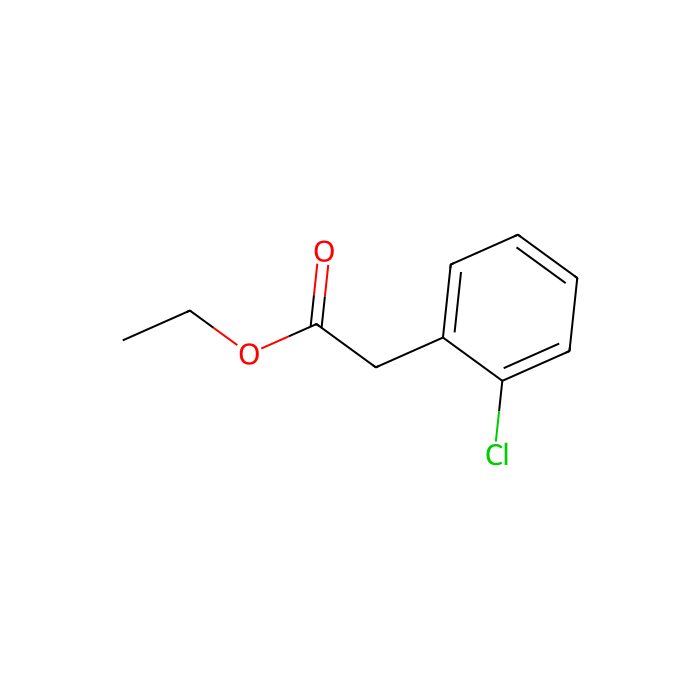
Ethyl 2-(2-chlorophenyl)acetate is an ortho-chloro-substituted arylacetic acid ethyl ester, comprising a chlorinated benzene ring attached via a methylene (–CH2–) to an ethyl acetate moiety.
Item-specific identifiers (from Product Data):
SKU: E193223
CAS: 40061-54-9
InChIKey: 228480 (as provided)
SMILES: Not specified for this item; refer to CoA/Spec Sheet.
Literature/computed identifiers and descriptors (for reference only):
Preferred IUPAC name (literature): Ethyl 2-(2-chlorophenyl)acetate
Molecular formula (literature): C10H11ClO2
Molecular weight (literature): ~198.65 g/mol
Example SMILES (literature): CCOC(=O)CC1=CC=CC=C1Cl
Structural features (general description):
Aromatic ring: monosubstituted benzene bearing a chlorine at the ortho position relative to the benzylic linkage.
Linker: benzylic methylene (–CH2–) connecting the aryl ring to the carbonyl carbon.
Functional group: ethyl ester (–COOCH2CH3) of an arylacetic acid; no stereogenic centers.
2D structure in words: a chlorobenzene ring, with the carbon ortho to chlorine bearing a –CH2–COOEt side chain (benzylic methylene attached to an ethyl ester carbonyl, then ethoxy).
Synthetic Utility
Key reactive elements and strategies (literature):
Benzylic acidity: The methylene alpha to the ester is sufficiently acidic to form enolates with strong bases (LDA/LiHMDS/NaH), enabling:
Alkylation with primary alkyl halides or Michael acceptors.
Acylation (e.g., to β-keto esters via Claisen-type condensations).
Formation of substituted phenylacetic motifs useful in SAR studies.
Orthogonal aryl chloride: The ortho-Cl enables Pd-catalyzed cross-coupling (Suzuki, Buchwald–Hartwig, Negishi), allowing installation of aryl, vinyl, or amino substituents without perturbing the ester.
Functional group interconversions:
Hydrolysis to 2-(2-chlorophenyl)acetic acid, followed by amide coupling or Curtius/Schmidt-type rearrangements (with appropriate safeguards).
Reduction to alcohols or aldehydes (DIBAL-H) for further elaboration (e.g., oxidation to ketones via benzoin-type sequences, or conversion to benzyl halides).
Protecting-group logic: The ethyl ester serves as a temporary protection of the acid; it endures many coupling conditions and can be removed under controlled basic or acidic conditions.
Regio-/chemo-selectivity notes:
Ortho substitution may influence cross-coupling rates (increased steric demand); select ligands favoring oxidative addition into aryl–Cl bonds (e.g., BrettPhos, XPhos).
Enolate geometry and alkylation outcome can be tuned by base/solvent/temperature, as with other arylacetic esters.
Target Specificity
Not applicable. This product is a small-molecule chemical building block and does not have biological target specificity, antigen/epitope information, species reactivity, clone, or isotype. Refer to Reaction & Applications and Synthetic Utility for relevant details.
Usamos cookies para garantir o funcionamento adequado do site e, quando permitido, para melhorar a sua experiência. Você pode gerenciar suas preferências a qualquer momento nas Configurações. Saiba mais em nossa Política de Cookies.
Deseja que lhe enviemos uma mensagem quando tivermos descontos disponíveis?
Lembrar-me mais tarde
Obrigado! Por favor, verifique a sua caixa de entrada de e-mail para confirmar.
Products are supplied to verified businesses, institutions, and qualified professionals for research and development use only. Not for use in humans, animals, diagnosis, or therapy.

 J2115141