
Determine the necessary mass, volume, or concentration for preparing a solution.
| Activity Type | Activity Value -log(M) | Mechanism of Action | Activity Reference | Publications (PubMed IDs) |
|---|
Product description:
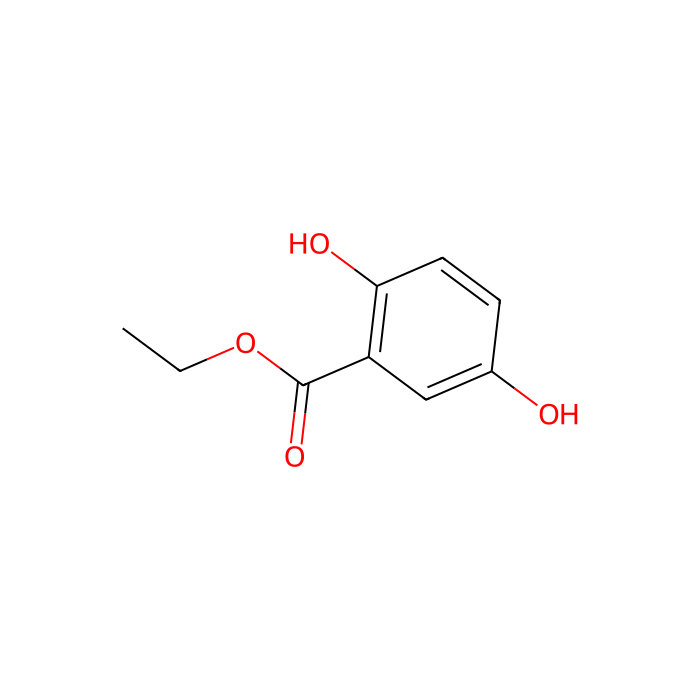
Ethyl 2,5-dihydroxybenzoate, also known as ethyl gentisate, is an aromatic ester. It can be synthesized from 2,5-dihydroxybenzoic acid by esterification process with absolute ethanol.
Application:
Ethyl 2,5-dihydroxybenzoate may be used for developing fourth generation acid dendrons.
Taxonomy Tree
| Kingdom | Organic compounds |
|---|---|
| Superclass | Benzenoids |
| Classe | Benzene and substituted derivatives |
| Subclass | Benzoic acids and derivatives |
| Intermediate Tree Nodes | Benzoic acid esters |
| Direct Parent | m-Hydroxybenzoic acid esters |
| Alternative Parents | o-Hydroxybenzoic acid esters Salicylic acid and derivatives Hydroquinones Benzoyl derivatives 1-hydroxy-2-unsubstituted benzenoids Vinylogous acids Carboxylic acid esters Monocarboxylic acids and derivatives Organooxygen compounds Organic oxides Hydrocarbon derivatives |
| Molecular Framework | Aromatic homomonocyclic compounds |
| Substituents | M-hydroxybenzoic acid ester - O-hydroxybenzoic acid ester - Dihydroxybenzoic acid - Salicylic acid or derivatives - Benzoyl - Hydroquinone - 1-hydroxy-2-unsubstituted benzenoid - Phenol - Vinylogous acid - Carboxylic acid ester - Monocarboxylic acid or derivatives - Carboxylic acid derivative - Organooxygen compound - Organic oxide - Organic oxygen compound - Hydrocarbon derivative - Aromatic homomonocyclic compound |
| Descrição | This compound belongs to the class of organic compounds known as m-hydroxybenzoic acid esters. These are benzoic acid esters where the benzene ring is meta-substituted with a hydroxy group. |
| External Descriptors | Not available |
| Activity Type | Activity Value -log(M) | Mechanism of Action | Activity Reference | Publications (PubMed IDs) |
|---|
| Activity Type | Activity Value -log(M) | Mechanism of Action | Activity Reference | Publications (PubMed IDs) |
|---|
| Activity Type | Activity Value -log(M) | Mechanism of Action | Activity Reference | Publications (PubMed IDs) |
|---|
| Activity Type | Activity Value -log(M) | Mechanism of Action | Activity Reference | Publications (PubMed IDs) |
|---|
| Activity Type | Activity Value -log(M) | Mechanism of Action | Activity Reference | Publications (PubMed IDs) |
|---|
| Activity Type | Activity Value -log(M) | Mechanism of Action | Activity Reference | Publications (PubMed IDs) |
|---|
| Activity Type | Relation | Activity value | Units | Action Type | Journal | PubMed Id | doi | Assay Aladdin ID |
|---|
| Activity Type | Relation | Activity value | Units | Action Type | Journal | PubMed Id | doi | Assay Aladdin ID |
|---|
| Activity Type | Relation | Activity value | Units | Action Type | Journal | PubMed Id | doi | Assay Aladdin ID |
|---|
| Activity Type | Relation | Activity value | Units | Action Type | Journal | PubMed Id | doi | Assay Aladdin ID |
|---|
| Activity Type | Relation | Activity value | Units | Action Type | Journal | PubMed Id | doi | Assay Aladdin ID |
|---|
Find and download the COA for your product by matching the lot number on the packaging.
| Lot Number | Certificate Type | Data | Item |
|---|---|---|---|
 E2308543 | Certificate of Analysis | Mar 24, 2023 | E344282 |
| E2308790 | Certificate of Analysis | Mar 24, 2023 | E344282 |
| E2308800 | Certificate of Analysis | Mar 24, 2023 | E344282 |
| E2308804 | Certificate of Analysis | Mar 24, 2023 | E344282 |
| Ponto de fusão (°C) | 77-81° C (lit.) |
|---|---|
| Peso molecular | 182.170 g/mol |
| XLogP3 | 2.600 |
| Hydrogen Bond Donor Count | 2 |
| Hydrogen Bond Acceptor Count | 4 |
| Rotatable Bond Count | 3 |
| Exact Mass | 182.058 Da |
| Monoisotopic Mass | 182.058 Da |
| Topological Polar Surface Area | 66.800 Ų |
| Heavy Atom Count | 13 |
| Formal Charge | 0 |
| Complexity | 180.000 |
| Isotope Atom Count | 0 |
| Defined Atom Stereocenter Count | 0 |
| Undefined Atom Stereocenter Count | 0 |
| Defined Bond Stereocenter Count | 0 |
| Undefined Bond Stereocenter Count | 0 |
| The total count of all stereochemical bonds | 0 |
| Covalently-Bonded Unit Count | 1 |
No application protocols are specified for this item; refer to your method-specific literature.
For chromatography or reaction screening, establish your own conditions and suitability using small-scale trials.
Item-specific biological role: None stated. For research use only.
Literature/general context:
No clinical or therapeutic claims are made or implied; any biological testing should be conducted under appropriate institutional approvals.
This compound is not a conventional buffering agent. It lacks a conjugate acid/base pair with pKa values in the physiological buffering range that would make it suitable as a dedicated buffer system.
For buffer preparation guidance, refer instead to established buffer systems appropriate to your application.
Greener solvent choices (literature/general):
Catalysis/biocatalysis:
Comparison snapshot (general): | Task | Conventional choice | Greener alternative | Trade-offs | |---|---|---|---| | Extraction/purification | DCM/hexanes | EtOAc/Heptane or 2-MeTHF | Slightly different selectivity; may need method re-optimization | | Williamson ether | DMF + NaH | Acetone/MeCN + K2CO3 | Sometimes slower; may require elevated temperature | | Hydrolysis | Aqueous NaOH in dioxane | EtOH/H2O NaOH | Similar efficacy; greener solvent system |
Note: Select alternatives consistent with your reaction kinetics, safety, and regulatory needs.
No pharmacopeial or excipient status is specified for this item; refer to CoA/Spec Sheet if required.
No medical or clinical claims are made. For regulated applications, verify identity, impurity profile, and residual solvent limits against relevant pharmacopeial or ICH guidelines.
Item-specific specifications (this lot):
Literature/general data (for reference; not item specifications):
Note: Concrete numerical values for melting point, boiling point, density, refractive index, UV cutoff, or ppm-level impurity limits are Not specified for this item; refer to CoA/Spec Sheet.
Item-specific status:
Guidance on grades (general):
Stabilizers/additives:
What to check on receipt (best practices):
Representative uses (literature/general; expand on typical benzoate chemistry):
Practical tips:
General literature guidance (not item-specific; adapt to your substrate and scale):
Saponification to 2,5-dihydroxybenzoic acid:
Selective O-alkylation (mono- vs di-):
Transesterification:
Reductions of the ester (with phenol protection):
Analytical monitoring:
Expected yields are reaction-dependent; literature commonly reports good conversions under optimized conditions.
Item-specific hazard data:
General safety considerations for aromatic phenolic benzoate esters (literature/general):
Always consult the product’s SDS for authoritative hazard classification and response measures.
Ethyl 2,5-dihydroxybenzoate is a moderately polar aromatic ester with two phenolic OH groups, giving it good solubility in a variety of organic solvents and limited solubility in water.
Polarity/miscibility (literature/general):
Selection guidance:
When to choose alternatives:
Storage (item-specific):
Stability considerations (general):
Reconstitution/solution preparation (general guidance; not item-specific):
For definitive stability/shelf-life and any lot-specific handling notes, consult the CoA and SDS for this SKU.
Ethyl 2,5-dihydroxybenzoate is the ethyl ester of 2,5-dihydroxybenzoic acid (gentisic acid), comprising a benzoate core bearing two phenolic hydroxyls at the 2- and 5-positions and an ethyl ester at the carboxyl carbon.
Item-specific (from Product Data):
Literature/computed identity details (not item-specific):
Stereochemistry: Not applicable (achiral).
Functional group reactivity:
Strategy and retrosynthetic value:
Named/typical transformations (literature):
Overall, it is a versatile scaffold for accessing gentisate-derived libraries.
Not applicable. This product is a small-molecule chemical reagent, not a biological targeting reagent (e.g., antibody, ligand with defined biomolecular target). No antigen/epitope, clone, isotype, or species reactivity data apply.