This compound belongs to the class of organic compounds known as thioglycosides. These are glycoside in which a sugar group is bonded through one carbon to another group via a S-glycosidic bond.
External Descriptors
Not available
1. Djoumbou Feunang Y, Eisner R, Knox C, Chepelev L, Hastings J, Owen G, Fahy E, Steinbeck C, Subramanian S, Bolton E, Greiner R, and Wishart DS. ClassyFire: Automated Chemical Classification With A Comprehensive, Computable Taxonomy. Journal of Cheminformatics, 2016, 8:61.
Determine the necessary mass, volume, or concentration for preparing a solution.
Dilution Calculator
Determine the dilution needed to prepare a stock solution.
Reconstitution Calculator
Revisões
Avaliações dos Clientes
Application Protocols
No vendor-tested bioassay protocols are provided for this item.
General guidance (research use only):
Solution preparation: Dissolve the solid in water or DMSO to prepare a concentrated stock (e.g., 100–500 mM as solubility permits). Filter-sterilize if required for sensitive assays.
Storage of solutions: Keep aliquots at 2–8 °C for short-term or at −20 °C for extended periods; avoid repeated freeze–thaw. Verify stability by NMR or LC-MS before critical experiments.
Synthetic use: For glycosylation, consult the Reaction Conditions tab for literature starting points; dry all glassware and solvents, and include molecular sieves.
Always adapt conditions to your system and consult primary literature for specific procedures.
Biological Roles
General context (literature; not product-specific claims):
Thioglycosides are analogs of O-glycosides in which the anomeric oxygen is replaced by sulfur, conferring enhanced resistance to enzymatic and acid-catalyzed hydrolysis. As such, they are widely used as stable mimics in glycoscience to probe carbohydrate–protein interactions (lectins, transporters) and to construct multivalent glycoconjugates.
Ethyl α-D-thioglucopyranoside, specifically, presents the D-glucose epitope in a sulfur-linked format. The α-linkage at C1 maintains the stereochemical presentation characteristic of α-D-glucopyranosides while resisting cleavage by many glycosidases that target O-glycosidic bonds.
In biochemical assays, simple alkyl thioglycosides can serve as reference ligands, solubilizing agents for certain membrane proteins, or as stability-enhanced substrates for investigating non-enzymatic glycation and binding events (literature/general usage). Suitability must be empirically determined for each system.
Metabolism and stability (general):
The C–S glycosidic bond is less susceptible to hydrolysis; metabolic processing through canonical glycosidase pathways is reduced relative to O-linked analogs. Oxidative metabolism of sulfur-containing moieties may occur under biological conditions but is substrate- and system-dependent.
All biological information above is for research context only and does not imply suitability for diagnostic or therapeutic use.
Buffer Applications
This product is not a buffering agent and is not typically used to set or maintain solution pH.
Practical note:
If included in biochemical assays, prepare in a compatible buffer (e.g., phosphate, HEPES) chosen for your biological system. Verify solubility and stability at the working pH and ionic strength.
For concentrated stock solutions, water or DMSO stocks can be diluted into the assay buffer; assess any effect on pH or ionic balance empirically.
Green Alternatives
When planning syntheses involving thioglycosides, solvent and activation choices drive the greenness profile.
Greener solvent options (general guidance):
Replace dichloromethane with 2-methyltetrahydrofuran (2-MeTHF) or cyclopentyl methyl ether (CPME) for nonaqueous steps where solubility allows.
Favor water or aqueous ethanol for dissolution, purification, or bioconjugation steps when compatible with the chemistry.
Activator/promoter choices:
Traditional systems (NIS/TfOH, Tf2O/Ph2SO) are effective but corrosive/hazardous. Consider milder electrophiles or catalytic methods (e.g., photo- or electrochemical activations reported in the literature) when feasible.
Waste and workup:
Use minimal halogenated solvents; employ solid-supported scavengers to reduce aqueous waste from neutralizations.
Crystallization or antisolvent precipitation (water/EtOH mixtures) may substitute for extensive chromatography in some carbohydrate steps.
Comparison snapshot (literature, qualitative):
DCM vs 2-MeTHF: 2-MeTHF offers renewable sourcing and higher boiling point, but may alter glycosylation selectivity; DCM provides excellent donor/acceptor solubility but is hazardous and non-renewable.
NIS/TfOH vs catalytic systems: classic promoters give robust activation; catalytic or electrochemical variants can lower reagent load but may require specialized setups.
Select the greenest option compatible with your target selectivity and substrate solubility; verify on small scale.
Pharmaceutical Uses
Item-specific pharmacopeial status: Not specified for this item; refer to CoA/Spec Sheet.
General, non-clinical context:
Ethyl α-D-thioglucopyranoside is primarily a research reagent and carbohydrate building block. In pharmaceutical process development, thioglycosides serve as stable intermediates or glycosyl donors during assembly of glycolipids, glycosylated small molecules, or carbohydrate motifs on complex APIs.
As an anomerically protected form of glucose, the S-ethyl group functions as a latent leaving group, enabling downstream formation of O-, S-, or C-glycosidic linkages under controlled activation without premature hydrolysis.
Formulation/excipient role:
Not typically employed as a pharmaceutical excipient. Any exploration of excipient-like functions (e.g., stabilizer, solubilizer) would require dedicated development and is beyond the scope of normal research use.
No therapeutic or clinical claims are made; this product is supplied strictly for research and laboratory use.
Physical Properties
Item-specific specifications: Not specified for this item; refer to CoA/Spec Sheet.
Literature/general expectations for ethyl α-D-thioglucopyranoside (reference only, not product specifications):
Physical state: typically a crystalline solid owing to the polyhydroxylated sugar core.
Solubility: expected to be highly soluble in water and polar protic solvents (e.g., methanol, ethanol) due to multiple hydroxyls; soluble in DMSO; limited solubility in nonpolar solvents (literature/general carbohydrate behavior).
Partitioning: strongly hydrophilic; low logP anticipated (literature trend for unprotected sugars and thioglycosides).
Thermal behavior: many unprotected thioglycosides decompose before boiling; they generally exhibit melting or softening with potential caramelization/decomposition upon heating (literature trend).
Optical activity: expected to be dextrorotatory or levorotatory depending on solvent and concentration; specific rotation values are reported in carbohydrate literature for the α-D-anomer (not specified here).
Practical handling notes (general):
Hygroscopic tendency is common for unprotected carbohydrates; minimizing atmospheric moisture exposure is advisable, though item-specific hygroscopicity is not specified here.
For analytical characterization, 1H/13C NMR in D2O or DMSO-d6 readily shows the anomeric C1 signals and ethyl S-CH2 multiplets; IR features include broad O–H stretches and C–S vibrations (literature).
Quality and Grades
Item-specific grade/purity: Not specified for this item; refer to CoA/Spec Sheet.
Interpreting common grades for carbohydrate building blocks (general guidance):
Research/biochemical grade typically emphasizes low inorganic residue and characterization by NMR/HRMS/optical rotation. For chromatography-sensitive work (e.g., HPLC analytics or glycomics), additional controls on UV background and metal content may be relevant.
Synthetic grade thioglycosides are often defined by anomeric ratio (α/β) and residual protecting-group impurities when applicable. For this unprotected α-thioglycoside, confirmation of α-anomeric configuration and low β-content is a key quality attribute (general consideration).
Documentation:
Certificate of Analysis (CoA) typically includes identity (NMR, HRMS), purity (HPLC/GC/combustion as applicable), and water content for hygroscopic materials. For any property not listed here, consult the CoA/Spec Sheet.
Stabilizers/additives: Not specified for this item; refer to CoA/Spec Sheet.
UV cutoff, residual metals, water/peroxide limits: Not specified for this item; refer to CoA/Spec Sheet.
Reaction and Applications
Research-use context: For research use only.
General application areas (literature-based):
Building block for carbohydrate synthesis: Ethyl α-D-thioglucopyranoside serves as a stable anomeric protecting group and a latent glycosyl donor. After appropriate per-O-protection (e.g., acetylation/benzylation), the thioglycoside can be activated for glycosylation.
Glycosylation donor under activation: Common activators for S-ethyl glycosides include N-iodosuccinimide (NIS) with catalytic TfOH, Ph2SO/Tf2O, or hypervalent iodine reagents. These conditions form glycosyl sulfonium/iodonium intermediates that couple to alcohol acceptors, delivering O-glycosides.
Reductive or exchange transformations: The S-ethyl handle can participate in sulfenyl transfer or be converted to alternative anomeric leaving groups (e.g., trichloroacetimidates) after displacement/oxidation protocols.
Practical considerations:
Control moisture rigorously during glycosylation; water competes as an acceptor, generating hydrolysis or anomeric mixtures.
Neighboring-group participation and stereocontrol are typically introduced via protecting groups at C2 (e.g., acyl) rather than present in the unprotected starting material.
The α-configuration of the starting thioglycoside does not mandate the configuration of the product; stereochemical outcome depends on protecting groups, solvent, temperature, and promoter.
Ancillary uses:
Reference standard or affinity probe precursor in lectin/transport studies, leveraging the hydrolytic stability of the C–S glycosidic bond (general research use; not an item-specific guarantee).
Reaction Conditions
The following are literature-style, general conditions for thioglycoside chemistry; they are not product specifications.
Activation/glycosylation (O-glycoside formation):
NIS (1.2–1.5 equiv) + catalytic TfOH (0.05–0.15 equiv) in CH2Cl2 at −78 to 0 °C; 4 Å sieves; donor (1.0 equiv) to acceptor (1.2–2.0 equiv). Reaction times: 0.5–4 h depending on substrates. Typical isolated yields: 60–90% in optimized systems.
Ph2SO (1.5–2.0 equiv)/Tf2O (1.2–1.5 equiv) in CH2Cl2 or toluene at −78 to −20 °C; rapid activation; strict temperature control advised.
p-TolSCl (1.5 equiv)/AgOTf (1.2 equiv) in CH2Cl2 at −40 to 0 °C as an alternative promoter system.
Protection steps prior to activation:
Per-O-acetylation: Ac2O/pyridine (or Ac2O/DMAP) at 0–25 °C, then purification; enhances solubility in organic solvents and enables neighboring-group participation from 2-OAc.
Benzylation: NaH/benzyl bromide in DMF or phase-transfer conditions; inert atmosphere; careful quench.
Solvent considerations:
Halogenated solvents (CH2Cl2) commonly used; greener alternatives (2-MeTHF, CPME) may be viable but can affect selectivity.
Workup/controls:
Quench iodinated activations with thiosulfate or ascorbate as needed. Monitor by TLC (anisaldehyde/sulfuric char) or LC-MS. Dry-load on silica to minimize streaking of polar carbohydrates.
Adjust promoter loadings, temperature, and equivalents to your specific donor/acceptor set; run small-scale trials to optimize stereoselectivity and yield.
Safety and Handling
GHS/Classification (item-specific):
Signal Word: Not specified for this item; refer to SDS.
H-Statements: Not specified for this item; refer to SDS.
GHS Classification: Not specified for this item; refer to SDS.
Pictograms: Not specified for this item; refer to SDS.
General laboratory safety (non-authoritative; supplement to SDS):
PPE: use lab coat, safety glasses, and appropriate chemical-resistant gloves (e.g., nitrile). Handle powders in a fume hood to avoid dust inhalation.
Avoid generating dust; wash hands thoroughly after handling. Prevent contact with strong oxidizers and strong acids that may cleave thioacetals under harsh conditions.
Although thioglycosides are generally of low volatility, avoid ingestion and inhalation; do not rely on odor detection.
Incompatibilities and stability (general carbohydrate/thioglycoside guidance):
Strong oxidants can oxidize sulfur to sulfoxides/sulfones; very strong Lewis/Brønsted acids under activating conditions can promote glycosyl exchange/decomposition.
Aqueous base typically preserves the S-glycosidic bond but may induce epimerization at susceptible centers under prolonged exposure.
First aid overview (consult SDS):
Inhalation: move to fresh air; seek medical advice if symptoms persist.
Skin/eye contact: rinse with water for several minutes; remove contaminated clothing; seek medical advice if irritation develops.
Ingestion: rinse mouth; do not induce vomiting; seek medical attention.
Always consult the product’s SDS for definitive hazard, exposure limits, and emergency measures.
Solvent Selection
Ethyl α-D-thioglucopyranoside is a highly polar, polyhydroxylated small molecule; solvent choice primarily reflects its strong hydrogen-bonding capacity and ionic compatibility.
Readily soluble in water and polar protic solvents (MeOH, EtOH). Soluble in polar aprotic media such as DMSO and DMF; limited solubility in acetonitrile unless water is present. Poorly soluble in nonpolar solvents (EtOAc, toluene, hexanes).
Typical use scenarios:
Aqueous workups, carbohydrate labeling, and bioconjugations favor water or water/alcohol mixtures.
For organic glycosylation workflows where the hydroxyls may first be protected, solubility improves in halogenated solvents (e.g., CH2Cl2) once per-O-acylated.
Stock solutions for screening assays are often prepared in water or DMSO, then diluted into buffers (verify compatibility with your assay matrix).
Comparison notes (general):
vs. O-glycosides: thioglycosides are more stable toward hydrolysis, enabling handling in mildly acidic aqueous media.
vs. protected thioglycoside donors: unprotected sugars are water-soluble but less soluble in common organic solvents; protection strategies tune solubility.
Practical tips:
If preparing concentrated aqueous solutions, gently warm (≤40 °C) and stir to aid dissolution. Filter sterile solutions through 0.22 µm membranes if required for sensitive applications.
Avoid strong oxidizing solvent systems if sulfur oxidation is a concern.
Storage and Reconstitution
Item-specific storage and shipping:
Storage Conditions: Store at 2–8 °C.
Shipped In: Wet ice.
Container and handling:
Keep tightly closed in the original container to minimize moisture uptake and contamination. Open and weigh in a low-humidity environment when possible.
Solution preparation (general guidance):
Water or DMSO are common solvents for stock solutions. For aqueous stocks, consider adding a bioburden control step (0.22 µm filtration) if sterility is required for your application.
Label aliquots with concentration and date. Use amber vials if performing light-sensitive follow-up chemistry.
Stability notes:
Avoid prolonged exposure to strong acids, bases, or oxidants which may affect the thioacetal center.
For extended storage of solutions, freezing at −20 °C in aliquots reduces degradation from repeated freeze–thaw.
Additional item-specific limits (water content, stabilizers, shelf life): Not specified for this item; refer to CoA/Spec Sheet.
Research Use Note: For research use only.
Structure and Identity
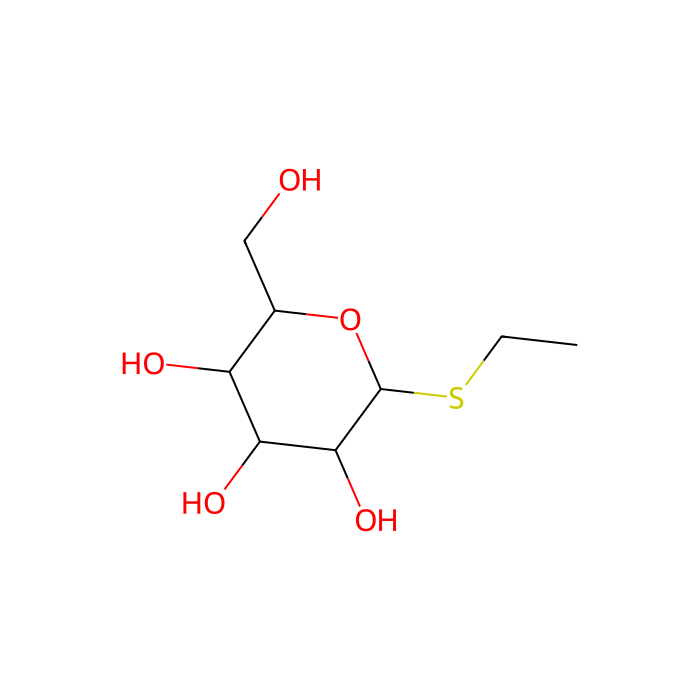
Ethyl α-D-Thioglucopyranoside is an anomerically sulfur-linked ethyl thioglycoside of D-glucose, featuring a six-membered glucopyranose ring and an S–ethyl substituent at C1 in the α-configuration.
Item-specific (Product Data):
SKU: E302467
CAS: 13533-58-9
InChIKey: 44014 (as provided)
SMILES: Not specified for this item; refer to CoA/Spec Sheet.
Molecular Formula: Not specified for this item; refer to CoA/Spec Sheet.
Molecular Weight: Not specified for this item; refer to CoA/Spec Sheet.
Literature/computed identifiers and features (non-specification; for reference only):
Typical empirical formula reported for ethyl α-D-thioglucopyranoside: ~C8H16O5S (literature)
Approximate formula weight: ~224.28 g/mol (literature, derived from above formula)
Functional groups: multiple secondary alcohols (C2–C6), thioacetal center at C1 (S-ethyl), ring oxygen at O5.
Stereochemistry: D-glucose configuration retained at C2–C5; α-anomer at C1 (axial anomeric substituent in the 4C1 chair depiction).
2D structural description (general):
A 4C1 chair glucopyranose ring with hydroxyls at C2, C3, C4, and C6 (primary OH), and a ring oxygen between C1 and C5. The anomeric position (C1) bears an S–CH2CH3 substituent in the α-orientation. The sulfur linkage renders the anomeric center a thioacetal, conferring enhanced stability toward hydrolysis compared with O-glycosides.
Synthetic Utility
Ethyl α-D-thioglucopyranoside is a versatile handle in carbohydrate synthesis, combining anomeric protection with donor potential.
Key reactivity (literature):
Latent glycosyl donor: Activation by NIS/TfOH, p-TolSCl/AgOTf, Ph2SO/Tf2O, or iodine/AgOTf generates a reactive species that couples with alcohols (glycosylation), thiols (S-glycosylation), or, with appropriate conditions, carbon nucleophiles (C-glycosylation).
Chemoselectivity: The thioacetal center is resilient to many bases and nucleophiles, allowing strategic protection of peripheral OH groups before activation.
Transformability: The anomeric S-ethyl can be converted to other leaving groups (e.g., halides, trichloroacetimidates) after oxidation or exchange, broadening donor modalities.
Retrosynthetic value:
Starting from an unprotected α-thioglycoside enables late-stage introduction of protecting groups tailored for neighboring-group participation (e.g., 2-O-acyl for β-selectivity) and solubility tuning (benzyl vs acyl sets).
Facilitates iterative oligosaccharide assembly using orthogonal activation schemes (e.g., thioglycoside donor with acceptors bearing non-participating or temporary protecting groups).
Practical notes:
Prior to glycosylation, per-O-acylation or benzylation is typically performed to suppress donor self-condensation and to modulate solubility in organic media.
Careful control of water and adventitious nucleophiles is critical; employ 4 Å molecular sieves and rigorously dried solvents.
Target Specificity
Not applicable. This product is a small-molecule carbohydrate reagent, not an antibody, enzyme, or targeted biologic. No antigen/epitope, clone, or species reactivity applies.
Perguntas frequentes
How is this product shipped?
This product ships chilled on wet ice. Unpack on arrival and transfer it to the storage condition stated above.
Usamos cookies para garantir o funcionamento adequado do site e, quando permitido, para melhorar a sua experiência. Você pode gerenciar suas preferências a qualquer momento nas Configurações. Saiba mais em nossa Política de Cookies.
Deseja que lhe enviemos uma mensagem quando tivermos descontos disponíveis?
Lembrar-me mais tarde
Obrigado! Por favor, verifique a sua caixa de entrada de e-mail para confirmar.
Products are supplied to verified businesses, institutions, and qualified professionals for research and development use only. Not for use in humans, animals, diagnosis, or therapy.

 F2103139