This compound belongs to the class of organic compounds known as benzoic acid esters. These are ester derivatives of benzoic acid.
External Descriptors
Not available
1. Djoumbou Feunang Y, Eisner R, Knox C, Chepelev L, Hastings J, Owen G, Fahy E, Steinbeck C, Subramanian S, Bolton E, Greiner R, and Wishart DS. ClassyFire: Automated Chemical Classification With A Comprehensive, Computable Taxonomy. Journal of Cheminformatics, 2016, 8:61.
Determine the necessary mass, volume, or concentration for preparing a solution.
Dilution Calculator
Determine the dilution needed to prepare a stock solution.
Reconstitution Calculator
Revisões
Avaliações dos Clientes
Application Protocols
Not applicable. No immunoassay or bioanalytical application protocols (e.g., WB, IHC, IF, FC) are defined for this small-molecule reagent. For synthetic or analytical uses, refer to the Reaction Conditions and Synthetic Utility sections.
Biological Roles
This product is a small aromatic ester intended for research and chemical synthesis. It does not possess specific biological roles in cellular pathways.
General context (literature):
Aromatic benzoate esters can undergo hydrolysis by esterases to give the corresponding carboxylic acid (m-toluic acid) and ethanol; the rate depends on steric and electronic factors (meta-methyl slightly retards hydrolysis relative to unsubstituted ethyl benzoate).
Such esters are often used as model substrates in enzymology to study esterase specificity and kinetics due to their UV-active aromatic ring.
No medical or clinical use: For research use only, as stated by the manufacturer.
If using in biochemical assays, confirm solvent compatibility and ensure concentrations remain below levels that perturb membrane integrity or protein stability (general guidance for hydrophobic aromatic esters).
Buffer Applications
Not typically applicable. Ethyl m-toluate is a hydrophobic organic ester and is not used as a buffering agent or pH control component.
Practical note: If included in aqueous biochemical systems (e.g., as a substrate analog), maintain organic cosolvent control (e.g., ≤1–5% v/v acetonitrile/ethanol) and select buffers that tolerate organic content (e.g., phosphate, HEPES).
Green Alternatives
Context: Ethyl m-toluate is typically a specialty reagent/intermediate rather than a workhorse solvent. Green chemistry considerations therefore focus on substitution in solvent roles or process simplification when it is used as a medium or carrier.
When used as a solvent or diluent (literature guidance):
Greener alternatives include ethyl acetate, dimethyl carbonate (DMC), propylene carbonate, 2-MeTHF, or Cyrene depending on reaction needs.
Trade-offs:
Ethyl acetate/DMC: Low toxicity, biodegradable, lower bp simplifies recovery; but less aromatic solvation power.
2-MeTHF: Bio-based, broader solubility, forms fewer peroxides than THF; immiscible with water which can aid workup.
Propylene carbonate/Cyrene: High boiling, polar aprotic; excellent EHS profiles, but may be too polar for some substrates and can participate in side reactions.
Comparison highlights (general, qualitative):
Ethyl m-toluate: High-boiling, aromatic ester; good for elevated-temperature transformations; not typically listed as a preferred green solvent.
Ethyl acetate/DMC: Preferred green esters for extractions and medium-polar reactions; lower energy for distillation.
2-MeTHF: Good for organometallic and biphasic processes; renewable source.
Green process tips:
If ethyl m-toluate is required (e.g., fragrance matrix), optimize solvent recycling and apply energy-efficient heating (microwave or flow). Consider biocatalytic transesterification to reduce harsh reagents.
Pharmaceutical Uses
Item-specific pharmacopeial/excipient status: Not specified for this item; refer to CoA/Spec Sheet.
General context (non-clinical):
Ethyl m-toluate is not a common pharmaceutical excipient. Aromatic ethyl esters may occasionally serve as fragrance components or research intermediates in pre-formulation chemistry.
In medicinal chemistry workflows, benzoate esters like this can be used as protected acid surrogates for synthetic routes; they are subsequently hydrolyzed to reveal the free acid in later steps.
Compliance note: This product is supplied for research use only and is not intended for human or veterinary use, clinical applications, or as an active pharmaceutical ingredient.
Physical Properties
Item-specific specifications: Not specified for this item; refer to CoA/Spec Sheet.
Literature/general values for ethyl m-toluate (for reference only; not product specifications):
Physical state: Colorless to pale yellow liquid (literature)
Boiling point: Typically reported ~232–234 °C at 1 atm (literature)
Melting point: Typically below 0 °C (liquid at ambient; literature)
Density (20/25 °C): Reported in the ~1.02–1.06 g/mL range (literature, analogous aryl ethyl esters)
Refractive index nD20: Commonly around 1.500–1.510 for aryl ethyl esters; specific value for this isomer reported near this range (literature)
Vapor pressure: Low at ambient; increases with temperature (literature trend for high-boiling esters)
LogP (octanol/water): Estimated ~2.6–3.0 (literature/estimation for aryl ethyl esters)
Solubility: Sparingly soluble in water; miscible with common organic solvents (e.g., ethanol, diethyl ether, toluene, dichloromethane) (literature)
Notes for practitioners (general):
As with many benzoate esters, the liquid exhibits moderate viscosity and a faint aromatic/fruity odor.
The meta-methyl substituent minimally perturbs bulk properties relative to ethyl benzoate; expect similar handling, solubility, and chromatographic behavior.
Quality and Grades
Item-specific grade/purity: Not specified for this item; refer to CoA/Spec Sheet.
Appearance: Not specified for this item; refer to CoA/Spec Sheet.
Guidance on grades for this compound class (general):
Research-grade aromatic esters may be offered as technical, laboratory, or ≥95–99% purity materials. Higher grades (e.g., GC, HPLC) emphasize low non-volatile residue and controlled UV background, which can be beneficial for analytical method development or as internal standards.
Stabilizers: Benzoate esters generally do not require added stabilizers; however, minimizing moisture limits hydrolysis to the corresponding acid (m-toluic acid) and ethanol. If a stabilizer is present in a specific lot, it will be indicated on the CoA.
Testing/ID: Typical characterization includes 1H/13C NMR (aromatic and ethyl resonances), IR (strong C=O ~1720–1735 cm−1), GC/GC–MS purity, and density/refractive index checks.
What to request/verify for sensitive applications:
Water content (Karl Fischer), residual solvents, and GC purity profile.
Low-UV absorbance baseline if using as an HPLC standard.
Confirm isomer identity (meta) where regioisomeric purity versus o-/p- may matter in fragrance or materials R&D.
Always consult the lot-specific CoA/Specification Sheet for definitive grade, assay, and analytical limits.
Reaction and Applications
Ethyl m-toluate (ethyl 3-methylbenzoate) functions as a stable benzoate ester and aryl building block. Key research uses leverage the ester’s transformability and the ring’s substitution pattern.
Transformations of the ester group (literature):
Hydrolysis/saponification to m-toluic acid under aqueous base (NaOH, KOH) or acid (H2SO4) to furnish 3-methylbenzoic acid.
Reduction with metal hydrides (e.g., LiAlH4) to 3-methylbenzyl alcohol; DIBAL-H can provide the corresponding aldehyde under controlled, low-temperature conditions.
Transesterification with alcohols (acidic or basic catalysis, or enzymatic CALB) to access alternative alkyl esters; useful in fragrance optimization.
Aminolysis to 3-methylbenzamides using amines with catalysts or activating conditions (e.g., DBU, boronic catalysts, or coupling via acid after hydrolysis).
Arene chemistry (literature):
Electrophilic aromatic substitutions are mildly deactivated by the meta-directing ester; the methyl (ortho/para-directing) competes, giving regioisomeric mixtures. Nitration/sulfonation require controlled conditions and may be low-to-moderate yielding.
Cross-coupling on the ring requires prior installation of a halogen or pseudohalide; the ester tolerates many Pd-catalyzed conditions.
Applications in R&D (general):
Fragrance and flavor intermediate screening.
Model substrate in kinetics of ester hydrolysis and transesterification.
Polarity/aromaticity probe in solvent–solute interaction studies.
Practical tips: Dry conditions minimize background hydrolysis; monitor by GC or HPLC (UV 254 nm response via aromatic chromophore).
Reaction Conditions
General literature guidance for common transformations of ethyl m-toluate (reference use only; optimize per substrate and scale):
Saponification to 3-methylbenzoic acid:
Conditions: 1–2 M NaOH or KOH in EtOH/H2O (1:1 to 4:1), rt to reflux.
Time: 1–6 h depending on concentration and temperature.
Workup: Acidify to pH ~1–2 with HCl, extract with organic solvent, dry, crystallize.
DIBAL-H partial reduction to 3-methylbenzaldehyde:
Conditions: 1.0–1.5 equiv DIBAL-H in toluene or hexane, −78 to −40 °C.
Quench: Careful MeOH/H2O at low temp, then workup with Rochelle’s salt.
Notes: Strict temperature control prevents over-reduction to alcohol.
LiAlH4 reduction to 3-methylbenzyl alcohol:
Conditions: 1.5–2.0 equiv LiAlH4 in dry THF or Et2O, 0 °C to reflux, 1–3 h.
Quench: Sequential H2O/NaOH/H2O; filter Al salts.
Transesterification (Fischer):
Conditions: Alcohol (excess, 3–10 equiv), catalytic H2SO4 or p-TsOH, Dean–Stark or molecular sieves, reflux.
Alternative: Enzymatic (CALB) at 30–60 °C in non-aqueous solvent.
Aminolysis to amide (via acid then coupling):
Hydrolyze to acid → activate with EDC/HOBt or convert to acid chloride → react with amine base (DIPEA) in DCM/DMF at 0–25 °C.
Yields are substrate- and condition-dependent; consult primary literature for detailed optimization.
Safety and Handling
Item-specific hazards: Not specified for this item; refer to the SDS for authoritative classification, GHS pictograms, signal word, and H-statements.
General safety guidance for aryl ethyl esters (literature/typical):
Hazards: Combustible liquid; may cause skin/eye irritation on contact and respiratory irritation if mist/vapor is inhaled. Low acute toxicity but handle as a harmful organic solvent.
PPE: Lab coat, safety glasses or face shield, and suitable chemical-resistant gloves (e.g., nitrile). Work in a fume hood to minimize inhalation exposure.
Handling: Avoid breathing vapors; prevent contact with skin and eyes. Keep away from heat, sparks, open flames, and hot surfaces. Ground/bond containers when transferring flammable liquids.
Incompatibilities: Strong oxidizing agents; strong bases and acids can catalyze hydrolysis/transesterification. Avoid prolonged contact with alkali metals or strong nucleophiles.
First aid (overview; consult SDS):
Inhalation: Move to fresh air; seek medical attention if symptoms persist.
Skin: Wash with soap and water; remove contaminated clothing.
Eyes: Rinse cautiously with water for several minutes; remove contact lenses if present and easy to do.
Ingestion: Rinse mouth; do not induce vomiting; seek medical advice.
Spill/Fire: Absorb small spills with inert material; dispose per regulations. For fire, use CO2, dry chemical, or foam; water spray to cool containers.
Always defer to the product-specific SDS for definitive safety and regulatory information.
Solvent Selection
This product is an aromatic ester primarily used as a reagent/intermediate rather than a routine process solvent. Nevertheless, its solvation profile aligns with high-boiling, moderately polar, aprotic organic liquids.
Polarity/class (literature): Moderately polar, aprotic; dielectric constant expected to be low-to-moderate (similar to ethyl benzoate).
Miscibility (literature):
Water: Poorly soluble.
Organics: Miscible with ethers, chlorinated solvents, aromatics, and alcohols.
Practical use cases:
Reaction medium for high-temperature ester-exchange or aminolysis where a high boiling, relatively inert aromatic ester is useful.
Chromatographic standard or matrix in fragrance/aroma studies.
Selection tips (general):
Choose ethyl m-toluate when an aryl ester medium with slightly higher hydrophobicity than ethyl benzoate is desired.
For lower boiling work, consider ethyl acetate (bp ~77 °C). For greener, bio-based options with similar functionality, 2-MeTHF or dimethyl carbonate may be preferable depending on chemistry.
Quick comparison (literature, qualitative):
Ethyl m-toluate: High bp, low volatility, aromatic character; good for elevated-temp operations.
Ethyl benzoate: Slightly less bulky; very similar behavior.
Ethyl acetate: Much more volatile, greener profile, but less aromatic solvation capacity.
Storage and Reconstitution
Storage conditions (from Product Data): Store at room temperature. Ship under normal conditions.
Container: Keep tightly closed in a dry, well-ventilated place. Use amber glass if long-term storage to limit light exposure.
Handling for longevity (general): Minimize moisture ingress to prevent slow hydrolysis to m-toluic acid and ethanol. Purge headspace with inert gas for prolonged storage if frequently opened.
Reconstitution: Not applicable. Supplied as a liquid; use as received or dilute in a compatible organic solvent (e.g., toluene, ethyl acetate, DCM) as required.
Stability considerations (general): Stable under recommended storage; avoid strong acids/bases and oxidizers. Monitor by GC or NMR if high-purity material is required over extended storage.
For lot-specific shelf-life and assay, consult the CoA/Specification Sheet.
Structure and Identity
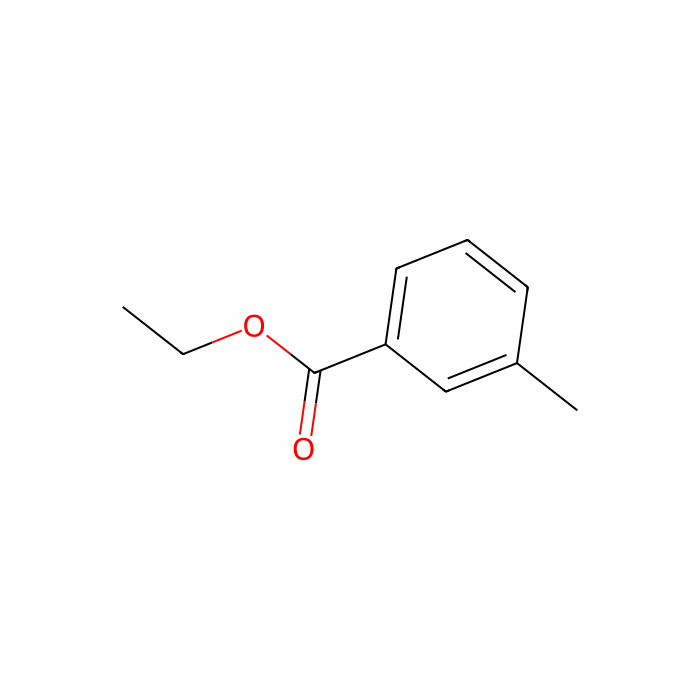
Ethyl m-toluate is the ethyl ester of 3-methylbenzoic acid (m-toluic acid), i.e., an aromatic benzoate bearing a meta-methyl substituent on the ring.
Item-specific identifiers (from Product Data)
SKU: E166415
Product name: Ethyl m-toluate
CAS: 120-33-2
PubChem CID: 67117
InChIKey: Not specified for this item; refer to CoA/Spec Sheet.
SMILES: Not specified for this item; refer to CoA/Spec Sheet.
Literature/computed identity details (general chemical knowledge)
Canonical SMILES (one representation, literature): CCOC(=O)c1cccc(C)c1 (depicts an ethyl benzoate core with a ring methyl; position is meta in the named structure)
InChI (literature): InChI=1S/C10H12O2/c1-3-12-10(11)9-5-4-6-8(2)7-9 (key not provided here)
Structural features (descriptive)
Functional groups: Aromatic ring (benzene), aryl ester (–CO2Et), alkyl substituent (methyl) meta to the ester.
2D description: A benzene ring bearing an ester carbonyl at position 1 (benzoate) and a methyl at position 3 (meta). No stereocenters; planar aromatic system with an sp2 carbonyl adjacent to an ethoxy group.
Synthetic Utility
Ethyl m-toluate is a versatile aryl ester building block with two orthogonal handles: an aryl ester (for acyl-chemistry) and a meta-methyl substituent (for directing and steric effects).
Ester functional group leverage (literature):
Hydrolysis to m-toluic acid enables downstream amide coupling (e.g., HATU/EDC) or acid chloride formation (SOCl2, oxalyl chloride) for acylations.
Reductions (LiAlH4 → 3-methylbenzyl alcohol; DIBAL-H → 3-methylbenzaldehyde) provide divergent access to benzylic derivatives.
Transesterification and enzymatic resolutions create libraries of alkyl esters for SAR in aroma/materials research.
Arene manipulation (literature):
Directed metalation is challenging due to deactivation by the ester; however, prior halogenation (via NBS after benzylic activation of the methyl or via electrophilic routes) can set up Suzuki/Heck/Sonogashira couplings.
Benzylic functionalization of the methyl group (oxidation to aldehyde/acid, radical bromination to benzyl bromide) extends diversity.
Retrosynthetic value:
Serves as a protected form of 3-methylbenzoic acid compatible with many coupling conditions.
Aromatic UV chromophore facilitates reaction monitoring (TLC/HPLC at 254 nm).
Tips: Maintain anhydrous conditions to avoid drift toward acid via hydrolysis in prolonged reactions; choose bases that do not promote uncontrolled transesterification if the ester must be retained.
Target Specificity
Not applicable. This product is a small-molecule aromatic ester and is not an antibody, enzyme, or affinity reagent. No target, epitope, clone, isotype, or species reactivity is defined for this item.
Usamos cookies para garantir o funcionamento adequado do site e, quando permitido, para melhorar a sua experiência. Você pode gerenciar suas preferências a qualquer momento nas Configurações. Saiba mais em nossa Política de Cookies.
Deseja que lhe enviemos uma mensagem quando tivermos descontos disponíveis?
Lembrar-me mais tarde
Obrigado! Por favor, verifique a sua caixa de entrada de e-mail para confirmar.
Products are supplied to verified businesses, institutions, and qualified professionals for research and development use only. Not for use in humans, animals, diagnosis, or therapy.

 D2312146