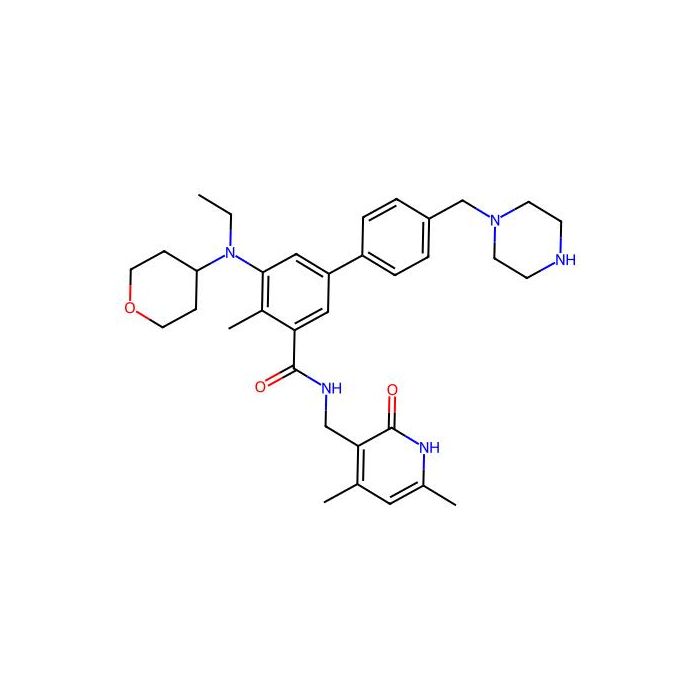
EZH2-IN-13 is a potent EZH2 inhibitor, for details please refer to compound 73 in patent WO2017139404. EZH2-IN-13 can be used to study cancers or precancerous lesions associated with EZH2 activity.
Form:Solid
Especificações
Especificações e pureza
≥99%
Mecanismos bioquímicos e fisiológicos
EZH2-IN-13 is a potent EZH2 inhibitor, for details please refer to compound 73 in patent WO2017139404. EZH2-IN-13 can be used to study cancers or precancerous lesions associated with EZH2 activity.
Condições de armazenamento de armazenamento
Store at -20°C
Enviado em
Ice chest + Ice pads
Este produto requer transporte de cadeia fria. Serviços terrestres e outros serviços econômicos não estão disponíveis.
Determine the necessary mass, volume, or concentration for preparing a solution.
Dilution Calculator
Determine the dilution needed to prepare a stock solution.
Reconstitution Calculator
Revisões
Avaliações dos Clientes
Application Protocols
No manufacturer-verified protocols, test methods, or recommended dilutions are provided for this item in the Product Data.
Guidance:
Follow your laboratory’s SOPs for preparing DMSO stock solutions, vehicle controls, and for executing biochemical methyltransferase assays or cell-based epigenetic studies.
Validate assay conditions (concentration ranges, exposure duration, detection modality) empirically in your system. Include appropriate positive/negative controls and replicate measurements.
For structured, peer-reviewed procedures, consult the primary literature relevant to EZH2/PRC2 chemical probes and adapt to your instrumentation and cell models. Always document lot numbers and preparation dates for traceability.
Biological Roles
General background (epigenetics context; no therapeutic claims):
EZH2 is the catalytic subunit of the Polycomb Repressive Complex 2 (PRC2) and catalyzes mono-, di-, and tri-methylation of histone H3 on lysine 27 (H3K27), establishing a transcriptionally repressive chromatin mark.
Small-molecule inhibitors named “EZH2-IN-×” are typically used as chemical tools to study PRC2 function, H3K27 methylation dynamics, and gene repression programs in cells and cell-free systems.
Utility of an EZH2-directed probe in research:
Dissecting chromatin regulation: Temporal inhibition allows researchers to connect changes in H3K27me3 with transcriptional and phenotypic outcomes, separating primary epigenetic effects from downstream adaptations.
Target validation: Parallel biochemical and cellular assays can establish whether observed phenotypes depend on PRC2 catalytic activity versus noncatalytic roles or off-targets.
Combination studies: Pairing with inhibitors of upstream SAM metabolism or chromatin reader/eraser proteins helps map pathway crosstalk.
Caveats and controls:
Off-target assessment is essential; employ chemoproteomics or broad enzymatic panels where possible.
Chromatin marks change on different timescales; plan time-course experiments and include washout studies to probe reversibility.
Item-specific biological data (potency, selectivity, cellular activity): Not specified for this item; refer to CoA/Spec Sheet and primary literature sources if applicable.
Buffer Applications
This product is a small-molecule probe, not a buffering agent. However, it is commonly used within buffered systems for biochemical or cellular assays.
General buffer guidance for methyltransferase/epigenetic assays:
Enzymatic assays: HEPES or Tris buffers (e.g., 20–50 mM, pH 7.5–8.0) with appropriate salt (e.g., 50–150 mM NaCl), cofactors (SAM), divalent ions as required by the specific assay, and reducing agent (e.g., 1–5 mM DTT) to maintain enzyme integrity.
Additives: Low percentages of detergent (e.g., 0.01–0.05% Tween 20) can reduce nonspecific adsorption. Include BSA (e.g., 0.1 mg/mL) if protein binding or surface loss is observed.
Compound handling: Dilute from DMSO stocks to maintain consistent final DMSO across control and treated wells; pre-warm buffers to improve solubilization and reduce precipitation.
Cell culture context:
Use standard culture media buffered with bicarbonate/CO2 or HEPES as required. Serum proteins may improve apparent solubility; validate free fraction if pharmacology depends on unbound concentration.
Item-specific buffer compatibility or pH stability: Not specified for this item; refer to CoA/Spec Sheet and evaluate empirically in your system.
Green Alternatives
Context: While the compound itself is fixed, sustainability considerations apply to solvent choice and workflow design used with this probe.
Greener handling strategies (general):
Prefer aqueous buffers with minimal DMSO where compatible; keep DMSO ≤0.1–0.2% v/v in biological assays when feasible.
For preparative dissolution or analytics, consider replacing dipolar aprotics with greener options where practical: Cyrene (dihydrolevoglucosenone) or propylene carbonate as cosolvents in method development. Verify solubility and assay compatibility.
Use microscale assays and high-density formats to reduce solvent and compound consumption.
Implement closed-vial aliquoting to minimize waste from repeated thaw and discard cycles.
Greener alternatives: Cyrene, 2-MeTHF (for synthetic steps, if any), ethanol/water cosolvent systems — lower hazard profiles; may have reduced solvency or different evaporation profiles; require revalidation of assay performance.
Waste minimization:
Segregate halogenated vs non-halogenated wastes; minimize acetonitrile volumes in LC methods via shorter gradients and smaller ID columns.
Note: Solvent substitutions must be validated for compound stability and biological readouts. No item-specific solvent constraints are provided; defer to your SOPs and the SDS.
Pharmaceutical Uses
Scope: Research-use only compound. No medical or clinical claims are made or implied.
Intended role: Functions as a reference standard or tool compound in discovery biology and preclinical research exploring PRC2/EZH2 biology. Suitable for method development (e.g., LC–MS quantitation in matrices), SAR benchmarking, or as a control article in assay qualification.
Formulation context (research only): For in vitro and cell-based work, compounds of this class are typically handled as DMSO stocks and diluted into aqueous systems. For in vivo method-development studies (if performed under appropriate approvals), vehicles often include DMSO/PEG/saline blends; however, no item-specific vehicle recommendations or stability data are provided here.
Compendial status: No pharmacopeial monograph is indicated.
Regulatory status: Not intended for human or veterinary use; not for diagnostic procedures.
Documentation:
Batch-specific purity, residual solvents, and identity testing should be confirmed via the CoA/Spec Sheet. Any application beyond basic research must be supported by your internal validation and appropriate regulatory oversight.
Physical Properties
Item-specific properties provided: none.
Molecular weight (item-specific): Not specified for this item; refer to CoA/Spec Sheet.
Molecular formula: Not specified for this item; refer to CoA/Spec Sheet.
Appearance: Not specified for this item; refer to CoA/Spec Sheet.
Melting point, boiling point, density, refractive index, pKa/logP, UV cutoff: Not specified for this item; refer to CoA/Spec Sheet.
General/literature guidance for small-molecule epigenetic probes (context only):
Many EZH2-targeted probes are crystalline solids with low aqueous solubility and good solubility in polar aprotic organic solvents (e.g., DMSO, DMF). Stock solutions are typically prepared in anhydrous DMSO and aliquoted to minimize freeze–thaw.
Working concentrations in biological assays are commonly achieved by diluting DMSO stocks into buffered saline or culture medium; maintain final DMSO ≤0.1–0.5% v/v as a common practice to reduce solvent effects (general guidance, not product specification).
Hygroscopicity and photostability vary by scaffold; protect from moisture and light pending confirmation from the item’s SDS/CoA.
Practical tip:
Before quantitative assays (e.g., enzyme inhibition, cell-based readouts), verify solution clarity and stability over the assay timeframe by a small-scale solubility/stability check (visual inspection, UV–Vis baseline, or LC analysis). Always defer to the CoA/Spec Sheet for batch-specific physicochemical data.
Quality and Grades
Item-specific quality information provided: none.
Grade/purity: Not specified for this item; refer to CoA/Spec Sheet.
Appearance: Not specified for this item; refer to CoA/Spec Sheet.
Interpretation and guidance:
In the absence of a stated grade, this listing should be treated as a research-use reference compound. Batch-specific purity (e.g., by HPLC/LC-MS, NMR) will be reported on the Certificate of Analysis (CoA). Confirm acceptance criteria (e.g., area % purity, residual solvents, water content) against your internal QC standards before use in sensitive bioassays.
Chromatography-grade or bioassay-grade designations, when present, indicate tighter controls on UV-absorbing impurities and trace metals. No such designation is specified here.
Impurity considerations for epigenetic probes: minor aromatic or polar impurities can affect enzyme assays and cellular phenotypes. It is prudent to re-verify purity upon receipt (orthogonal methods such as LC-UV at multiple wavelengths and HRMS) if you require stringent control.
Stabilizers: None stated. If the CoA lists a stabilizer or counterion, consider potential assay interference.
Documentation:
For regulated workflows (GLP/GMP not intended), retain the CoA/Spec Sheet and SDS with the batch number. Contact Aladdin Scientific for additional analytical data (e.g., spectra) if needed for method development.
Reaction and Applications
Chemistry reactions: This material is supplied as a finished small molecule and is not typically employed as a reagent or catalyst in synthetic transformations. Therefore, classic organic reaction families (e.g., Grignard, cross-coupling) are not generally applicable to its routine laboratory use.
Research applications (general use of EZH2-targeted probes):
Biochemical assays: Employed as a chemical probe in in vitro methyltransferase assays to interrogate PRC2/EZH2 catalytic activity and to benchmark inhibitor potency under defined SAM and peptide substrate conditions.
Cellular studies: Used to modulate histone H3 lysine 27 methylation (H3K27) status in cell culture, enabling target engagement and pathway validation studies via readouts such as H3K27me3 levels (e.g., western blot or ELISA-based quantification) and transcriptional derepression of PRC2 target loci.
Chemical biology controls: Serves as a positive control for EZH2 inhibition in screening cascades; pairing with an inactive or less-active analog supports selectivity profiling.
Practical tips:
Prepare concentrated DMSO stocks, filter if needed (0.22 μm PTFE) to remove particulates, and verify concentration by UV or quantitative NMR when exact dosing is critical.
Include matched vehicle controls and, when possible, perform time-course studies to distinguish primary epigenetic effects from downstream changes.
Confirm on-target activity using orthogonal assays (e.g., enzymatic IC50 shift in the presence of elevated SAM, or CETSA/DARTS for cellular target engagement).
Note: No item-specific activity data are provided; consult primary literature and your internal validation for use conditions.
Reaction Conditions
Organic reaction conditions: Not typically applicable. This product is supplied as a finished small molecule, not a reagent for synthetic transformations.
Assay-use conditions (general guidance for small-molecule probes):
Stock preparation: Dissolve in anhydrous DMSO; prepare aliquots to avoid repeated freeze–thaw. Verify concentration by UV or qNMR if dosing precision is critical.
Working concentrations: Determine empirically from your assay; typical chemical biology practice keeps final DMSO ≤0.1–0.5% v/v. Include vehicle controls.
Incubation: For enzyme assays, pre-incubate the enzyme with compound (e.g., 10–30 min at room temperature) before initiating the reaction with SAM/substrate. For cells, exposure times can range from hours to several days depending on endpoints such as H3K27me3 turnover; perform time-course studies.
Temperature: Room temperature for biochemical assays; 37°C for mammalian cell culture.
Readouts: Enzymatic methyltransferase activity (radiometric, fluorescence, or coupled assays), H3K27me3 levels by WB/ELISA, target engagement (thermal shift or protease protection), and transcriptomic changes for downstream effects.
Item-specific potency, kinetic mechanism, or recommended concentrations: Not specified for this item; consult the CoA/Spec Sheet and relevant literature for assay design.
Safety and Handling
Hazard classification (item-specific):
Signal word: Not specified for this item; refer to SDS.
H-statements: Not specified for this item; refer to SDS.
GHS classification: Not specified for this item; refer to SDS.
Pictograms: Not specified for this item; refer to SDS.
General laboratory safety (good practice for small organic research chemicals):
Use in a chemical fume hood. Avoid inhalation of dust/aerosols and contact with skin/eyes.
Personal protective equipment: lab coat, safety glasses, appropriate chemically resistant gloves (e.g., nitrile). Consider double-gloving for extended handling of DMSO solutions due to enhanced dermal transport potential.
Storage incompatibilities: Keep away from strong oxidizers and strong acids/bases until compatibility is confirmed. Avoid moisture ingress for DMSO stock vials; cap tightly and use desiccant.
First aid overview: In case of skin contact, wash with soap and water; for eye exposure, rinse cautiously with water for several minutes; if inhaled, move to fresh air; if ingested, rinse mouth—seek medical attention in all cases. Always follow the SDS for decisive instructions.
Spill response: Absorb small spills with inert material (vermiculite, silica). Prevent discharge to drains. Dispose according to institutional hazardous waste policies.
Authoritative source: For definitive hazard classification, exposure limits, and transport information, consult the product’s SDS accompanying your shipment.
Solvent Selection
Applicability: This product is a small-molecule tool compound, not a solvent. The following provides practical guidance for dissolving and handling such compounds in chemical biology workflows.
Primary solvent for stocks (general practice): Anhydrous DMSO is typically preferred due to broad solvating power for heteroaromatic inhibitors and compatibility with biochemical/cell assays at low final percentages.
Alternative co-solvents (if required): DMF, NMP, ethanol, or acetonitrile can assist dissolution; mixtures with aqueous buffers (e.g., 10–30% cosolvent, then titrate down) may be used for intermediate stocks.
Aqueous compatibility: For biological assays, dilute DMSO stocks into buffered saline or cell culture medium. Maintain final DMSO commonly ≤0.1–0.5% v/v (literature practice) to minimize solvent effects; match vehicle controls.
Polarity considerations: EZH2-directed scaffolds are often moderately lipophilic; inclusion of serum proteins can improve apparent solubility in cell media. Evaluate adsorption to plastics; low-binding tubes/plates may reduce loss.
Stability: Assess stability in chosen solvent by LC over assay timescales. Avoid prolonged exposure to strong acids/bases or oxidants.
Quick comparison (general):
DMSO: highest solvency; excellent for 10–50 mM stocks; biological compatibility at low %.
Ethanol: volatile, lower solvency for some heteroaromatics; common as a secondary choice.
DMF/NMP: strong solvency; consider cytotoxicity at higher %; generally for analytical or chemistry use rather than direct cell exposure.
General handling and reconstitution (good practice for small-molecule probes):
Upon receipt: Allow the sealed container to equilibrate to room temperature before opening to minimize moisture condensation. If provided as a solid, quickly subdivide into single-use aliquots under dry conditions.
Solubilization: Prepare concentrated stocks in anhydrous DMSO. Filter if needed (0.22 μm PTFE) to remove particulates. Record exact concentration; consider qNMR or UV for verification when dose accuracy is critical.
Aliquoting: Dispense into low-binding microtubes to avoid adsorption losses. Store aliquots at −20°C or below. Avoid repeated freeze–thaw cycles; thaw on ice or at room temperature just before use and promptly return unused aliquots to storage.
Light and moisture: Protect from light and humidity; use desiccants in secondary containment as appropriate.
Stability/shelf life: Not specified for this item; refer to CoA/Spec Sheet. Verify stability in your chosen solvent and matrix by LC at relevant timepoints for critical assays.
Research use note: For research use only.
Structure and Identity
Brief overview: EZH2-IN-13 (SKU E647586) is offered as a research-use small-molecule tool compound from Aladdin Scientific’s small-molecule/compound library category.
Product name: EZH2-IN-13 (catalog name; suggests an EZH2-targeted chemical probe by naming convention)
SKU: E647586
CAS: 1403255-41-3
Category path: 全部 / 可售 / 小分子和化合物库
Item-specific identifiers (from Product Data):
Molecular formula: Not specified for this item; refer to CoA/Spec Sheet.
Molecular weight: Not specified for this item; refer to CoA/Spec Sheet.
SMILES: Not specified for this item; refer to CoA/Spec Sheet.
InChIKey: Not specified for this item; refer to CoA/Spec Sheet.
Structural description (general/literature-level, not item-specific):
“EZH2-IN-13” nomenclature is commonly used in the literature for small molecules designed to modulate the histone methyltransferase EZH2 (the catalytic subunit of PRC2). Such inhibitors are often heteroaromatic, H-bond acceptor–rich scaffolds with polar surface areas balanced for cell permeability, and may incorporate motifs that target the SAM-binding pocket or the substrate channel of EZH2.
As no structural string or exact stereochemistry is supplied for this SKU, please consult the item’s CoA/Spec Sheet or SDS for definitive structure, molecular formula, and mass.
Notes:
Where precise identity fields are required for registration or analytical method development, verify against the CoA/Spec Sheet for this batch. Do not substitute literature structures without confirmation.
Synthetic Utility
Primary intent: This product is a finalized small molecule for use as a biochemical/cellular probe. It is not generally employed as a synthetic reagent or building block.
How chemists may still leverage it:
Reference standard: Use as an analytical comparator during synthesis of related analogs (e.g., LC–MS retention time match, HRMS, and NMR comparisons) in medicinal chemistry programs targeting PRC2/EZH2.
Control compound: Include as a positive control in enzymatic and cellular assays when profiling newly synthesized analogs for potency and selectivity.
Degradation/stability studies: Evaluate forced degradation pathways (acid/base, oxidative, photolytic) to inform storage and handling of the scaffold series; results guide protective group and core modifications during lead optimization.
Not typically applicable:
The compound is not intended as a coupling partner, catalyst, ligand, or reagent in named organic reactions. If derivatization is contemplated for probe development (e.g., linker installation for PROTACs or biotinylation), ensure IP freedoms-to-operate and re-validate target engagement after modification.
Item-specific functional groups/reactivity: Not specified for this item; consult CoA/Spec Sheet or structural data before planning any chemical transformations.
Target Specificity
This section is primarily applicable to biologics (antibodies, enzymes) where clone, isotype, antigen, or epitope information is defined. For this small-molecule product, no item-specific target-binding data are provided in the Product Data.
Item-specific target details (e.g., KD, IC50, selectivity panel): Not specified for this item; refer to CoA/Spec Sheet and primary literature if available.
For conceptual context on use as a chemical probe, see the “Biological Roles” and “Reaction & Applications” sections.
Usamos cookies para garantir o funcionamento adequado do site e, quando permitido, para melhorar a sua experiência. Você pode gerenciar suas preferências a qualquer momento nas Configurações. Saiba mais em nossa Política de Cookies.
Deseja que lhe enviemos uma mensagem quando tivermos descontos disponíveis?
Lembrar-me mais tarde
Obrigado! Por favor, verifique a sua caixa de entrada de e-mail para confirmar.
Products are supplied to verified businesses, institutions, and qualified professionals for research and development use only. Not for use in humans, animals, diagnosis, or therapy.