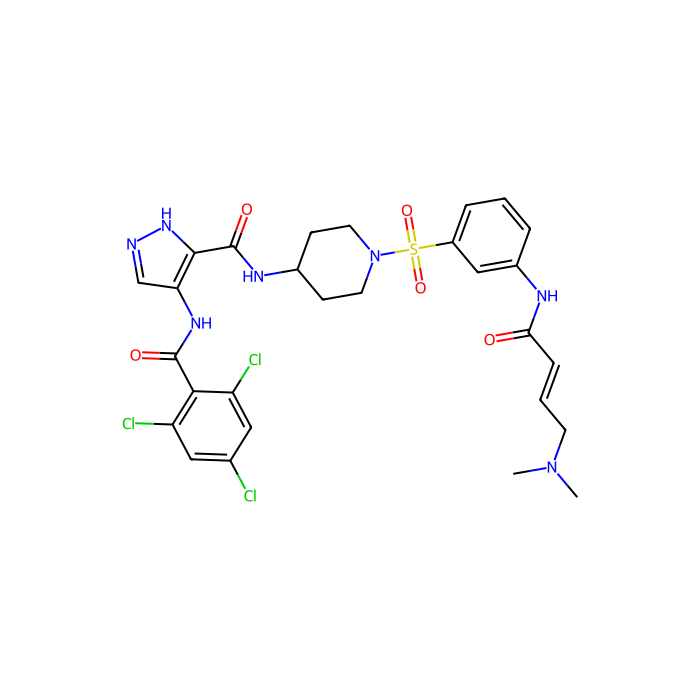
Potent inhibitor of CDK14 and CDK16 (IC50= 40 nM for CDK14 in cellular BRET assay; IC50values are 88 and 10 nM for CDK14 and CDK16 in kinase activity inhibition assay, respectively). Inhibits other TAIRE kinase family members at 1 μM (CDK17 and CDK18). Al
Condições de armazenamento de armazenamento
Store at -20°C
Enviado em
Ice chest + Ice pads
Este produto requer transporte de cadeia fria. Serviços terrestres e outros serviços econômicos não estão disponíveis.
This compound belongs to the class of organic compounds known as benzenesulfonamides. These are organic compounds containing a sulfonamide group that is S-linked to a benzene ring.
External Descriptors
Not available
1. Djoumbou Feunang Y, Eisner R, Knox C, Chepelev L, Hastings J, Owen G, Fahy E, Steinbeck C, Subramanian S, Bolton E, Greiner R, and Wishart DS. ClassyFire: Automated Chemical Classification With A Comprehensive, Computable Taxonomy. Journal of Cheminformatics, 2016, 8:61.
Solvent:DMSO, Max Conc. mg/mL: 68.3, Max Conc. mM: 100; Solvent:ethanol, Max Conc. mg/mL: 13.66, Max Conc. mM: 20
Calculadoras de soluções
Molarity Calculator
Determine the necessary mass, volume, or concentration for preparing a solution.
Dilution Calculator
Determine the dilution needed to prepare a stock solution.
Reconstitution Calculator
Revisões
Avaliações dos Clientes
Application Protocols
Item-specific (Product Data)
Tested applications (e.g., WB, IHC, IF, ELISA, FC) and recommended dilutions: Not specified for this item; refer to CoA/Spec Sheet.
General guidance (literature/general)
If using as a capture/detection reagent: Titrate across a broad range (e.g., 0.05–5 µg/mL coating for ELISA; 0.1–2 µg/mL for WB primary) depending on protein function and binding strength.
For conjugation prior to use (HRP, biotin, fluorophore): Determine DOL and run small‑scale pilots to optimize signal‑to‑noise; include appropriate blocking agents and controls.
For analytical standards: Prepare serial dilutions in assay buffer containing carrier protein (e.g., 0.1% BSA) to minimize adsorption; verify linearity and recovery.
Because no validated applications are provided for FMF‑04‑159‑2, establish conditions empirically and include positive/negative controls relevant to your assay. Always defer to the CoA for any lot‑specific recommendations.
Biological Roles
Item-specific (Product Data)
The biological identity and function of FMF‑04‑159‑2 are not disclosed in the listing. No sequence, origin, or role is specified.
General context (literature/general)
Proteins in biology serve catalytic (enzymes), structural (cytoskeleton, ECM), transport (hemoproteins, carriers), signaling (receptors, hormones), and immune functions (antibodies, complement). Specific roles depend on amino acid sequence, structure, and PTMs.
Biochemical properties such as isoelectric point, stability, and binding specificity determine interaction networks and localization in cells or extracellular spaces.
Use in research (general)
Purified proteins are used to dissect biochemical pathways, validate binding hypotheses, and benchmark analytical platforms (ELISA, MS proteomics, SPR/BLI).
When target identity is unknown, proteins may still function as generic matrices or standards in method development (e.g., assessing aggregation, filtration recovery, or conjugation yields).
Given the absence of target information for FMF‑04‑159‑2, do not attribute any native biological role or pathway involvement without consulting the CoA/Spec Sheet or primary literature tied to this CAS/CID.
Buffer Applications
Applicability note: As a proteinaceous reagent, performance is highly buffer‑dependent. However, no item‑specific buffer system is provided for FMF‑04‑159‑2.
Item-specific (Product Data)
Recommended buffer/pH: Not specified for this item; refer to CoA/Spec Sheet.
General buffer systems for proteins (literature/general)
Neutral pH handling: 1× PBS (10 mM phosphate, 137 mM NaCl, 2.7 mM KCl, pH 7.2–7.4) or 20–50 mM HEPES, 150 mM NaCl, pH 7.4 for routine work.
Conjugation: 20–50 mM sodium phosphate or HEPES, pH 7.2–7.5 (amine‑free for NHS chemistry); include 1–5 mM EDTA to chelate metals when working with maleimides.
Storage stabilization: Add 5–10% glycerol and 0.1–0.5% trehalose/sucrose; include 0.01–0.05% nonionic detergent to reduce surface adsorption when compatible with downstream assays.
Low ionic strength formulations can reduce salting‑out and are preferred for lyophilization; reconstitution buffer should match intended application.
Practical tips (general)
Filter buffers (0.22 µm) and degas if using in binding instruments (SPR/BLI) to reduce baseline drift.
Avoid Tris or glycine for NHS ester reactions; avoid DTT/TCEP before maleimide coupling unless generating free thiols deliberately.
Always verify buffer compatibility with the actual composition and intended downstream assays of FMF‑04‑159‑2.
Green Alternatives
Item-specific (Product Data)
No alternative formats or stabilizers are specified for this item.
Green chemistry considerations for protein reagents (literature/general)
Cold-chain impact: Shipping on ice and storage at −20 °C consume energy. If the product is lyophilized (not specified here), reconstitution on demand can reduce cold‑storage volume and transport mass.
Buffer choices: Prefer Good’s buffers (HEPES, MOPS) at minimal effective concentrations; avoid azide where not necessary to reduce hazardous waste in downstream streams.
Packaging and process: Use aliquots to minimize freeze–thaw waste; select recyclable secondary packaging and consolidate shipments.
Comparison of practices (general)
Practice: High‑salt, azide‑containing storage vs. Low‑salt, azide‑free with sterile technique
Trade‑offs: Azide improves bioburden control but introduces hazardous waste and can inhibit heme enzymes; sterile filtration and aseptic handling can obviate azide.
Practice: Continuous cold storage vs. Lyophilized storage (if available)
Trade‑offs: Lyophilization can increase stability at ambient temperatures, reducing energy use, but may require stabilizers and optimization to prevent activity loss.
Pragmatic recommendation: Follow the item’s CoA for mandated storage. Where options exist (e.g., aliquoting, lyophilization in‑house for non‑labile proteins), choose conditions that balance stability, energy use, and safety.
Pharmaceutical Uses
Item-specific (Product Data)
No pharmacopeial grade or formulation role is claimed. For research use only.
General roles of proteins in pharmaceutical development (literature/general; no therapeutic claims)
Process development: Model proteins are used to optimize chromatography steps (capture, intermediate polishing), ultrafiltration/diafiltration parameters, and formulation screening.
Analytical controls: Reference standards for SDS‑PAGE, SEC, CE‑SDS, and LC‑MS method qualification; spike‑recovery studies in bioanalytical method development.
Excipients/testing: Proteins can serve as stress models for screening stabilizers (sugars, polyols, amino acids) and assessing container‑closure interactions, agitation sensitivity, or freeze–thaw robustness.
Considerations before use (general)
Endotoxin and bioburden specifications are critical for any work contacting mammalian cells; confirm values on the CoA.
Carrier proteins (e.g., BSA) or preservatives (e.g., sodium azide) may interfere with downstream analytics and must be known prior to use.
This listing does not assert compliance with USP/EP monographs or suitability as an API/excipient; it is intended only for laboratory research and method development.
Physical Properties
Item-specific (Product Data)
Appearance: Not specified for this item; refer to CoA/Spec Sheet.
Molecular weight (exact): Not specified for this item; refer to CoA/Spec Sheet.
Molecular formula: Not specified for this item; refer to CoA/Spec Sheet.
Solubility: Not specified for this item; refer to CoA/Spec Sheet.
pI/pKa: Not specified for this item; refer to CoA/Spec Sheet.
Extinction coefficient: Not specified for this item; refer to CoA/Spec Sheet.
General properties for proteinaceous materials (literature/general)
Physical state: Proteins may be supplied lyophilized (solid cake/powder) or as aqueous solution with stabilizers (e.g., salts, glycerol). Actual form for this item is not specified.
Solubility: Typically water/buffer soluble; solubility depends on sequence, pH relative to isoelectric point (pI), ionic strength, and presence of denaturants (urea, guanidinium).
Thermal behavior: Proteins denature upon heating; no meaningful boiling point. Transition temperatures vary widely with buffer and additives.
Spectral features: Aromatic residues yield UV absorbance at 280 nm; A280 quantification requires extinction coefficient or protein assay.
Density/refractive index: Not typically reported for protein solids; nD of aqueous protein solutions approaches that of water and depends on concentration.
Practical notes (general)
If lyophilized: reconstitute in appropriate buffer (see Storage & Reconstitution) and avoid vigorous vortexing that may induce aggregation.
If solution: verify buffer composition, salt, pH, and any carriers (BSA, trehalose, glycerol) on the CoA before dilution or freezing.
Quality and Grades
Item-specific (Product Data)
Grade/Purity: Not specified for this item; refer to CoA/Spec Sheet.
How to interpret grades for protein reagents (literature/general)
Common descriptors include: research grade, recombinant grade, endotoxin‑tested, carrier‑free, low‑salt, and electrophoresis grade. Each implies specific QC and use cases (e.g., carrier‑free for conjugation; endotoxin-controlled for cell studies).
Protein QC typically includes one or more of: SDS‑PAGE purity (% band at expected MW), SEC‑HPLC monomer content, intact mass/peptide mapping by MS, UV A280 concentration, residual host cell protein/DNA, endotoxin (EU/mg), bioburden, activity assay (if enzymatic or binding function defined).
Practical guidance
Without an explicit grade or purity on this listing, do not assume suitability for sensitive bioassays or in vivo work. Verify endotoxin and carrier content on the CoA if using with primary cells.
If conjugation (e.g., NHS‑ester dyes) is planned, confirm the absence of carrier proteins (BSA) and amine‑containing excipients (Tris, glycine) that compete in coupling.
Lot‑specific documentation: Request the CoA/Spec Sheet for exact purity metrics, buffer composition, residual contaminants, and recommended handling unique to FMF‑04‑159‑2.
Reaction and Applications
Item-specific (Product Data)
Manufacturer Applications: Not provided in the listing; no item-specific application claims are made beyond “For research use only.”
General laboratory applications for protein reagents (literature/general)
Analytical: Use as calibration standards (e.g., SDS‑PAGE markers), binding studies (ELISA, SPR, BLI), or as capture/detection components when specificity is known.
Conjugation chemistry: Proteins are amenable to bioconjugation (NHS‑ester to Lys ε‑amines; maleimide to Cys thiols; click chemistry via azide/alkyne handles introduced enzymatically or chemically).
Surface immobilization: Covalent coupling to activated resins (NHS‑Sepharose, epoxy resins) for affinity matrices.
Stabilization/formulation: Model proteins for excipient screening, aggregation studies, or process development (e.g., filtration behavior, ultracentrifugation).
Practical tips (general)
Maintain cold chain and minimize time at room temperature to reduce proteolysis and aggregation.
Filter (0.22 µm) if compatible and sterility is required; note potential adsorption losses—use low‑binding membranes.
For conjugations, desalt into appropriate buffer (amine‑free for NHS; reducing‑agent‑free and pH 6.5–7.0 for maleimide). Quantify by A280 if extinction coefficient known, or use BCA/Bradford assays.
Because protein identity, activity, and sequence are not specified for FMF‑04‑159‑2, validate suitability experimentally for any of the above uses before adopting into critical workflows.
Reaction Conditions
Item-specific (Product Data)
No reaction or processing conditions are specified for this product.
Typical conditions for protein conjugation/modification (literature/general)
NHS‑ester coupling to Lys/N‑terminus: 20–50 mM phosphate or HEPES, pH 7.4–8.5; protein 0.5–10 mg/mL; 1.5–10× molar excess of NHS reagent; 30–120 min at room temp; quench with Tris/glycine and desalt. Expected recoveries often 70–95% with careful handling.
Maleimide–thiol coupling to Cys: Degassed PBS or HEPES, pH 6.5–7.2 with 1–5 mM EDTA; generate free thiols via mild reducing agents (TCEP 0.2–1 mM briefly) then remove excess; 1–5× maleimide; 30–60 min at RT. Avoid elevated pH to minimize maleimide hydrolysis.
Carbodiimide (EDC/NHS) coupling (carboxyl to amine): MES buffer, pH 5.0–6.0 for activation; couple to amine‑bearing partner at pH 7.0–7.4; control for crosslinking vs monofunctional attachment.
Click chemistry (SPAAC/tetrazine ligations): Near‑physiological pH (7.0–7.4), additive‑free aqueous buffers; kinetics depend on handle density and reagent choice; often completes within minutes to hours.
Handling parameters (general)
Temperature: 4–25 °C; keep on ice when stability is uncertain.
Mixing: Gentle inversion/tilt; avoid foaming and air–liquid interfaces to reduce aggregation.
Purification: Desalting columns (NAP‑5/10), SEC, or diafiltration to remove unreacted small molecules.
These are literature guidelines; optimize empirically for the specific protein and application.
Safety and Handling
Item-specific (Product Data)
GHS Classification: Not specified for this item; refer to SDS.
Signal word / H‑Statements / Pictograms: Not specified for this item; refer to SDS.
Storage: Store at −20 °C (per Product Data). Shipped on cold packs in an ice chest.
General safety guidance for protein reagents (literature/general)
Proteins are typically considered low acute toxicity by dermal/ocular exposure; however, treat all laboratory reagents as potentially hazardous. Avoid inhalation of powders/aerosols.
Potential additives (buffers, salts, preservatives) may carry hazards; in absence of item-specific information, review SDS/CoA prior to use.
PPE and engineering controls (general)
Wear lab coat, safety glasses, and nitrile gloves. Handle powders in a fume hood or biosafety cabinet to minimize aerosolization.
Avoid repeated freeze–thaw cycles to prevent degradation; aliquot when first thawed.
Incompatibilities and stability (general)
Avoid strong acids/bases, oxidizers, and elevated temperatures that promote denaturation or hydrolysis.
Shear stress and surface adsorption can induce aggregation; use low-binding plastics and gentle mixing.
First-aid overview (general; not a substitute for SDS)
Skin/eye contact: Rinse with water for ≥15 minutes; remove contaminated clothing.
Inhalation: Move to fresh air; seek medical attention if symptoms persist.
Ingestion: Rinse mouth; do not induce vomiting; seek medical advice.
Always consult the product-specific SDS for authoritative hazard, exposure limits, and disposal guidance.
Solvent Selection
Applicability note: For proteins, “solvent” primarily means the aqueous buffer used for reconstitution, storage, and assays rather than organic solvents.
Item-specific (Product Data)
Supplied form and preferred buffer: Not specified for this item; refer to CoA/Spec Sheet.
General buffer/solvent guidance for proteins (literature/general)
Aqueous systems: Use physiological salts (e.g., PBS, TBS) for routine handling; for stability, consider HEPES (pH 7.2–7.6) due to good buffering capacity and minimal metal interactions.
Additives: 5–10% glycerol, 0.1–0.5% trehalose/sucrose, or low levels of nonionic detergents (e.g., 0.01% Tween‑20) may reduce aggregation or adsorption, depending on downstream use.
Avoid: High concentrations of organic solvents, extremes of pH, or chaotropes unless denaturation/solubilization is intended.
When to choose alternatives (general)
For conjugation: Use amine‑free buffers (e.g., 50 mM sodium phosphate, pH 7.2–7.5) to prevent interference with NHS esters; for thiol chemistry, include EDTA and avoid reducing agents unless generating free thiols.
For metal‑sensitive proteins: Avoid phosphate if precipitation with divalent cations is a risk; use HEPES or MOPS instead.
Note: Confirm compatibility with the exact composition and intended application; rely on the CoA for any item-specific solvent or excipient requirements.
Storage and Reconstitution
Item-specific (Product Data)
Storage Conditions: Store at −20 °C.
Shipped In: Ice chest + ice pads (cold chain).
Supplied form, buffer composition, and concentration: Not specified for this item; refer to CoA/Spec Sheet.
General guidance (literature/general)
Upon receipt: Inspect for evidence of thawing or container compromise. Centrifuge briefly to collect contents before opening.
If lyophilized (not specified here): Reconstitute with sterile, appropriate buffer (e.g., PBS or HEPES, pH ~7.4) to desired concentration. Let sit on ice to fully dissolve with gentle mixing; avoid vigorous vortexing.
If supplied in solution (not specified here): Store at −20 °C as instructed; for long‑term storage, aliquot into single‑use volumes to avoid freeze–thaw. Consider adding 10–50% glycerol only if compatible and not contraindicated by CoA.
Freeze–thaw: Minimize cycles; thaw on ice and mix gently. Do not store in frost‑free freezers that warm periodically.
Light and metals: Protect from light if chromophores are present; include EDTA if metal‑catalyzed oxidation is a concern and compatible with use.
Stability statement
Exact shelf life and reconstitution protocol are Not specified for this item; refer to CoA/Spec Sheet. For best results, document lot number, preparation date, buffer, and aliquot scheme in your lab records.
Structure and Identity
Brief overview: This catalog entry is listed under proteins; item-specific structural identifiers are minimal. Treat as a proteinaceous research reagent unless the CoA/Spec Sheet states otherwise.
Item-specific (Product Data)
SKU: F288523
Product Name: FMF-04-159-2
CAS: 2364489-81-4
PubChem CID: 138454780
InChIKey: 135203 (as provided; format atypical for standard InChIKey)
Molecular formula: Not specified for this item; refer to CoA/Spec Sheet.
Molecular weight: Not specified for this item; refer to CoA/Spec Sheet.
SMILES: Not specified for this item; refer to CoA/Spec Sheet.
General structural context (literature/general)
Proteins/peptides are polymers of α‑amino acids joined by amide (peptide) bonds, forming a backbone –(NH–CHR–CO)–n– with sidechains that define physicochemical properties.
Core functional groups: amide bonds (peptide linkages), terminal amine (N‑terminus) and carboxylate (C‑terminus) unless blocked; possible thiols (Cys), phenols (Tyr), imidazole (His), guanidinium (Arg), indole (Trp), etc.
Note: Because sequence and composition are not provided, do not infer specific motifs, domains, or stereochemistry beyond standard L‑amino acid peptide polymers. Consult the CoA for definitive identity testing (e.g., SDS‑PAGE, MS, HPLC).
Synthetic Utility
Applicability note
While proteins are not classic small‑molecule building blocks, they are highly versatile substrates for bioconjugation and materials synthesis in chemical biology and bioorthogonal chemistry.
General utility (literature/general)
Functional handle diversity: Surface‑exposed Lys (amines), Cys (thiols), Asp/Glu (carboxylates), Tyr (phenols), and N/C termini enable selective or semi‑selective chemistry (NHS esters, maleimides, EDC/NHS coupling, diazonium/enzymatic tyrosine labeling, transglutaminase/glutarate linkages).
Bioorthogonal strategies: Strain‑promoted azide–alkyne cycloaddition (SPAAC), tetrazine–TCO ligation, and oxime/hydrazone formation after introduction of azido/alkoxyamine groups via carbamate linkers or enzymatic tags.
Materials and devices: Protein conjugates for biosensors, affinity resins, and nanoparticle functionalization; layer‑by‑layer films using electrostatic assembly depending on pI.
Practical notes (general)
Control degree of labeling (DOL) by stoichiometry and buffer pH; excessive modification can compromise folding or activity.
Remove interfering excipients prior to coupling (e.g., exchange out of Tris/glycine for NHS chemistry; out of DTT/TCEP for maleimides) using desalting columns or dialysis.
No specific synthetic transformations are attributed to FMF‑04‑159‑2 without sequence/composition data; treat as a generic protein substrate pending CoA details.
Target Specificity
Item-specific (Product Data)
Target/antigen, species reactivity, clone/isotype: Not specified for this item; refer to CoA/Spec Sheet.
General note (literature/general)
If FMF‑04‑159‑2 is an antibody or binding protein, target specificity would be defined by sequence and affinity constants (KD). In absence of such data, no claims about binding targets, epitopes, or selectivity can be made.
Action: Consult the product CoA or contact Aladdin Scientific technical support for target identity, tested species, and any available binding data (e.g., ELISA, SPR).
We use cookies to ensure the website functions properly and, where permitted, to improve your experience. You can manage your preferences at any time in Settings. Learn more in our Cookie Policy.
Shall we send you a message when we have discounts available?
Remind me later
Thank you! Please check your email inbox to confirm.
Products are supplied to verified businesses, institutions, and qualified professionals for research and development use only. Not for use in humans, animals, diagnosis, or therapy.